Fort Hancock: A U.S. Coastal-Defense Installation on Sandy Hook
Site at a Glance
- Country
- United States
- Primary era
- Modern
- Eras represented
- Early Modern, Modern
- Civilizations
- British
- Site type
- Military
- Remains
- Fort
On this page21 sections
History
Fort Hancock is a United States coastal-defense installation on the Sandy Hook peninsula. The U.S. Army began building its artillery batteries in 1890 under the Endicott Program, a modernization effort that introduced concrete-and-earth gun positions and new coastal weapons. Named in 1895 for Union general Winfield Scott Hancock, the fort became one of the program’s early installations and served as a model for several weapons positions.
The earlier fort and the proving ground
Before Fort Hancock, Sandy Hook was part of the Third System, a federal coastal-defense program centered on massive masonry forts. Construction of a predecessor fort began in 1857 to plans by Army engineer Robert E. Lee, later a Confederate general. The design called for an irregular five-sided fort with five bastions, or projecting defensive sections. Work stopped in 1867, leaving a usable but largely unfinished fort. The vulnerability of masonry defenses to rifled artillery led the federal government to end funding that year.
The unfinished fort had no official name. After the area took the name Fort Hancock in 1895, people often used it for the earlier structure as well; local names included Fort Lincoln and Fort Hudson. Beginning in 1885, parts of its fabric were reused for the proving ground, the later fort, and supporting works such as a seawall.
The Army Ordnance Department, responsible for weapons and military equipment, established the Sandy Hook Proving Ground in 1874, chiefly to test coastal-defense weapons. It remained organizationally separate from Fort Hancock, although the two installations worked in conjunction until 1919. After the First World War, the proving ground’s work moved to Aberdeen Proving Ground in Maryland.
Endicott batteries and early service
Fort Hancock’s first batteries became operational in 1896. Battery Potter, a trial position for a steam-powered system that raised a gun into firing position, received its first gun in 1892, was completed in 1894, and entered service in 1898, apparently after extensive testing. The gun-lift system proved costly because its steam plant had to operate continuously. Potter was disarmed by 1907, and three spare lifts were converted to gun mounts and sent to Fort Flagler and Fort Worden in Washington.
The position that became the Nine Gun Battery began in 1896 as Battery Halleck, with seven guns. Expansion to nine guns led to its division in 1904 into Batteries Bloomfield, Richardson, Halleck, and Alexander. Battery Dynamite’s weapons had been withdrawn by 1902 because their low-velocity projectiles created fire-control difficulties. A separate one-gun battery was probably armed with a proving-ground test gun after the Spanish-American War began.
Battery Reynolds was divided in 1906, with one part renamed Battery McCook. Its sixteen-mortar arrangement made reloading difficult. Four mortars, one from each pit and near the magazine entrances, were moved to the Highlands Military Reservation. Four more mortars were removed from Reynolds-McCook in 1917 for remounting there.
Fort Hancock belonged first to the New York Artillery District and, from 1913, to the Coast Defenses of Southern New York. Around 1915 it became the center of its own command, the Coast Defenses of Sandy Hook. That command was renamed the Harbor Defenses of Sandy Hook in 1924 and joined the Harbor Defenses of New York on May 9, 1942.
World War I and the interwar years
Fort Hancock lost fewer heavy guns to transfers for the Western Front during the First World War than many American forts, since it remained important to New York City’s defenses. One of Battery Halleck’s 10-inch guns was removed for possible railway-artillery service, though other guns listed for removal stayed in place. Battery Engle’s single 5-inch gun was taken for field use and never returned. Work on the long-range 12-inch batteries later named Kingman and Mills began in 1917; they were completed in 1921.
From 1919 into the 1930s, the fort was generally kept in caretaker status. It served as a practice range for railway-artillery units and hosted a Citizens’ Military Training Camp, a program that gave civilian men military instruction. In 1931, two batteries of the 2nd Battalion, 52nd Coast Artillery (Railway) Regiment, were stationed there with two 12-inch railway mortars and two 8-inch railway guns.
World War II and changing defenses
Fort Hancock became a mobilization center in 1940–41, first housing trainees in tents and later in temporary buildings. As newer defenses at Fort Hancock, Fort Tilden, and the Highlands Military Reservation provided gun protection for Greater New York, Fort Hamilton’s other 6- to 12-inch weapons were gradually scrapped in 1942–43. In 1943, the disused Battery Potter became a harbor-entrance control post. Battery Gunnison was rebuilt to hold Battery Peck’s 6-inch guns as an examination battery, a position associated with controlling and inspecting vessels entering a harbor.
During the Second World War, two anti-motor-torpedo-boat batteries were established to counter fast enemy craft and aircraft. Each was authorized four 90 mm guns, two on fixed mounts and two on towed mounts; the weapons included M3 and M1A1 models. The guns had an effective range of about 8,000 yards and required a crew of fifteen each. The location of AMTB 7 is uncertain; AMTB 8 occupied the former Battery Peck. The batteries were disarmed after the war.
Postwar use and preservation
In 1946, the Army judged gun defenses obsolete and scrapped Fort Hancock’s guns. The installation was deactivated in 1950, reactivated the following year with 90 mm and 120 mm antiaircraft guns, then deactivated again in 1953. In 1956 it reopened as Nike missile site NY-56, part of the Cold War system intended to intercept aircraft approaching New York City. The Nike system was deactivated in 1974, when Fort Hancock ceased to be an active Army installation.
Fort Hancock is now part of the National Park System and Gateway National Recreation Area. The site includes Fort Hancock Memorial Park and a museum managed as part of the Sandy Hook unit. Fort Hancock was designated a contributing property in a historic district in 1980; Fort Hancock and the Sandy Hook Proving Ground Historic District became a National Historic Landmark District in 1982.
Hurricane Sandy damaged Buildings 119 and 120, both built during the Second World War, as well as the NY-56 launch area. The National Park Service decided in 2018 to demolish the two buildings, and work began in 2020. Restoration work has been undertaken at Battery Gunnison with the aim of recovering its 1943 appearance, while Army Air Defense Artillery veterans have also worked on the Nike radar site at Horseshoe Cove.
Remains
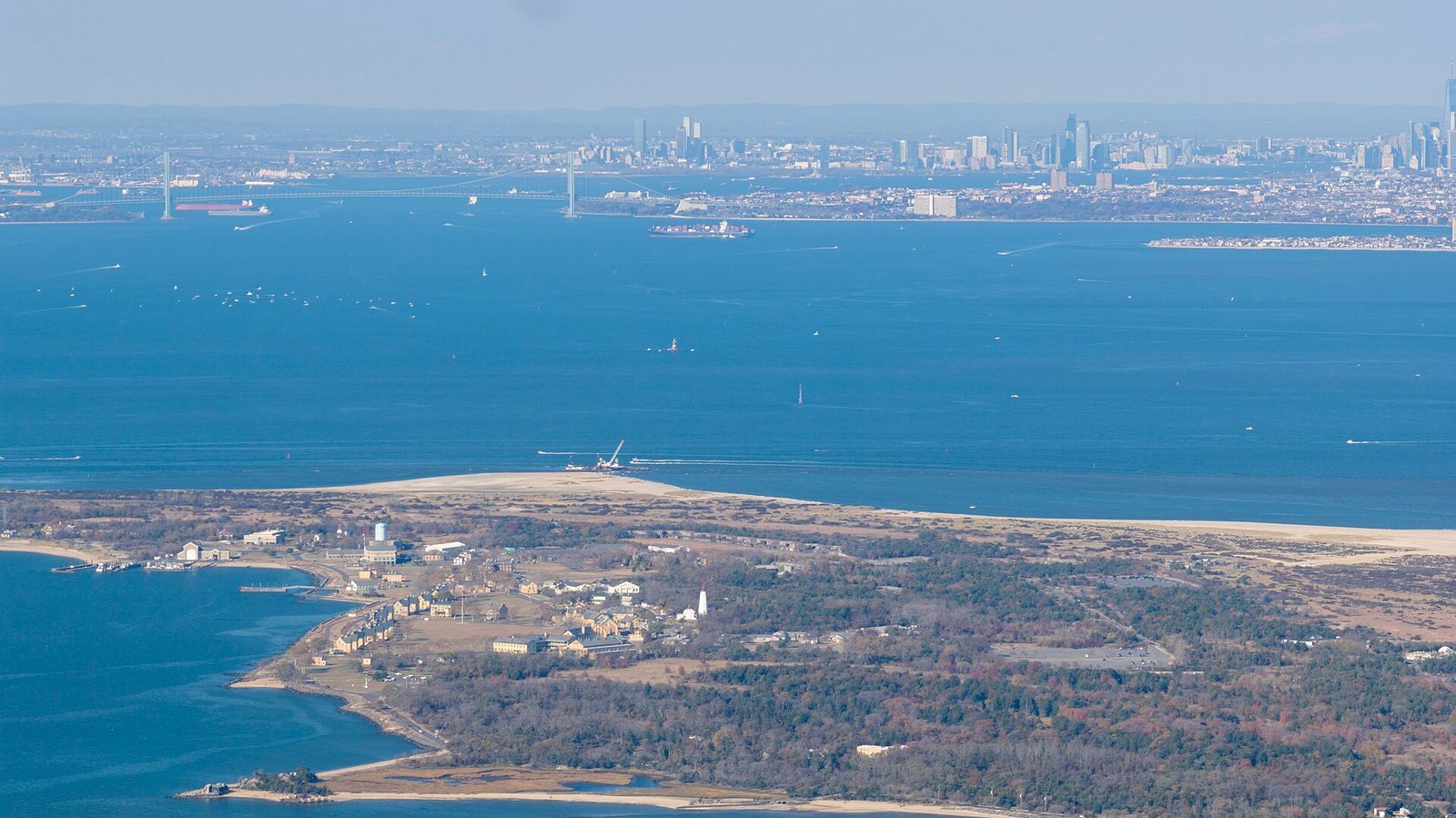
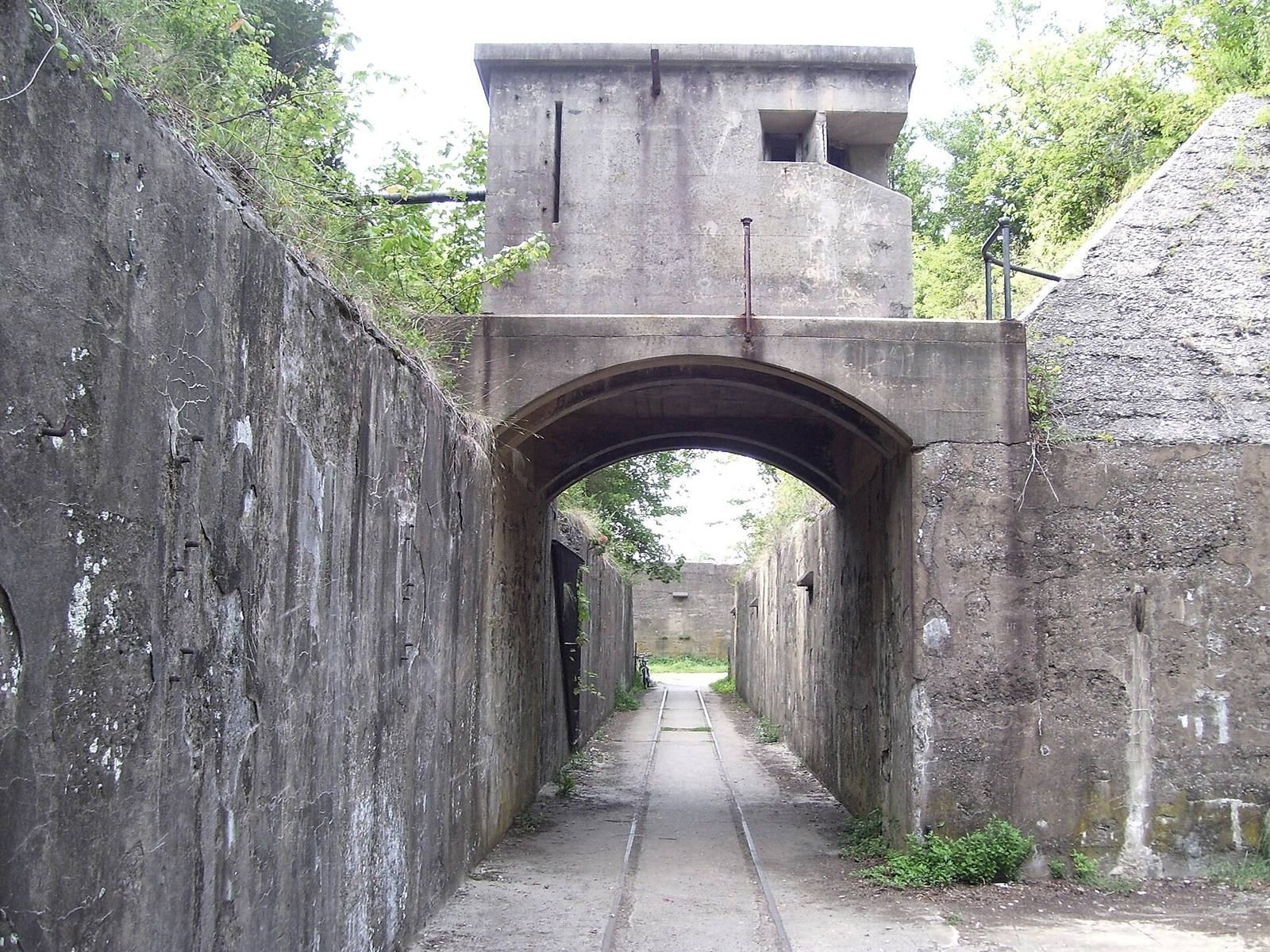
The fort occupies about 14.6 hectares on the landward side of the Sandy Hook peninsula. Its remains combine concrete-and-earth artillery positions with military buildings and later missile-defense facilities. Several batteries are linked by tunnels below ground. The former mortar battery lies farther north; Battery Gunnison’s seaward defenses are to the east, with Gunnison Beach in front. Battery Granger, Battery Potter, and the Nine Gun Battery are among the positions farther north.
The earlier fort and coastal batteries
The predecessor fort
The original fort was planned as an irregular pentagon with five bastions, built mainly of granite. Its proposed armament occupied two levels: an enclosed, protected gun level and an open level from which guns fired over a parapet. The plan called for 173 guns on the three seaward sides and 39 more to cover the land approaches. During construction, the landward bastion was removed from the design and adjacent bastions simplified. Only a short section of one wall survives, with four openings for cannon.
Battery Potter
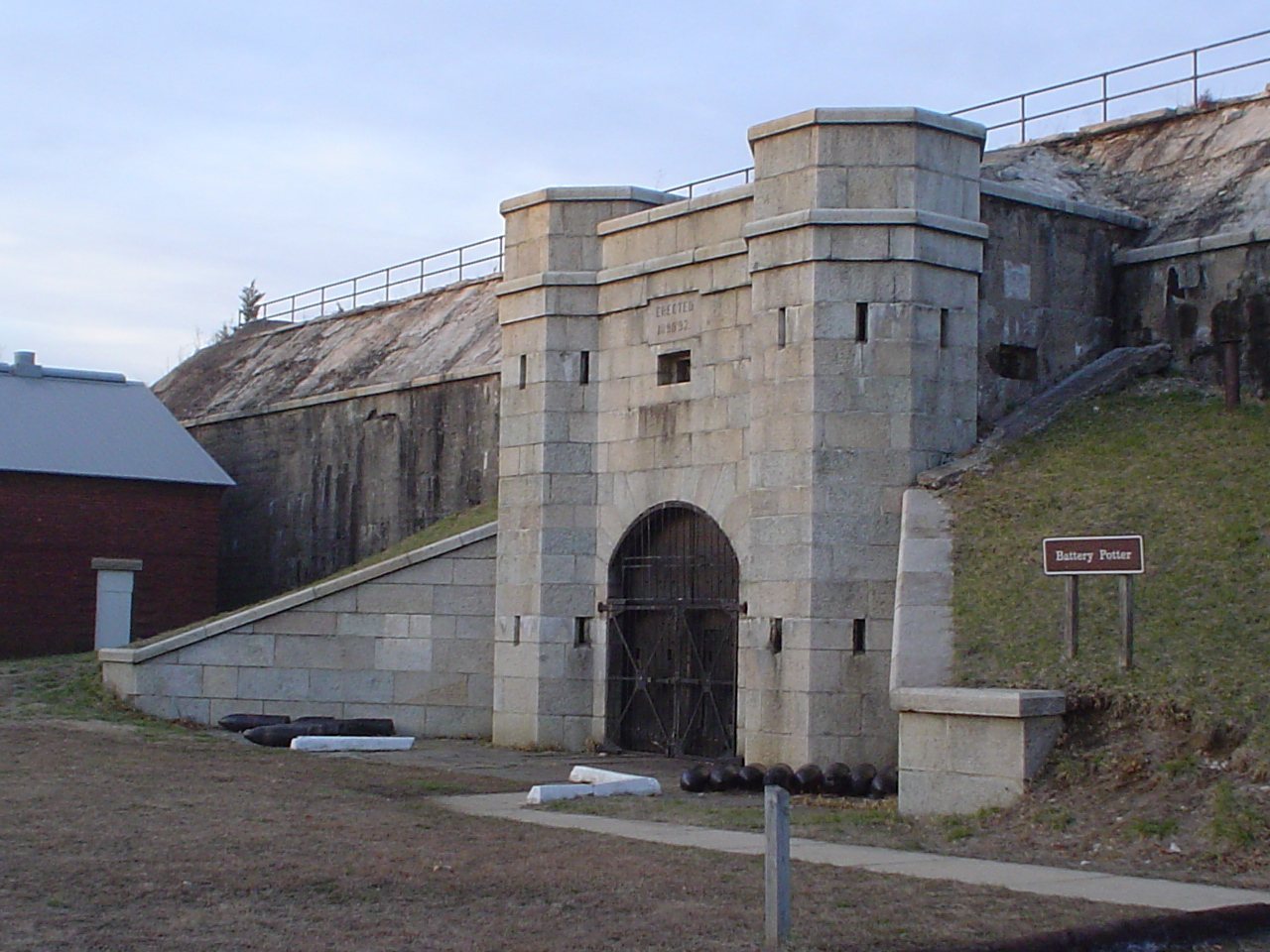
Battery Potter was designed around a steam-powered lift that raised a 12-inch M1888 gun, Watervliet serial number 11. This was the first operational gun of the Endicott Program. The lifting system allowed the weapon to fire through a full circle, while high enclosing walls protected the battery on its landward side.
Battery Reynolds and Battery McCook
The mortar battery used an Abbot Quad layout, meaning four square pits each held four 12-inch mortars. Concrete cross-walls between the pits contained magazines and storage spaces. Earth covered these structures, and vegetation covered the earth. A high concrete wall, also faced with earth, enclosed the battery.
The Nine Gun Battery
Batteries Bloomfield, Richardson, Halleck, and Alexander formed a continuous gun line, described as one of the longest in the Endicott system. The group’s connected positions reflect its development from a single seven-gun battery into a nine-gun line divided among four batteries.
Dynamite guns and mine defenses
Battery Dynamite was equipped for pneumatic dynamite guns, which used compressed air to launch projectiles carrying large explosive charges. Fort Hancock also had facilities for laying and controlling an underwater minefield. Its 3-inch batteries served as mine-defense positions, intended to guard the field against minesweepers.
Other gun positions
Battery Arrowsmith held three 8-inch guns, while Battery Engle had one 5-inch gun and Battery Urmston held 3-inch M1898 guns. The separate one-gun battery held a French-made 4.72-inch Schneider weapon, an unusual type in the U.S. artillery system.
Batteries Kingman and Mills
Each of these batteries had two 12-inch guns on barbette mounts, which allowed the guns to fire over a protective parapet. Their positions were first open to the air, then enclosed in protective casemates, or covered gun chambers, in 1942–43 to guard against air attack.
Battery Gunnison and Battery New Peck
Battery Gunnison was adapted to accommodate Battery Peck’s pedestal-mounted 6-inch guns. Two rare 6-inch M1900 guns remain at Battery New Peck, mounted on barbette carriages manufactured in 1903. This is the only Fort Hancock gun battery whose weapons were not salvaged for scrap after the Second World War.
Grounds and later installations
Military buildings and tunnels
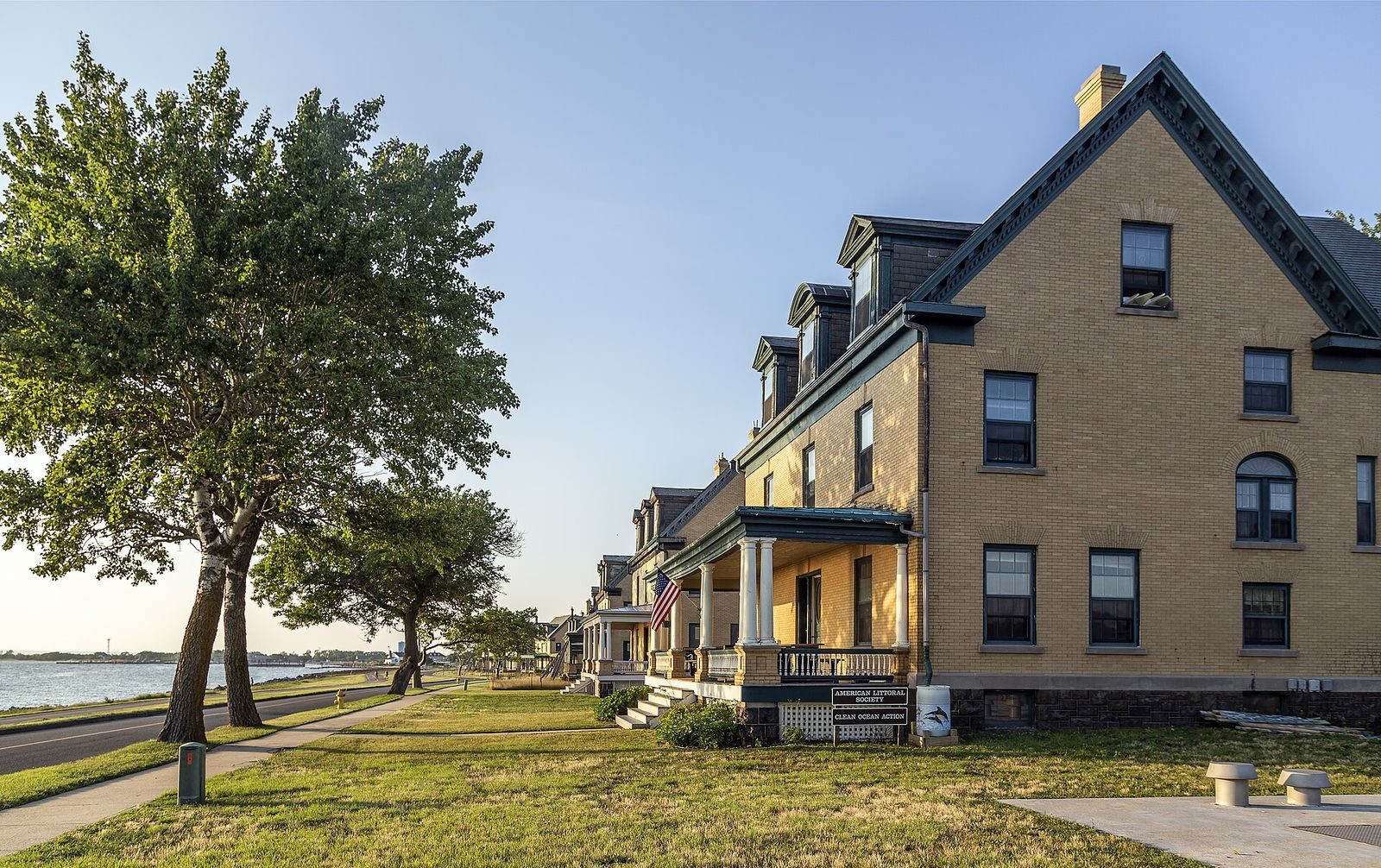
More than 100 military-era buildings survive, mostly houses designed for one or two families; many remain occupied. The grounds also preserve a large collection of Endicott batteries, including experimental positions at the former proving ground. A network of tunnels passes beneath several of the batteries.
Sandy Hook Lighthouse
The Sandy Hook Lighthouse stands near the former housing area within the Fort Hancock grounds. Built in 1764, it is the oldest working lighthouse in the United States.
Nike site NY-56
NY-56 retains both its launch and radar sections, a configuration shared by few surviving Nike batteries in the country. Hurricane Sandy heavily damaged the launch area. The radar site is at Horseshoe Cove.
Displayed weapons
Displays at Fort Hancock include a 20-inch Rodman gun, a large cast-iron, muzzle-loading coastal cannon described as the biggest gun produced during the Civil War era, and a 10-inch Rodman gun. Several Nike missiles are also displayed.