Uppsala-Näs Church: A Medieval Church in Sweden
Site at a Glance
- Country
- Sweden
- Primary era
- Medieval
- Eras represented
- Medieval, Early Modern, Modern
- Civilizations
- Swedish
- Site type
- Religious
- Remains
- Church
On this page14 sections
History
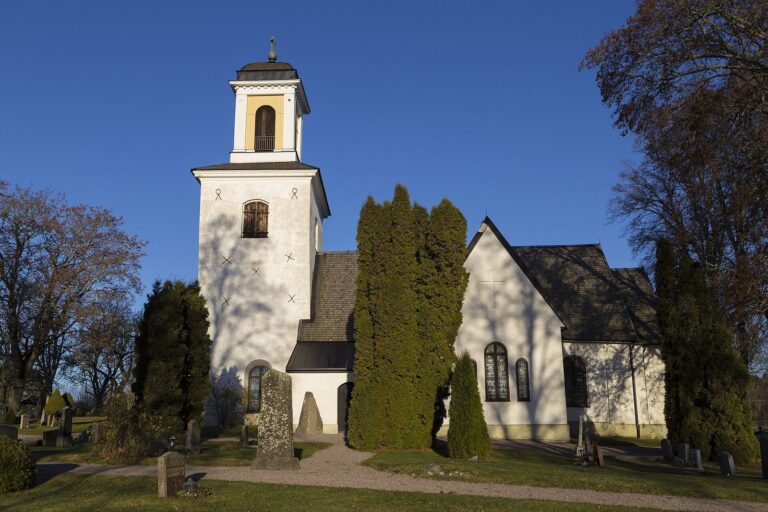
Uppsala-Näs Church is a medieval church in Uppsala, Sweden, built and consecrated in the 15th century. Its development was influenced by the late-13th-century donation of the Näs estate to Uppsala Cathedral, the principal church of the diocese. The church belongs to the Church of Sweden, a Lutheran church, and is part of Uppsala Diocese, an ecclesiastical district, and Uppsala-Näs Parish.
The earlier church and its successor
A medieval church was originally planned in stone but was built of wood for reasons that are unknown. It had an associated detached sacristy, a room for clergy and church furnishings, probably constructed between the mid-13th and late 14th centuries.
The present church was built and consecrated on higher ground within the churchyard, where ground conditions were better than at the earlier site. Its interior received vaulted ceilings at the end of the medieval period, probably in the early 16th century.
Later changes
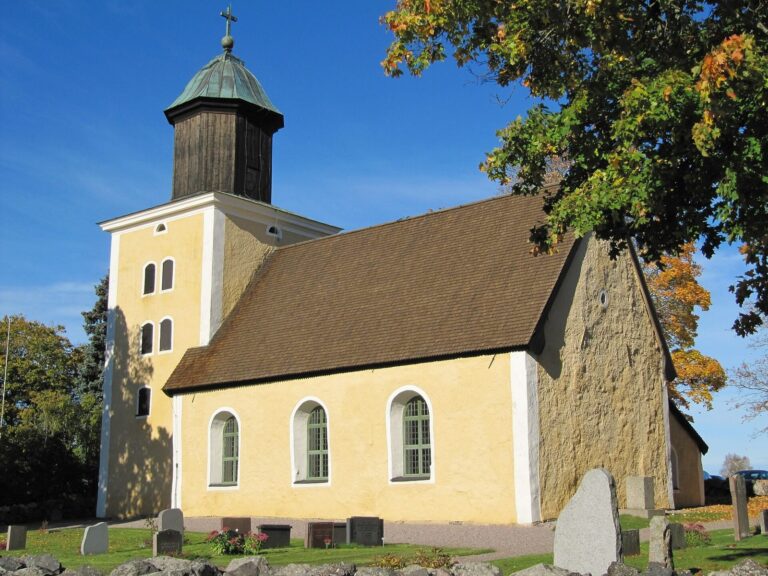
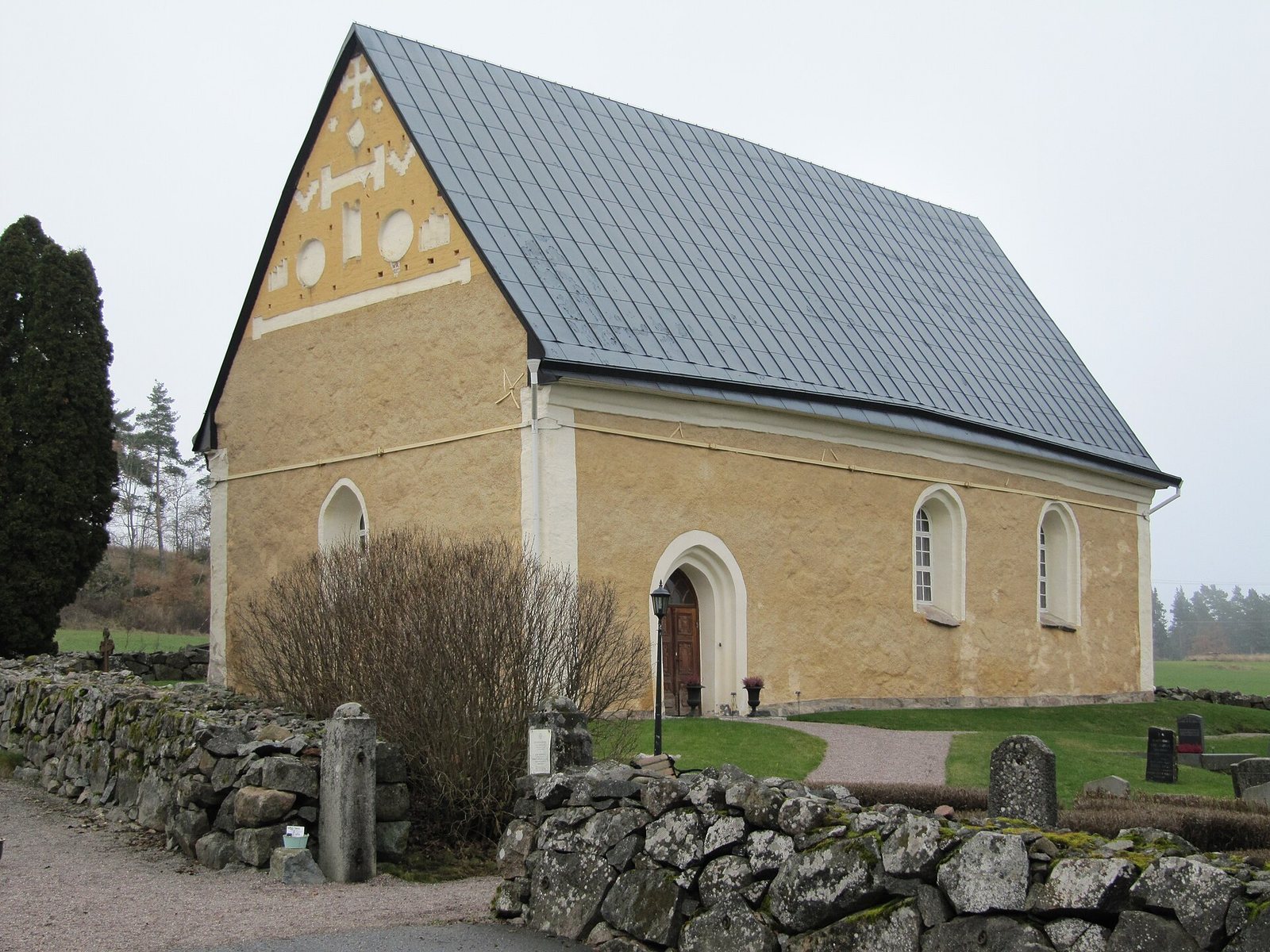
A sacristy was added to the church’s north side during the 16th or 17th century. The original entrance on the south side had a wooden porch. A stone porch replaced it in 1666, but was demolished in 1843; the present entrance porch is beneath the gallery at the west end. In 1843, plaster was applied to the church, covering its previously exposed stonework.
An interior restoration in 1941 introduced fixed pews. During remodelling from 2005 to 2007, cavities beneath the floor were filled with lightweight concrete, the limestone flooring was replaced with brick, and floor heating was installed. The fixed pews were removed and replaced by movable benches.
Remains
Churchyard setting
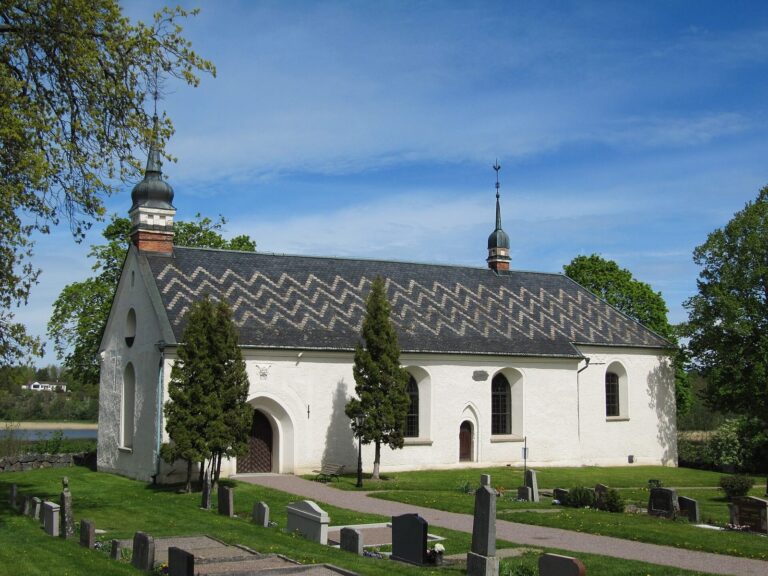
The church stands relatively low beside Näsviken, an inlet of Lake Mälaren. A separate belfry, a structure that houses bells, stands on a wooded rise to the north. The parish clerk’s farmstead lies west of the church and includes an older dwelling. A detached sacristy in the churchyard is built of gray stone and brick. An archaeological investigation in 1991 partly exposed the foundation of the earlier wooden church.
Main church
Gray stone forms the church walls, while brick is used in the gable ends and around the windows. The building has a rectangular nave, the main body of the church, and a straight-ended chancel, the area at the altar end, of the same width. Its gabled roof is covered with seamed sheet metal. The west- and south-side windows retain their original size. Heavy iron bands encircle the church to help prevent cracking.
North sacristy
The narrow sacristy attached to the church’s north side has a single-slope roof covered with seamed sheet metal. Its ceiling is a barrel vault, a curved vaulted ceiling.
Interior and furnishings
Vaulted interior
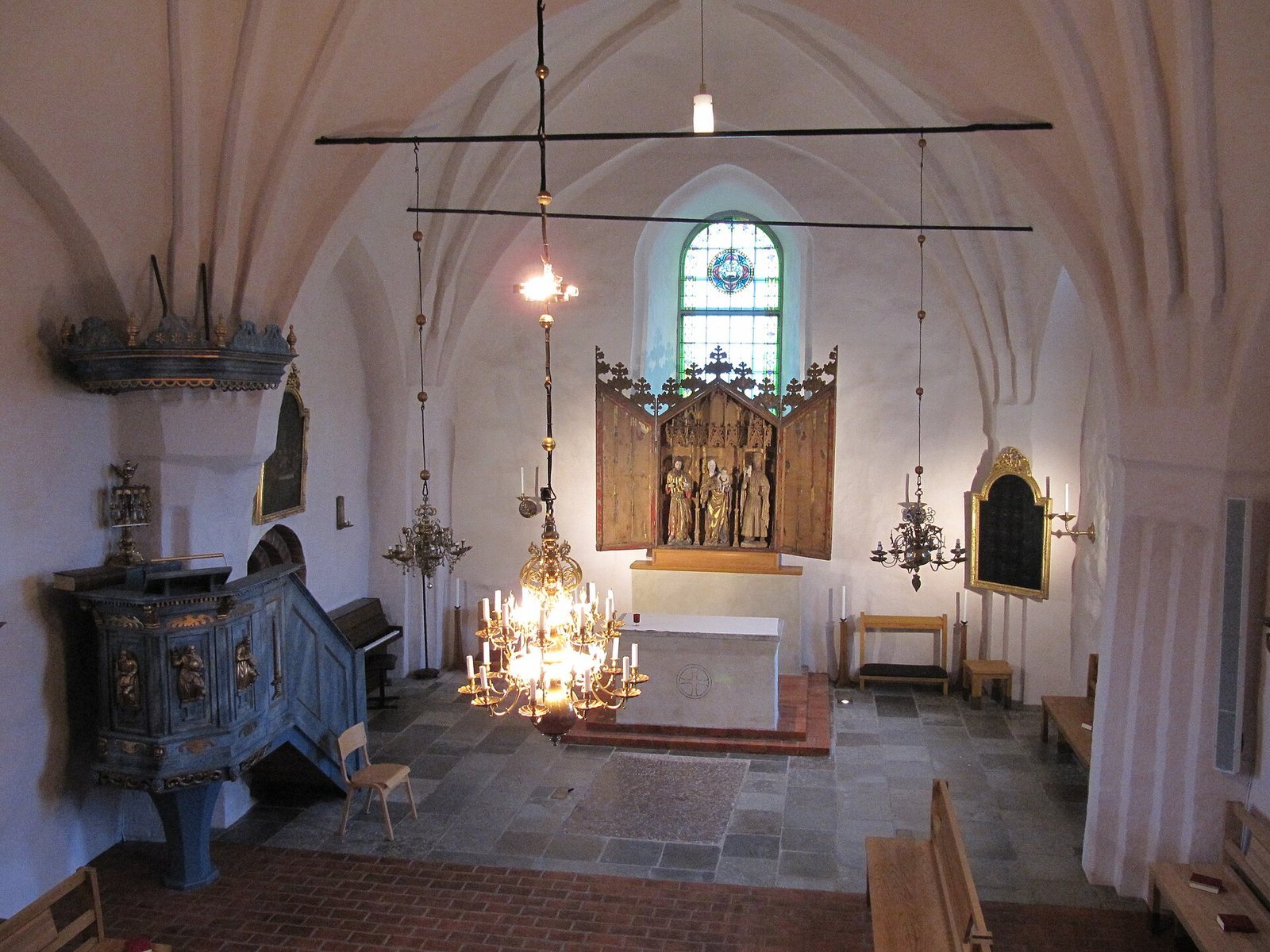
The interior is divided into three sections, or bays. The chancel bay and the eastern bay of the nave have star vaults, ceilings with ribs arranged in star patterns. The western nave bay has a rib vault, a ceiling supported by crossing ribs. The interior has never had paintings.
Baptismal font
The oldest item in the church’s inventory is a baptismal font, a basin used for Christian baptism, dating to about 1200. Its plain bowl has painted marbling from 1665. The font stands on a newly made brick base beneath the gallery.
Pulpit
The pulpit dates to the 17th century. In 1780, it was moved to its present position against the north wall and fitted with a sounding board, a canopy above the speaker.
Altarpiece and Madonna image
The altarpiece, a decorated structure placed behind or above an altar, dates to the mid-15th century. A German-made Madonna image, depicting the Virgin Mary, dates to the 1430s.
Organ
The present organ dates to 1859 and has been rebuilt several times.
Bells
Two bells hang in the belfry. From largest to smallest, their pitches are F-sharp 1 and G-sharp 1.