Katarina Church, Stockholm: A Baroque Lutheran Parish Church
Site at a Glance
- Country
- Sweden
- Primary era
- Early Modern
- Eras represented
- Early Modern, Modern
- Civilizations
- Swedish
- Site type
- Religious
- Remains
- Church
On this page16 sections
History
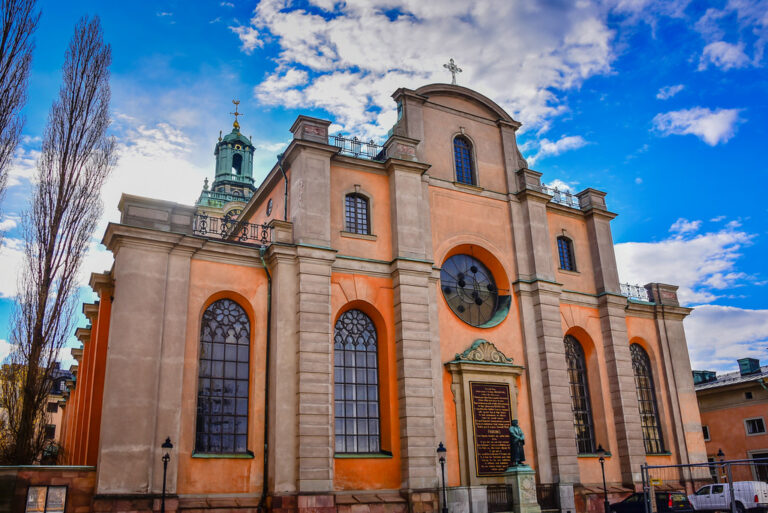
Katarina Church, Stockholm, is a Lutheran parish church on Katarina Hill in Sweden, serving Katarina Parish in the Diocese of Stockholm and the Church of Sweden. Construction began in 1656, and the church was first completed in 1695 after interruptions. It is built in the Baroque style, a European architectural and artistic movement prominent in the 17th and 18th centuries. The church and parish were named for Princess Catherine, or Katarina Karlsdotter Vasa, mother of Charles X Gustav, king of Sweden from 1654 to 1660.
The hill and the first church
The site has an earlier and more troubled history. In 1520, after Denmark’s conquest of Sweden, victims of the Stockholm Bloodbath, a mass execution in the city, were burned on Katarina Hill. Local belief later held that a curse lay on the ground. A legend also predicted that the church tower would fall twice, a story associated with its collapses in 1723 and 1990.
A chapel completed in 1590, known as Sture Chapel, stood here before the church. A Danish map from the 1640s depicts a chapel at the centre of the square plot and labels it Södermalm Chapel. It was demolished during the 1650s, and its building materials were reused. Work on Katarina Church began in 1656, when a service was held beneath a temporary roof. Construction proceeded in stages until the church’s first completion in 1695. The Katarina witch trial took place in the parish during the 1670s. In 1709, a copy of the church was built in Jelenia Góra, Poland, as the Church of the Exaltation of the Holy Cross. Its form preserves the appearance of Katarina Church’s tower before the 1723 fire.
Fire and rebuilding
On 1 May 1723, a fire destroyed Katarina Church and much of the surrounding built-up area. The church was rebuilt, and the reconstructed building was consecrated on 18 October 1724.
Later alterations and the 1990 fire
The church’s exterior was recoloured in 1784. In 1891–92, open pews were installed and decorative painting was added to the walls and vaulted ceilings. The painted decoration was removed during renovation work in 1952–54.
A second major fire began on the night of 17 May 1990. The tower collapsed through the roof vault, leaving the roofs over the church’s cross-arms and its exterior walls. Church silver and valuable textiles were saved, while the cause of the fire remains uncertain. Fundraising led to the creation of the Save Katarina Foundation, and the church was rebuilt and consecrated again by Bishop Henrik Svenungsson in 1995. Katarina Church is one of 43 churches in Stockholm protected under the Cultural Environment Act.
Remains
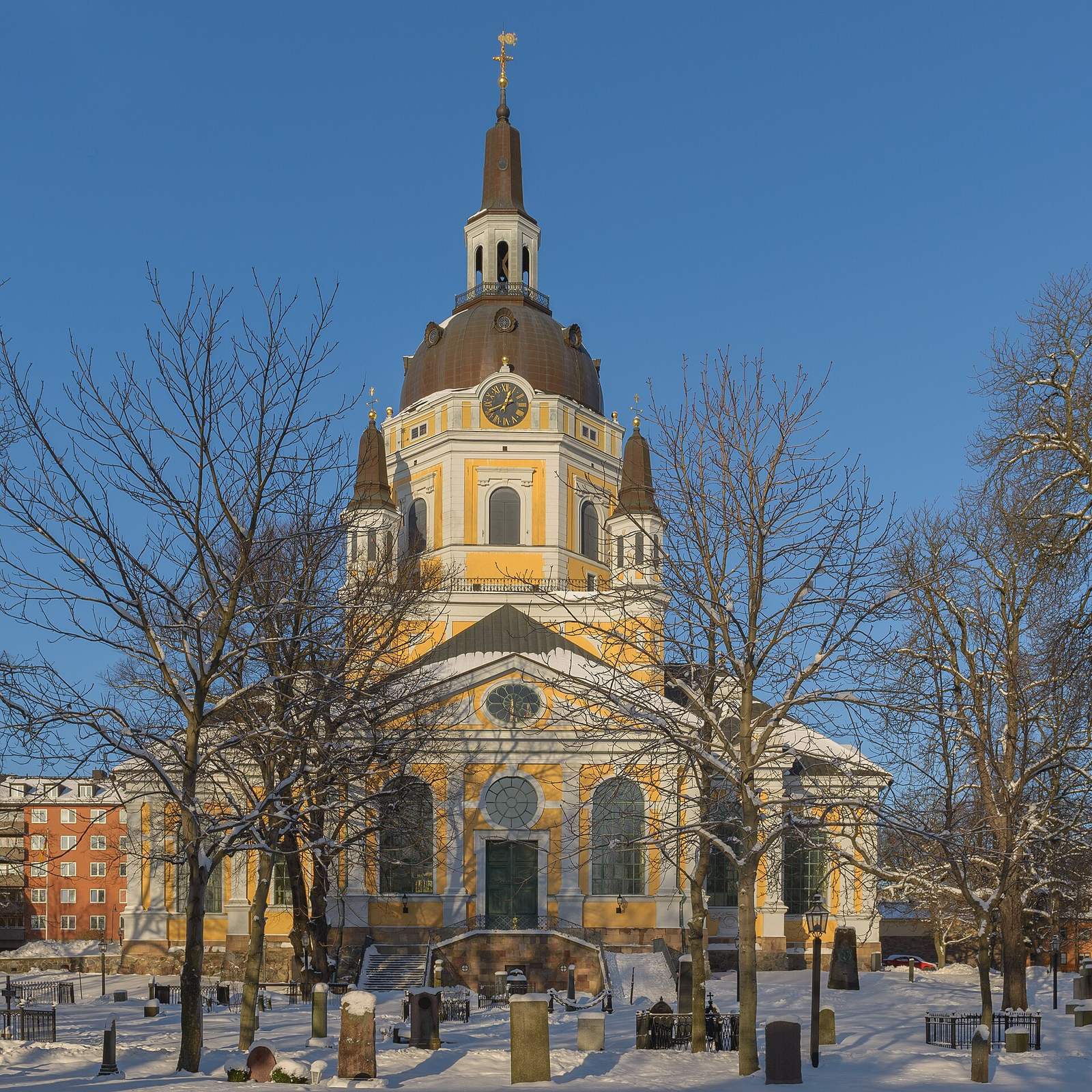
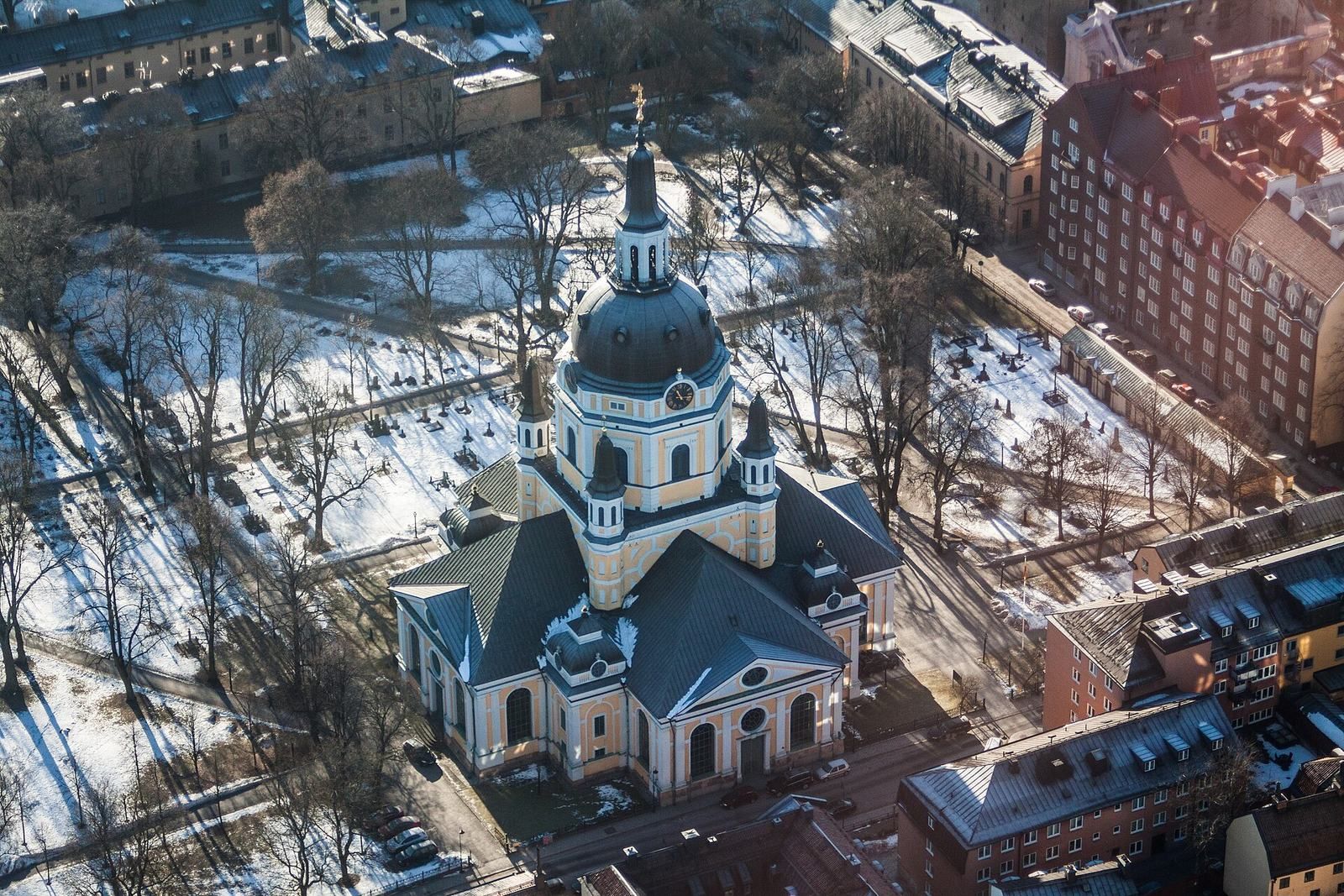
Set on elevated ground, the church is a prominent feature of Stockholm’s cityscape. It is a brick building with copper among its construction materials. Its Greek-cross plan has four arms meeting at a central junction, making Katarina Sweden’s first central-plan church, organized around a central space.
Church architecture and interior
Plan, tower, and exterior
A tower rises above the centre of the church and is surrounded by four smaller towers. The original wooden dome was lower than the later one. Work on it began in 1670, after a five-year suspension caused by financial difficulties. The wooden dome was completed in 1675, the same year that a brick vaulted ceiling was built over the central junction. After the 1723 fire, the church acquired a taller, eight-sided tower that reached 72 metres from ground level. The exterior, once red with white details, was changed in 1784 to yellow with grey vertical wall strips resembling columns. This remains its characteristic colour scheme.
Reconstructed fabric
The reconstruction used building methods and types of materials associated with the church’s 17th-century construction. It required 52,000 hand-forged nails, 120,000 old-format bricks from Bältarbo brickworks, 5.5 tonnes of birch bark, 1,600 mouth-blown panes of green-tinted antique glass, and 5,000 square metres of copper sheet. The timber came from forests around Edsbyn and Rättvik.
Interior and altarpiece
The present altarpiece, the artwork behind the altar, is Presence through Absence, a scene of Golgotha, the hill associated with Jesus’s crucifixion. Sculptor Liss Eriksson created it with other artists and craftspeople, including textile artist Kajsa Melanton. The work depicts a cross, a burial shroud, and a crown of thorns.
Bells and clock
The four bells were cast in 1991 and 1992 at M & E Ohlsson’s foundry in Ystad as replacements for bells lost in the fire. Some metal from the earlier bells was reused, and the largest new bell has the clapper from the 1724 bell. The original mechanical tower clock, made in the early 19th century, was also lost in 1990. During rebuilding it was replaced by four electric mechanisms, one for each bell, linked by GPS to the atomic clock in Frankfurt. M & E Ohlsson’s foundry reconstructed the clock and its dial.
Organs
The gallery organ
Katarina Church had a small organ before 1690. A similar instrument was acquired after the 1723 fire and sold in 1750 to Västerhaninge Church. In 1751, Jonas Gren and Petter Stråhle built a gallery organ with 30 stops, which control sets of pipes, two hand keyboards, a foot-operated pedal, and eight bellows. Per Larsson Åkerman supplied another gallery organ in 1863, with 25 stops. It was enlarged to 45 stops in 1909 and rebuilt by Åkerman & Lund in 1938.
In 1975, Åkerman & Lund Orgelbyggeri built a new organ behind the 1751 facade. The instrument and facade were destroyed in the 1990 fire. A replacement was commissioned in 1993 from Jan L. van den Heuvel Orgelbouw in Dordrecht and inaugurated in 2000. This French-symphonic organ draws on the French Romantic tradition of orchestral and symphonic organ music. It has 62 stops, three hand keyboards, and a pedal. Its facade recreates the earlier design in simplified form, without some of the original ornaments and sculptures. Barker levers, which assist the movement of organ keys, serve all keyboards; electric controls provide 999 combinations.
Choir and altar organs
A mechanical choir organ built by Åkerman & Lund in 1971 was destroyed in the 1990 fire. An altar organ made in 1954 by Åkerman & Lunds nya orgelfabriks AB was also lost. Until 1975, the gallery organ could be played from the altar organ.
Churchyard
Charles XII’s Staircase
A double staircase leads from the churchyard to the south entrance. Known as Charles XII’s Staircase, its upper section bears the monogram of Charles XII, king of Sweden from 1697 to 1718, and an inscription marking its inauguration in 1715. Pillars beside the stairs carry a poem about the king that invokes Jacob’s ladder and urges religious reflection. It also expresses a hope that the church and the word of God will endure. Blacksmith Benjamin Roth made the staircase rail, which Carl Roth, possibly his grandson, renovated in 1776.
Plantings and burials
The churchyard was laid out with the church. Its first trees were planted in the 1710s, but difficult growing conditions led to repeated planting. Livestock damaged trees and other vegetation despite the churchyard’s walls and gates. A reorganization in the 1780s added soil and brought extensive new planting.
The churchyard contains the graves of Lars Wivallius, Cornelis Vreeswijk, Stig Sjödin, Sven “Svenne Berka” Bergqvist, Tosse Bark, Johan Bergenstråhle, Anna Lindh, Per Anders Fogelström, Rolf Ericson, Jacob Dubbe, Putte Wickman, Mikael Nyqvist, Gösta Ekman, and Nils “Einár” Grönberg. The 18th-century Swedish poet and songwriter Carl Michael Bellman evoked the cemetery’s barren ground in an epistle, remarking that irises did not grow there.