Fort Pickens: A Coastal Defense of Pensacola Harbor
Site at a Glance
- Country
- United States
- Primary era
- Modern
- Eras represented
- Modern
- Civilizations
- Unclassified
- Site type
- Military
- Remains
- Fort
On this page16 sections
History
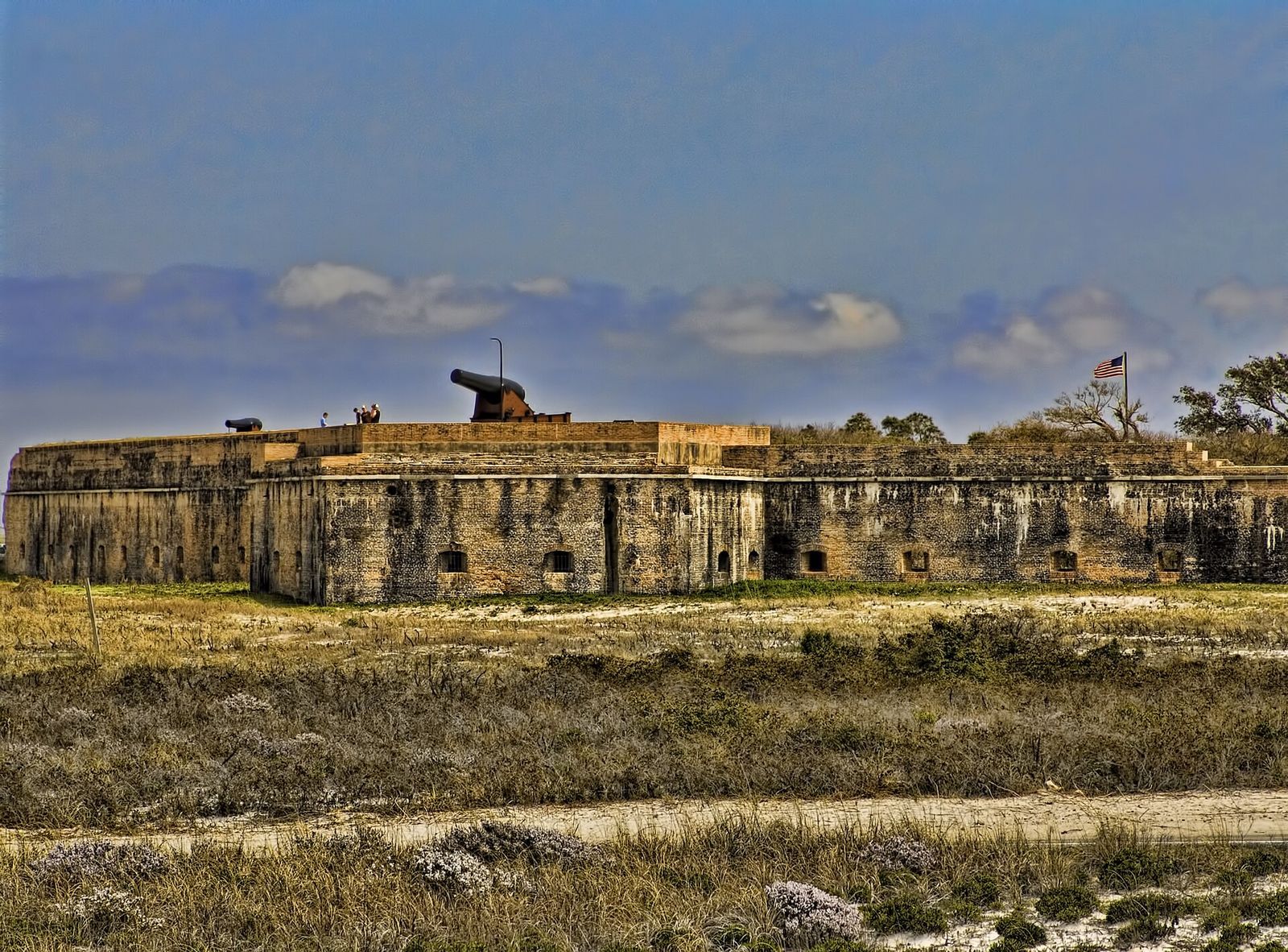
Fort Pickens is a coastal fort on the western tip of Santa Rosa Island near Pensacola, Florida, United States. Built between 1829 and 1834 under the Third System, the U.S. program for major coastal defenses at strategic harbors after the War of 1812, it was the largest fortification protecting Pensacola Harbor. French engineer Simon Bernard designed the fort, and Colonel William H. Chase of the Army Corps of Engineers supervised its construction. Fort Barrancas, Fort McRee, and the Pensacola Navy Yard formed part of the harbor’s wider defenses.
Construction and harbor defense
Much of the work was carried out by enslaved people, and the fort was named for Andrew Pickens, an officer and political figure of the American Revolution. On January 20, 1858, a major fire broke out at the fort. Sailors and boats from the cutter Robert J. Walker, along with a hydrographic party from the survey steamer Varina, helped fight the blaze. The Army Corps of Engineers captain commanding at Pensacola Harbor later recognized their assistance.
The Civil War
The fort’s occupation ended shortly after the Mexican-American War, which concluded in 1848, and it was in disrepair by the start of the Civil War. On January 8, 1861, Union guards at Fort Barrancas turned back local civilians attempting to take the post. Some historians regard this confrontation as involving the first shots of the war. Lieutenant Adam J. Slemmer then judged Fort Pickens the strongest position available in the area.
On January 10, the day Florida left the Union, Slemmer destroyed more than 20,000 pounds of gunpowder at Fort McRee, disabled the guns at Fort Barrancas, and moved to Fort Pickens. He brought 51 soldiers and 30 sailors who had escaped the Confederate takeover of the nearby Navy Yard. Chase, who had overseen the fort’s construction and now commanded Florida militia for the Confederacy, demanded its surrender on January 15 and again on January 18. Slemmer refused both times.
An informal truce arranged by U.S. Senator Stephen R. Mallory and President James Buchanan called for Union forces not to reinforce the fort and Confederate forces not to attack it. The Brooklyn, carrying a company of soldiers, remained nearby. Its naval commander was ordered not to land the men unless an attack on the fort occurred or appeared imminent. In March, the Army directed that they land at the first suitable opportunity, but the Navy issued no matching order, so they stayed aboard until April 12. Colonel Harvey Brown then took command from Slemmer. By late June, Colonel William Wilson and troops from the 6th New York Infantry had further strengthened the Union garrison.
On October 9, more than 1,000 Confederate troops landed about four miles east of Fort Pickens and attacked the western end of Santa Rosa Island. Artillery and gunfire drove them back; the Confederates withdrew with 90 casualties. After Confederate forces secured Fort McRee and Fort Barrancas, the Union warships Niagara and Richmond entered the bay on November 22 and bombarded Confederate positions for two days. Fort McRee was nearly destroyed, while Warrington and the Navy Yard were destroyed.
A further bombardment began on January 1, 1862, after the Confederate commander at Fort Barrancas fired on Santa Rosa Island. This was the final exchange between U.S. forces and General Braxton Bragg’s army before Confederate troops left Pensacola in May. With supplies and morale declining, the last Confederate forces in the area surrendered to Fort Pickens on May 10. The fort stayed under Union control for the rest of the war, one of only four Southern forts to do so.
Later military use and preservation
From October 1886 to May 1887, Apache leader Geronimo, known for resisting U.S. expansion into Apache lands, and several of his warriors were imprisoned at Fort Pickens. Their families were held at Fort Marion in St. Augustine.
In the late 1890s and early twentieth century, the Endicott Board’s coastal-defense program introduced batteries spread across a wider area instead of concentrating guns in a single masonry fort. Fort Pickens was altered to fit the new defenses. On June 20, 1899, a fire in Bastion D reached a magazine holding 8,000 pounds of gunpowder. The explosion killed one soldier. Battery Cooper’s six-inch guns were removed in 1917, as the fort’s armament continued to change around the First World War.
During the Second World War, the U.S. Navy strengthened the defenses against German submarines operating in the Gulf of Mexico and the risk of air attack. The Army abandoned Fort Pickens in 1947. Added to the National Register of Historic Places on May 31, 1972, it is part of Gulf Islands National Seashore and is administered by the National Park Service.
Remains
The masonry fort
Plan and defensive works
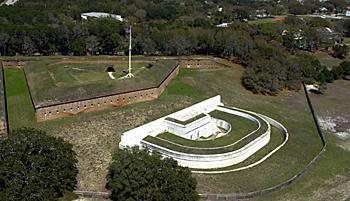
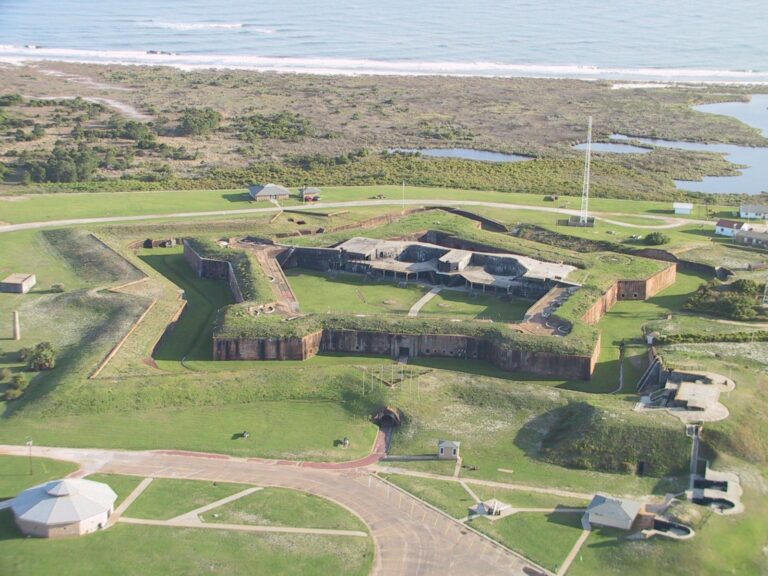
The fort has a pentagonal plan, three stories, and a position at sea level. Its construction used about 21.5 million bricks. The western walls are broader, providing a wide field of fire over the bay. On the east side, a counterscarp, the outer face of a defensive ditch, formed a moat intended to guard against an attack from the west. The western bastions, projecting sections of the fort wall, contained chambers prepared for explosives as a final defense.
Entrance and alterations
The Sally Port, a controlled opening through the fortification, allowed equipment for Battery Pensacola to pass through. To clear space for that battery’s 12-inch guns, the south parapet, a protective wall, and the officers’ quarters beneath it were demolished. The southeast barbette, a gun platform designed to fire over a protective wall, was also removed, along with the arched roofs of gun chambers in the southernmost bastion.
The 1899 explosion tore away foundations and sections of wall, and later removals made access to the batteries easier. After the Army’s departure, neglect and partial demolition further changed the fort. The north wall was removed, and a road was cut through the south wall.
Coastal batteries
Outer gun positions
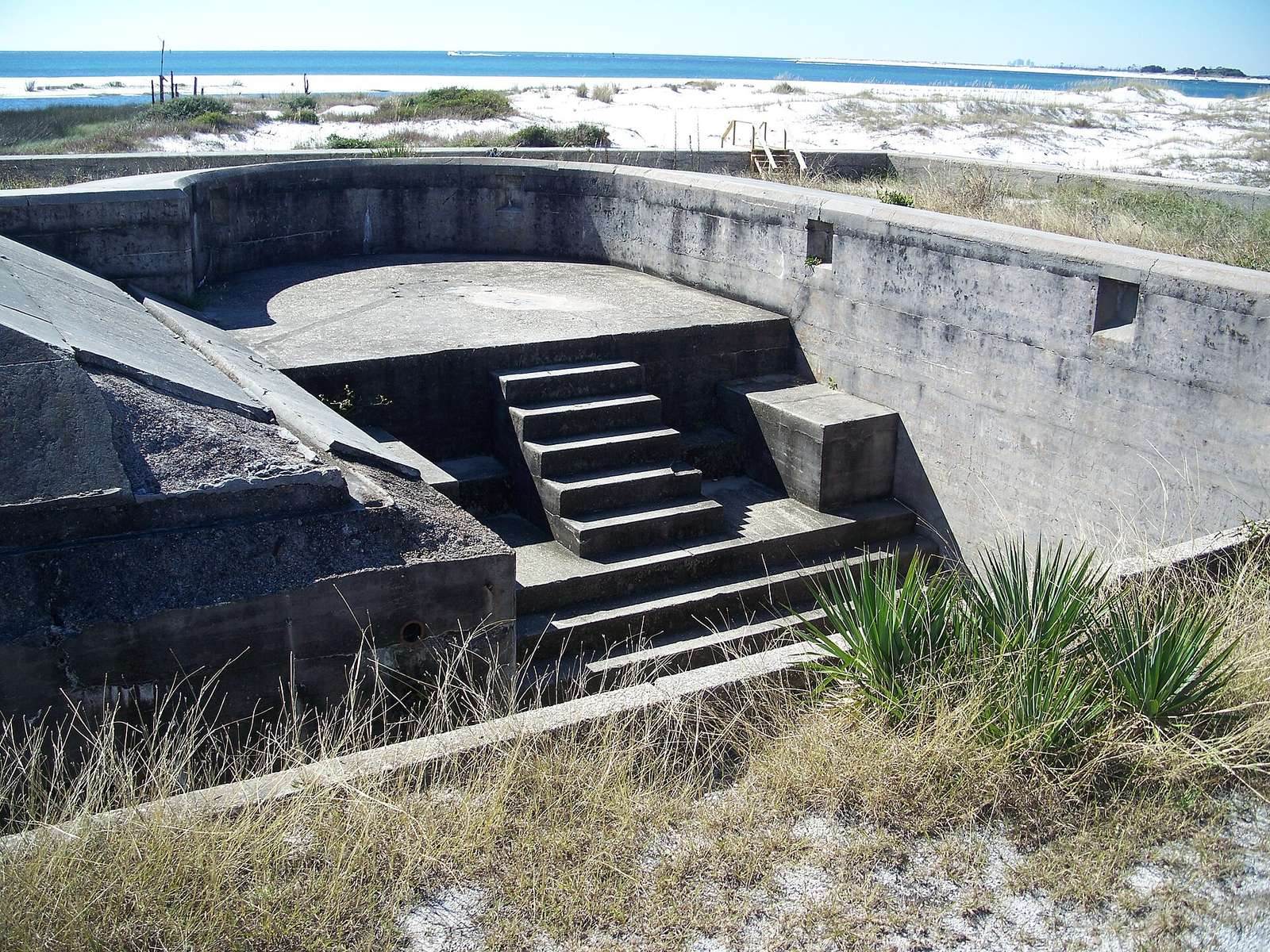
The Endicott-era batteries spread guns around the fort. South of it, Battery Sevier had four 10-inch guns, while Battery Van Swearingen had two 4.7-inch guns. Battery Payne, to the southwest, held two 3-inch guns, and Battery Trueman, to the northwest, had two of the same caliber. Southeast of the fort, Battery Cooper was equipped with two 6-inch guns. Battery Cullum had two 10-inch guns.
Battery Pensacola
Battery Pensacola stood within the fort and had two 12-inch guns. The changes made to accommodate them included removing the south parapet and the officers’ quarters below it, as well as parts of the southeast wall and southernmost bastion.
Twentieth-century batteries
Battery Langdon
East of the fort, Battery Langdon was built in 1923 with two 12-inch guns intended to complement Battery Pensacola’s armament. The guns were initially exposed, with ammunition and the command center housed in a reinforced embankment between them. In 1943, 17 feet of concrete was added around the guns to form a casemate, a fortified chamber for guns. Sand and soil then covered the structure to create an artificial hill.
Battery Cooper positions
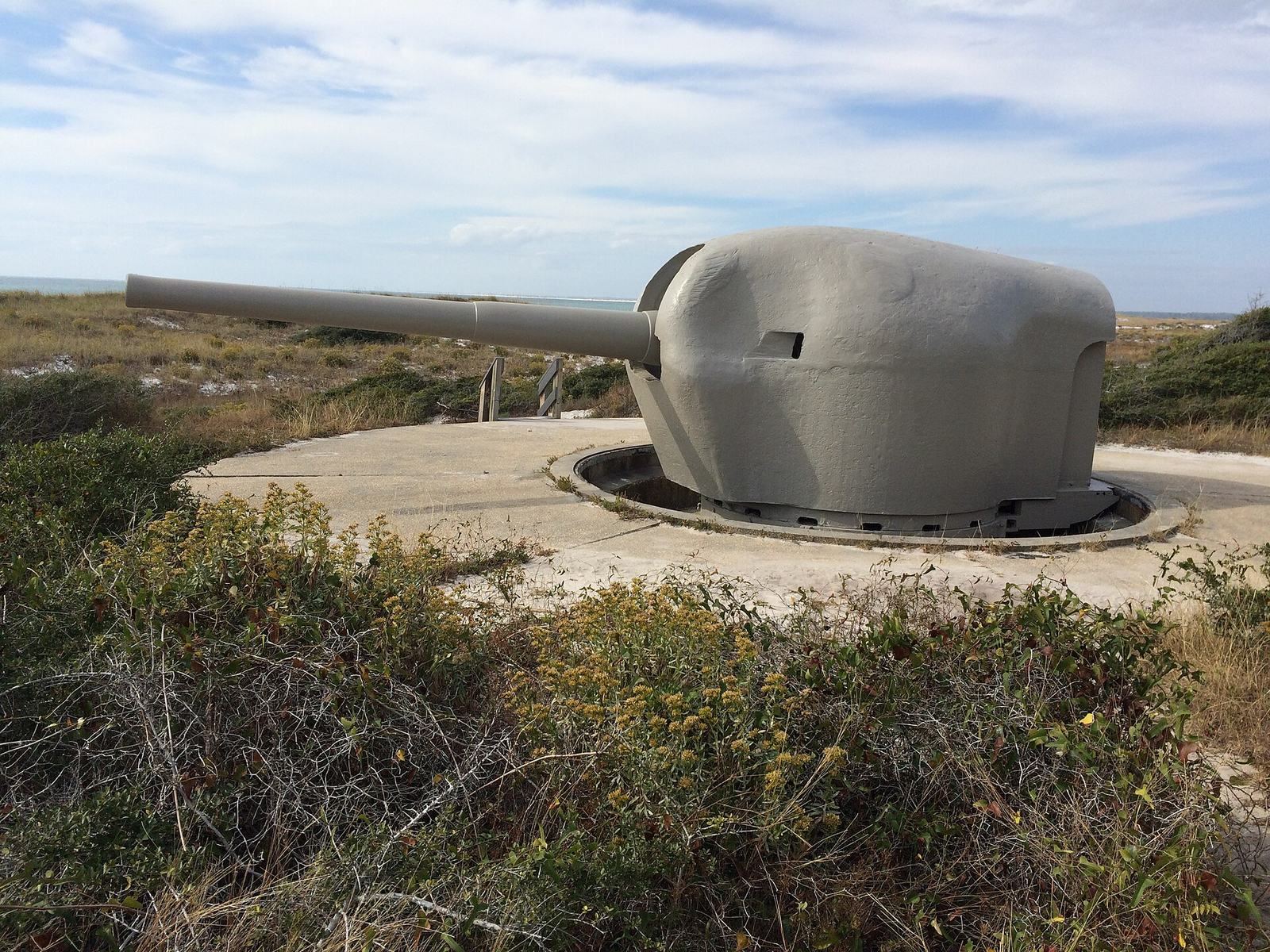
Four 155-millimeter guns were placed around Battery Cooper in 1942, two forward and one on each side. Concrete rings used to position and aim the guns remain. The installation relied on Battery Cooper’s magazines, communications, and other support facilities. A gun formerly at West Point was transferred to the battery in 1976.
Battery 234
Southeast of the fort, Battery 234 was designed for two 6-inch M1905 guns in cast-steel chambers. Its command center lies beneath an artificial hill. The Smithsonian donated the guns in 1976, and they are present at the battery.
Battery Worth
Battery Worth, east of the fort, was built after 1918 and had two guns.