Fort Barrancas: A Harbor-Defense Fort in Pensacola, Florida
Site at a Glance
- Country
- United States
- Primary era
- Modern
- Eras represented
- Early Modern, Modern
- Civilizations
- British, Spanish
- Site type
- Military
- Remains
- Fort
On this page10 sections
History
Fort Barrancas is a harbor-defense complex overlooking Pensacola Bay in Pensacola, Florida, United States. Spain established fortifications on the hill in 1698, and the United States later replaced the wooden hilltop work with a brick fortress between 1839 and 1844. The fort formed part of the defenses protecting Pensacola Bay and the Navy Yard.
Spanish and British fortifications
Spanish settlers occupied part of Santa Rosa Island from 1559 to 1561, but their settlement did not include the hilltop where Fort Barrancas stands. Spain built Fort San Carlos de Austria there in 1698. In 1707, Native American forces under the general leadership of English traders besieged the fort but failed to take it. French forces captured Pensacola and destroyed the fort in 1719.
After Britain gained control of West Florida in 1763, it built the Royal Navy Redoubt at the site. Spain retook Pensacola in 1781. Spanish authorities then constructed a masonry water battery in 1787 and added a wooden-and-earthen hilltop fort over the following decade. Completed in 1797, the hilltop work was named Fort San Carlos de Barrancas.
Rebuilding and expansion under the United States
In 1814, as U.S. forces under Andrew Jackson advanced during the War of 1812, a conflict involving the United States and Britain, retreating British troops demolished the fort. Spain rebuilt it in 1817. The following year, the Spanish garrison exchanged cannon fire for several days with an American battery led by Jackson, then surrendered. Pensacola passed into American hands.
After the United States acquired Florida in 1821, it chose Pensacola for a major Navy Yard and planned further defenses for the deepwater bay. Fort Barrancas, Fort Pickens, and Fort McRee became parts of the harbor-defense system. The lower battery was repaired in 1838, and the hilltop fort took the name Fort Barrancas in 1839. From 1839 to 1844, the United States replaced the earlier wooden fort with a brick fortress designed to defend against both ships entering the harbor and attacks from land. U.S. Army engineer Joseph Gilbert Totten designed the expansion, while Major William Henry Chase supervised the work. Enslaved Black people carried out most of the construction.
Between 1845 and 1869, the Army built the Advanced Redoubt north of the fort and connected the two defenses with a trench line. Together they were intended to protect the Navy Yard from infantry attacks. In 1870, an eight-mile railroad linked Pensacola with the fort through Warrington and Woolsey. The section on Naval Air Station Pensacola was abandoned around 1979, and its tracks and bridges were removed.
The Civil War
On January 8, 1861, Florida state troops under Colonel William Henry Chase demanded the surrender of the fort from its company of 50 U.S. Army soldiers, commanded by John H. Winder. With Winder away, Lieutenant Adam J. Slemmer led the garrison and ordered shots fired to repel the militia. Slemmer considered Fort Pickens easier to defend. He disabled Barrancas’s guns, moved ammunition and supplies by flatboat, and took his company across the bay. Union forces held Fort Pickens throughout the Civil War, the conflict between the Union and the Confederacy, the government formed by seceding Southern states.
Confederate troops from Alabama, Louisiana, and Mississippi occupied Fort Barrancas and built additional coastal sand batteries. General Braxton Bragg took command of Confederate forces at Pensacola on March 11, 1861, and continued work on the batteries. On October 9, a Confederate force of about 1,000 landed east of Fort Pickens but was driven back. Fort Barrancas and Fort McRee exchanged heavy cannon fire with Pickens in November 1861 and January 1862. After Union forces captured New Orleans, Confederate troops left Pensacola in May 1862. The development of rifled cannon and ironclad ships was also making masonry forts such as Barrancas increasingly obsolete.
Military use and preservation
Between the world wars, the fort served as a Citizens’ Military Training Camp, a U.S. Army program that trained civilian men. The Army also used it as a signal station, small-arms range, and storage area. It was deactivated on April 15, 1947, and the Navy incorporated the site into Naval Air Station Pensacola.
Fort Barrancas received National Historic Landmark status in 1960, a federal designation recognizing national importance in U.S. history. The 640-acre Fort Barrancas Historic District was added to the National Register of Historic Places, a federal register of historic properties, in 1966. In 1971, the fort became part of Gulf Islands National Seashore, managed by the National Park Service. Restoration began that year and intensified between 1978 and 1980.
Remains
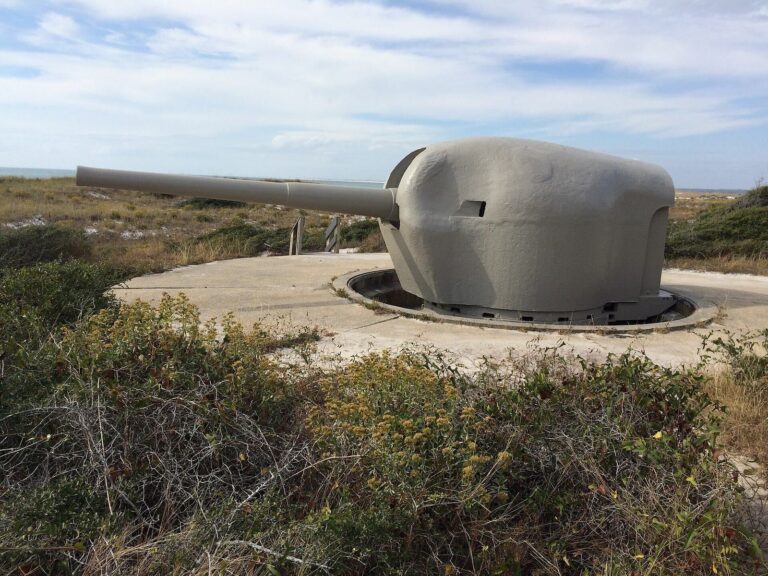
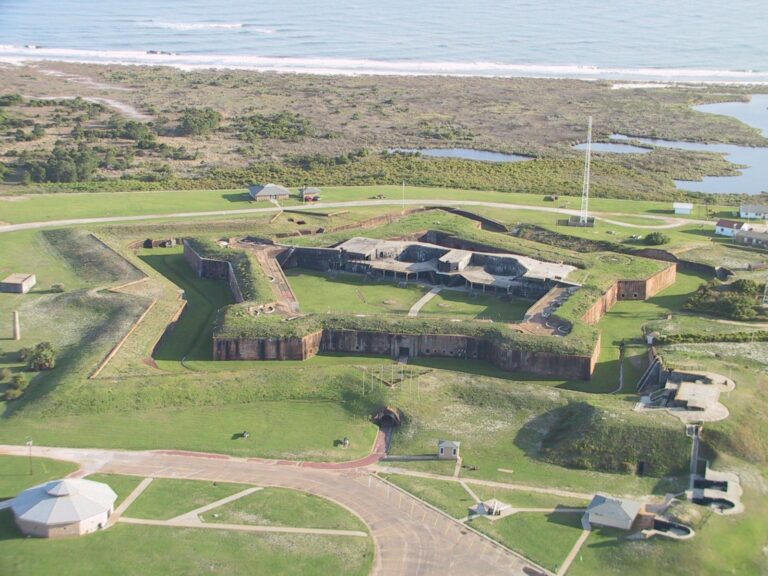
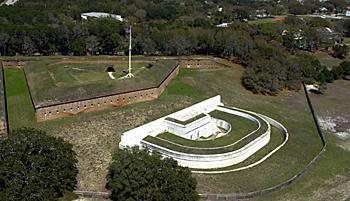
The complex occupies a hill above Pensacola Bay, with the main fort on the hilltop and a masonry gun battery at sea level on the seaward side. An underground passage connects the two works. Farther north, the Advanced Redoubt formed a separate landward defense.
The hilltop fort and water battery
Hilltop fortress
The hilltop fort is a brick fortress arranged as a casemated block, a structure with enclosed, protected spaces for troops or weapons. Its plan is broadly triangular, but a projecting front with a wide, obtuse angle gives the whole an approximately four-sided outline. The rear narrows to a point. At the front, two forward sections, or faces, meet two side sections, or flanks.
A dry ditch follows both flanks and ends at the embankment near the inward corners beside the faces. A covered way, a protected route for moving troops, leads toward the northern infantry position.
Lower battery
The Spanish-built masonry battery below the fort is known as the Bateria de San Antonio and, separately, as Fort San Carlos. It is a surviving part of the earlier Spanish fortifications. Its position below the hilltop work on the bay’s seaward side, and its underground connection to the fort above, make it a distinct component of the complex.
Advanced Redoubt
The Advanced Redoubt, a detached defensive work, lies about 1,400 feet (427 meters) north of Fort Barrancas near an arm of Grand Bayou. A trench line linked it to the main fort. Its position blocked the landward approach to the Pensacola Navy Yard.