Fort Rice: A U.S. Frontier Military Post in Dakota Territory
Site at a Glance
- Country
- United States
- Primary era
- Modern
- Eras represented
- Modern
- Civilizations
- Unclassified
- Site type
- Military
- Remains
- Fort
On this page9 sections
History
Fort Rice was a 19th-century U.S. frontier military post on the Missouri River in what was then Dakota Territory, within the United States. Established in 1864, it supported military campaigns on the Northern Plains. The post was named for Union brigadier general James Clay Rice, who died at the Battle of Spotsylvania Court House on May 10, 1864. Its Lakota name, Psíŋ Otȟúŋwahe, means “Wild Rice Village.”
Establishment and frontier service
Gold discoveries in Montana drew miners, settlers, and other travelers through Lakota territory. After U.S. Army officer Alfred H. Sully’s victory at Whitestone Hill in 1863, attacks on wagon trains and boats on the Missouri River intensified. In 1864, Sully led a campaign of about 3,500 men intended to protect settlers and press the Sioux toward reservations. Fort Rice was built as part of this military response by the 30th Wisconsin Infantry, under Colonel Daniel J. Dill, and became operational on July 7, 1864. It served as a base for Sully’s campaign and helped secure a Missouri River landing used to supply troops.
The 1st U.S. Volunteer Infantry took over from the Wisconsin regiment. Many of its members were former Confederate prisoners of war who had enlisted for Union service on the frontier. Two companies of the 4th U.S. Volunteer Infantry reinforced the garrison in 1865, and the 50th Wisconsin Infantry took over in October. Regular U.S. Army troops later replaced the volunteers.
Lakota resistance and diplomacy
The Lakota, an Indigenous people of the Northern Plains, opposed the fort’s presence on land they considered theirs. Local leaders regarded its establishment as a breach of the 1851 Treaty of Fort Laramie, an agreement between the United States and Native nations concerning territory and relations on the Plains, and demanded that the post be removed. Attacks continued, including raids on supplies and livestock led by the Hunkpapa Lakota leader Sitting Bull. During the first winter, 81 soldiers died, most from scurvy or dysentery; seven were killed in attacks. On one occasion, Sitting Bull led about 400 warriors in an assault. After three hours of fighting, about a dozen Lakota warriors and two U.S. soldiers were dead, and three U.S. soldiers were wounded.
Matilda Galpin, also known as Eagle Woman That All Look At, was a peace activist and the wife of a U.S. officer. When First Lieutenant Benjamin Wilson was wounded in a Lakota ambush, she carried him back to the fort and prevented him from being scalped. Wilson died days later from an arrow wound that had pierced his lung. Galpin earned the soldiers’ respect and was praised for helping foster greater understanding between the United States and the Sioux.
Fort Rice also hosted meetings between U.S. representatives and Sioux communities. In July 1868, an estimated gathering of more than 50,000 Sioux took place there in connection with negotiations that led to the Treaty of Fort Laramie of 1868. Hunkpapa leader Running Antelope and Miniconjou leader Two Bears attended. Sitting Bull did not, but sent a representative. The treaty restored a substantial portion of land and was a victory for the Oglala, Miniconjou, and Brulé Lakota.
Expeditions and abandonment
From 1865 to 1873, the fort supported military and exploratory expeditions, including Sully’s journey to Devil’s Lake in 1865 and expeditions up the Missouri River. Major Joseph Whistler led an expedition along the Yellowstone River in 1871; Colonel David S. Stanley led others in 1872 and 1873. During the 1873 expedition, the Lakota warrior Rain-in-the-Face ambushed the party and killed two civilians accompanying it. In 1874, four companies from Fort Rice joined George A. Custer’s expedition to the Black Hills. Troops of the 7th U.S. Cavalry were also stationed at the post at times, and two companies from Fort Rice fought at the Battle of the Little Bighorn.
Fort Rice was abandoned on November 25, 1878, after Fort Yates was enlarged at Standing Rock Agency and took its place. North Dakota acquired the site in 1913, and a historic site was established there in 1940. It is now protected as Fort Rice State Historic Site by the State Historical Society of North Dakota.
Remains
The fort stood on the right bank of the Missouri River, north of the Cannonball River’s mouth and south of the Heart River’s mouth. Its first enclosure was a rough wooden post with dug-in log huts; the rebuilt fort occupied the same site, about 300 meters from the riverbank, and expanded into a larger four-sided compound.
Enclosures and buildings
Original enclosure
The original enclosure measured about 500 by 510 feet. Its rough huts were built from locally available cottonwood logs and had roofs of earth or prairie sod. An earthen defensive bank and a wooden perimeter enclosed the post, with projecting defensive positions at the northeast and southwest corners.
Rebuilt fort
Rebuilt and expanded in 1868, the fort formed a quadrangle measuring 864 by 544 feet, enclosed by wooden defensive barriers about 10 feet high. The earlier buildings were demolished and replaced with more substantial wooden structures intended to improve soldiers’ living conditions. The post could house a garrison of 420 men and had stables for 184 horses. Renovations completed in 1875 included a guardhouse, library, bakery, ammunition store, hospital, four company quarters, five storehouses, and seven officers’ buildings. Other structures housed command offices and soldiers, and provided storage, an armory, and stables.
Surviving traces
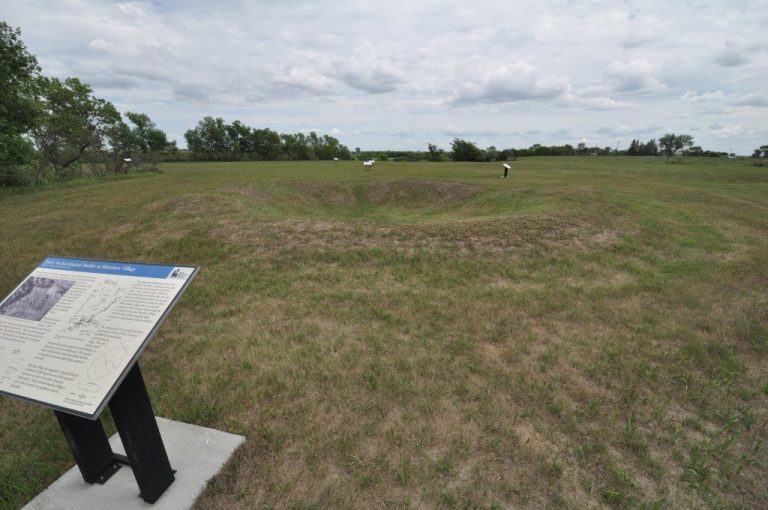
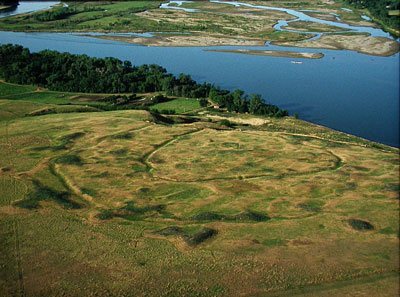
Depressions and foundation lines across the site mark building locations. Works Progress Administration corner markers, installed by the federal public-works agency active in the 1930s and early 1940s, also mark the site. An informational marker provides a map and a brief history.