Huff Archeological Site: A Prehistoric Mandan Village in North Dakota
Site at a Glance
- Rating
- 4.5
- Popularity
- Very Low
- Country
- United States
- Primary era
- Medieval
- External website
- Open
- Eras represented
- Medieval
- Civilizations
- Unclassified
- Site type
- Military
- Remains
- Fortified Town
On this page11 sections
History
Huff Archeological Site is a prehistoric Mandan village in North Dakota, United States, built around AD 1450 during the period before European influence. The Mandan, an Indigenous people historically associated with the Missouri River and northern Great Plains, established a large agricultural settlement here while also hunting bison. Its extensive defenses show that protection from conflict was an important concern for the community.
A Fifteenth-Century Mandan Settlement
The village was occupied during the fifteenth century, although the exact duration of settlement remains uncertain. One interpretation places its habitation within that century rather than extending continuously across two hundred years. The inhabitants cultivated crops, stored agricultural produce, and relied on bison hunting alongside farming. Their settlement included substantial earth lodges, communal spaces, storage facilities, and fortifications characteristic of Mandan villages along the Missouri River.
Huff was discovered in the early twentieth century. During the 1960s, excavators worked with the U.S. Army Corps of Engineers to stabilize the Missouri River bank and protect the archaeological area. Most of the site was left undisturbed, preserving evidence of the settlement’s layout and occupation.
Protection and Heritage
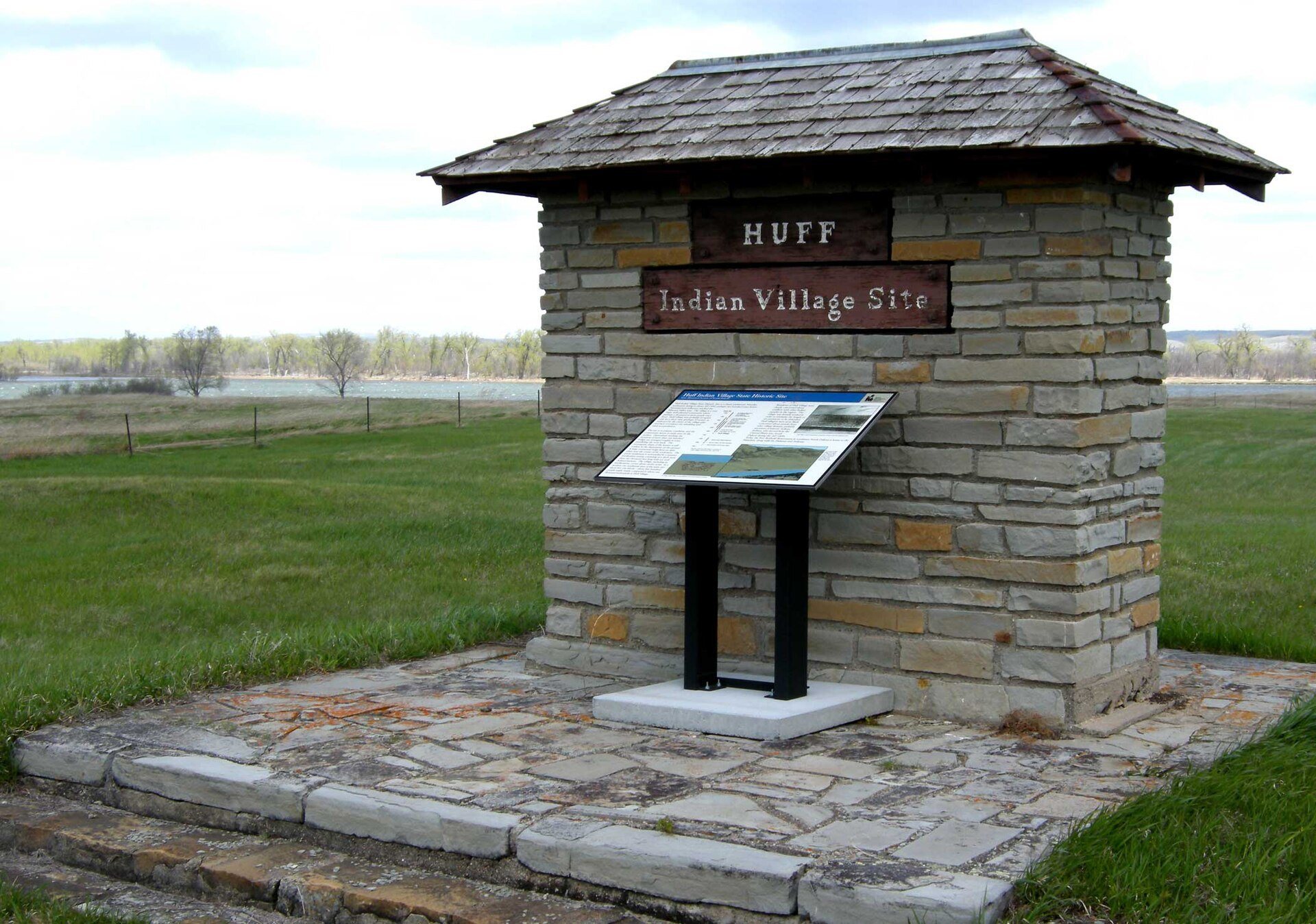
Huff Archeological Site was added to the U.S. National Register of Historic Places on July 23, 1980. It became a U.S. National Historic Landmark on February 18, 1997, a designation for places judged to possess exceptional national historical significance. The State Historical Society of North Dakota also protects it as Huff Indian Village State Historic Site.
The village forms an important part of North Dakota archaeology and Native American heritage. The Mandan people now reside on the Fort Berthold Reservation in North Dakota, a federally recognized Indigenous reservation associated with the Mandan, Hidatsa, and Arikara peoples.
Remains
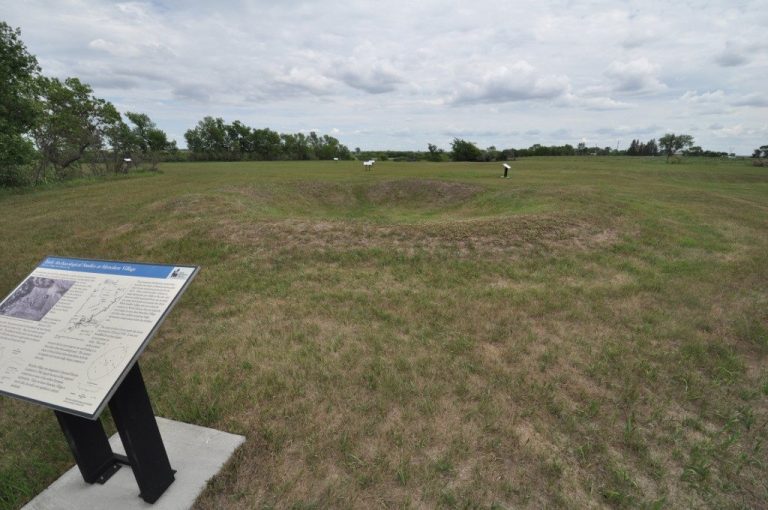
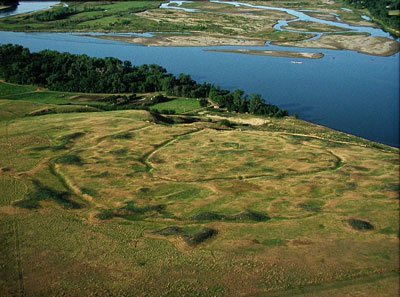
Huff occupies approximately 12 acres, or 4.8 hectares, on the west bank of the Missouri River in Morton County. The settlement lies beside a steep bluff descending toward the river and has a clearly defined rectangular layout. More than one hundred elongated earth lodges stood in somewhat irregular rows within the settlement, which formerly contained hundreds of lodges and substantial outer defenses.
Fortifications and Village Layout
Defensive Works
A defensive ditch approximately 2,000 feet, or 610 meters, long enclosed the village on three sides. A palisade nearly 700 meters long provided an additional barrier and included ten bastions. Bastions are projecting fortifications that allow defenders to observe and protect adjoining sections of a wall or palisade. Together, the ditch and palisade formed a substantial protective system around the settlement.
Central Plaza and Ceremonial Structure
A central plaza covered approximately 1,500 square meters. A ceremonial structure opened onto this space, following a layout comparable to that of other Mandan villages. The plaza provided the settlement with a large communal area within the fortified village.
Dwellings and Agricultural Facilities
Earth Lodges
The village’s dwellings were generally rectangular and set into pits about one or two feet deep. Their support posts were made from trees growing in the surrounding area, and the entrances faced southwest, away from the river. One dwelling differed from the others in being more nearly square and having rounded corners. The lodges were earth-covered structures built around timber frameworks, a traditional Mandan form of substantial housing.
Corn-Storage Pits
Numerous bell-shaped underground pits for storing corn lay generally outside the earth lodges. Their combined capacity approached 2,500 cubic meters, indicating the scale of agricultural production supported by the settlement. The storage facilities formed an important part of the village’s agricultural organization.
Archaeological Deposits
Small refuse deposits contain bison bones, ash, soil from hearths, and pottery sherds. These remains reflect both food preparation and daily domestic activity within the village, while the combination of farming facilities, hunting debris, dwellings, and communal spaces helps define the character of the Mandan settlement.