Castle Cornet: A Fortress Defending Guernsey and Saint Peter Port
Site at a Glance
- Country
- United Kingdom
- Primary era
- Medieval
- Eras represented
- Medieval, Early Modern, Modern
- Civilizations
- British, English, French, German
- Site type
- Military
- Remains
- Castle
On this page17 sections
History
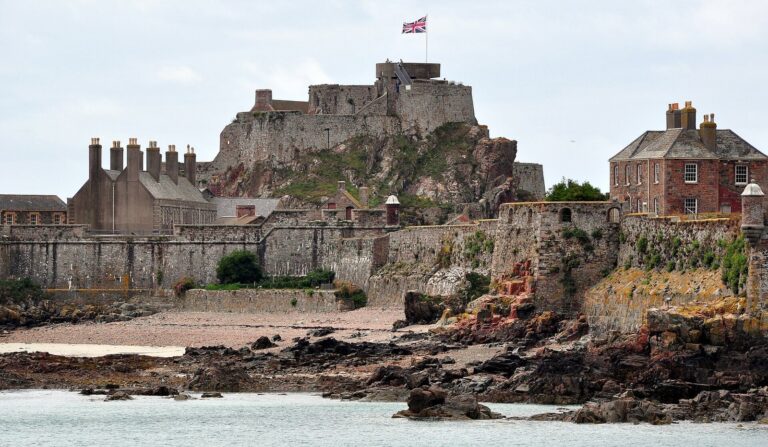
Castle Cornet is a fortress on a tidal islet off Guernsey in the Channel Islands, built to defend the island and the roadstead, a sheltered anchorage, of Saint Peter Port. Its first fortifications date to 1206–1256, after the Duchy of Normandy, a medieval polity ruled by a duke, was divided in 1204.
Medieval fortification and French attacks
During Geoffrey de Lucy’s term as warden, the official responsible for the castle, in 1225–1226, a period of fortification took place in the Channel Islands. Timber and lead were sent from England for castle building in Guernsey and Jersey.
In 1338, a French force captured Guernsey and took Castle Cornet on 8 September. The garrison, comprising 11 men-at-arms and 50 archers, was killed. Guernsey was retaken in 1340, but the castle remained under French control until August 1345, when professional soldiers and local militia captured it after a three-day assault. During their seven-year occupation, the French strengthened the defences, possibly including the barbican.
The French seized the castle again in 1358 and were driven out the following year; an island traitor was executed. In 1372, Owain Lawgoch, a Welsh claimant to the throne who led a military company for France, attacked Guernsey. His force killed 400 island militiamen but failed to take the well-supplied castle, whose artillery deterred the assault. The French captured it again in 1380, but island forces soon expelled them.
New defences and gunpowder warfare
Carey Tower was built around 1435, and a French assault in 1461 was repulsed. The cost of building and maintaining the castle and its garrison came from island revenues raised by the warden under royal warrant, an authorization issued in the monarch’s name.
The arrival of cannon and gunpowder led to remodelling in 1545 and 1548. In 1547, after taking Sark, the French attacked Guernsey. Guns fired from off Saint Peter Port, while the castle answered with cannon fire. Further construction followed. In 1566, materials were quarried on Crevichon and sand was brought from Herm. Polygonal bastions, projecting parts of a fortification, were built, and the Royal Battery and Sutler’s House were completed in 1594.
Royalist stronghold and surrender
In 1627, Charles I granted Guernsey additional rights intended to reduce the Crown’s costs of maintaining the castle. In return, the island had to provide each year 100 tuns of beer, with a tun defined as 252 gallons; 600 flitches, or sides, of bacon; 1,200 pounds of butter; 20 weys of cheese, about 4,600 pounds; 3,000 stockfish; 300 pounds of tallow; 12 bulls; wood; and coal.
During the English Civil Wars of 1642–1651, fought between Royalists supporting the Crown and Parliamentarians supporting Parliament, Castle Cornet backed the Royalist cause while Guernsey supported Parliament. The castle had four commanders during the conflict. Sir Peter Osborne closed it on 14 March 1642, and its guns fired on Saint Peter Port. The bombardment reduced many buildings to ruins and forced the Royal Court to move to Elizabeth College; an estimated 10,000 cannonballs were fired at the town.
Captured island commissioners were held in Carey Tower. They made a rope from flax, escaped, and returned to the island at low tide. In 1651, Parliamentarian ensign Nicholas Robert, a junior military officer, recovered Charles I’s crown from the Court House in Royalist Jersey and delivered it to the castle’s governor. After holding out for nine years with support from Jersey, the castle surrendered under Colonel Roger Burges on 17 December 1651, two years after Charles I’s execution. The 55-man garrison was allowed to leave Guernsey bearing arms, and the crown was returned to London. Castle Cornet was the penultimate Royalist garrison in the British Isles to surrender.
Explosion, prison, and later military use
Prominent Parliamentarian leader John Lambert was imprisoned at the castle from 1662 to 1670. It remained the governor of Guernsey’s official residence until 30 December 1672, when lightning struck the powder magazine. The explosion destroyed the keep, the castle’s principal fortified tower, and several living quarters, and killed seven people, including Lord Hatton’s mother and wife, Lady Hatton, as well as staff and children. The governor moved elsewhere on the island, and the tower was not rebuilt.
Additional barracks were built during the Napoleonic Wars, conflicts between Napoleonic France and its opponents in the late eighteenth and early nineteenth centuries. A new prison on St James Street, built in 1811, ended Castle Cornet’s role as the island’s only prison, although it continued to hold prisoners until the end of the Second World War. In 1859, the islet became part of a breakwater serving Saint Peter Port harbour. A pond for toy or model yachts was built along it in 1887 for Queen Victoria’s Golden Jubilee, marking 50 years of her reign. During the First World War, the pond served as a base for flying boats.
Twentieth century and museum use
A small German garrison occupied Castle Cornet during the Second World War and called it “Harbour Castle.” In 1947, the Crown gave the castle to the people of Guernsey as a token of their loyalty during the two world wars. The castle and islet had been listed as a Protected Monument, a place formally recognized for its historical or archaeological importance, on 26 March 1938. Today the complex includes museums covering the castle’s history, maritime history, No. 201 Squadron of the Royal Air Force, and the Royal Guernsey Militia. The militia museum includes artefacts from the Royal Guernsey Light Infantry.
Remains
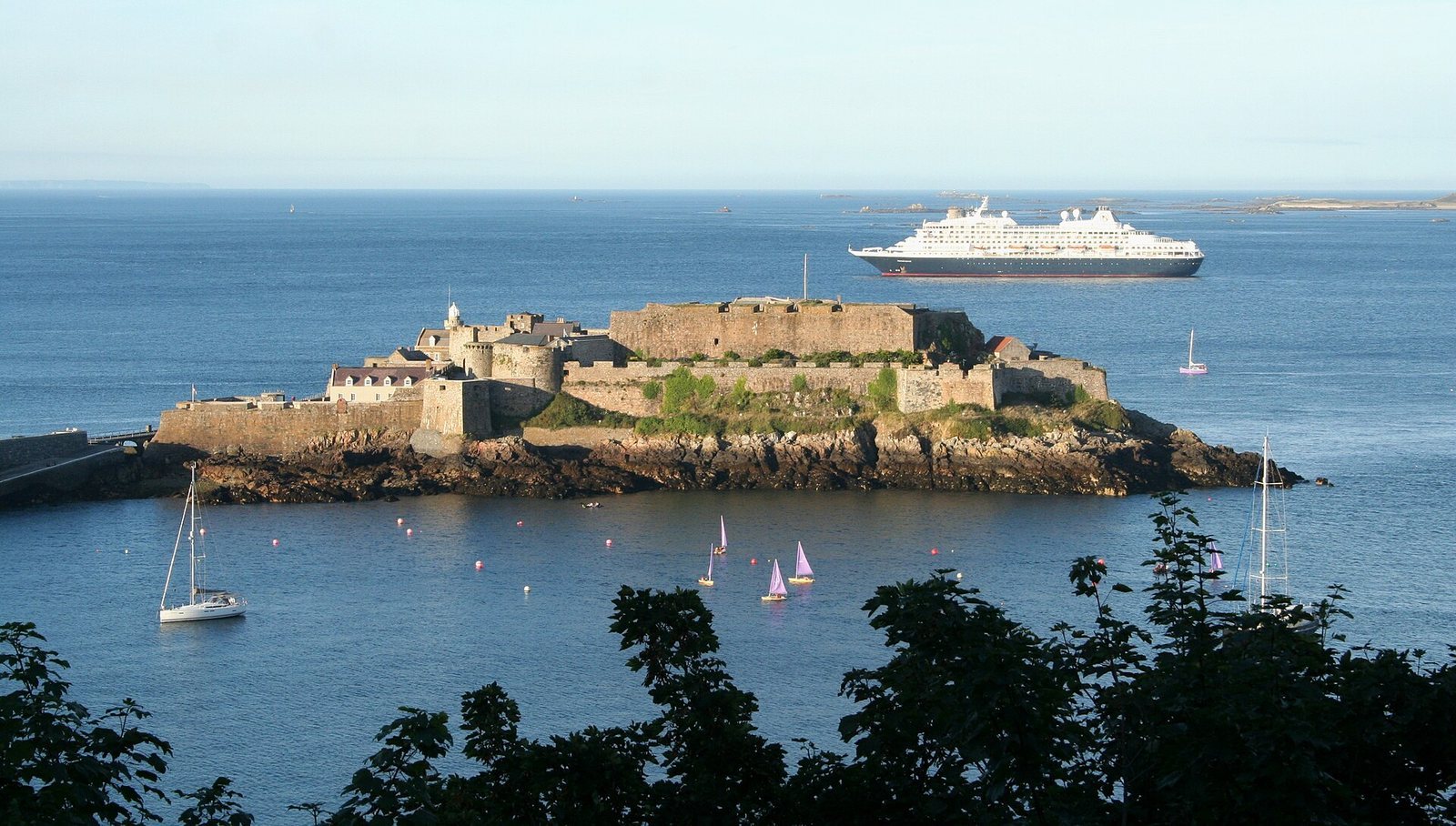
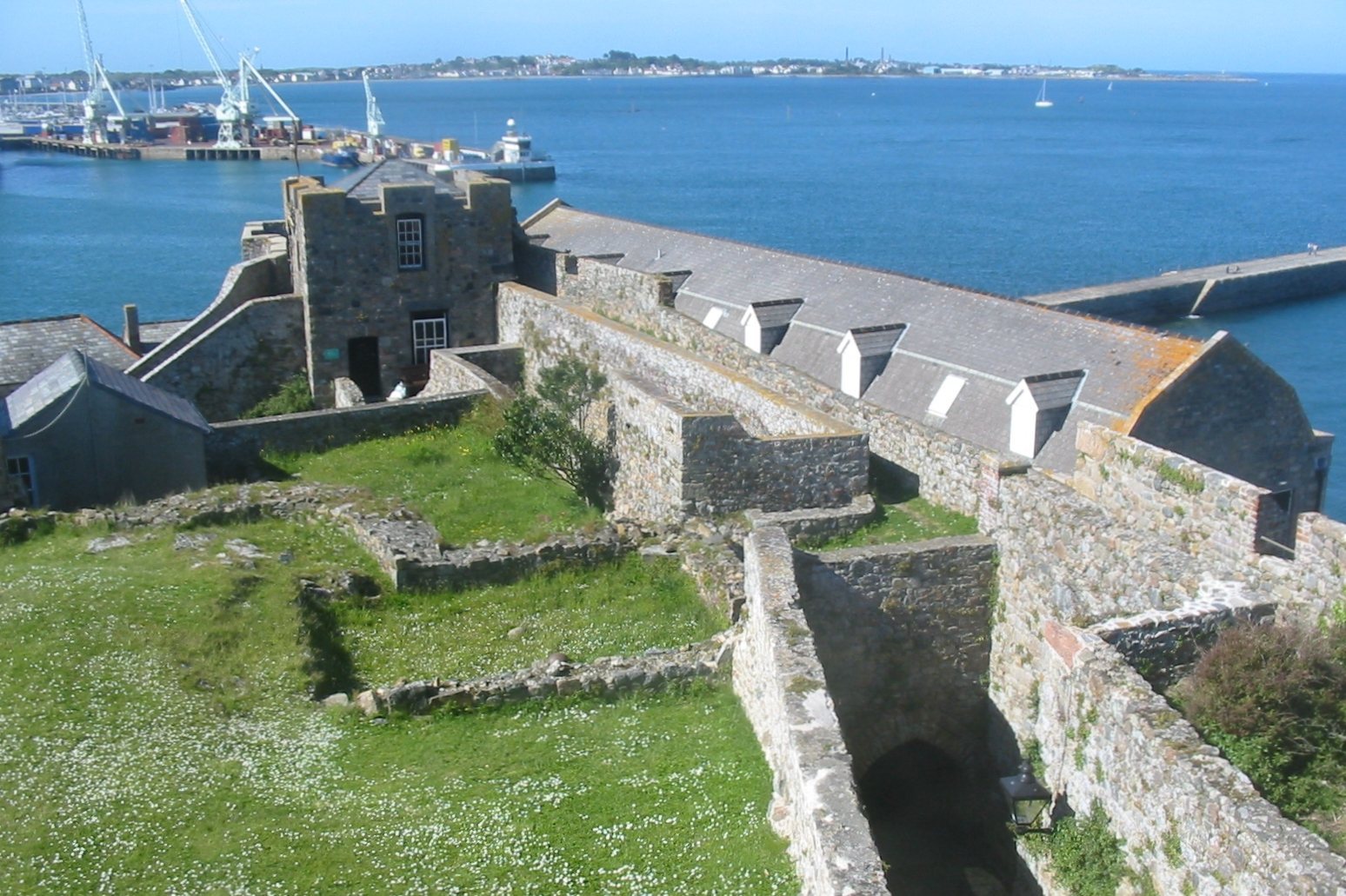
The castle occupies an islet formerly identified as Little Roussel and also known as Cornet Rock or Castle Rock. It covers about two hectares, measures approximately 175 metres by 130 metres, and rises to as much as 13 metres. It lies nearly 600 metres east of Guernsey’s coast and southeast of Saint Peter Port’s artificial harbour. Since 1859, Castle Pier, roughly 500 metres long, has connected the islet’s northern end to Guernsey. Castle Breakwater extends a further 150 metres east; together, pier and breakwater form the harbour’s southern boundary.
Built and altered over roughly 800 years, the castle has an irregular plan. Its materials include diorite, carefully cut stone blocks known as ashlar, mortar, and timber. The earliest described complex comprised a keep, a chapel, two courtyards, and curtain walls, defensive walls linking towers or other strongpoints. Six gateways lead to the citadel at the summit.
Outer defences and entrances
Medieval barbican
The barbican, an outer defensive work, forms the castle’s outermost part and dates to the mid-thirteenth century. Arches allowed defenders above to attack people below with missiles and liquids, including quicklime and liquid lead. Some walls are built of small stones and poorer materials and may have been constructed by the French during the siege around 1345. A sharply turning passage hindered the use of a battering ram, while a drawbridge marks the original thirteenth-century entrance. The former gatehouse consists of a vaulted passage with a tower above. Later used as the town prison, its passage became known as Prisoners’ Walk.
Main gate and Outer Ward
The main gate is shielded from cannon fire from the island, and the arms of Queen Elizabeth I appear above it. It leads into the Outer Ward, the castle’s outer courtyard, through a portcullis, a heavy gate raised or lowered across an entrance. A barrack block stands to the right, and a guardroom dates to the nineteenth century. The second curtain wall dates to the English Civil Wars. At the top of the ward, another gate turns sharply, making a direct assault more difficult.
Citadel entrance and summit
A further portcullis and a door protect the citadel entrance. The original curtain wall dates to around 1570 and was later refaced for added strength; many of the citadel’s defensive walls date to the sixteenth century. Concrete work added during the German occupation of 1940–1945 also forms part of its defences. A square tower at the summit is associated with the escape of three Parliamentarians in 1643.
Towers and internal buildings
Towers and courtyard
The castle includes the medieval Tour Carré, or Square Tower, the Gunners’ Tower, and a medieval courtyard. A round tower once stood at the summit but was destroyed in the 1672 explosion.
Barracks, hospital, and domestic buildings
The married quarters barracks date to around 1750. In the Inner Bailey, or inner courtyard, the hospital was built in 1746. The Sutler’s House, the castle’s oldest domestic building, survived the 1672 explosion.
Battery and harbour works
Royal Battery
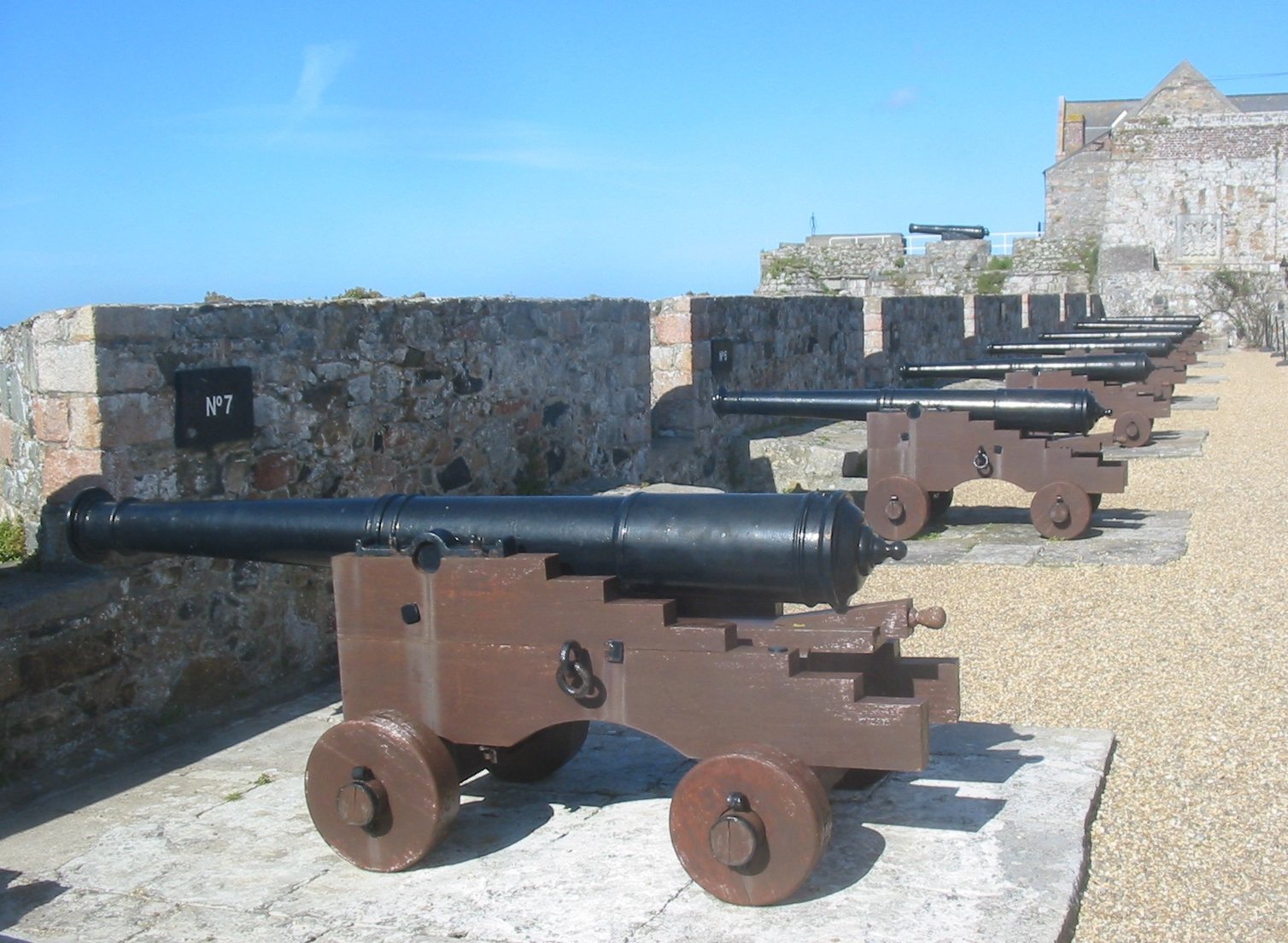
The Royal Battery occupies the castle’s northeastern corner. It dates to around 1575 and was completed in 1594. The noon-day gun is fired from the curtain battery.
Breakwater pond
The pond for toy or model yachts lies along the breakwater, which extends eastward from Castle Pier.