Skånela Church: A Medieval Parish Church in Sweden
Site at a Glance
- Country
- Sweden
- Primary era
- Medieval
- Eras represented
- Medieval, Early Modern, Modern
- Civilizations
- Swedish
- Site type
- Religious
- Remains
- Church
On this page11 sections
History
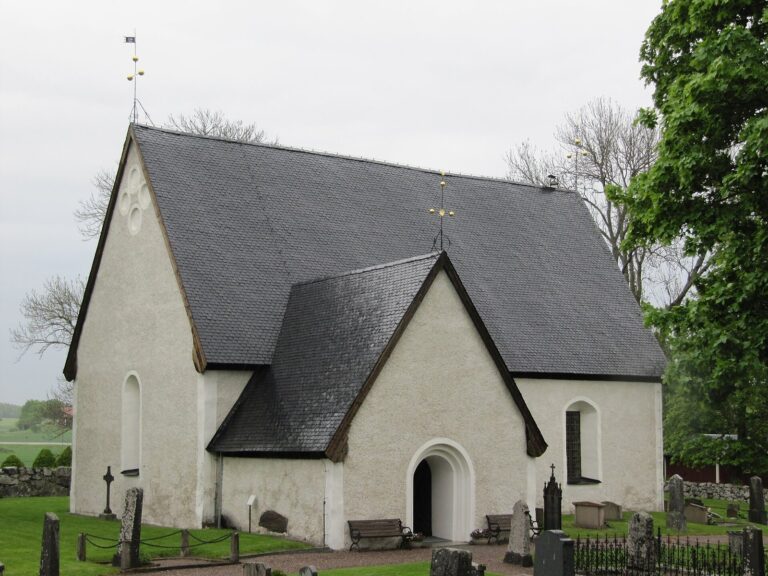
Skånela Church is a medieval parish church in Rosersberg, Sweden, erected in the 1160s in the Romanesque style, a form of medieval architecture. It served Norrsunda Parish and is among the oldest churches in Stockholm County. The surrounding area was important in prehistoric and medieval times because it had a direct connection with Lake Mälaren.
Foundation and medieval development
The architect is unknown. The designer may have trained abroad, perhaps in what is now Germany, and may have been associated with the building workshop at Lund Cathedral. Sigtuna and Lund have also been suggested as possible origins for the architect. Skånela Church later served as a model for other churches in the area.
A local landowner may have commissioned the church, perhaps the owner of nearby Skånelaholm Castle. That landowner may have fallen out of favour with Birger Jarl, a 13th-century Swedish statesman whose office carried royal and military authority. The church appears to have been confiscated and sold to Sko Abbey, a medieval religious house in Uppland, in 1276.
A chapel and sacristy, a room for storing objects used in worship and preparing for services, were added in the 14th century. In the 15th century, a porch was built on the south side, the church’s main body, or nave, was extended westward, and the tower was raised. Arched ceilings were added to the nave and chapel around the middle of that century.
Changes from the 17th to the 19th centuries
A fire in 1642 destroyed the east and west gables, which were rebuilt with thicker walls. In 1707, the sacristy was enlarged northward and given a wooden barrel vault, a continuous arched ceiling. A flat wooden ceiling replaced it late in the 18th century. Supports built against the western walls, called buttresses, were added from 1724 to 1728, and around 1750 the owner of Skånelaholm Castle built a burial chapel for the Jennings family beside the medieval north chapel. After the eastern ceiling collapsed, it was rebuilt in 1790. A fire in 1806 burned the roof structure; a new roof was installed, the interior walls were covered with several layers of plaster, and some windows were rebuilt.
A church inspection in 1751 led to the removal of a medieval stone baptismal font. A wooden baptismal stand was acquired in 1780, together with a pewter basin that survives. The church had an organ by 1751, and Jonas Ekengren of Stockholm built a seven-stop instrument in 1785, meaning it had seven sets of pipes.
Nineteenth- and twentieth-century work
After a collapse in 1827, the tower openings were rebuilt and the western buttresses were raised. Johan Edberg of Björklinge built an organ in 1878. A major repair to the church followed in 1915. In 1926, Alfred Fehrling of Stockholm supplied a ten-stop organ with two hand keyboards and a foot pedal.
A renovation completed in 1957 restored the church’s medieval character inside and out. Architect Erik Fant prepared the plans but died before the work was finished; Rolf Bergh took over. Archbishop of Uppsala Yngve Brilioth rededicated the church on 26 May 1957, with King Gustaf VI Adolf present. Grönlunds Orgelbyggeri built the present organ in 1972. The church is Lutheran and belongs to the Church of Sweden and Norrsunda Parish, within the Archdiocese of Uppsala, a senior territorial jurisdiction of a Christian church.
Remains
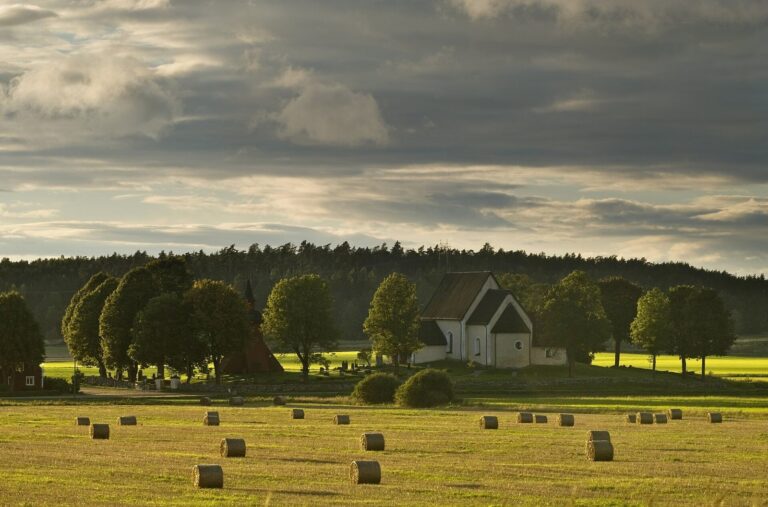
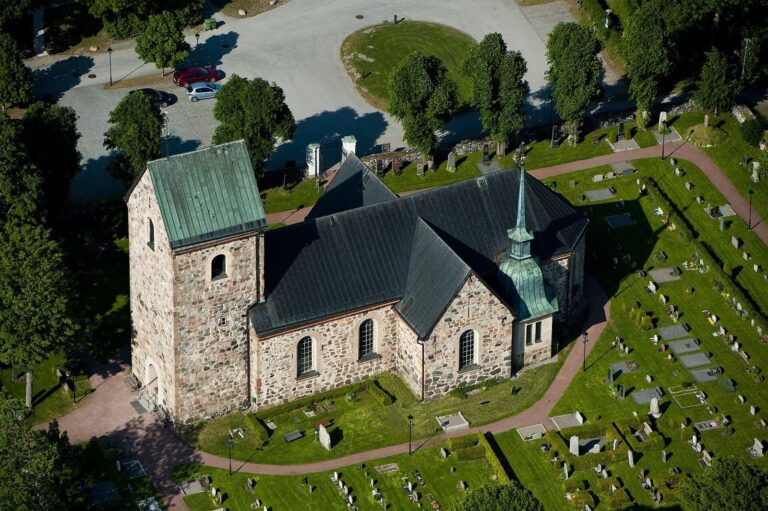
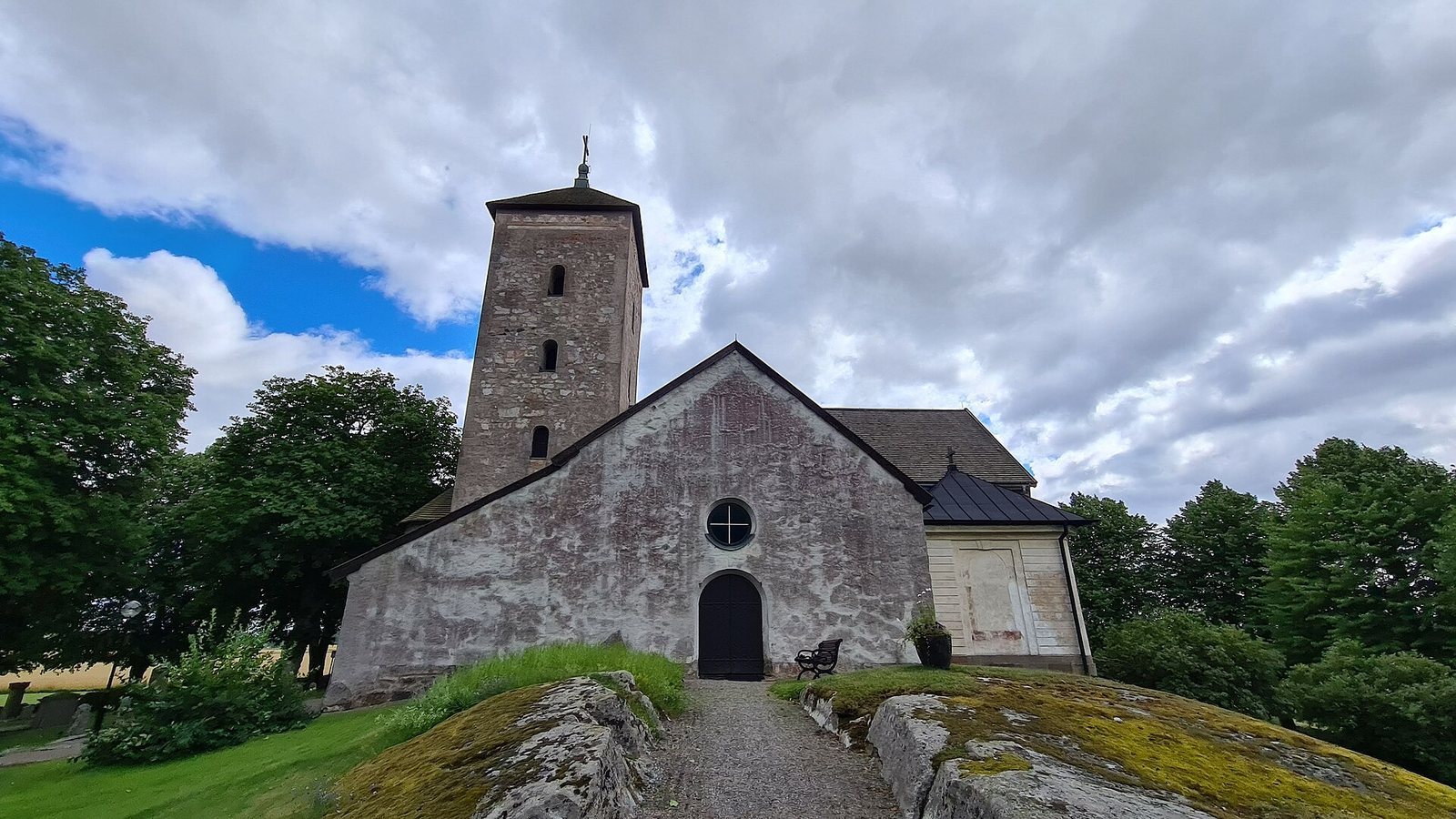
The church stands near the eastern shore of Lake Fysingen in Uppland, within a cultural landscape with ancient traditions. Fifteen runestones, stones bearing inscriptions in runes, an early writing system used by Germanic peoples, are located in and close to the church. Its plan brings together a rectangular nave, a narrower choir around the altar, and a semicircular apse, the rounded end of a church. A tower rises above the eastern choir and altar, a feature shared by a small group of churches in Uppland. A porch projects from the south side; on the north are a chapel, the Jennings family burial chapel to its west, and the sacristy to its east.
Exterior and masonry
The church retains a mainly Romanesque appearance, with later additions in the Gothic style, another form of medieval architecture. The eastern tower dominates the exterior, while the apse and south portal preserve Romanesque features. The masonry is carefully executed, with selected stones and sandstone used for several details where granite was more common locally. Western buttresses remain part of the exterior.
Interior decoration and furnishings
Vaults and wall paintings
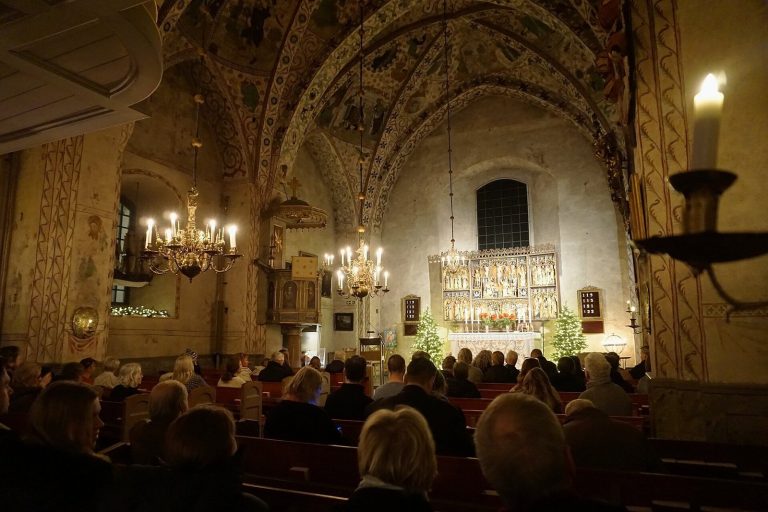
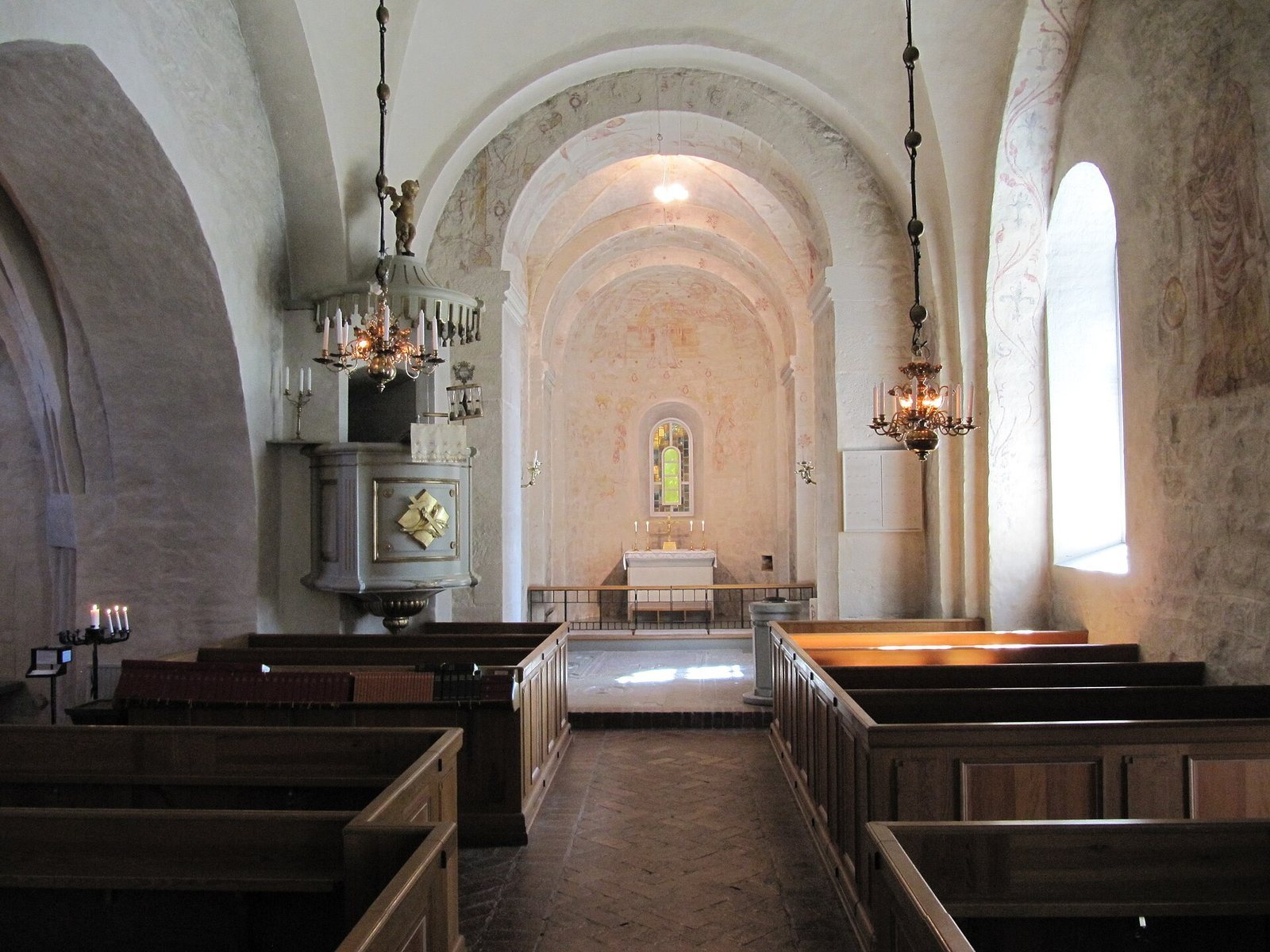
The nave and chapel have vaulted ceilings, and the sacristy has a wooden barrel vault. The interior includes 15th-century frescoes, paintings made on plaster, depicting the Coronation of the Virgin, the Christian image of Mary being crowned in heaven. Fragments of earlier paintings were also uncovered and exposed during the 1957 renovation. Paintings from three periods were brought to view, the oldest dating to the 14th century. The window behind the altar has non-figurative stained glass.
Chapel and choir carvings
A well-preserved Madonna carved from limewood around 1505 stands in a niche in the east wall of the north chapel and is covered with gold leaf. On the choir’s north wall, a carved wooden relief probably from an earlier altarpiece dates to the late 15th century. It depicts Jesus and three sleeping disciples in the Garden of Gethsemane, where Jesus prayed before his arrest.
Altar and baptismal furnishings
The present baptismal font stands in the northern extension. Made in 1957 by Albert Flink’s stone firm to Rolf Bergh’s design, it is limestone on a sandstone base. The altar, built during the same renovation, is masonry with a limestone slab; it replaced an earlier wooden altar. A low communion bench took the place of the altar rail. The pulpit was made in 1789 by master carpenter Widgren to designs from the Royal Academy of Painting and Sculpture. It has a white finish and gilded reliefs. Its associated hourglass stand is topped by a painted metal plaque inscribed, “Carl Hökerstedt and Maria Thegner, 1720.”
Organ, bells, and lighting
The present organ is at the west end of the church. It has mechanical action and slider chests, mechanisms that regulate air to the pipes, and its stated range is 56 notes on the hand keyboards and 30 on the foot pedal. Its front was made for the instrument. Two eight-armed brass chandeliers hang in the forward nave ceiling; the older was donated in 1723, and the other is a modern imitation. Both bells in the tower were cast by the Bergholtz foundry in 1876.