Kumla Church: A Late 12th-Century Church in Sweden
Site at a Glance
- Country
- Sweden
- Primary era
- Medieval
- Eras represented
- Medieval, Early Modern, Modern
- Civilizations
- Swedish
- Site type
- Religious
- Remains
- Church
On this page12 sections
History
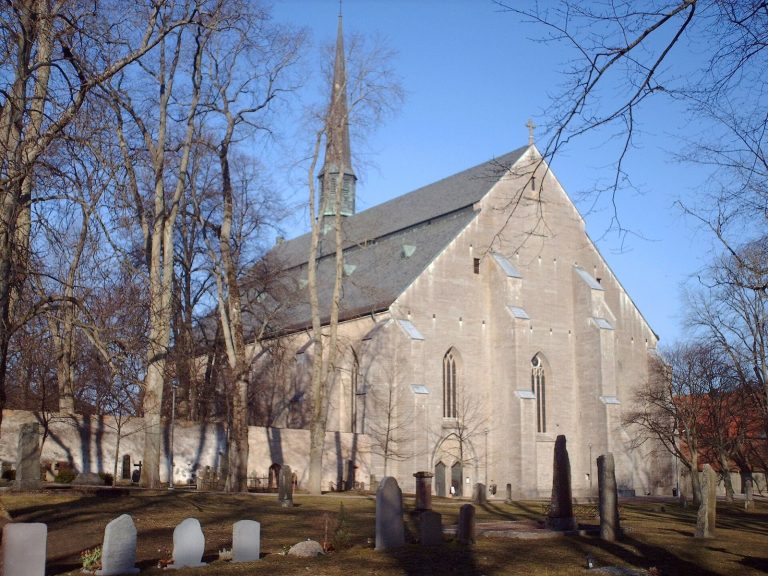
Kumla Church is a limestone church in Kumla, Sweden, built in the late 12th century and consecrated during that century. Its eastern parts belong to the Romanesque period, a medieval European architectural style. The church belongs to the Lutheran Church of Sweden, within Linköping Diocese and Väderstad Parish.
Medieval church and later alterations
The church’s medieval west tower was altered in 1818 after cracks developed. Its upper part was taken down, while the lower section was incorporated beneath the nave roof. At the same time, the 15th-century nave vaults were removed and replaced by a wooden barrel vault.
Furnishings and organ
An oak winged altarpiece made in Lübeck in the second half of the 15th century came to Kumla from Svanshals Church as a gift from Svanshals Parish in the early 18th century. It has undergone several restorations, including conservation and regilding in 1934. The present pulpit replaced an earlier one made in 1755 by Hans Setterberg and painted by Sven Gustafsson Stoltz.
August Rosenborg built the church’s mechanical positive organ in 1863. A positive organ is a relatively small pipe organ, and its stops select groups of pipes to produce different sounds. Ludvig Hawerman designed its façade. In 1866, the original Cornet stop was changed to Octava 4′ and Qvinta 3′, the latter actually 2⅔′; the Cornet’s Tierce ranks apparently were never installed. The original Trumpet stop was removed in the late 1940s. During a restoration in 1969, Richard Jacoby added a Trumpet 8′ and placed a Ters 1⅗′ stop in an unused position. Combined with Qvinta 2⅔′, it formed a Cornett II, although the stop label still reads “Qvinta 3′.”
Modern care
The church was limewashed in the 1950s, after which its bells hung in a bell tower. In 2003, the organ was repainted, while the pulpit, altar rail, gallery barrier, and pews also received repainting; the pulpit and altar rail were regilded. The Gustavsson brothers carried out work on these fittings. Bergenblad & Jonsson Orgelbyggeri restored the organ again in 2010.
Remains
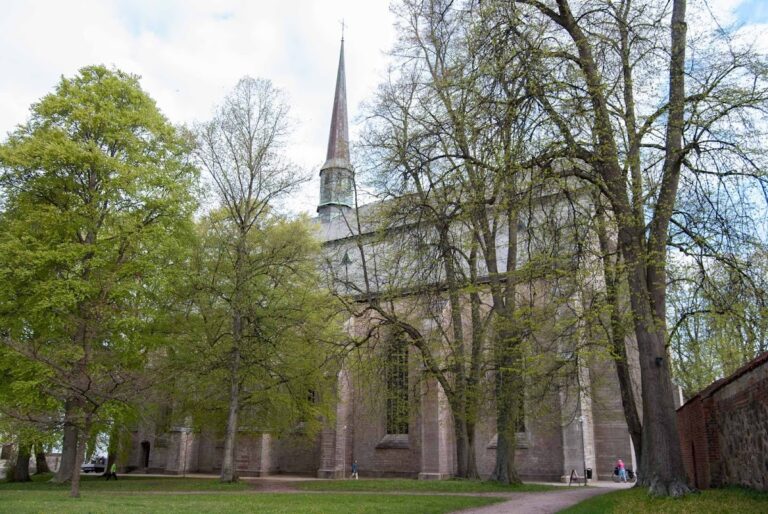
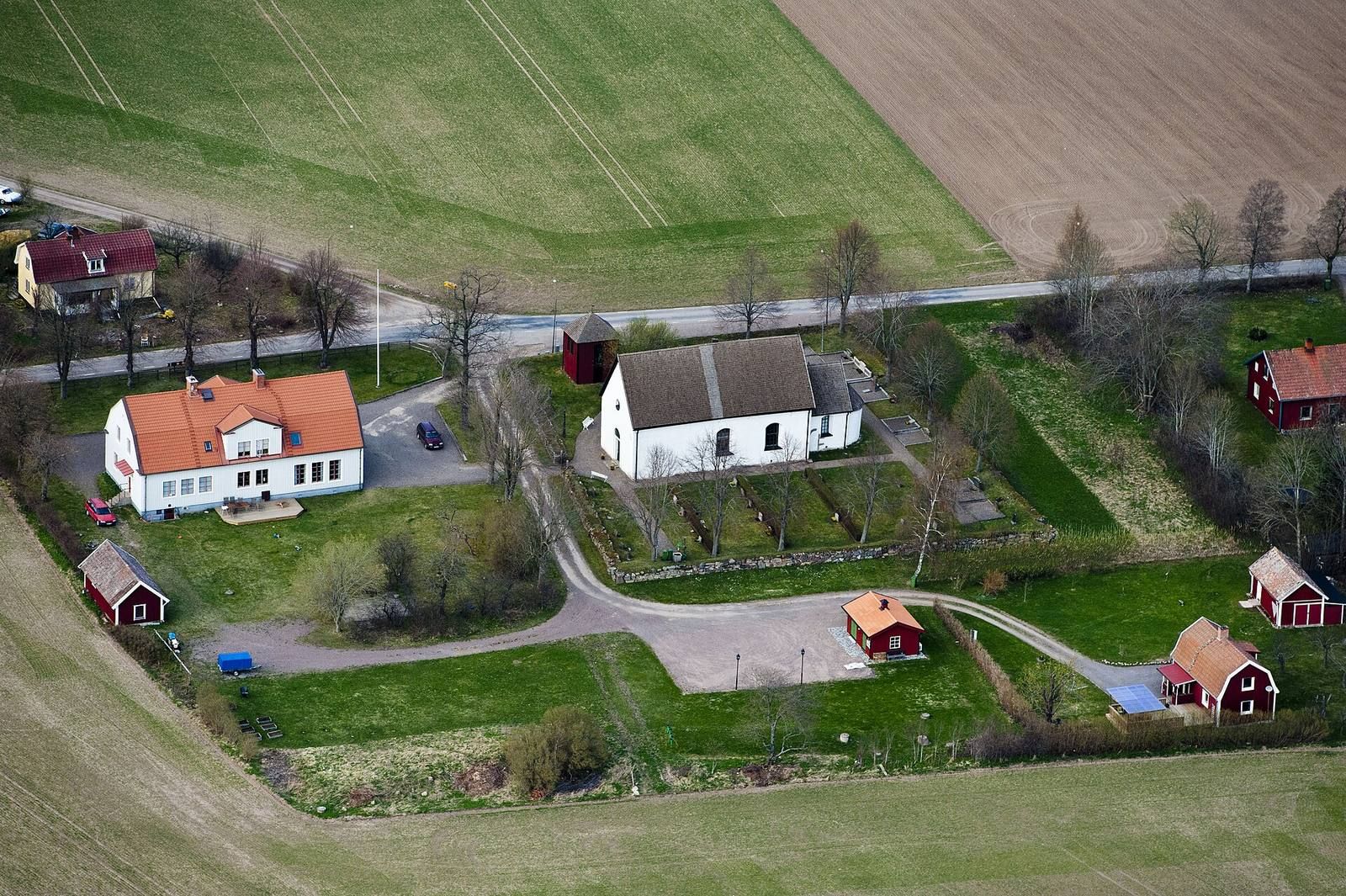
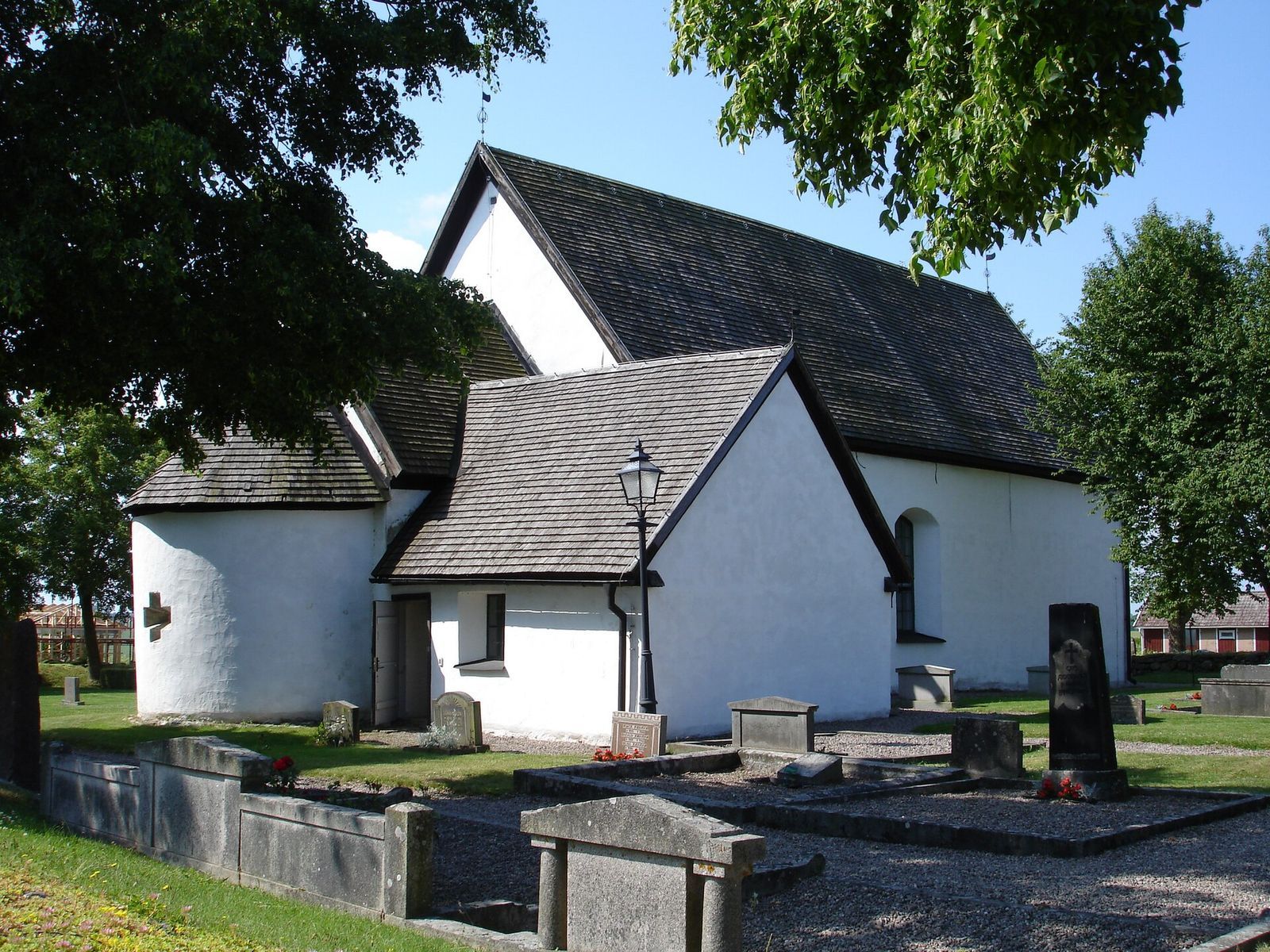
Beside Lake Tåkern, about 4 km northwest of Väderstad, the church retains a largely medieval plan. Its limestone structure has a rectangular nave, a narrower choir ending in an apse, and a sacristy attached to the choir’s north side. A gabled roof covers the building, and the entrance is in the west gable.
Medieval fabric
The apse choir and eastern end of the nave are Romanesque. The sacristy is probably medieval, and its wooden door has iron cladding on the outside. The lower part of the former west tower is incorporated beneath the nave roof, whose ceiling is a wooden barrel vault. A cross-shaped window pierces the apse, while a chancel entrance has been blocked. A bell shed is also among the exterior structures.
Interior features
Altarpiece and stonework
The oak altarpiece measures 155 by 287 cm. Its upper scene shows the Coronation of Mary between two beardless saints. Below are Andrew with an X-shaped cross, Peter with a key, Paul with a cross-staff, and John with a chalice. The left wing depicts the Annunciation and Nativity; the right shows the scourging of Christ and the Crowning with Thorns. Carved, gilded crockets edge the top. The wing paintings were repainted in the 19th century, with older paint layers beneath the visible ones. A carved basin used in church rites survives in the apse choir. Fragments also remain of a baptismal font from the church’s building period, alongside a separate 13th-century font decorated with leaf forms.
Pulpit and other furnishings
The pulpit has a round canopy and four framed panels bearing an anchor, chalice, cross, and tablets. Fluted pilasters divide the panels; gray paint, gilded moldings, and gilded decoration cover the structure. Its bowl rests on a baptismal-font base. The Nyström brothers may have made the pulpit and designed the pew furnishings. The wooden altar rail has two shades of gray paint and gilded moldings. The 18th-century wooden gallery barrier has green marbling and green panels, while the 19th-century wooden pews are painted to imitate oak grain.
Organ
The mechanical organ’s console is at the south end of its case. Its white façade has gilded moldings and decoration, with the gilding probably original. The instrument has a range of 54/18.
Bells
The great bell is probably from the 16th century. Magnus Hultman of Norrköping recast it on 9 June 1741. Its inscription says that people may enjoy the bell’s sound, but God’s word brings joy to the soul, and that prayer and song heard by God are better than the bell’s ringing. Jöns Magnus Fries of Jönköping cast the smaller bell in 1773; Lars Öhman of Norrköping recast it in 1818. Its inscription urges Christians to praise God, heed his word, remember the dead, and help protect a neighbor’s property in a fire.
Bible
A copy of the Gustav Vasa Bible, printed in 1541 and named for the 16th-century Swedish king, is held in the church.