Amoreira Aqueduct: Elvas’s Historic Water-Supply System
Site at a Glance
- Country
- Portugal
- Primary era
- Early Modern
- Eras represented
- Early Modern, Modern
- Civilizations
- Portuguese
- Site type
- Infrastructure
- Remains
- Aqueduct
On this page13 sections
History
The Amoreira Aqueduct in Elvas, Portugal, is a water-supply system built to carry spring water into the town. Work began in 1529. For centuries, Elvas had relied on the Poço de Alcalá, a well near Porta do Bispo, but by about 1498 it was drying up and could no longer meet the needs of a growing population.
Water shortage and early construction
King Manuel I authorized a Real de Água, a tax to fund waterworks, and the town used the proceeds to repair the well. The repairs did not end the shortage, so Elvas turned to springs near Amoreira, about 8 km away. Preliminary aqueduct work began in 1529. In 1533, the town dismissed public-works official Lourenço Domingues, apparently because his work had not met expectations. An inspector’s post was created in 1542, and responsibility for maintenance was assigned the following year.
King John III commissioned a revised plan in 1537. By 1542, the conduit had reached the Convent of São Francisco. Beyond the first 6 km, the more difficult sections required larger arches and greater expenditure. The town financed construction through increased local taxes, fines, sales of municipal land, and loans from orphanages in Elvas and Estremoz.
Interrupted construction and delivery to Elvas
Work stopped in 1547 for lack of money. Queen Catherine urged the town to continue in 1558, and King Sebastian later authorized a levy based on residents’ income. He inspected the unfinished works on 23 August and, on 29 May 1573, ordered the town council to complete them. Construction had restarted in 1571. In 1579, Cardinal-King Henry, who briefly ruled Portugal after Sebastian, asked the bishops of Elvas to contribute funds.
The Castilian invasion of 1580, an attack by forces from the Iberian kingdom of Castile, redirected attention to Elvas’s fortifications and put the aqueduct at risk of abandonment. Completion became a condition in negotiations over the city’s surrender. Around 1602, the town investigated additional springs in the foothills. Work resumed in 1606 with a new waterworks tax. In 1610, the council asked Philip II of Portugal to restart construction and adapt the system to serve higher parts of Elvas. A review of the plan recommended raising the aqueduct by about 5.5 m to improve the supply to Largo da Misericórdia.
Water reached the city gates in 1620 and fed a temporary fountain near the Church of Madalena. The aqueduct and the Fonte da Misericórdia fountain were inaugurated in 1622, but structural problems led to further work. In 1625, builders added hollow supports filled with earth and loose stone, and began a branch down Rua de São Lourenço. Rocky ground slowed that work. By 1628, the system supplied fountains at Misericórdia, Madalena, São Lourenço, São Domingos, São Vicente, and Alameda. Fountains at Biquinha, Cavaleiros, and São José were then being built.
Fortifications, damage, and expanding supply
In 1641, King John IV authorized the aqueduct’s demolition to make way for new defences. Elvas opposed the plan, and Martinho Afonso de Melo, Count of São Lourenço, appealed to the Crown to preserve the water supply. Castilian forces damaged or destroyed parts of the structure in 1644, and a storm brought down two arches in 1646. Demolition was debated again in 1648 as a way to strengthen the city. A large cistern was built beneath Elvas, and in 1652 the Count of Soure ordered an underground conduit to maintain water supply while part of the aqueduct was sacrificed. In 1655, Governor André de Albuquerque Ribafria also sought the removal of sections within the citadel and their replacement with underground passages.
The aqueduct was damaged during the 1663 Castilian invasion led by the Habsburg commander John Joseph of Austria. Two fortified positions were later built at Outeiro dos Pobres and Outeiro de São Francisco, joined by a defensive zone with casemates, protected enclosures for artillery. A new aqueduct plan followed in 1683. In 1698, a rupture disrupted the connection supplying the hospital.
By the early eighteenth century, calcium deposits had reduced water pressure. Builders added an arch at the Borracha spring to allow sediment to settle. In 1708, protests damaged the structure. King John V proposed replacing the arches with pressure-driven pipes, but the town chose reconstruction instead: finding a break in such a pipe network could require opening the entire system. The aqueduct was also strengthened with support piers.
The supply was enlarged in stages. In 1715, water from Poço do Concão was added, followed by nine other springs, including one in the Serra do Bispo region. In 1733, the system was extended to nine springs at Herdade de Trinta-Alferes and reinforced in 1739. The town explored Poço do Gorgulhão in 1743 and extended the supply to Poço Seco in 1745.
Repairs and modern use
An earthquake destroyed two arches at Outeiro dos Pobres in January 1796, but they were quickly repaired. New springs at Herdade de Trinta-Alferes were explored from 1825, and repairs followed between 1825 and 1827. A seasonal storm destroyed a buttress in February 1846.
In 1870, town councillors sought funds to repair and clean the aqueduct, proposed a supplementary conduit to make future cleaning easier, and called for calcium deposits to be removed every ten years. Major restoration from 1872 to 1890 added a secondary conduit and 462 arches. By 1902, most springs were considered unsuitable for drinking water, although those at Ruy de Mello and São Lourenço continued to feed the aqueduct.
In the 1980s, the system still supplied Elvas through its cistern, using water raised from the Trinta-Alferes and Algaravenha springs. Human consumption ended in the 1990s after contamination affected some captured springs. Pipes were repaired and cleaned in 1995, and some arches in the highest section were repaired during the second half of the twentieth century. A restoration campaign from 2020 to 2023 covered 270 m of the main aqueduct at 31 m above sea level; the wider project was divided into 21 sections.
The aqueduct has been a Portuguese National Monument since 1910. It is part of the UNESCO World Heritage property Garrison Border Town of Elvas and its Fortifications, inscribed in 2012 and extended in 2013.
Remains
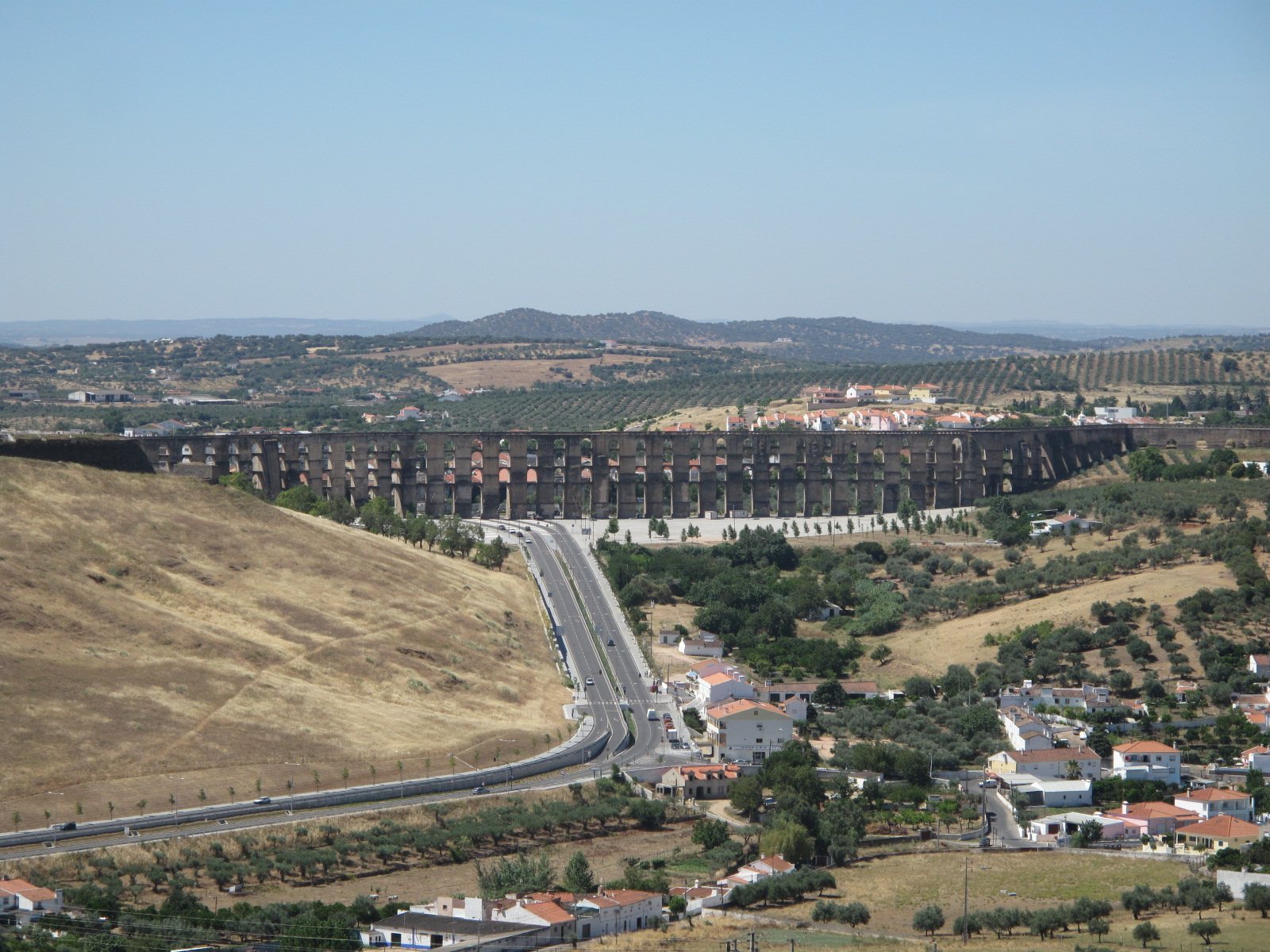
The aqueduct runs from the springs at Fonte da Amoreira, in the Serra do Bispo near Amoreira, toward Elvas. It crosses the rural-urban boundary and the plains of the São Francisco valley and Rossio. Its route combines underground channels, ground-level sections, and an elevated arcade, a structure formed by repeated arches, built of stone set in mortar.
Course and elevated structure
Route and branches
The measured route from the spring to the Chafariz do Jardim fountain is 7,054 m, with a further 450 m to a town fountain; the overall length is about 8.5 km. The route includes 1,367 m underground, 4,049 m at ground level, and 1,683 m on elevated arches. A second conduit branches from Outeiro de São Francisco toward Outeiro dos Pobres and can be seen in the arcade at Rossio.
Within Elvas, the Municipal Gardens lie in front of the aqueduct, and its southern connection leads toward the Convent of São Francisco. A defensive outwork, or ravelin, lies to the southwest.
Elevated arcade
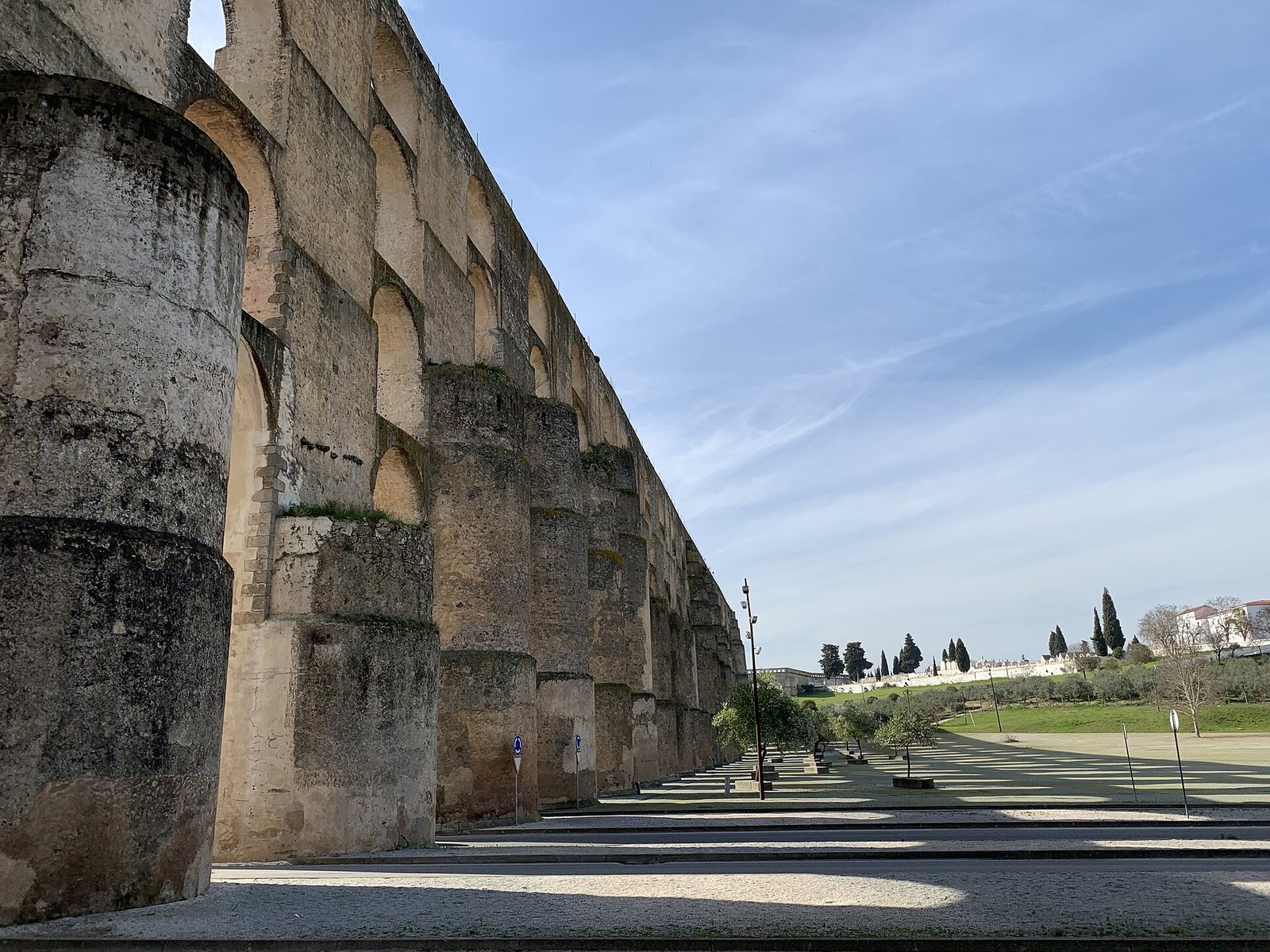
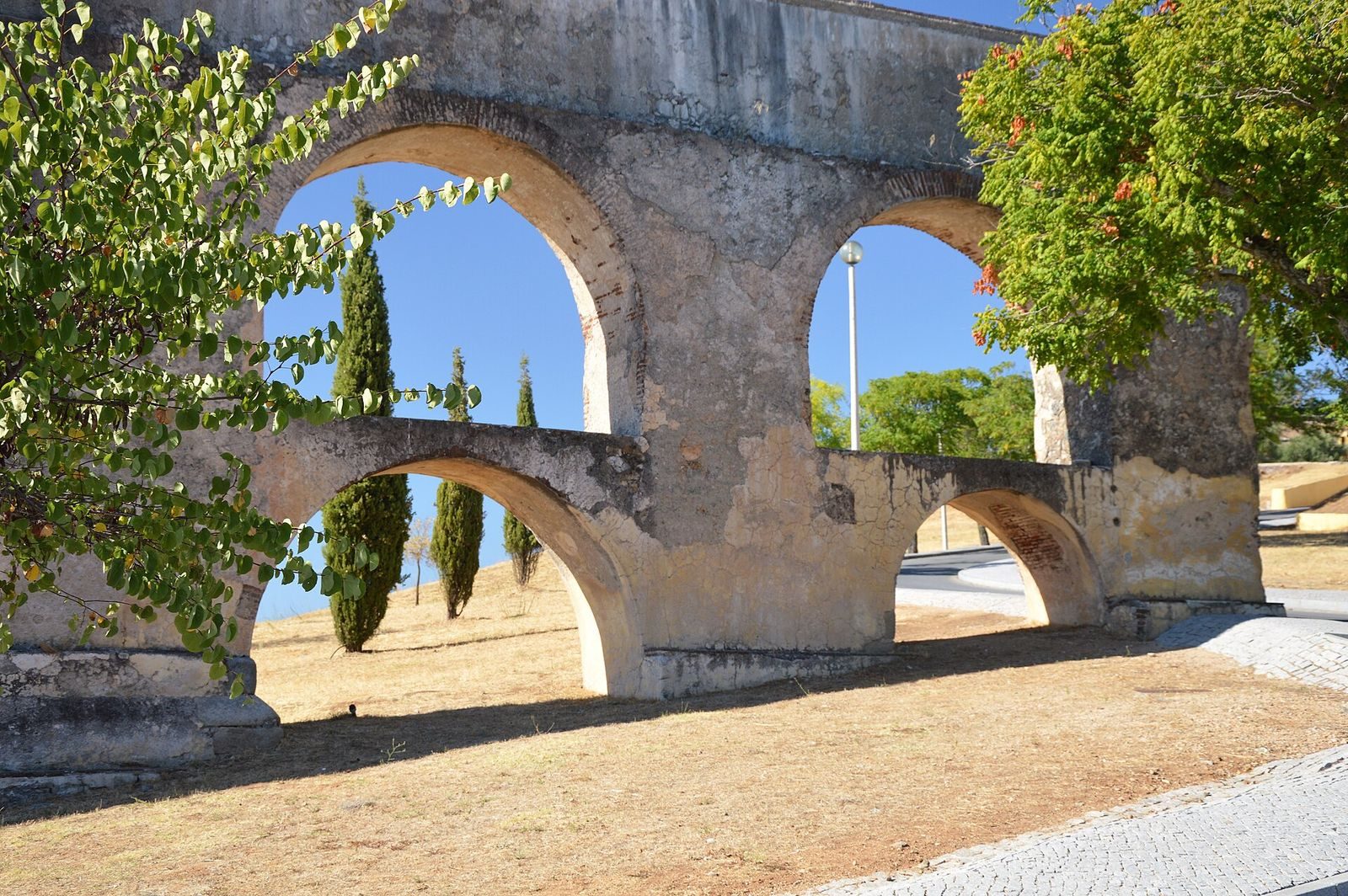
The elevated section contains 833 arches, rising in some places through as many as four tiers. The upper arches become smaller, and the rows rest on square or rectangular pillars. Semicircular and pyramidal buttresses, projecting supports that strengthen a wall, reinforce the structure. Its maximum height is about 31 m. The aqueduct bridge is regarded as the largest on the Iberian Peninsula.
Water distribution and associated structures
Town fountain and cistern
The aqueduct’s route ends at the Fonte da Misericórdia. Beneath Elvas, a vaulted cistern built in 1650 connects to the aqueduct by an underground conduit. It can hold 2,300 m³ of water and was designed to supply the population and garrison for four months during a siege. Its construction was intended to withstand bombardment.
Springs, reservoirs, and tanks
A reservoir stands at Horta de Trinta-Alferes. Other associated structures include a rounded arch in the São Gonçalo downtown area, an arch at Herdade da Serra do Bispo, and an arch and tank at the Borracha spring.
Decorative features
Municipal coats of arms on the aqueduct are made of marble or painted ceramic tiles. The tilework was installed in 1864, with further examples added in 1873.