Convent of San Giuliano: A Franciscan Complex in L’Aquila
Site at a Glance
- Country
- Italy
- Primary era
- Medieval
- Eras represented
- Medieval, Early Modern
- Civilizations
- Kingdom of Naples, Spanish
- Site type
- Religious
- Remains
- Monastery
On this page14 sections
History
The Convent of San Giuliano is a Franciscan religious complex northwest of L’Aquila, Italy. Founded by the Franciscan Giovanni Vici da Stroncone, it is a Roman Catholic institution of the Roman rite within the Archdiocese of Aquila. Construction began in the 14th century, and the convent was completed and consecrated in 1415. Its buildings bring together Renaissance and Baroque features, and it became one of the Franciscans’ earliest establishments.
Franciscan foundation and development
The convent’s community was associated with the Franciscan preachers and saints Giovanni da Capestrano and Bernardino da Siena. In 1452 it hosted the General Chapter of the Cismontane Observance, a reform movement within the Franciscan order. The group had previously met at the church of San Francesco in Piazza Palazzo, inside L’Aquila’s walls.
Until 1592, the convent served as a seat of the Friars Minor. That year it became a major church of the Friars Conventual. The Friars Minor and Friars Conventual are branches of the Franciscan order.
Disruption and return to religious use
French forces arrived in 1798 and looted the convent. They also desecrated the sacred remains of Blessed Vincenzo dell’Aquila, which were later reassembled. In the first half of the 19th century, Gioacchino Murat, a French military commander and king of Naples during the Napoleonic era, removed the convent from its religious function. The order reacquired it in 1875, and it was declared a national monument in 1902.
Restoration and later uses
Extensive restoration in 1960 removed Baroque additions from the exterior. The work also demolished a small, nearly collapsed building attached to the church; its portico dated to 1712. The convent’s position on a rocky spur helped it escape damage in the 2009 earthquake.
A city library opened at the convent in 2008. A natural-sciences museum developed there in the late 2000s as a project of the Domenico Cotugno High School, intended to introduce the natural environments of Abruzzo.
Remains
Setting and layout
The complex stands outside L’Aquila’s city walls, beside the district of San Giuliano. Its principal elements are the church, an outer cloister, meaning a covered courtyard, and a small hermitage-like building attached to the church. The convent marks the beginning of a broad mountainous landscape of woodland and meadows extending toward San Vittorino, Arischia, Collebrincioni, Aragno, Tempera, Camarda, and Assergi. The surrounding area includes the San Giuliano pinewood and numerous trails. The church of Madonna Fore stands slightly higher up, while a forest fire in 2007 devastated much of the pinewood.
Church and attached building
Church exterior
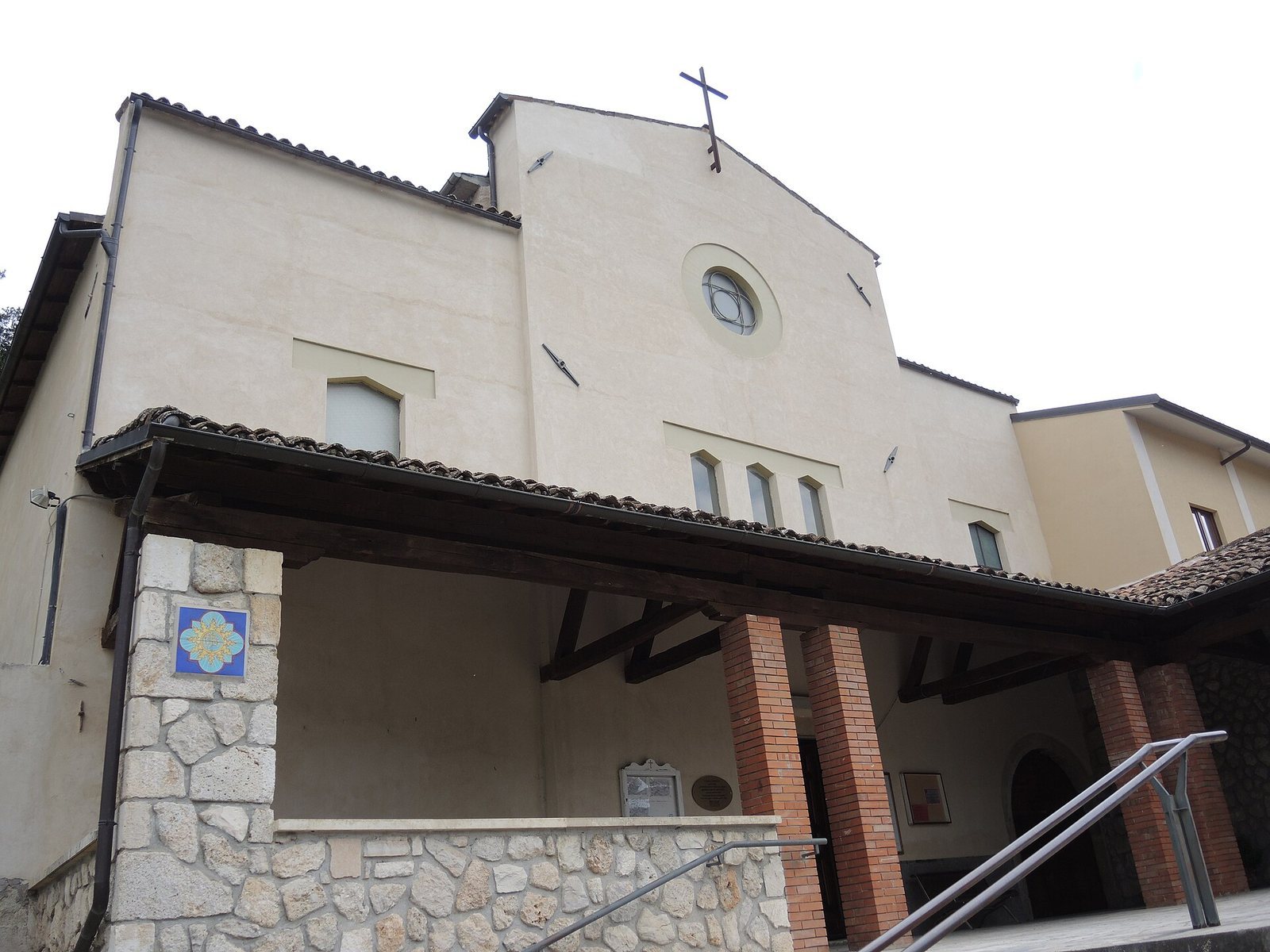
The church has a restrained, gabled façade with a covered porch above the main doorway, a central circular window, and a small bell structure on the left. A modest dome rises above the church’s crosswise section.
Attached hermitage-like building
The small building attached to the church may be the convent’s original structure. Its portal and two tall, narrow Gothic side windows have led to its attribution to the 13th century. The stone façade has a gabled form and a bell-bearing wall structure.
Church interior
The interior has a single rectangular nave, the church’s main hall, with Baroque stucco decoration and chapels. On the left, the chapel of Blessed Vincenzo was created by the Renaissance painter and sculptor Saturnino Gatti in the 15th century; nearby is the chapel of the Holy Crucifix. Between them stands a Baroque tomb for Vincenzo dell’Aquila, commissioned by Gaspar Salgado Gayoso, bishop of Aquila in the 17th century.
Two large 18th-century paintings by Vincenzo Damini hang on the right: Giovanni da Capestrano at Belgrade and San Diego D’Alcalà. The main altar has a canopy in a style associated with the Baroque artist Gian Lorenzo Bernini, an Assumption painting, and other 18th-century works by Damini, including an Adoration of the Magi.
Outer cloister
The outer cloister retains its original form. Its covered walkways have arches supported by buttresses and closely spaced round-arched windows. Eighteen semicircular wall panels show episodes from Giovanni da Capestrano’s life. The vaulted ceilings of the portico bear 17th-century wall paintings by Giovanni Paolo Cardone.
Library and museum collections
Library
The convent library holds more than 4,500 old volumes.
Natural-sciences museum
The museum has extensive displays on the local flora and fauna of the L’Aquila area. Its collection also includes a cast of a victim from Pompeii, associated with the eruption that destroyed the city.