Independence National Historical Park: A District of the American Revolution and Founding Era
Site at a Glance
- Country
- United States
- Primary era
- Early Modern
- Eras represented
- Early Modern, Modern
- Civilizations
- Unclassified
- Site type
- Civic
- Remains
- Park
On this page23 sections
History
Independence National Historical Park is a federally protected historic district in Philadelphia, United States, preserving places associated with the American Revolution and the founding of the nation. Congress authorized the park on June 28, 1948, and it was formally established and opened to the public on July 4, 1956. The district entered the National Register of Historic Places and became a National Historic Landmark District in 1966, recognitions of its historical importance at the federal level. Independence Hall received UNESCO World Heritage status in 1979, a designation for places considered important to humanity as a whole.
The Continental Congresses and independence
Carpenters’ Hall hosted the First Continental Congress from September 5 to October 26, 1774. The Congress was an assembly of delegates from Britain’s North American colonies, convened in response to measures imposed on Boston after the Boston Tea Party. Twelve colonies sent delegates; Georgia did not. The delegates organized a colonial boycott of British goods, effective December 1, and called for another congress.
The Second Continental Congress met at the Pennsylvania State House, now Independence Hall, beginning on May 10, 1775, after the battles of Lexington and Concord. In July, it adopted the Olive Branch Petition, a final major appeal for reconciliation that affirmed loyalty to Britain and asked King George III to prevent further conflict. The king rejected the appeal in August and declared the colonies in rebellion. In February 1776, Congress received news of the Prohibitory Act, which blockaded American ports and treated American ships as enemy vessels. Congress could not yet declare independence because each colony first had to authorize its delegates to vote for it.
On June 11, 1776, Congress appointed John Adams, Benjamin Franklin, Thomas Jefferson, Robert R. Livingston, and Roger Sherman to prepare a declaration. Congress unanimously adopted the final Declaration of Independence on July 4, establishing the United States. The Liberty Bell is believed to have been among the bells rung when the Declaration was read publicly on July 8.
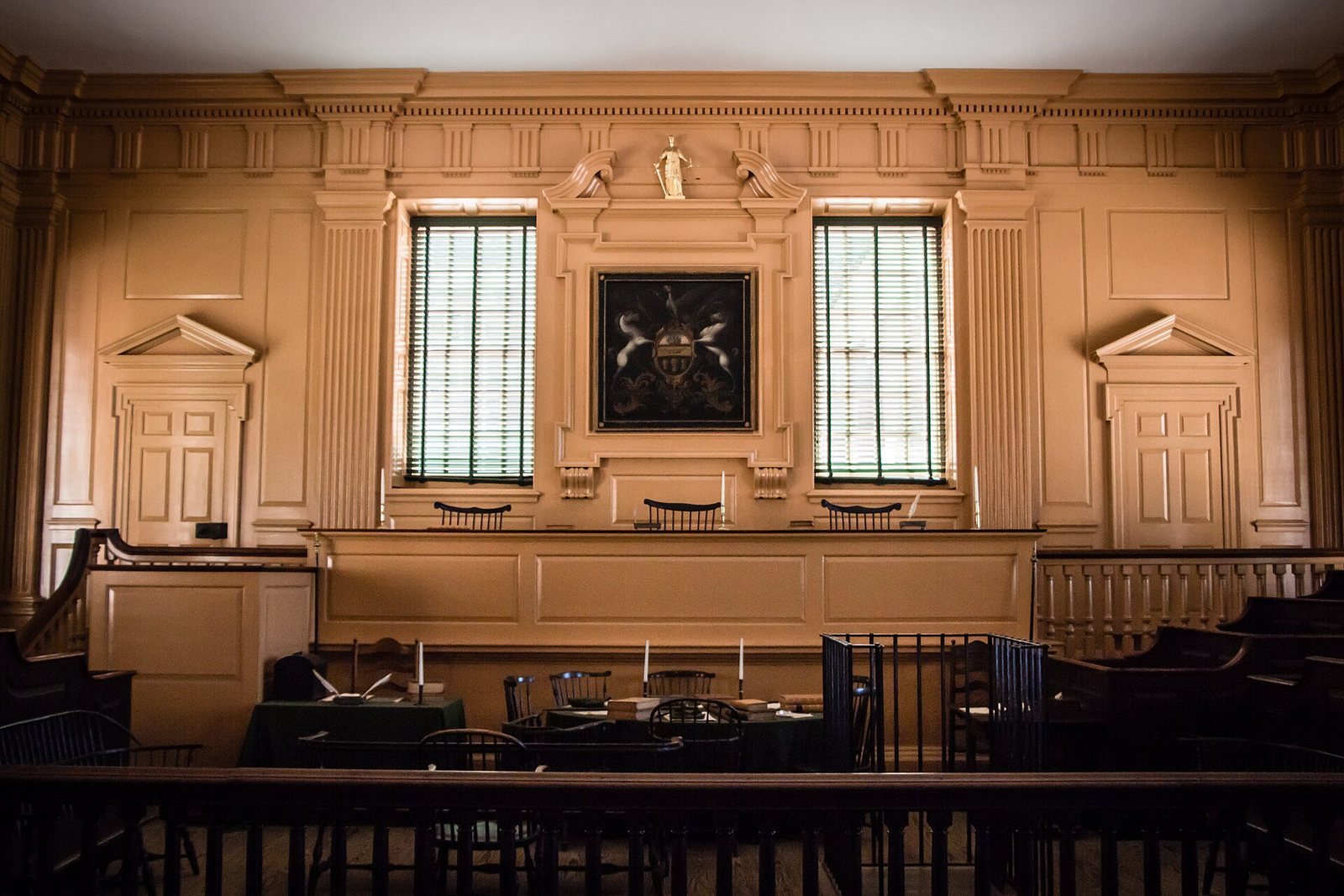
Independence Hall served as the Second Continental Congress’s principal meeting place from 1775 to 1783. It also hosted the Constitutional Convention from May 14 to September 17, 1787. Delegates had been called to address trade and the structure of government under the Articles of Confederation, the country’s first framework for national government. James Madison presented the Virginia Plan, and William Paterson put forward the New Jersey Plan. Roger Sherman combined elements of the competing proposals in the Connecticut Compromise, which set out a solution to a major dispute over representation in Congress. Delegates adopted it on July 16 by seven votes to six. Disagreements over slavery and federal authority to regulate commerce prompted further compromises.
Philadelphia as the federal capital, 1790–1800
The Residence Act of 1790 allowed President George Washington to select a permanent capital along the Potomac River. Robert Morris persuaded Congress to make Philadelphia the temporary federal capital while the permanent one was being developed. From December 6, 1790, to May 14, 1800, the same block accommodated federal, state, county, and city government offices. Congress met in Congress Hall, originally built as the Philadelphia County Courthouse. During Philadelphia’s years as capital, Vermont, Kentucky, and Tennessee joined the Union, the Bill of Rights was ratified, and Washington’s second inauguration and John Adams’s inauguration took place.
The President’s House was Washington’s official residence and principal workplace during his two presidential terms. Adams lived there from March 1797 until May 1800. The Fugitive Slave Act of 1793 and the Alien and Sedition Acts were signed at the house. The Supreme Court met in Old City Hall, where Chief Justices John Jay, John Rutledge, and Oliver Ellsworth presided over eleven cases.
Pennsylvania delegates continued opposing the plan for a permanent capital on the Potomac. Philadelphia began building a large presidential palace on Ninth Street and an extension to Congress Hall, but the federal government left the city for the last time on May 14, 1800.
Municipal use and preservation plans
After the federal government departed, the buildings served mainly municipal purposes. Pennsylvania’s government moved to Harrisburg in October 1812. The state had considered selling the State House and dividing its yard into lots as early as 1802, and came close to demolishing Independence Hall in 1816. Philadelphia bought the buildings as surplus state property in 1818 and used them until the city government moved to a new City Hall in the late nineteenth century.
The Liberty Bell was taken from its steeple in 1852 and placed on public display in Independence Hall’s Declaration Chamber. From 1885 to 1915, it travelled by train to seven expositions and celebrations. Philadelphia later declined further loan requests. Meanwhile, the neighborhood’s civic importance diminished as City Hall and other institutions moved west, although businesses continued to operate in the area.
In 1915, architects Albert Kelsey and D. Knickerbacker Boyd proposed clearing half a block in front of Independence Hall. They sought to create an appropriate setting, reduce fire risk and congestion, and improve the district. Support for a park grew during the 1920s and 1930s, including during the 1926 American Sesquicentennial, which marked 150 years since the Declaration of Independence. The start of World War II added urgency to efforts to protect national monuments. The Historic Sites Act of 1935 helped establish a basis for a park, and in 1937 architect Roy F. Larson developed an Independence Mall concept extending five blocks from Chestnut to Callowhill Streets and incorporating approaches to the Benjamin Franklin Bridge.
In 1947, Judge Edwin O. Lewis of the Independence Hall Association urged the federal government to buy three blocks north of Independence Hall. When the National Park Service focused on the first block, Lewis took the wider proposal to the Pennsylvania General Assembly. The legislature created a state park intended to honor Pennsylvanians who died in World War II, an aim that was never fully realized. Pennsylvania and Philadelphia developed Independence Mall State Park during the 1950s, using state bonds and oversight from city planner Edmund Bacon.
Expansion and changing interpretation
The park’s boundaries were redefined in 1972 as Independence Mall was donated to the National Park Service. Ownership and operation of the entire Mall passed to the Service in 1974. The park had incorporated the Old Philadelphia Customs House, identified with the Second Bank of the United States, in 1959; the building had received National Historic Site status in 1939. A National Historic Site is a National Park Service designation for a place of historical importance.
In preparation for the 1976 Bicentennial, planners sought a new location for the Liberty Bell because Independence Hall could not accommodate the anticipated crowds. Proposals for sites at South Third and Chestnut Streets in 1972 and between Race and Arch Streets in 1973 met with opposition. Mayor Frank Rizzo suggested a location immediately north of Independence Hall. Romaldo Giurgola designed a glass-and-steel pavilion there in 1974; construction began in early 1975, and the pavilion was completed that year. The bell moved there during New Year celebrations and remained until October 9, 2003.
The National Park Service announced a redesign of the Mall in 1997. The Liberty Bell moved into the Liberty Bell Center in October 2003, and the earlier pavilion was demolished in 2006. The Service maintains the park’s buildings, archaeological sites, cultural landscapes, and approximately 1.5 million artifacts through its cultural-resource program. It also administers the Benjamin Franklin National Memorial, Edgar Allan Poe National Historic Site, Gloria Dei (Old Swedes’) Church National Historic Site, and Thaddeus Kosciuszko National Memorial.
A memorial at Sixth and Market Streets marks the former President’s House and commemorates the enslaved people who worked there. In 2026, signs commemorating them were removed under an executive order issued during the second Trump administration.
Remains
The park covers approximately 55.42 acres (22.43 hectares). Its historic buildings are concentrated around four landscaped blocks between Chestnut, Walnut, Second, and Sixth Streets. Independence Mall forms a separate three-block area directly north of Independence Hall, bounded by Chestnut, Race, Fifth, and Sixth Streets. The park’s architectural traditions include Colonial, Georgian, and Federal styles, drawing respectively on European building traditions, eighteenth-century British design, and early American neoclassical influences.
Buildings around Independence Hall
Independence Hall
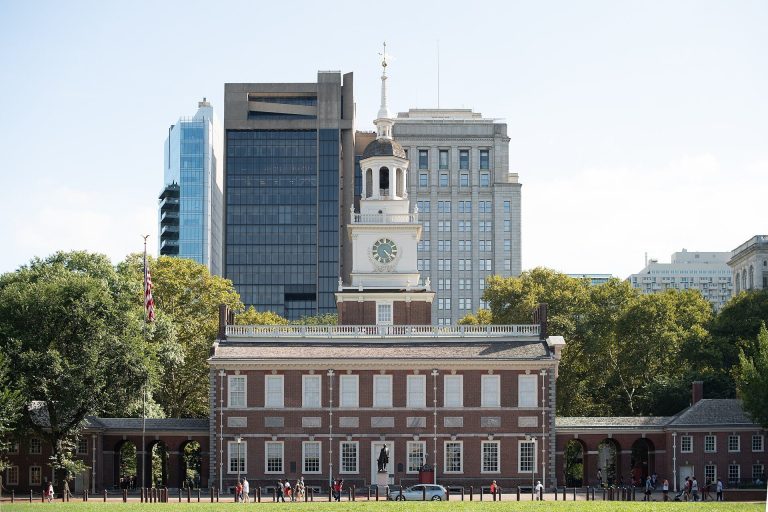
Independence Hall is the park’s central landmark. Its historic role as a meeting place for the Continental Congresses and the Constitutional Convention connects the building to the debates and decisions that produced the Declaration of Independence and the Constitution.
Carpenters’ Hall
Carpenters’ Hall stands two city blocks east of Independence Hall. Its principal historical association is the First Continental Congress, which met there in 1774.
Congress Hall
Congress Hall stands west of Independence Hall and is a two-story building. The House of Representatives met on its first floor, while the Senate met on the second. The building was originally constructed as the Philadelphia County Courthouse.
Old City Hall
Old City Hall stands east of Independence Hall. It housed the Supreme Court during Philadelphia’s period as the federal capital. Together, Old City Hall and Congress Hall stand south of Independence Mall, on either side of Independence Hall.
Other historic buildings and collections
The First Bank of the United States
The park includes the First Bank of the United States, the first bank chartered by the U.S. Congress.
The Second Bank of the United States
The Second Bank of the United States is also identified as the Old Philadelphia Customs House. A customs house is a government office responsible for administering duties on imported goods.
City Tavern
City Tavern is a recreated colonial tavern within the park.
Franklin Court
Franklin Court occupies the site of Benjamin Franklin’s former home. The complex includes a Franklin museum and the United States Postal Service Museum. Franklin was a printer, diplomat, and political leader who also served as the revolutionary government’s first postmaster general, the official responsible for directing postal services.
The Syng inkstand
The park’s collection includes the Syng inkstand, which was used during the signing of both the Declaration of Independence and the Constitution.
Independence Mall
Landscaped blocks and design plans
The first block of Independence Mall was completed in 1954 to a design by the Philadelphia landscape architecture firm Wheelwright, Stevenson and Langren. Its plan included a central lawn, terraces, walkways, and a formal tree-lined avenue. A proposed plan for the next block called for a central fountain, a square reflecting pool, terraces, and two brick arcades.
Dan Kiley designed the northernmost block in 1963 around a layout based on Philadelphia’s original plan of five squares. Fountains were intended to represent those squares at a scale drawn from a Center City map. The brick-paved plaza was planted with 700 honey locust trees, set 12 feet 6 inches by 18 feet apart. Many were later removed after the dense planting and urban conditions caused the scheme to fail. The 1997 redesign proposed placing buildings along Sixth Street and smaller landscaped areas, some raised above the central lawn, along Fifth Street. Its plan also included trees, straight brick paths through the lawn areas, and two cross-paths in the southern block corresponding to Ranstead and Ludlow Streets.
Free Quaker Meetinghouse
The Free Quaker Meetinghouse stands at Fifth and Arch Streets on the middle block. Before restoration for the Mall project, it had been used as a plumbing-supplies warehouse. In 1961, the building was moved 38 feet west and 8 feet south to make room for the widening of Fifth Street. Quakers are members of the Religious Society of Friends, a Christian tradition emphasizing spiritual equality and worship.
President’s House memorial
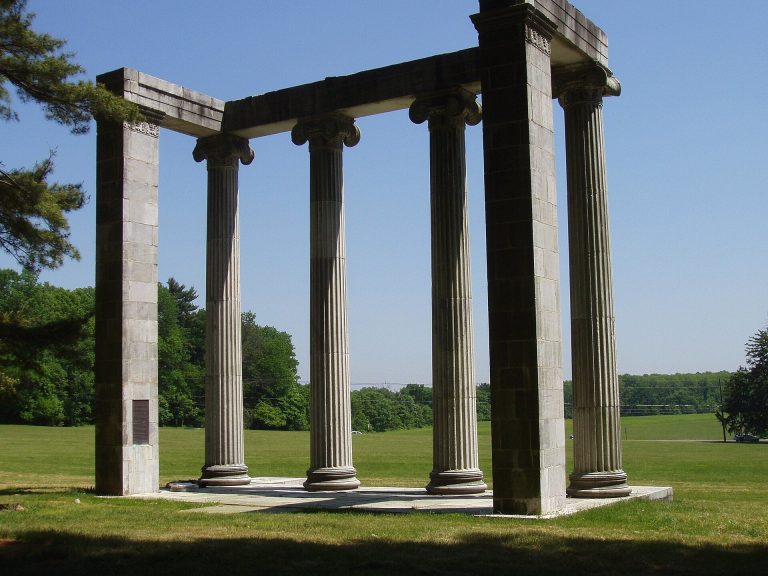
The memorial at Sixth and Market Streets marks the former President’s House site on the southern block. Foundations can be seen below ground, and surviving walls of the house were affected by development of the Mall.
Liberty Bell Center and former pavilion
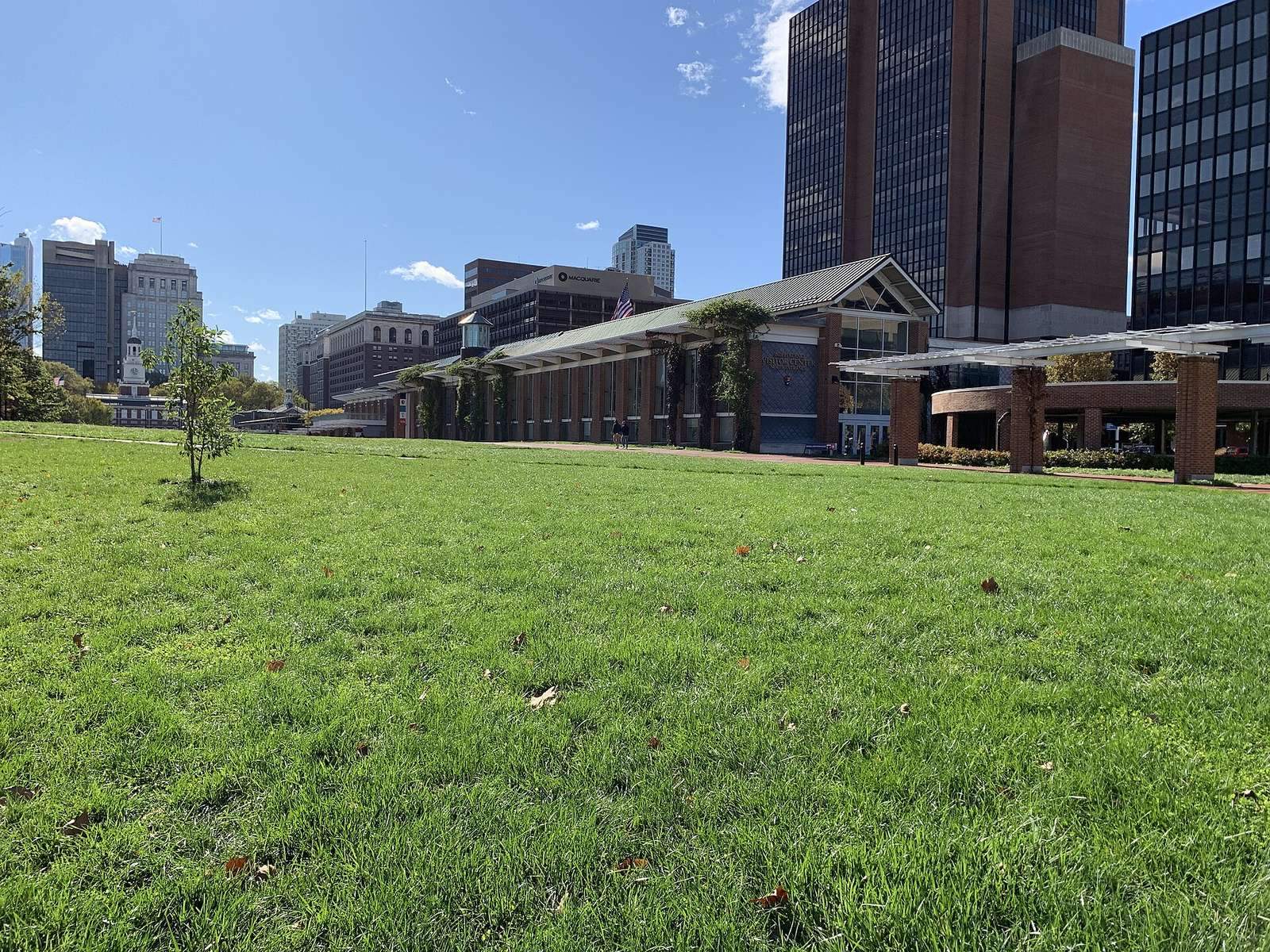
The Liberty Bell Center stands north of Independence Hall on the southern block of the Mall. The First Amendment Area, also called People’s Plaza, is located on this block. The First Amendment protects freedoms of religion, speech, press, peaceful assembly, and petition. The former Liberty Bell Pavilion was a glass-and-steel structure designed by Romaldo Giurgola. Completed in 1975, it housed the bell until 2003 and was demolished in 2006.
National Constitution Center
The National Constitution Center occupies the northern block of Independence Mall, completing the arrangement of major buildings and spaces across the three blocks.