Asklanda Church: A Medieval Parish Church in Sweden
Site at a Glance
- Country
- Sweden
- Primary era
- Medieval
- Eras represented
- Medieval, Early Modern, Modern
- Civilizations
- Swedish
- Site type
- Religious
- Remains
- Church
On this page9 sections
History
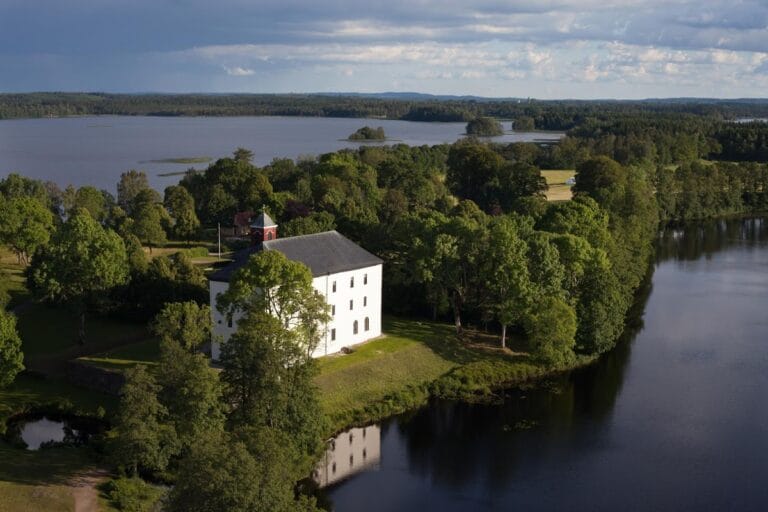
Asklanda Church stands in Asklanda, in Vårgårda Municipality, Sweden. It is thought to have been built in the second half of the 12th century, probably at the initiative of an ambitious local magnate, and was consecrated during that century. The church belongs to Asklanda Parish, a local church community, in the Diocese of Skara, an ecclesiastical jurisdiction, and the Church of Sweden, a Lutheran church.
Restoration and later changes
A major restoration in 1897–1898, led by Swedish architect Adrian C. Peterson, added the church tower. The interior has also undergone alterations on several occasions.
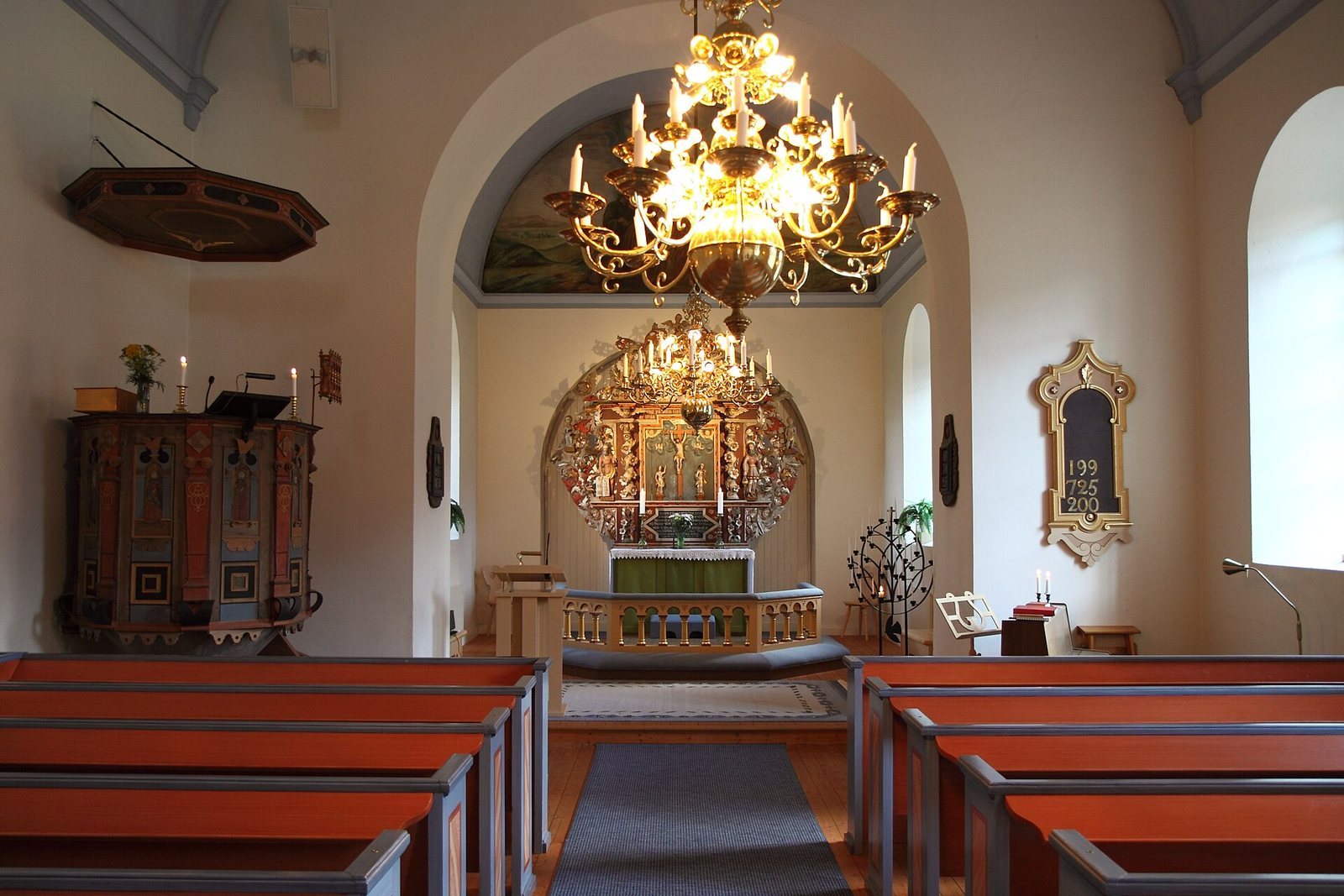
The church’s Renaissance-style pulpit, reflecting a European artistic tradition that preceded the Baroque, dates from the second half of the 17th century. It was replaced in 1898 by a new pulpit considered more stylistically suitable, but the earlier one returned to the church in 1941. In 1960, an organ took the place of an earlier harmonium, a keyboard instrument that produces sound with air-driven reeds.
Remains
Plan and exterior
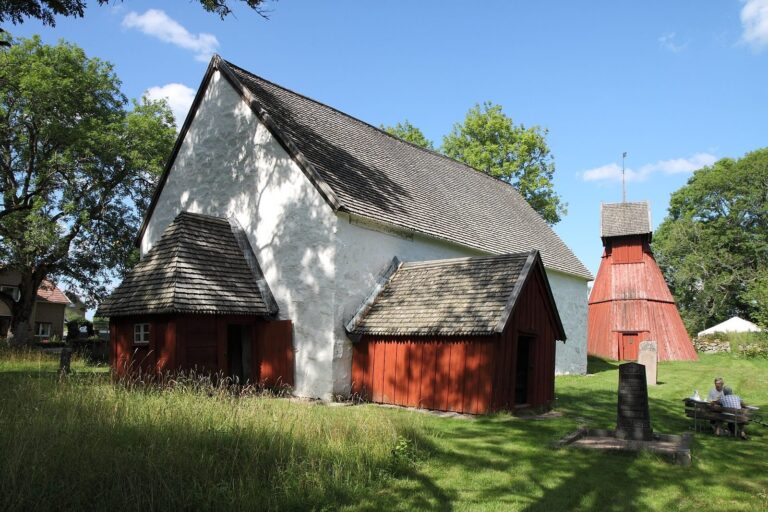
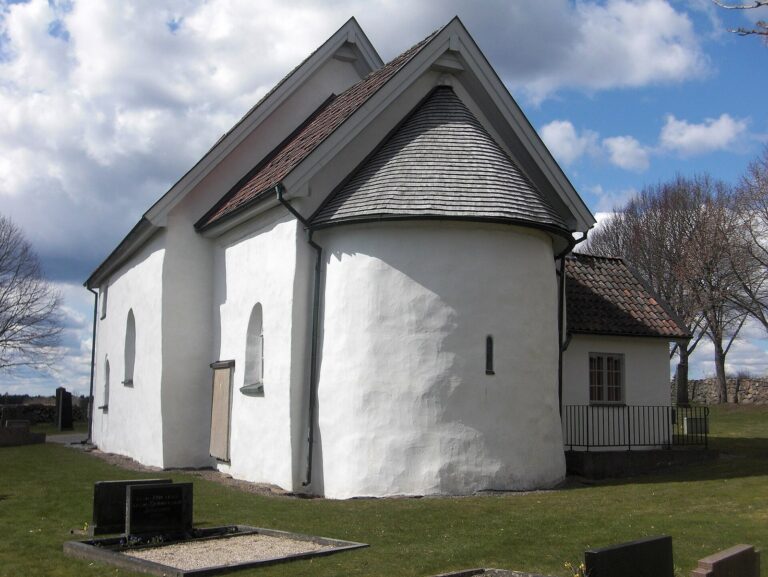
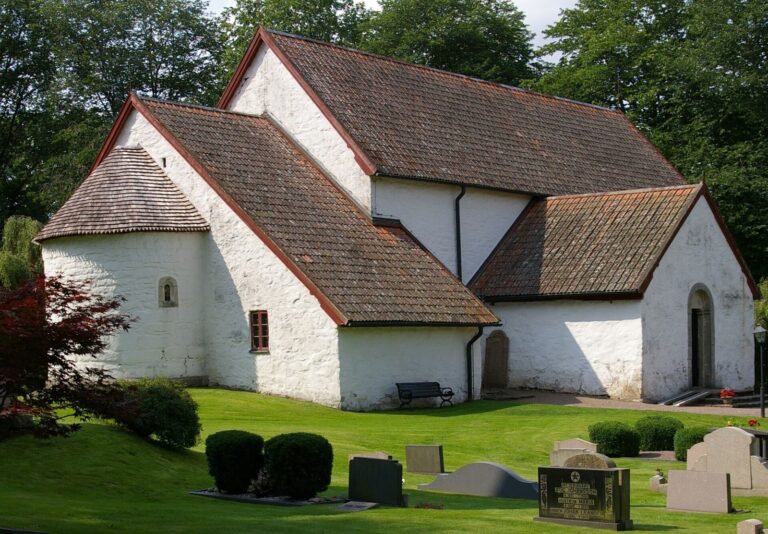
The church is built of ashlar masonry, made from regularly cut sandstone blocks. Its plan has a nave (the main body of the church), a narrower, straight chancel (the area around the altar) at the east end, and a tower at the west. A rounded apse (a projecting space) extends east of the chancel and contains the sacristy, a room for liturgical items and vestments. The nave and chancel have steep gabled roofs covered with single-curved clay tiles. Black seamed sheet metal covers the apse roof, while the tower has a pyramidal roof of seamed copper.
The tower is constructed from locally quarried red granite blocks. The nave’s north wall preserves a medieval blank-wall arrangement, an unusual feature. The tower holds the church’s only bell, a standard type from the late medieval period.
Interior furnishings and fittings
Baptismal font and basin
The well-preserved sandstone baptismal font, made around 1200, stands 78 centimetres high and consists of two pieces. Its cylindrical bowl has a bulging underside and decorative bands at the top and bottom. The round base narrows toward its upper end and has a prominent rope-shaped molding; a drainage channel passes through the centre. The associated brass basin was made in Magdeburg in 1688 and probably came to the church as war booty from Germany. Its inscription reads, “Eat and drink in the Lord’s name.”
Altarpiece
Made in 1715 by the sculptor Michael Schmidt, the Baroque altarpiece belongs to a European style known for dramatic compositions and elaborate ornament. It centres on a painting of Christ on the cross, with Moses and Aaron at the sides and acanthus foliage, a decorative leaf motif, framing the work.
Pulpit
The church retains its Renaissance-style pulpit, with its raised platform serving as a place from which a preacher addresses the congregation.
Organ
Made by Tostareds Kyrkorgelfabrik, the organ is positioned on the west gallery. Its six stops, each selecting a set of pipes, are divided between a hand-played manual keyboard and a foot-operated pedal keyboard. The pipes visible in the organ’s front produce sound.