Derfflinger Hügel: A Multi-period Burial Mound in Germany
Site at a Glance
- Popularity
- Very Low
- Country
- Germany
- Primary era
- Bronze Age
- Eras represented
- Stone Age, Bronze Age, Medieval
- Civilizations
- Merovingian
- Site type
- Burial
- Remains
- Burial Mound
On this page19 sections
History
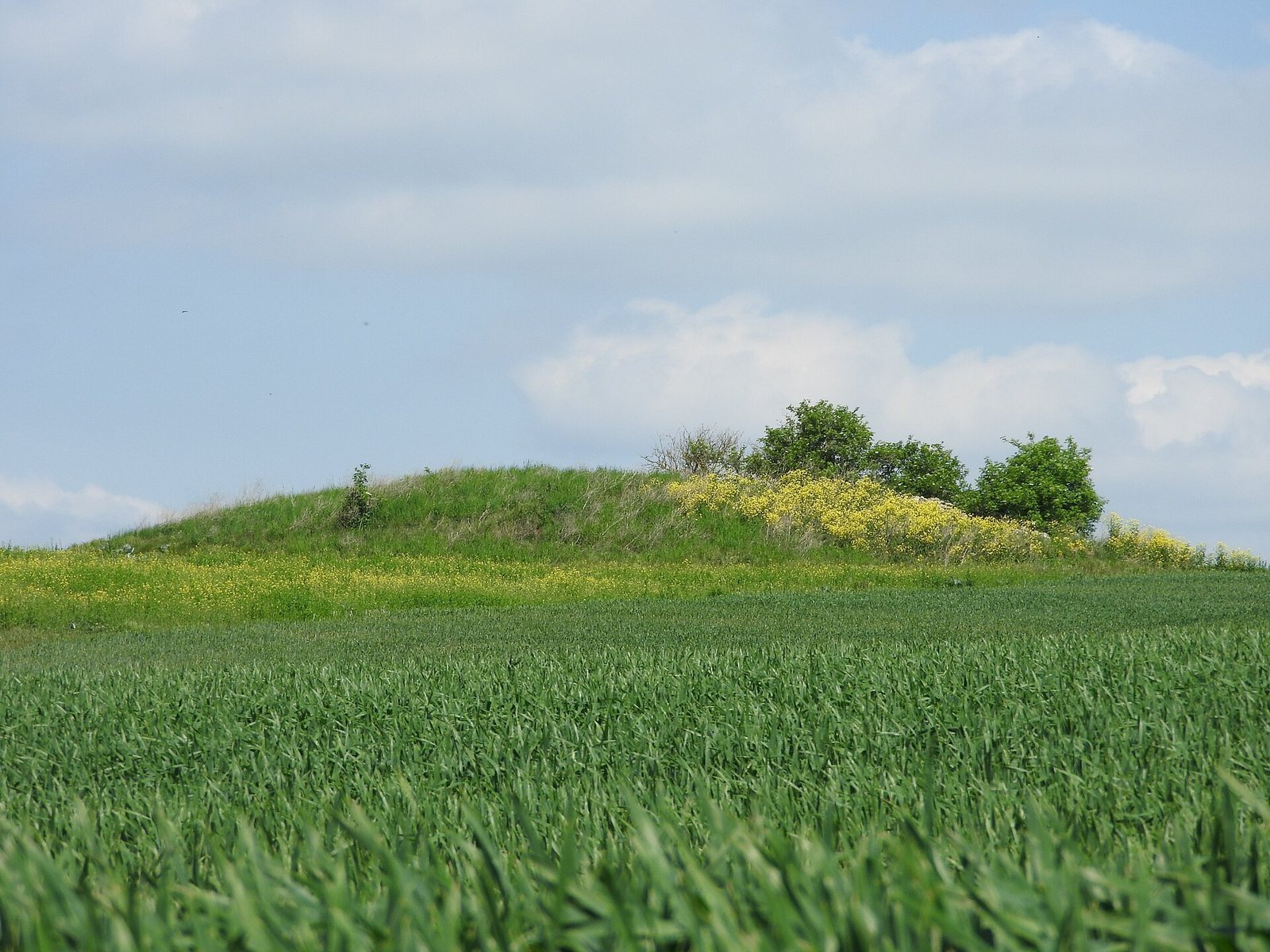
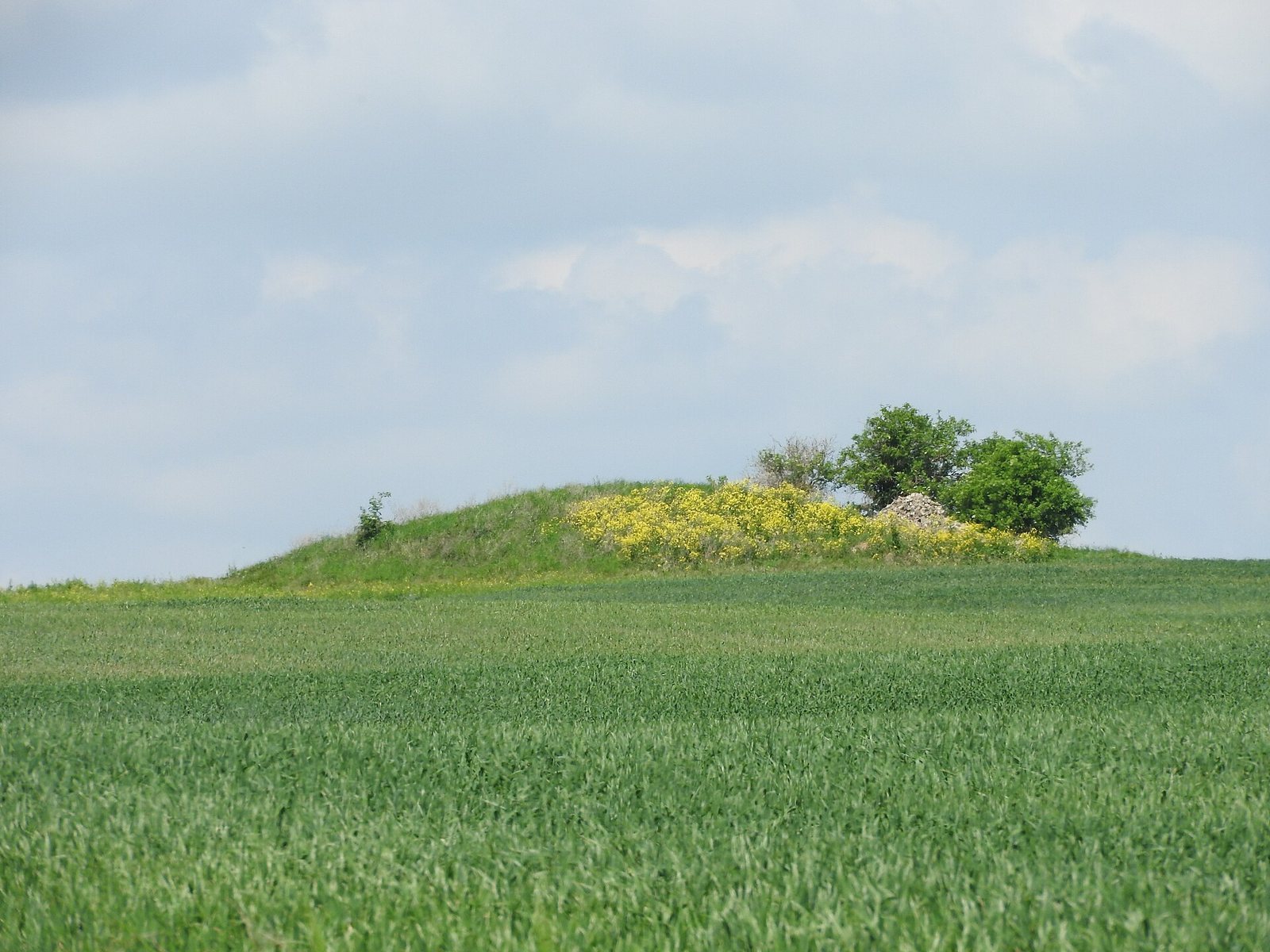
Derfflinger Hügel is a multi-period burial mound 1.7 km southeast of Kalbsrieth in Germany. Burial activity continued here from the Neolithic into the early Christian period, as the mound was enlarged and used by successive communities. Its archaeological phases include the Baalberg, Globular Amphora, Corded Ware and Únětice cultures, groups recognized partly through characteristic burial customs and material remains.
Prehistoric development
The oldest phase began with a natural rocky rise and a simple grave. The earliest burial cannot be dated more precisely, and another burial also remains undated. The mound grew in stages, reaching its final size during the Early Bronze Age. Later prehistoric burials include those associated with the Corded Ware culture (2800–2200 BC) and the Únětice culture (2300–1550 BC). Earlier burial activity is associated with the Baalberg culture (4200–3100 BC) and the Globular Amphora culture (3100–2700 BC).
Iron Age and early medieval burials
During the La Tène period, an Iron Age cultural period dated here from 450 BC to the beginning of the Common Era, people buried cremated remains in urns at the mound. Burial use continued in the Merovingian period, named for the early medieval Frankish ruling dynasty and lasting from the fifth century to 751. A Frankish warrior was buried there, followed by a group of graves associated with a broadly defined early Christian period. The label early Christian describes a general historical phase, not a precise date.
Excavations and local traditions
Amateur researchers investigated the mound during the nineteenth century. An excavation on its west side is known, although its date and excavator are uncertain. Reinhard, an accounting official from Buttstädt, dug on the north side without success. Oscar Förtsch of Halle and Kalbsrieth mayor Freysold also excavated there and found a black polished urn. It was taken to the State Museum of Prehistory in Halle, but Armin Möller later could not locate it there.
From July to October 1901, Möller, curator of the Weimar City Museum, carried out an extensive excavation that lasted six weeks. He published his findings in 1912. Finds from the mound are now held at the Museum of Prehistory and Early History of Thuringia in Weimar.
The mound’s name has no established origin. Möller suggested a link to Georg von Derfflinger, a Brandenburg military commander whose troops crossed Thuringia in June 1675 during the war against Sweden. Whether they passed through Kalbsrieth is unknown. Local stories warned against passing the mound at night and told of a carriage drawn by headless horses on a nearby road. Another tale placed a king in a silver coffin beneath the mound. Residents apparently took the story seriously, and an estate inspector urged Möller to dig deeper in search of it. A similar golden-coffin legend was associated with the Rössen burial mound, about 50 km to the east.
Derfflinger Hügel forms part of a wider landscape of Corded Ware burials. Huthügel, another mound built by people of that culture, lies 800 m to the north and contained Corded Ware finds as well as remains of a possible secondary burial from the Early Bronze Age. Further Corded Ware burials were found at In der Loh, 3 km east-southeast of Kalbsrieth; southeast of the village on the road toward Schönewerda; at the Rabenhüttenhügel gravel pit, 2.5 km southeast of the village; in another gravel pit between Kalbsrieth and Schönewerda; and in a gravel pit east of the road toward Artern. Isolated finds also came from several places in the municipality.
Remains
The mound occupies the highest point in the surrounding area on the left bank of the Unstrut, about 1.7 km southeast of Kalbsrieth toward Schönewerda. It stands on limestone, with gypsum beneath, and can be seen from a considerable distance. Its outline was probably once close to circular; a major enlargement to the east gave it an approximately trapezoidal shape. Möller measured 17.20 m north to south, while the mound’s earlier diameter was estimated at 28 m or more. Its original height was estimated at 4.10 m. The south and west sides remain relatively well preserved, while cultivation has heavily disturbed the north and east. Human skeletal remains and pottery sherds have been exposed during ploughing.
Early mound and stone-built features
First mound and earliest grave
The mound’s first phase incorporated a natural rocky rise and a grave cut into it. Möller estimated this early mound at no less than 12 m in diameter. Above the grave was 0.6 m of earth, followed by a layer of small sandstone and limestone slabs. This layer was about 0.2 m thick at the center and 0.1 m at the edge. A further 0.5–0.6 m of earth covered it; this material could be distinguished clearly from later mound deposits only in a small area.
The grave pit was cut into the natural rise and measured 0.6 m wide, 1.1 m long at the top and 0.98 m long at the bottom. It was 0.25–0.28 m deep. A poorly preserved person had been placed in a tightly contracted position in the pit, which contained black soil.
Dolmen
At the eastern foot of the early mound stood a small dolmen, a stone-built burial chamber, aligned east to west. Two red-sandstone side stones supported a capstone, with three sandstone slabs laid above it. A cairn of assorted fieldstones, about 0.9 m high, covered the structure and incorporated 35–40 millstone fragments. Two teeth were recovered, leaving the chamber’s use as a formal burial uncertain. Two ceramic vessels found inside were a plain four-handled amphora, 15.3 cm high and 12 cm across at its widest, and a handled bowl, 8.7 cm high with a rim 16.2 cm across.
Stone cist and forecourt
East of the dolmen was a stone cist, a small burial chamber formed from slabs. Its east–west arrangement used a sandstone floor and four sandstone wall slabs. Gypsum sealed the joints, and traces above the western wall suggest that the cist once had a capstone. Smaller slabs braced the narrow walls from the outside. An upright slab formed a forecourt against the eastern end, leaving its north and south sides open. The chamber measured 1.7 m long by 0.94 m wide.
The cist held the remains of an adult man, estimated to have been 33–40 years old, and a child about 1.5–2.5 years old. The better-preserved adult lay on his left side in a contracted position, with his head to the east and face south. His skull showed a healed injury from a blow. Four vessels were placed near his forehead: a decorated and a plain globular amphora, and two decorated four-handled pots. A bowl lay near his feet. Other objects included two bone needles, a bone awl, a flint axe and three boar’s teeth, at least two pierced as ornaments. Pig bones and a crane lower leg were also found among the remains.
Cup-marked stone
A lignite-quartzite stone lay between the dolmen’s cairn and the cist. Measuring 46 by 41 by 18 cm, it had five cup-shaped hollows on its upper surface.
Stone pavements
Two oval stone pavements lay near the cist, one to the north and one to the south. The southern pavement stood 0.7 m from the chamber and 0.6 m above the natural ground. It measured 1.1 m east to west and 1 m north to south. Nine irregular yellow and red sandstone slabs surrounded a central stone 60 cm across. Discoloration of that stone, together with ash and charcoal, indicates that the pavement served as a hearth.
The northern pavement was 0.5 m from the cist and slightly basin-shaped. It measured 1.55 m north to south and somewhat more across the other direction. Small red-sandstone slabs formed its surface, with upright slabs along the north edge and sandy clay filling the joints. Discoloration, ash and charcoal also point to use as a hearth. Bone fragments, including cattle bone, and pottery sherds were recovered there.
Later prehistoric burials
Corded Ware graves
Three Corded Ware burials lay in a roughly north–south line at the southeastern edge of the early mound. They were 0.6 m apart and occupied different levels in relation to the mound’s stone layer. The southern grave lay below it, the middle grave cut through it, and the northern grave was above it. Each person had been placed on the right side in a contracted position, with the head to the west and face toward the south. The southern individual had a healed right-shin fracture, unusual growths on the foot bones and heavily worn teeth.
The middle burial included a cord-decorated beaker and an axe behind the skull. The beaker was 18.2 cm high, with spiral cord decoration running from its rim to about 7.3 cm above the base; the grey-black serpentine axe measured 11.4 by 5 by 4.8 cm. A flint axe measuring 8.2 by 4.7 by 1.7 cm lay in front of the northern individual’s hips. The southern grave had no goods recorded. The burials’ sex was not established, although their posture and orientation are characteristic of male Corded Ware burials.
Únětice tree-trunk coffin
Near the center of the mound was an east–west tree-trunk coffin, a hollowed trunk used as a burial container. It lay about 1.3 m north of the mound’s east–west axis, at a depth of 1.2–1.3 m. The coffin measured 3.9 m long, 0.65 m wide and 0.55–0.6 m high, with walls 8–10 cm thick. A later burial damaged its south side. The skeleton was poorly preserved and further damaged during excavation; the head was at the west end, and identifiable remains included a rib, part of a collarbone, the damaged pelvis and the thigh bones.
Five objects were associated with the coffin: a 3.9 cm bronze or copper fishhook, a faceted hammer axe of blue-green siliceous slate, a typical Únětice cup, a bowl with a knob handle and a miniature urn. The miniature urn was 4.2 cm high and 4.6 cm across at its widest. The bowl’s association with the burial is uncertain because it lay between the lower legs where the coffin floor had not survived.
La Tène cremation burials
Four La Tène-period urn burials lay on the eastern side of the enlarged mound, at depths of 0.6–1 m. One was at the northeastern edge, two at the eastern edge just north of the east–west axis, and one at the mound’s northeastern foot, slightly beyond the surviving fill. Later Christian burials disturbed all four. Cremated remains were judged to be adult; associated finds included an unidentified iron fragment, possibly from a brooch, and a bronze bowl-shaped earring.
Merovingian and early Christian burials
Frankish warrior grave
A rectangular shaft grave in the northwestern part of the mound extended from the surface to 50–60 cm below the natural ground. It measured 2.55 m long by 1 m wide. At its bottom, a heavily decayed wooden coffin had been covered with oak planks before the shaft was filled again. The deceased lay extended on his back, with his head to the west.
An 89.6 cm-long sword lay beside his left leg, with part of its wooden scabbard preserved. A knife with traces of a wooden handle was found near the right shoulder, an iron spearhead at the feet, and a shield on the right side. The shield’s raised central fitting and grip survived. A five-piece bone comb, 20 cm long, lay by the head. Two ceramic vessels, a biconical pot and a bowl, stood outside the coffin at its foot end.
Early Christian row graves
The mound contained 91 early Christian graves, placed just below the surface and concentrated particularly around the center. Rows extended for 5 m on the west and 7 m on the east. Burial depths varied with the surviving mound height: graves on the east were 25–30 cm deep, while those near the center were about 50 cm deep, against an estimated original depth of 70 cm. Simple wooden coffins were spaced about 1.5 m apart on average. Most were aligned east to west; some had stone slabs along parts of their sides.
Coffins ranged from 1.2 m long for children to 1.9 m, and were 0.45–0.55 m wide. The dead were generally laid on their backs with their heads to the west. Most were buried singly, although three graves included a child and one coffin held two adults. All age groups were represented, including adolescents in about a quarter of the burials. Four graves yielded objects, including two iron knives, remains of a square buckle and an unidentified iron item.
Burial of uncertain date
On the western slope, an adult and a child were buried beside a loose sandstone pavement with traces of burning. The adult’s surviving lower vertebrae, pelvis and legs formed an unusually wide, bent position; the child’s surviving pelvis and legs lay extended across the adult’s right leg. Irregular sandstone pieces and limestone slabs were found about 0.5 m below the surface, with the pavement roughly 30 cm lower. Eight pottery sherds, probably from three vessels, accompanied the burials. The pottery is later than the Neolithic but does not establish a more precise date.