Hypogeum of Ħal Saflieni: A Neolithic Sanctuary and Burial Complex
Site at a Glance
- Popularity
- Very High
- Country
- Malta
- Primary era
- Stone Age
- Eras represented
- Stone Age
- Civilizations
- Maltese Temple Culture
- Site type
- Burial
- Remains
- Catacomb
On this page15 sections
History
The Hypogeum of Ħal Saflieni is an underground sanctuary and burial ground in Malta, used by Neolithic communities, people of the later Stone Age associated with farming and settled life. Use may have begun around 4000 BC or earlier, while the main Saflieni phase, a period of Maltese prehistory, dates to about 3300–3000 BC. The complex was probably abandoned around 2500 BC, and its upper burial chambers belong to an earlier phase than the middle and lower levels.
Neolithic use
The Hypogeum served both religious and burial purposes. The remains of about 7,000 people were eventually estimated within the complex. Maria Gimbutas interpreted the shared burials as showing no clear social hierarchy and suggested that some bodies may have been exposed before their bones were gathered into communal chambers. She also read animal remains as possible evidence of seasonal offerings to a female deity associated with fertility.
Excavations indicate that a shrine once stood on the surface near the entrance. Its later destruction may have helped conceal the underground rooms for thousands of years. The site’s purpose has also prompted differing interpretations. Themistocles Zammit proposed that it might have served as an oracle, a place believed to provide divine guidance, and attracted pilgrims from around the Mediterranean.
Discovery and excavation
Building work above the complex broke through its roof, bringing the discovery to the attention of museum authorities in 1902. Workers had initially concealed it, and rooms on the upper level were used for discarded soil and building debris. A coin that circulated between 1741 and 1773 suggests earlier access. A French cannonball found there may point to an entry during French rule in Malta, from 1798 to 1800.
Jesuit priest and archaeologist Manuel Magri began the first investigation in 1903. During clearance, some human bones and burial objects were discarded without proper recording, and many bones disappeared. Magri’s notes were lost after his death in Tunisia in 1907. Zammit continued excavation from 1908 to 1911, seeking to recover what remained, and estimated that the skeletal material represented about 7,000 individuals. He published reports in 1910 and 1911; finds from his work went to the National Museum of Archaeology in Valletta. The Hypogeum opened to visitors in 1908, while excavation was still in progress.
Conservation and heritage recognition
Four houses above the complex were demolished to make way for a museum. Further excavations took place from 1990 to 1993. A monitoring programme to track deterioration began in 2011, and later conservation work included environmental-management improvements and a new climate-control system. UNESCO inscribed the site on its World Heritage List in 1980 as exceptional testimony to a cultural tradition or civilization, under the official name Ħal Saflieni Prehistoric Hypogeum.
Remains
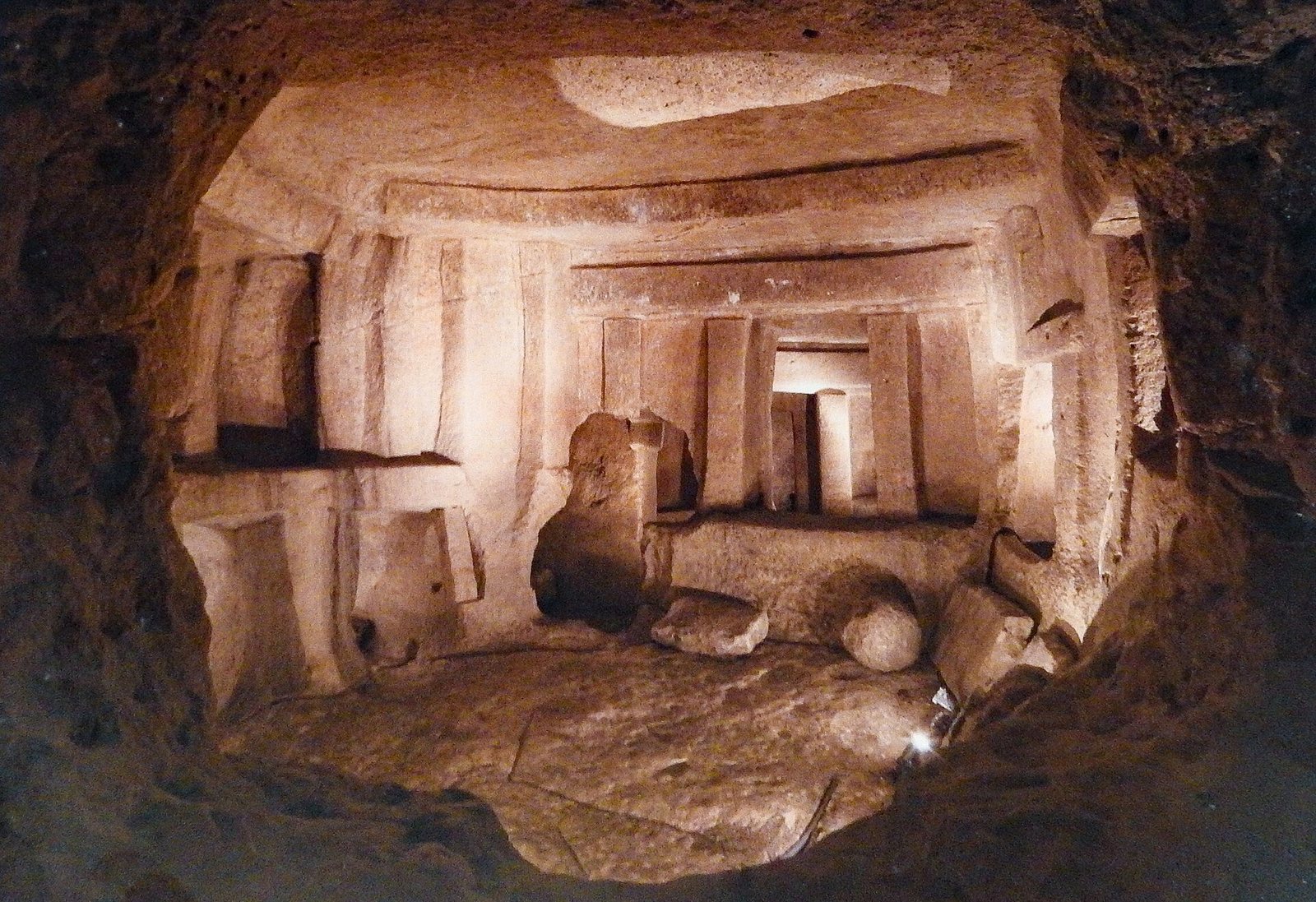
The complex covers about 500 square metres and was carved into soft globigerina limestone, a rock formed from the remains of microscopic marine organisms. Its more than 30 rooms occupy three irregular levels connected by passages, doorways, steps and lintels. The layout includes branching chambers and multiple entrances. The design may have developed by enlarging natural cavities, or the builders may have shaped the rooms entirely by removing rock and using natural irregularities as walls and ceilings. Its forms have also been interpreted as an underground translation of features found in Malta’s above-ground megalithic temples.
Levels and principal chambers
The upper level lies close to the surface and includes natural cavities enlarged by people as well as burial rooms. The middle and lower levels were excavated later. Water was present in the lowest level, which may have been used to store grain.
Main Chamber
The roughly circular Main Chamber is cut directly into the rock. Its entrances include forms like trilithons, frames of two uprights supporting a crosspiece. Some are blind, while others open into adjoining rooms. Much of the chamber’s wall surface was coated in red ochre, an earth pigment. A pit in the chamber yielded a small figurine known as the Sleeping Lady.
Oracle Room
The roughly rectangular Oracle Room is a small chamber beside other rooms. A recess in its rock wall produces strong resonance. Red-ochre spirals, scroll-shaped ornaments and circular marks decorate its ceiling, including three large disks and further disks linked by spirals. Acoustic research in 2014–2015 measured resonances at 70 and 114 hertz. A male voice tuned to those frequencies, as well as percussion, can reproduce the effect. The possibility that resonant sound intensified ritual experiences remains an interpretation.
Decorated Room
Beside the Oracle Room, the spacious Decorated Room has rounded form and smooth walls that slope inward. Geometric spiral designs cover parts of the chamber. A human hand is carved into the rock on the right-hand wall beside the entrance.
Holy of Holies
The Holy of Holies may be the complex’s central chamber. It is oriented toward the winter solstice, the shortest day of the Northern Hemisphere year. Sunlight entering through an original opening at the surface would have illuminated the chamber’s façade; that opening is now sealed. A focal opening sits within one trilithon, framed in turn by two larger trilithons. The ceiling steps inward in successive courses, a form that may offer clues to the roofing of Malta’s above-ground megalithic temples.
Painted surfaces
Red ochre forms spirals, scroll-like ornaments, disks, animal figures, handprints, ideograms and honeycomb-like patterns in some rooms. Black manganese-dioxide pigment was also used. A black image to the left of the Holy of Holies entrance measures about 1.15 by 0.95 metres and depicts an ancestor of the European bison. Its proposed date in the Palaeolithic, the earlier Stone Age, remains disputed. In a passage Zammit designated Room 17, painted disks sit about 0.25 metres above the floor in groups of three.
Burials and finds
Human remains
A complete skeleton recovered during Zammit’s investigation was placed on its right side in dark-red alluvial soil, sediment deposited by flowing water. Most of the skulls were sent to the National Museum of Archaeology, and six elongated skulls were preserved. One, presumed to belong to an adult, lacked the sagittal suture, the joint running along the skull’s midline.
Objects and figurines
Excavated objects include pottery, stone and clay beads, shell buttons, amulets, axe heads, human and animal figurines, animal-bone ornaments, antler objects, flint and other stone tools, and alabaster objects. Stone balls were arranged near the entrance and also found in burials. A decorated pottery bowl shows cattle, pigs and goats realistically on one side, with stylized animals incorporated into geometric designs on the other.
Two Sleeping Lady figurines were found at the Hypogeum and are now held at the National Museum of Archaeology in Valletta. The example recovered by Magri from the Main Chamber pit is about 12 centimetres long, has traces of red ochre and is broadly dated to 4000–2500 BC. It has been interpreted as a mother-goddess image, although it may instead represent death or eternal sleep.
Surface remains
On the hill above the underground chambers, large stone slabs and blocks form foundations interpreted as belonging to a temple or burial complex. Objects found there were similar to those recovered underground. Remains of megalithic construction marking the entrance can also be seen above ground.