Church of Notre-Dame de Dives-sur-Mer: A Medieval Pilgrimage Church
Site at a Glance
- Popularity
- Medium
- Country
- France
- Primary era
- Medieval
- Eras represented
- Medieval, Early Modern, Modern
- Civilizations
- French, Norman
- Site type
- Religious
- Remains
- Church
On this page24 sections
History
The Church of Notre-Dame de Dives-sur-Mer is a Catholic church in France whose surviving fabric begins in the eleventh century and combines Romanesque and later Gothic work. A place of worship stood here by the Carolingian period, and possibly as early as the sixth or seventh century. The church became a pilgrimage centre devoted to Christ the Savior, bringing income to the village.
Early worship and the pilgrimage
Dives depended on Jumièges Abbey from the ninth century. Tradition places the discovery of a statue of Christ the Savior on April 6, 1001. In the story, a fisherman’s axe grazed the image and it bled; a cross was found at sea three years later. Sailors from Dives and Cabourg disputed where the statue had been found. After church authorities advised casting it into the estuary, it washed ashore at Dives. The statue has been linked to Nicomedes, traditionally credited with making religious images, but it may instead have come from a place of worship lost to coastal erosion or from a shipwreck. The village retained the name Saint-Sauveur into the early modern period.
A document issued by Richard II, duke of Normandy, refers to the church in 1025. Its association with the statue drew pilgrims seeking safety at sea, relief from epidemics, and salvation. The pilgrimage took place twice yearly, from Pentecost to Trinity Sunday and again in August. Offerings from pilgrims contributed to the village’s income.
Medieval patronage and rebuilding
The church’s oldest surviving parts date to the eleventh century, although work on its first stone building may have begun earlier. Tradition credits William the Conqueror, duke of Normandy and conqueror of England in 1066, with building the church in 1067. A charter from the late eleventh century records Guillaume de Breteuil’s grant of land to Troarn Abbey for an enlargement, probably carried out in the late eleventh or early twelfth century. A priory was established in the twelfth century, perhaps in response to the pilgrimage’s success, but both its precise date and location remain uncertain.
Following the Norman conquest of England, Dives’s fief became connected to Caen’s Abbaye aux Hommes, a men’s abbey, and Saint-Martin de Troarn. Their rights were shared from 1066. Odo, William’s half-brother and a senior Norman magnate, confirmed the division between the abbeys between 1079 and 1083; his charter called the church an old chapel. The Abbaye aux Dames, Caen’s women’s abbey, held Dives’s tithe, while Caen’s abbot also received tithes and rights connected with whale tolls and salt production. Troarn held rights over the church, including the appointment of its priest, and over the cemetery.
After Philip Augustus, king of France, conquered Normandy, Dives entered the royal domain and was administered as a farmed fief, whose revenues or rights were assigned to a holder. Estates belonging to lords who had supported the English were transferred to supporters of the new rulers. Around 1280, the fief was assigned to the abbot of Saint-Étienne. Construction and rebuilding continued through the fourteenth and fifteenth centuries, while the statue was kept in an upper chapel guarded by three monks.
War, religious change, and decline
The Hundred Years’ War, a long conflict between the English and French crowns, brought repeated violence to the area. English troops devastated Dives in 1362 and 1410, and a battle in 1443 ended in a fire. The Black Death, a devastating pandemic that reached Europe in the mid-fourteenth century, further delayed building. From 1417, English and French forces periodically ravaged the coast. A sea watch was probably kept from the church tower, but warfare disrupted trade and halted construction.
In the sixteenth century the church received further work in the Flamboyant Gothic style. During the French Wars of Religion, conflicts between Catholics and Protestants, Huguenot forces associated with Admiral Gaspard de Coligny occupied Dives in 1562 while awaiting English support after sacking Troarn Abbey. They are credited with destroying the statue of Christ the Savior. A fire is also said to have left marks on the bell tower.
A replacement statue was made in the seventeenth century. It was kept first in the Virgin’s chapel and later placed in the north arm of the church’s cross-shaped plan. Pilgrimages attracted fewer people as religious practice and economic conditions changed. Dives also declined in population and prosperity into the nineteenth century; the upper chapel was still mentioned in the early eighteenth century. Marine carvings on the church walls, often offerings connected with fishing or an avoided shipwreck, reflect individual and communal devotion. The practice faded amid changes in the town and closer supervision of popular religious observance in the late nineteenth century.
Revolution and renewed worship
During the French Revolution, parish priest Perrin took the oath required by the revolutionary government and emigrated in 1792. A priest who had sworn the oath replaced him. The church was looted in 1793, and 5.6 kilograms of silver treasure were lost, although the bells narrowly escaped being melted down. A local resident kept the statue hidden during the Revolution. In August 1793, the church was turned into a Temple of Reason, a revolutionary civic setting intended to replace traditional Catholic worship.
Worship resumed in 1802 after the Concordat, an agreement restoring the Catholic Church’s recognized position in France. The pilgrimage had stopped but began again in 1812, when a new stained-glass window was installed and the statue returned. Restoration work is recorded from 1842 onward. The church was listed as a historic monument on May 4, 1888, and its upper chapel was demolished in the 1850s. Medieval stained glass was replaced during the second half of the nineteenth century, and the replacement glazing was restored after the Second World War.
Modern restoration and parish use
A major restoration campaign began in the 1990s. Work from 2012 to 2014 repaired the lantern tower and cross-arm, with further restoration in the 2010s addressing the nave bays, windows, and furnishings. Sea air continues to erode the church’s carved stonework. The church serves the Catholic parish of Saint-Sauveur-de-la-Mer, established in 1997 for Dives-sur-Mer and Houlgate. A statue of Christ the Savior was given to the church in 2001.
Remains
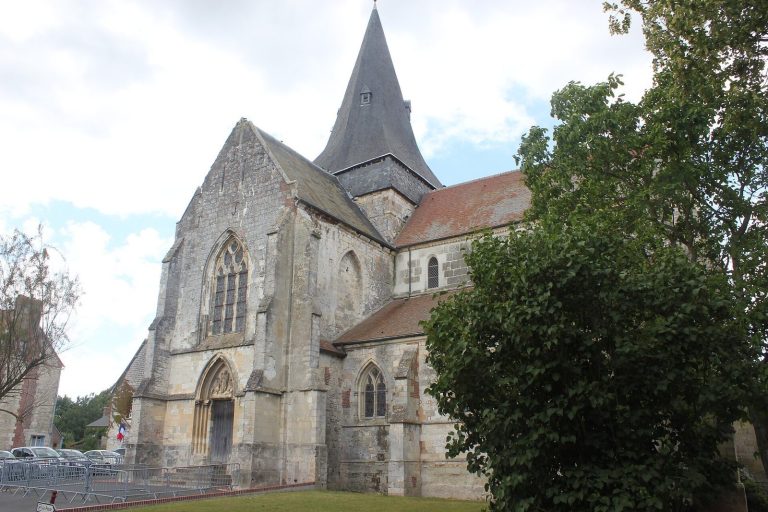
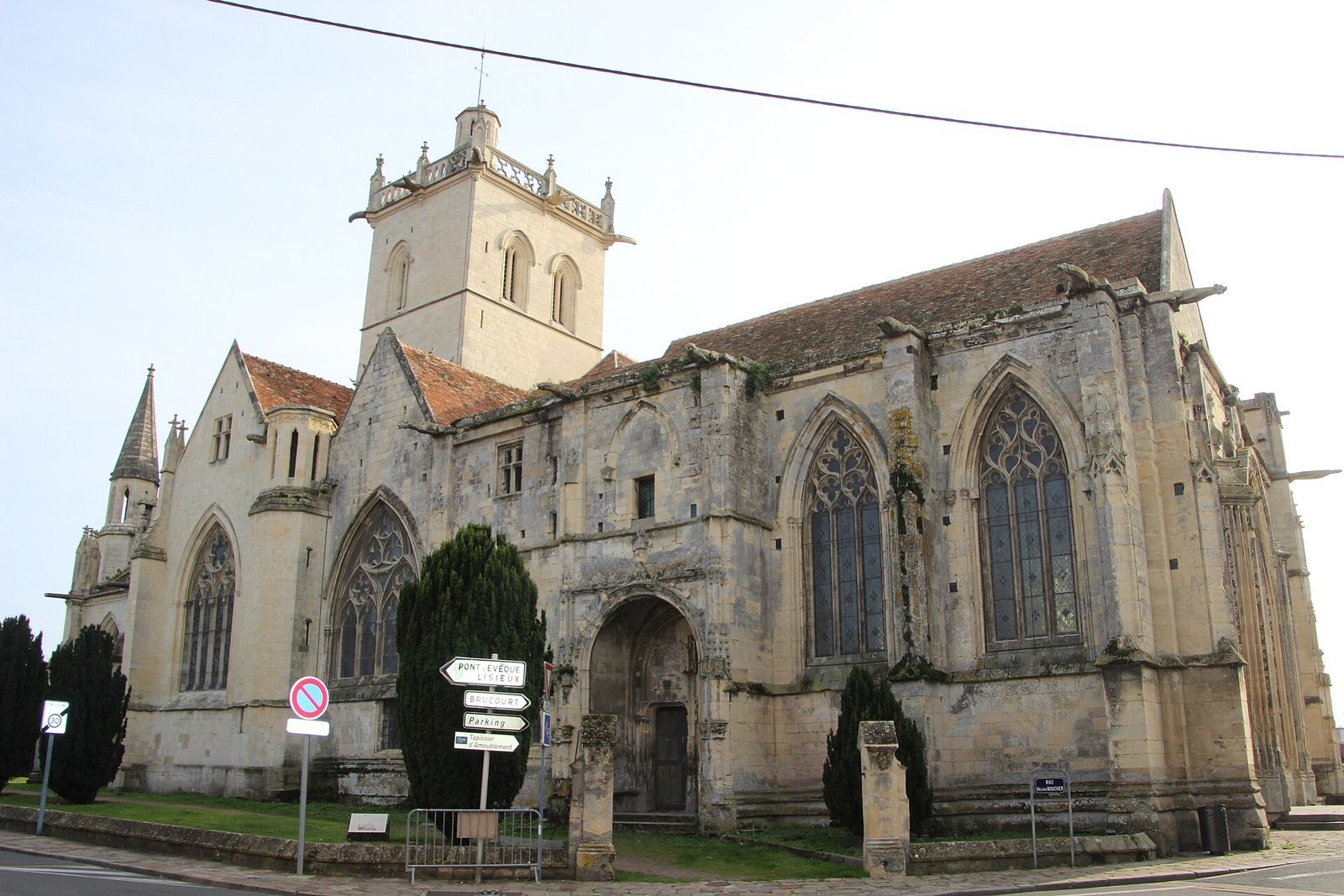
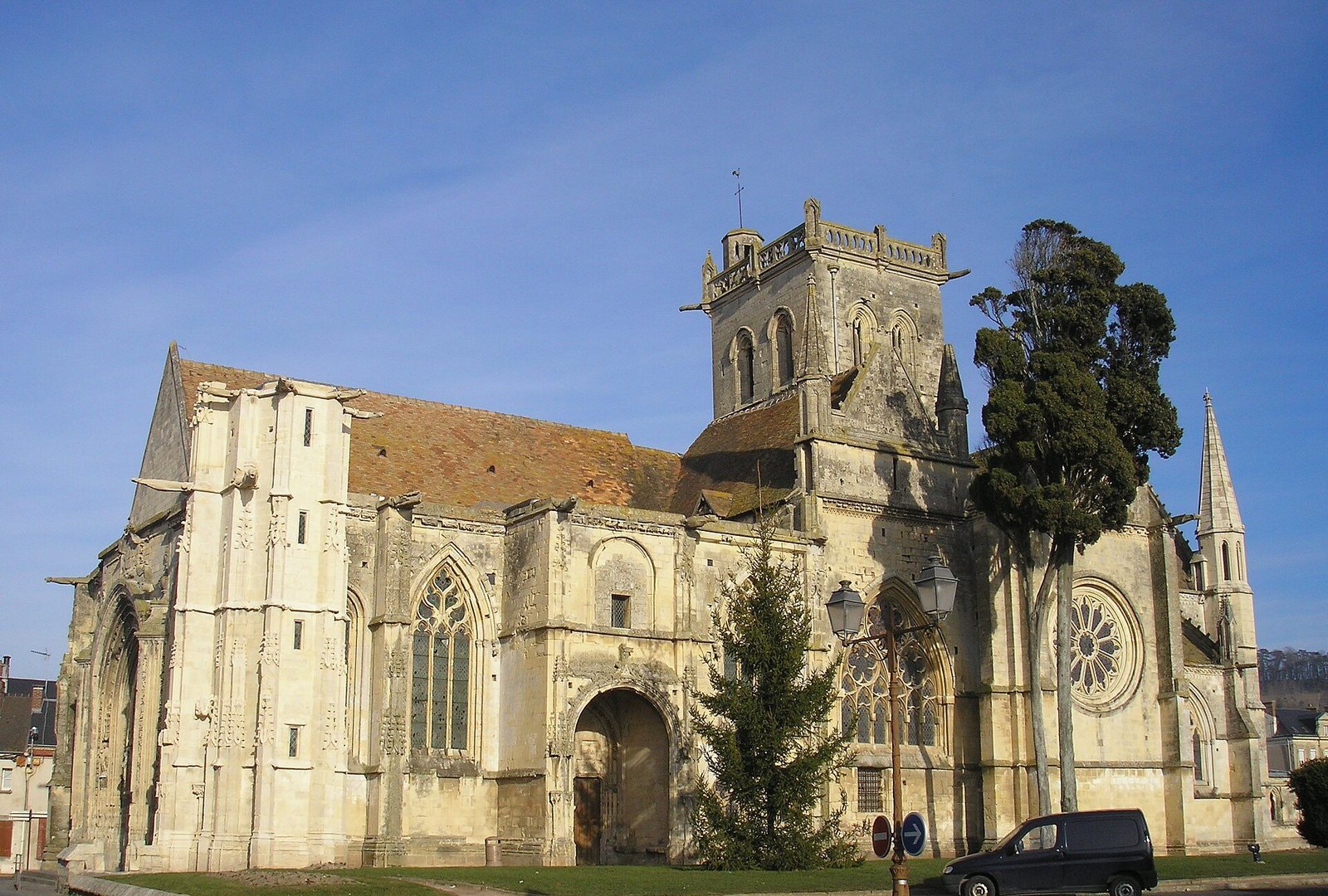
Built of limestone, the church follows an east-west orientation and a Latin-cross plan. Its nave has two side aisles, porches stand on the north and south sides, and chapels flank the building and occupy the cross-arms. The east end is flat, with a pentagonal structure behind it that may be a sacristy. The church stands in the eastern part of the old village, set back from three main roads. A cemetery surrounded the building into the nineteenth and twentieth centuries; its northern entrance is marked by surviving pillars bearing carved shields.
Construction phases
Romanesque fabric
Interlaced patterns carved into capitals survive in the crossing, where the nave and cross-arms meet, within the church’s early section. These are among its Romanesque features, a medieval style associated with rounded arches and substantial masonry. The cross-arms and east end were enlarged in the twelfth century.
Gothic rebuilding
Fourteenth-century rebuilding produced a choir with side aisles, a renewed cross-arm, the upper part of the square tower, and the eastern bay. Later work used Rayonnant Gothic, which emphasizes elaborate window tracery, and Flamboyant Gothic, known for flame-like tracery. A later medieval phase added the first four nave bays, their aisles and side chapels, the two porches, and a stair turret; its exact date is uncertain.
Entrances and former monastic spaces
West doorway
The richly carved west doorway once had a porch. Above it, an eighteenth-century pediment bears the inscription, “The temple of God is holy.” Canopied statues of the Virgin and Child, Saint Peter, and Saint John the Baptist frame the large entrance; the panel above the doorway is plain. A polygonal tower rises on the west front.
North and south porches
The two side porches face one another. The south porch has two levels and a round-arched entrance. The church’s charter archive was kept in its upper area and above the baptismal font; an upper section of the south chapel also held charters. Two-storey rooms in the north porch housed monks who guarded the statue, with an upper chapel reserved for clergy. A fireplace survives in this area, and mullioned windows in the north aisle are associated with the monks’ rooms.
Tower, roof, and carved stone
Tower and roofline
The lantern tower, a tower above the crossing that admits light, has two levels, with windows in the upper stage. A walkway around the roof could be reached by a southwest staircase; a balustrade once linked its small towers. Romanesque pillars and round arches remain at the crossing. The main roof is gabled, while the aisles and chapels have flat roofs; the side aisles also have sloping roofs. Gables mark the east end and crossing, and the bell tower has a balustrade and pinnacles. Large windows in the stair and bell towers provided a wide view of the surroundings for the sea watch.
Sculpture and viewing opening
Carved exterior details include a fifteenth-century gargoyle with a human head and a sixteenth-century monk figure known as the Malaucœureux. Other carved figures express admiration, doubt, and boredom. A sundial is set into the south wall. An angled opening through that wall, called a hagioscope, let people with leprosy observe services from outside the main worship space. It is associated with a leprosarium recorded in Dives in 1475, possibly along the cemetery to the south.
Marine graffiti
Locations and techniques
More than 400 carvings on the limestone walls include ships, sea monsters, and other images connected with the sea. They date from the fifteenth to the early twentieth century, with most made in the seventeenth and eighteenth centuries. Artists used pointed tools to scratch the stone, as well as lead pencil and a red iron-oxide drawing medium. Most carvings are at human height, although some are much higher. Some may have been commissioned, while the makers were usually unnamed adult parishioners.
The carvings are concentrated outside on the south wall, bell tower, southwest tower, and south porch. Together, the south wall and porch account for about half the known group; the bell tower has about 140 examples, the upper chapel seventeen, the nave twelve, and the southwest tower seven. Other carvings appear along the interior south wall and on the southwest staircase. Some are sheltered from view, and the placement of some south-side examples may relate to the former cemetery.
Images and devotional meanings
Alongside boats, the carvings show people, animals, objects, and buildings that may represent the church. Human figures include archers, sailors, and caricatures. Crosses, crucifixes, fleurs-de-lis, rosettes, and marks known as “devil’s claws” also appear, together with inscriptions whose meanings are sometimes uncertain. Names may refer to boats or their makers, and some inscriptions may be children’s epitaphs. Shoes, which have been interpreted as signs of pilgrimage on foot, date to the seventeenth and eighteenth centuries.
Ships and boats
A total of 268 ship carvings have been inventoried, depicting vessels from large sailing ships to small craft and flat-bottomed river boats. Most date to the eighteenth and nineteenth centuries, though examples range from the late fifteenth to the early twentieth century. The oldest, found in the bell tower, near the staircase, or in the upper chapel, include medieval sailing vessels and carracks, large ships used in the late medieval and early modern periods. Later images include fishing boats, trawlers, brigs, three-masted ships, and river craft. Weather, pollution, and restoration work threaten the carvings; some of the best-preserved examples are high on the exterior walls.
Glass, memorials, and furnishings
Stained glass
A fourteenth-century panel of musician angels was donated by Guy d’Harcourt, bishop of Lisieux, according to a fragmentary inscription. It once occupied the upper part of a window at the east end, which also contained religious scenes, saints, and donors. Eight surviving angel medallions, each 40 centimetres across, come from a group of ten described in the nineteenth century. Removed during later glazing work, the panel passed into a private collection, was rediscovered in 1928, and was found again late in the twentieth century. It was repurchased by the state and town and is now held at the Dives-sur-Mer Tourist Office.
Other windows combine nineteenth-century work with medieval medallions showing the Creation, the temptation of Adam and Eve, and their expulsion from Paradise. Windows by Louis-Gustave Duhamel-Marette were installed in 1875, and glass depicting the Fishing of Christ and the Judgment followed in 1880. The church’s other named panels include a south cross-arm rose with medallions of the Virgin and Saint Dominic, and scenes of the Virgin, Saint Peter, Saint John the Baptist, Saint Dominic receiving the rosary, the death of Saint Joseph, and Christ the Savior.
Memorial slab
A 24-square-metre slab above the main entrance lists 475 principal barons said to have accompanied William the Conqueror to the English coast. Arcisse de Caumont, a French historian and archaeologist, installed it in 1862; it was inaugurated on August 17 of that year. The names vary in authenticity. Archaeologist Vincent Carpentier regarded a list compiled by historian Léopold Delisle, drawing on the Domesday Book, as more reliable than later lists at Battle Abbey and Falaise Castle. The memorial refers to the embarkation in the Bay of Dives, which the Bayeux Tapestry depicts as involving 1,000 boats and 8,000 men.
Furnishings and bells
Recorded furnishings include a group of Saint Anne and Mary, adoring angels, a polychrome Virgin, and a Pietà, a depiction of Mary mourning the dead Christ, dated 1877. The church also has a painting of the Baptism of Christ by Rémy Eugène Julien, dated 1840, and one of the Ecstasy of Saint Teresa of Ávila by Georges de Dramard, dated 1876. An eighteenth-century lectern bears a bird, serpent, and globe; the bird represents good overcoming the serpent’s evil. The south altarpiece is dedicated to Pentecost. Three bells are named Marie-Jeanne, cast in 1772, Marie, cast in 1853, and Marie-Georgina, cast in 1891.