Enkomi: A Bronze Age Copper-Trading Settlement in Cyprus
Site at a Glance
- Popularity
- High
- Country
- Cyprus
- Primary era
- Bronze Age
- Eras represented
- Bronze Age
- Civilizations
- Mycenaean
- Site type
- City
On this page20 sections
History
Enkomi is an ancient settlement near Tuzla, Cyprus, that became an important center for copper trade and smelting during the Late Bronze Age. Occupied in the Middle Bronze Age and flourishing from roughly the sixteenth to the twelfth centuries BC, it was connected to coastal networks and to communities beyond Cyprus.
Early settlement and coastal growth
Enkomi’s earliest known occupation, called Level A in the site’s sequence of archaeological layers, dates to about 1900–1700 BC. This settlement was later abandoned. Toward the end of the Middle Bronze Age, communities in Cyprus increasingly moved from inland locations to the coast. Enkomi, like Kition, was associated with this change as the island entered the Late Bronze Age.
From approximately the sixteenth through the twelfth centuries BC, Enkomi produced and traded copper. It had strong cultural connections with Ugarit, a major city on the Syrian coast, and showed early Egyptian influence. Its political role remains open to interpretation: it has been proposed as Cyprus’s capital, while another view sees the island at the time as divided among several political centers.
Expansion and Late Bronze Age change
Enkomi’s numbered archaeological levels mark successive phases of settlement, rather than being identical to the period labels used for Cyprus. The term Late Cypriot refers to the island’s Late Bronze Age. Levels I A and I B represent the settlement’s gradual development from about 1550 to 1500 BC and its destruction in an earthquake around 1400 BC. Levels II A and II B encompass a major expansion during the fourteenth and thirteenth centuries BC, followed by extensive destruction around 1220 BC.
Imported Mycenaean pottery, associated with Bronze Age Greek culture, reached Enkomi early, and imports increased sharply in the fourteenth century BC. By the last quarter of the thirteenth century, locally made pottery in Mycenaean styles was also in use. This change has been interpreted as evidence for the settlement of Mycenaean Greeks. Meanwhile, other trading centers were developing on Cyprus’s southern coast.
A major fire around 1200 BC marked the transition from Level II B to Level III A and destroyed House 18. The building was later repaired, additional ashlar buildings were constructed, and the street network became more regular. Level III A is associated with Mycenaean settlers and a destructive attack that may have been connected with the Sea Peoples, a modern name for groups linked in ancient records with movements and attacks near the end of the Bronze Age. Level III B continued the culture of III A before ending in destruction around 1125 BC. Level III C was the settlement’s final Mycenaean phase, when the population was declining.
Abandonment and the name Alashiya
Enkomi was abandoned around 1050 BC after an earthquake, and its population moved to nearby Salamis. The ancient inlet that had connected the settlement with the sea had silted up, a change that may also have contributed to the move. Enkomi has been proposed as the Alashiya named in the Amarna letters and other ancient Near Eastern texts. Alashiya is often associated with Cyprus, but interpretations differ over whether the name referred to Enkomi specifically or to the island as a whole.
Excavation and modern history
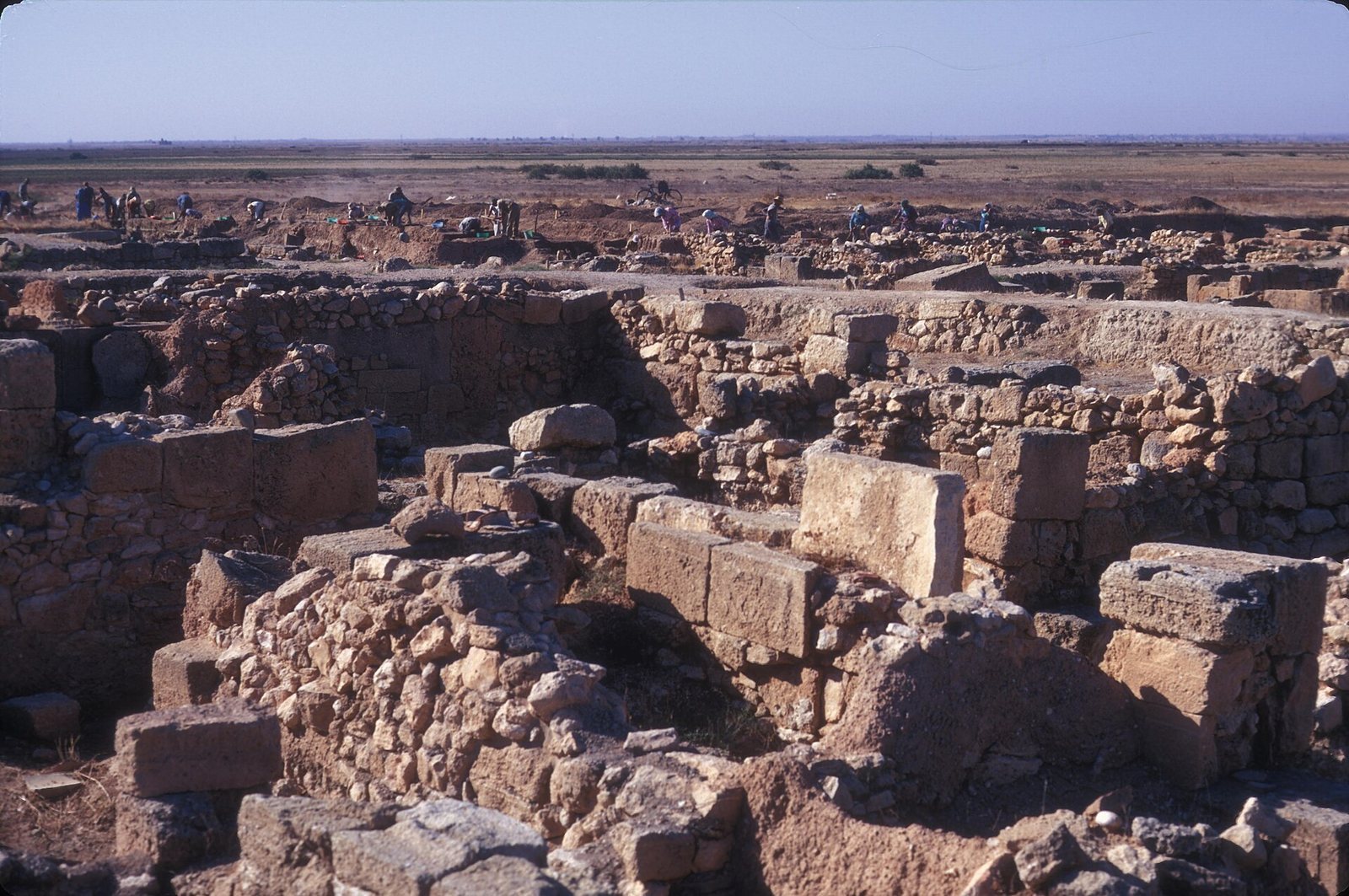
Rich offerings in the tombs attracted looters, who damaged the site for more than a decade before antiquarian Alessandro Palma di Cesnola’s brief excavation in 1878 brought it to wider archaeological attention. Early work concentrated on burials. Some settlement remains were mistaken for Byzantine buildings and destroyed as unimportant. Alexander Stuart Murray’s excavations for the British Museum from 1895 to 1898 uncovered about 100 tombs, most already looted. Under the laws then in force, two-thirds of the finds went to the British Museum and the rest to the Cyprus Museum. Murray’s published results emphasized high-status objects; his field notebook, with details of most individual tomb excavations, was published in 2003.
Further investigations included an unsuccessful Cyprus Museum trial in 1913, R. Gunnis’s 1927 excavation of a bronze hoard, and a 1930 Swedish Cyprus Expedition that excavated 28 tombs, 22 of them productive. The expedition assumed the settlement and burial areas were separate and used digging methods that damaged settlement remains. In 1934, Claude F.-A. Schaeffer made about 200 test excavations and partly uncovered a building he called the Maison des Bronzes. Cypriot excavations led by Porphyrios Dikaios continued from 1948 to 1958, while a joint French and Cypriot expedition worked from 1948 to 1973. Schaeffer led the French work until 1970, after which Oliver Pelon took charge. The French team excavated 37 tombs and the Cypriot team 30.
Fieldwork ended after the 1974 Turkish invasion of Cyprus. Political restrictions have prevented further excavation, and in 2005 the Republic of Cyprus maintained its opposition to renewed fieldwork in the area. The status of expedition objects held in storage after the invasion remained uncertain. Enkomi lies in northern Cyprus, whose governance is disputed.
Remains
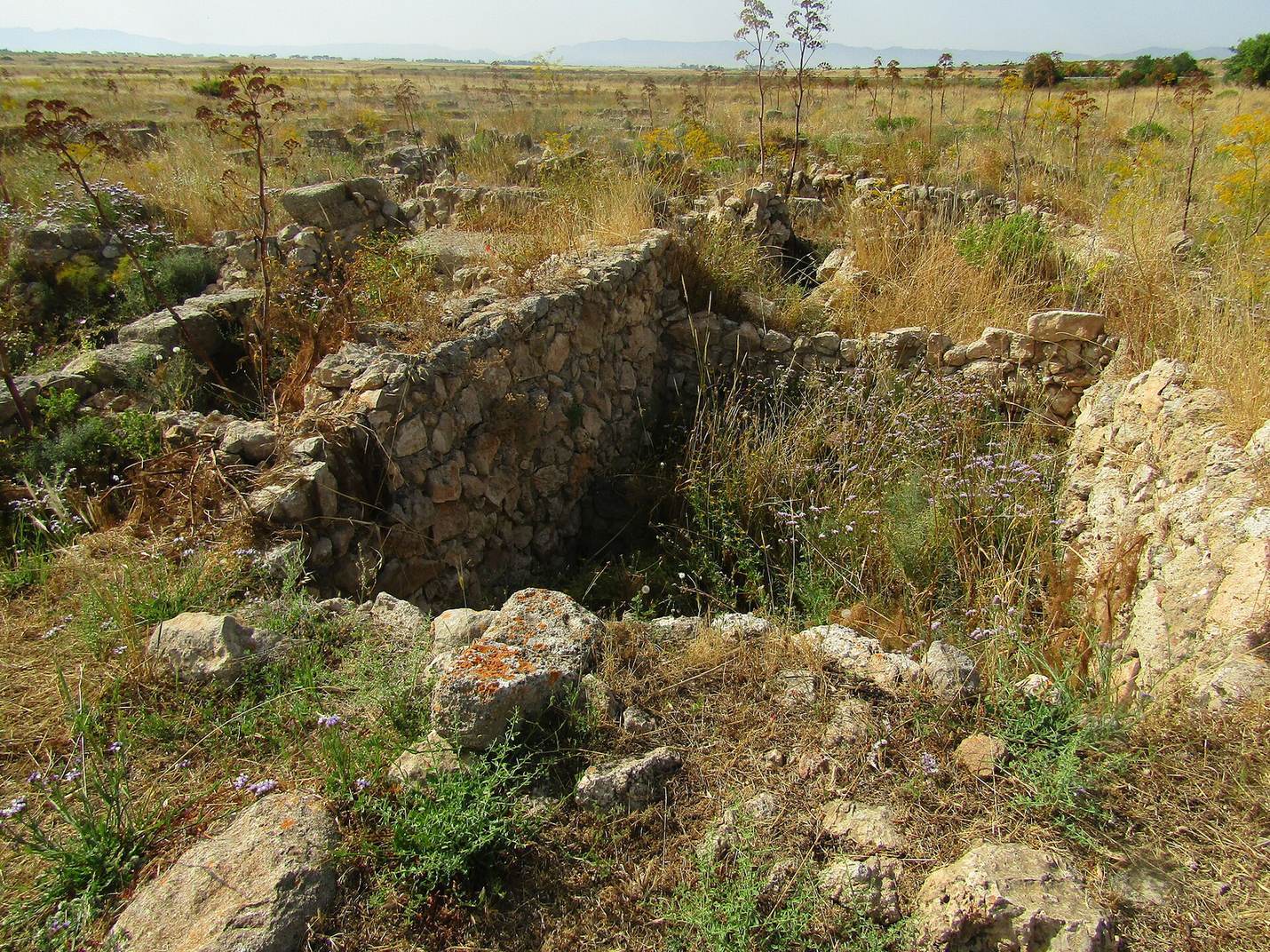
Enkomi stood on the Mesaoria plain in eastern Cyprus, close to the coast. In antiquity, an inlet and the Pedhieos River linked the settlement to the sea; the inlet later silted up. The settlement covered about 2.5 hectares within a walled boundary. Its streets, gates, houses, workshops, and sanctuaries formed an organized urban layout.
Enclosure and street plan
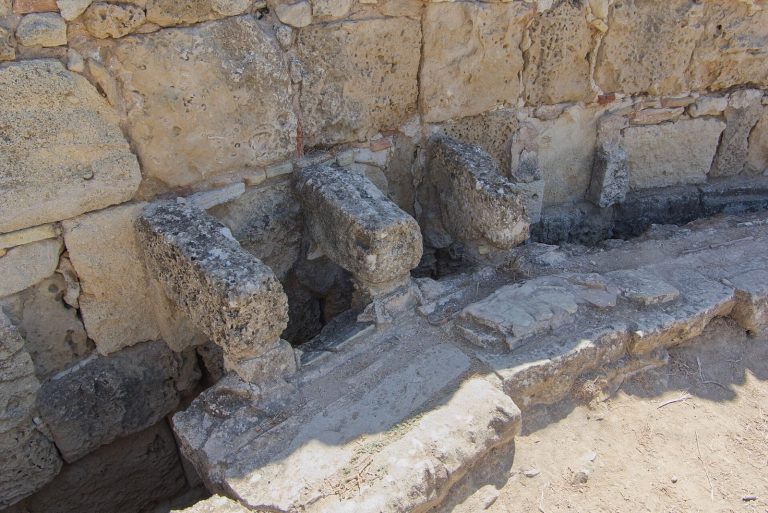
The settlement wall used exceptionally large stones, a construction sometimes called Cyclopean masonry; the term describes the size of the stones, not a connection with mythical Cyclopes. Some slabs were as long as 3.5 metres. The wall is also described as having a foundation of large stones topped by mudbrick. At least three gates stood on the north, west, and south sides. A rectangular enclosure in Level I A, built with carefully cut limestone blocks, formed part of the defensive system. Streets ran approximately north to south and east to west, with smaller routes crossing a main north–south street. The layout related to the gates, and the settlement had a developed drainage system.
Houses and excavated areas
Houses generally consisted of several rooms arranged around a central courtyard. Late Bronze Age buildings included larger, more elaborate structures built with dressed stone blocks; some may have been storehouses, while certain building groups have been described as palace-like. Only Areas I and III have been fully excavated down to bedrock. Area I’s earliest phase comprised 12 rooms and two courtyards, apparently forming an independent unit. Most rooms have been interpreted as domestic spaces, including vestibules, halls, and possible storage rooms; one corridor may have served as a bathroom. Area III has been interpreted variously as an industrial site, an elite building, or a fortification, with copper production among the proposed uses. It underwent rebuilding and changes of use more often than Area I.
The Ashlar Building, or House 18
The centrally located Ashlar Building, also called House 18, was the oldest and largest of Enkomi’s buildings made with carefully cut stone blocks. It served industrial, ritual, and residential purposes over several occupation phases. In its Level III A form, it measured about 32.5 by 28.5 metres at the base, contained 38 rooms, and covered roughly 930 square metres. Stairways in Rooms 13 and 28 suggest that parts of the building had upper storeys; each storey is estimated to have been at least 1.5 metres high. Its construction combined large-grained rubble and finely cut blocks with a mudbrick upper structure, and included material reused from an earlier destroyed level.
Room 14, near the center, held a large hearth surrounded by four stone columns. A short staircase joined it to Room 64, which had a covered area and direct access to a nearby street. The northern part of the building mainly served the community. Wells, hearths, and benches in its southern part point to industrial activity there. The building was destroyed in the fire around 1200 BC and was subsequently repaired.
Copper working
Enkomi had extensive facilities for processing copper, with raw materials and finished goods found at the site. Workshop remains included tuyere tubes, nozzles that directed air into furnaces, as well as crucible fragments and deposits of slag left by smelting. Three copper ingots shaped like ox hides were excavated; one is held by the Cyprus Museum and another by Harvey Mudd College. Copper-working installations stood both inside and outside the main walled area, prompting the suggestion that the fortification also helped protect industry and its resources.
Tombs and burial customs
Tomb forms
Enkomi’s tombs are estimated to have numbered about 2,000. Most excavated graves were chambers cut into the limestone, often beneath houses within the settlement. Outside the settlement, people were most commonly buried in rock-cut chamber tombs. Other forms included one circular, often domed, tomb, Tomb 71; four built tombs, Tombs 1, 11, 12, and 66; pit graves; pot burials; and burials beneath houses. One room in Area I contained infant burials from two periods of occupation and was the only room there in which burials beneath buildings were identified. The infants were placed in jars and buried in pits, including one burial in a Canaanite jar.
Burials and grave goods
Excavated graves contained people buried in seated or extended positions. Some wore robes fastened with gold pins. Offerings included objects of gold, silver, faience, a glazed siliceous material, and ivory. Some burials had diadems decorated with geometric designs, flowers, or figures, while gold foil was placed over the mouth. Ceramic and bronze vessels held food and drink offerings. Differences between tombs, particularly in metal goods and imported objects, point to social hierarchy and competition expressed through burial customs. One pottery fragment was tentatively linked to production in Canaan, possibly at Ashdod.
Sanctuary of the Ingot God
Hall and installations
The sanctuary was arranged around a beaten-earth floor with a burnt surface, thought to be associated with the placement of a bronze figurine. Its main hall had rubble walls and massive masonry pillars set across the central axis. Benches of rubble coated with white lime ran along the north, south, and west walls. Two plaster-covered niches made of mudbrick or rammed earth were built into the north side. During a later phase, a small room measuring 2 by 1.9 metres was added in the hall’s northeast corner. A circular hearth coated in white plaster stood in the central area. Nearby stone installations included a concave block traditionally interpreted as a slaughtering table and a pierced block often associated with tethering animals; these uses remain interpretations.
Figurines and other finds
A bronze figurine about 0.35 metres high was found near the entrance. It wears body armor, a horned helmet, and leg guards, and carries a shield and spear. The base beneath it has been interpreted as a copper ingot. Another representation conventionally called the Ingot God shows a figure in a horned conical hat and leg guards, carrying a shield and spear while standing on a small ingot shaped like an ox hide. That figure is held by the Cyprus Museum. These conventional labels describe the figures’ appearance and do not establish the identity of a deity.
Sanctuary finds included deep bowls, a drinking or pouring vessel with an ox-skull motif, a dark burnished jug, a Canaanite jar, a ladle, six inscribed clay balls, a terracotta cylinder seal, lamps, rings, and bronze and iron objects. Large quantities of ox skulls, horns, and small animal bones were also found. One niche contained a bronze knife and shoulder blades incised with lines.
The Horned God building
A bronze figure about 0.55 metres high, conventionally known as the Horned God, dates to the twelfth century BC. It was found in a pit dug during the third phase of a large, three-part stone building. The building had been constructed in the early twelfth century BC above structures destroyed by an earthquake. At the spot where the statue had originally stood, excavators found ox skulls, stag antlers, animal bones, small horns made from gold sheet, and other gold ornaments. The building’s level was later destroyed, and the statue is now in the Cyprus Museum.
Inscriptions and other finds
Cypro-Minoan texts
Cypro-Minoan was a writing system used in Bronze Age Cyprus. Its signs have not been deciphered, and the language they represent remains uncertain. A small terracotta cylinder found in 1967 dates to the fourteenth century BC and bears 27 lines with 217 signs in the Cypro-Minoan 1 variant. It is the longest known text in that variant found outside Syria. Four clay tablets were also recovered at Enkomi; three are in the Cyprus Museum in Nicosia and one is in the Louvre.
Tablet 1885 came from Room 103 in the north of the site, in a Late Cypriot I building called the Fortress. Dated to 1525–1425 BC, it has 23 signs, 21 on its face and two on its edge, though only its upper part survives. Tablet 1193, preserved in two pieces, dates to the twelfth century BC and came from a Level III B context in the north. Tablet 1687 dates to the late thirteenth or early twelfth century BC and came from a Level III A context in the central area. Short inscriptions also occur on three pottery fragments. Two date to about 1200 BC, one with four signs and part of a fifth, the other with six signs in two lines; a third bears a single sign cut after firing and is undated. A seven-sign example came from a tomb looted before the 1913 trial excavation, and a clay ball in the Louvre bears two signs.
Metalwork and pottery
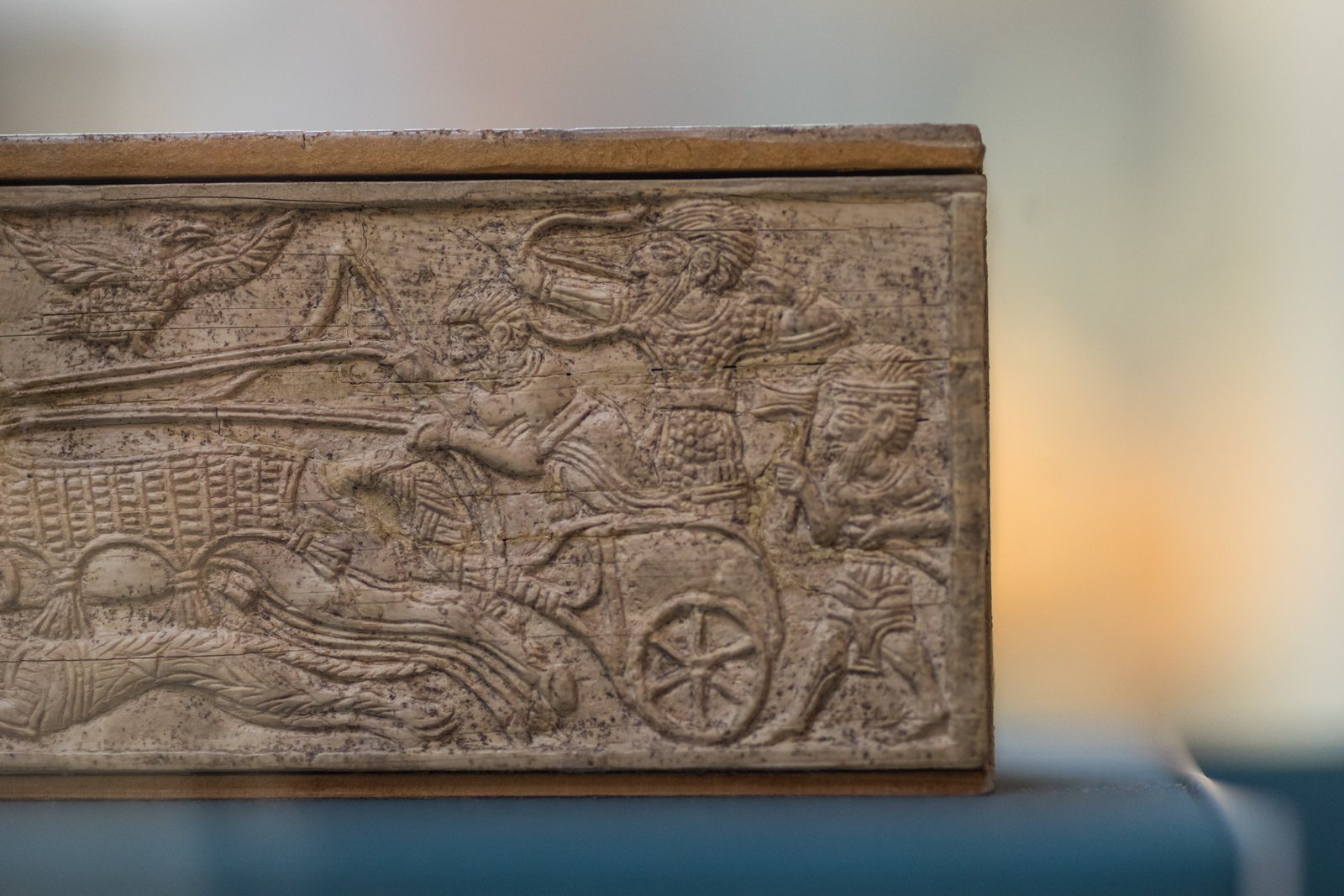
A silver bowl from Tomb 2/7 dates to the fourteenth century BC. Its upper band shows bull heads alternating with lotus flowers, while rosettes decorate the lower band. Gold and a dark metallic inlay material called niello fill parts of its decoration. The bowl resembles one from Dendra in Greece, and the possibility that the same craftsperson made both has been suggested. Whether the decoration on another decorated metal vessel known as the Enkomi Cup uses niello remains disputed.
Other finds attributed to Enkomi include hemispherical gold bowls, gold foil interpreted as body ornaments, earrings shaped as bull heads, and faience vessels modeled on Egyptian examples, some decorated with lotus flowers. The pottery spans a long period: finds include a red-polished lidded container dated to about 4000 BC; red-polished bowls and wares dated to 2300–2075 BC; red- and black-polished pottery dated to 2300–1900 BC; red-polished pottery dated to 1900–1725 BC; and white-painted pottery dated to 1900–1625 BC. Amphorae found at the site date to 850–750 BC and 750–600 BC.