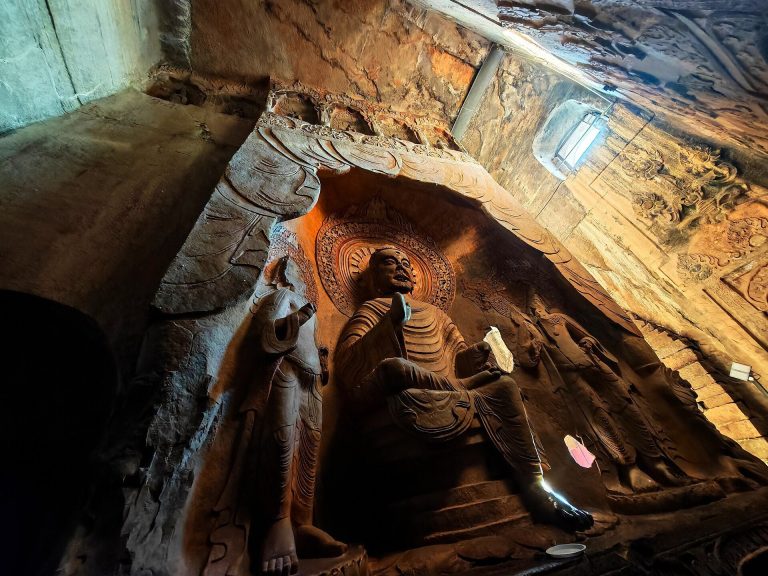
Yinxu: The Archaeological Site of the Shang Dynasty’s Final Capital
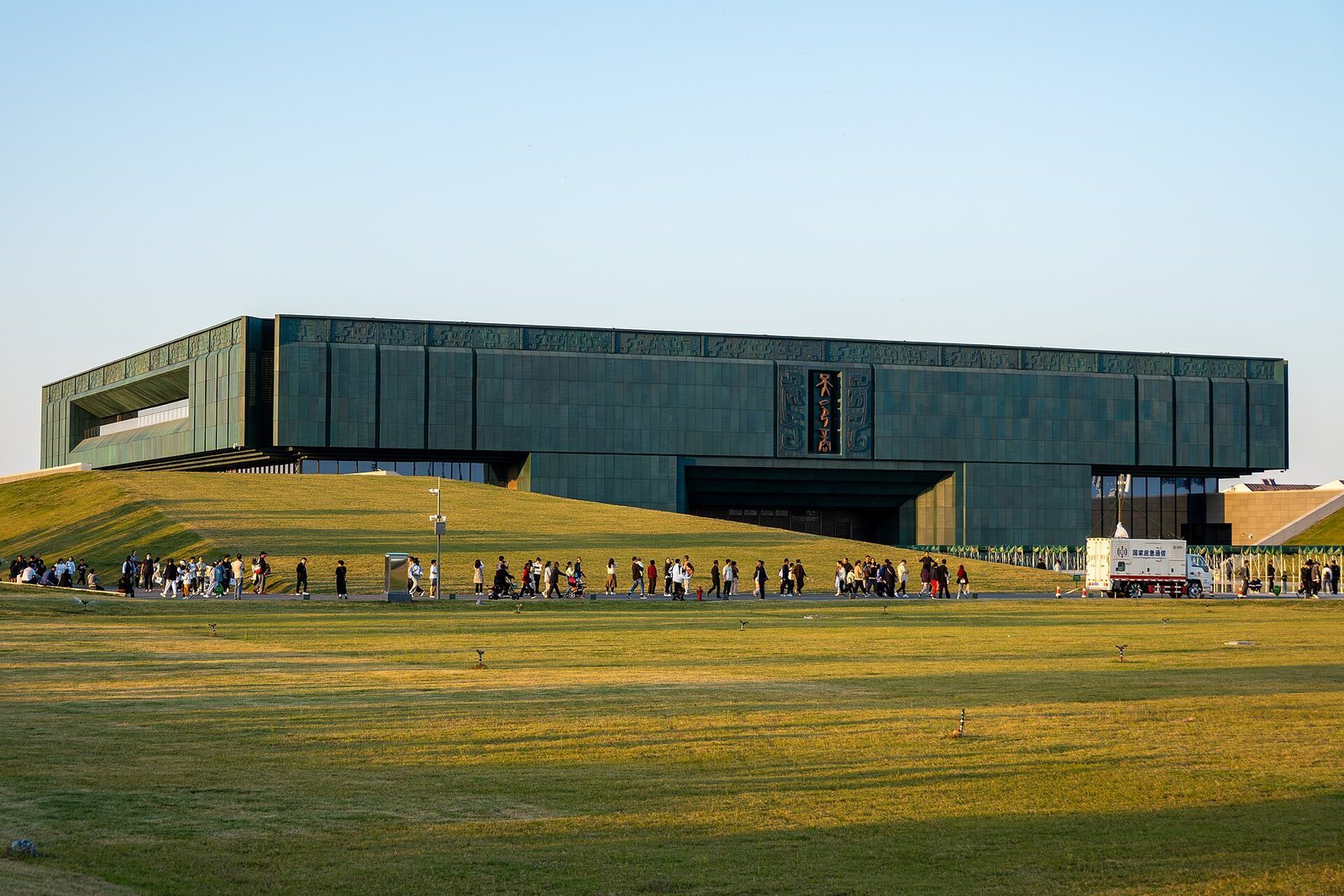
Site at a Glance
- Popularity
- Very High
- Country
- China
- Primary era
- Bronze Age
- Eras represented
- Bronze Age
- Civilizations
- Shang
- Site type
- City
On this page18 sections
History
Yinxu is the archaeological site of Yin, the Shang dynasty’s final capital, in Anyang, Henan, China. It served as the capital during the Late Shang, approximately 1250–1046 BCE, across the reigns of twelve kings and eight generations. Oracle-bone inscriptions, divination texts written on animal bones and turtle shells, provide evidence of the city’s political and spiritual life and some of the earliest evidence of Chinese writing.
A capital of the Late Shang
Traditional histories associate the Shang capital’s transfer to Yin with King Pan Geng around 1300 BCE. The Book of Documents and the Bamboo Annals connect the move with Pan Geng, though they differ from Sima Qian’s account. The Bamboo Annals describe a move from Yān, near modern Qufu, to Běimĕng, later called Yin. Sima Qian instead places the move from north of the Yellow River to Bo, south of it, a location that does not correspond to Yinxu. Inscriptions from the site call the state Shang and its capital Dàyì Shāng or Shāngyì; Yin became a name for the dynasty and capital in the succeeding Zhou period.
By the reign of King Wu Ding, Yin was established as the Shang capital. Wu Ding led campaigns against surrounding groups from the city, strengthening Shang rule and bringing the dynasty to its historical zenith. Archaeologists divide Yinxu’s cultural sequence into four periods, using pottery types and approximate correlations with inscriptional phases, royal reigns, and the Xia–Shang–Zhou Chronology Project, a modern effort to establish dates for China’s early dynasties. The settlement was small during much of the first period. Large buildings, inscribed bones, extensive human sacrifice, and chariot burials appeared later in that phase.
The dating of the earliest rulers at Yinxu remains uncertain. Dong Zuobin assigned Pan Geng, Xiao Xin, and Xiao Yi to the first cultural period, but inscriptions cannot securely connect reigns before Wu Ding to the site. Some scholars associate these kings with nearby Huanbei, which was roughly contemporary with the early part of Yinxu’s first period. Huanbei predates the characteristic Late Shang culture of Yinxu and follows the early Zhengzhou culture; it may have served as a Shang capital during the middle-to-late Shang period.
Fall and later memory
Traditional accounts portray later Shang rulers as increasingly absorbed in pleasure and inattentive to government. Di Xin, traditionally regarded as the last Shang king, was remembered for cruelty and debauchery. His autocratic laws alienated nobles, and King Wu of Zhou gained their support, defeated the Shang, and established the Zhou capital at Fenghao near modern Xi’an. Yin was abandoned and fell into ruin.
Sima Qian referred to the ruins, and the geographer and writer Li Daoyuan described them in detail during the Southern and Northern Dynasties, a period of political division in China from 420 to 589 CE. Yin and the Shang later became legendary until the site’s rediscovery in the final years of the Qing dynasty, China’s last imperial dynasty, which lasted from 1644 to 1912.
Rediscovery and archaeological study
In 1899, scholar Wang Yirong recognized ancient writing on “dragon bones” sold as medicine. The discovery attracted antiquities collectors and led to decades of illegal digging, during which tens of thousands of pieces were removed. In 1910, Luo Zhenyu identified the Anyang area as the last Shang capital, and James Menzies independently reached the same conclusion. In 1917, Wang Guowei deciphered Shang kings’ names on the bones and reconstructed a genealogy that closely matched Sima Qian’s account, strengthening the historical identification of the Shang.
Archaeological excavation began with an eighteen-day trial in 1928 led by Dong Zuobin. It recovered more than 800 inscribed oracle bones, along with bronze, pottery, and bone objects. Li Ji led subsequent campaigns through 1937, by which time fifteen scientific excavations had taken place. Chinese archaeological institutions resumed work from 1950, extending investigation across Yinxu and its surrounding remains.
The inscriptions helped confirm the Shang dynasty’s historical existence and allowed historians to reassess traditional accounts and reconstruct early Chinese history. Excavation also contributed to the development of archaeological research elsewhere in China. Yinxu was included among China’s first group of key protected cultural relics in March 1961 and was added to the UNESCO World Heritage List in 2006. The World Heritage property covers 414 hectares, with a 720-hectare buffer zone.
Burial practices at Yinxu included human and animal sacrifice. A 2023 excavation of a sacrificial pit dated to the reigns of Di Yi and Di Xin found substantially fewer human bones than in earlier periods, alongside more cattle and sheep bones. The human remains were identified as prisoners of war rather than civilians or enslaved people.
Remains
The archaeological complex extends across about 30 square kilometers along the Huan River, also known as the Anyang River. Its open, ring-shaped settlement plan centers on palace and ancestral-temple remains at Xiaotun, while archaeological areas lie on both sides of the river. The complex includes royal tombs, residential and clan settlements, family cemeteries, oracle-bone pits, bronze-casting remains, and workshops. More than eighty building foundations have been identified across the site.
Palace and temple district
Buildings and courtyards
The palace and ancestral-temple district covered 71.5 hectares at Xiaotun and a second village south of the Huan River. Its foundations include palaces, shrines, tombs, and workshops, many raised on platforms of rammed earth, formed by compacting damp soil in layers. Buildings were principally made with timber posts, walls of compacted earth, and thatched roofs. The main structures were elevated and interconnected, with courtyards arranged in regular, symmetrical patterns.
Defensive moat
A hand-dug moat bordered the western and southern sides of the palace and temple district. It measured about 1.1 kilometers north to south and 0.65 kilometers east to west, with a width of 10 to 20 meters and a depth of 5 to 10 meters. The moat connected to the Huan River at its eastern and northern ends and served both flood-control and defensive purposes.
Huanbei and other settlement areas
Huanbei Shang City
The remains of Huanbei Shang City lie northeast of traditional Yinxu, on the Huan River’s north bank, with a small area of overlap between the two sites. The nearly square city covered about 4.7 square kilometers, measuring approximately 2.15 kilometers east to west and 2.2 kilometers north to south. A moat surrounded it.
Residential and working areas
Other parts of the complex include residential and clan-settlement remains, family cemeteries, oracle-bone pits, bronze-casting areas, and workshops. At Hougang, archaeological work revealed successive occupation layers.
Royal burials and sacrificial remains
Royal cemetery
The royal cemetery occupies elevated ground on the north bank of the Huan River, north of two settlements. It measures about 450 meters east to west and 250 meters north to south, covering approximately 11.3 hectares. Excavations since the 1930s have identified thirteen large tombs and more than 2,000 secondary tombs, sacrificial pits, and chariot-and-horse burial pits. Bronze, jade, stone, and pottery objects were found in the cemetery.
A tomb associated with Wu Ding includes evidence of an unusually extensive set of sacrifices. A group of 68 people and 18 horses was buried during the tomb owner’s lifetime. Its leader came from a noble family and was associated with two sacrifices. The tomb is estimated to contain 164 sacrificial victims, including 61 people. The cemetery also contains the heaviest bronze object yet found.
Tomb of Fu Hao
About 100 meters north of Xiaotun village lies the tomb of Fu Hao, wife of Wu Ding and a military leader. Archaeologist Zheng Zhenxiang discovered it in 1976 and dated it to about 1250 BCE. It was undisturbed when found and is the only completely preserved Shang royal-family tomb identified so far. Its contents included six dog skeletons, sixteen human slave skeletons, 468 bronze objects, 755 jade objects, 564 bone objects, and about 7,000 shells. The tomb was thoroughly excavated and extensively restored.
Chariot pits
Six excavated chariot pits each contained the remains of a chariot and two horses. Five also held human sacrificial remains, consisting of four adult men and one child.
Inscriptions and crafted objects
Oracle bones
About 150,000 inscribed oracle bones have been recovered from Yinxu. Their texts preserve more than 5,000 distinct signs, of which about 1,700 recognizable Chinese characters have been identified. The inscriptions name the state Dàyì Shāng or Shāngyì and offer evidence of Shang writing and government.
Bronze and jade
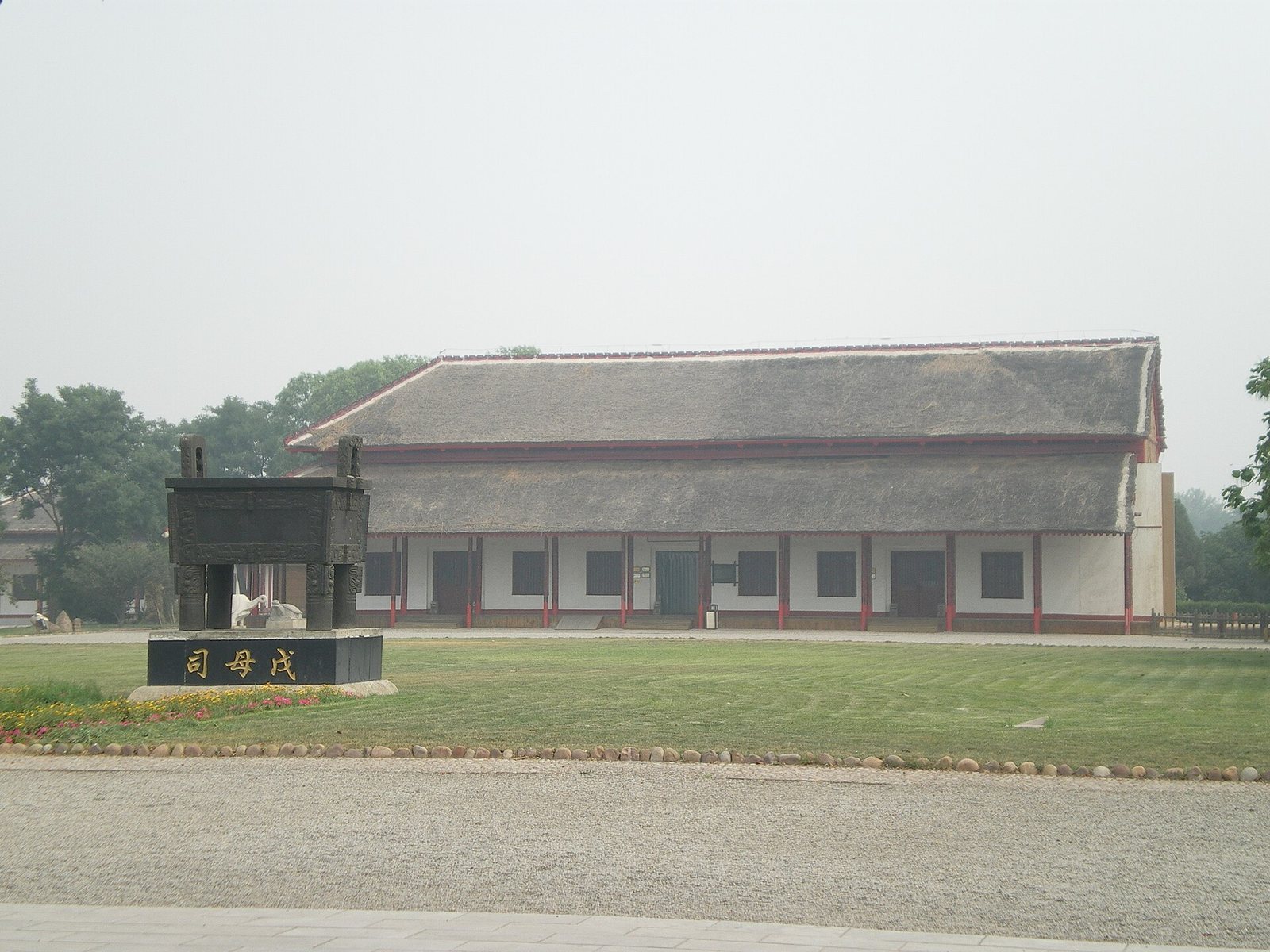
Bronze and jade objects from Yinxu illuminate Shang material culture and burial customs. Shang bronzes include animal-face and spiral designs, as well as the stylized face-like pattern known as taotie. Large ritual bronze vessels, including the Houmuwu ding, an ancient Chinese ritual vessel, were cast using multiple fitted sections of a mold. A Shang-period road discovered in 2000 at the Anyang Aero Sports School measured 8.35 meters wide.