Sainte-Radegonde Church in Poitiers: A Funerary and Pilgrimage Church
Site at a Glance
- Popularity
- High
- Country
- France
- Primary era
- Medieval
- Eras represented
- Medieval, Modern
- Civilizations
- Duchy of Aquitaine, French, Merovingian
- Site type
- Religious
- Remains
- Church
On this page22 sections
History
Sainte-Radegonde Church is a funerary church in Poitiers, France, founded in the sixth century by the Frankish queen Radegund. Its architecture combines Romanesque work, known for rounded arches and substantial masonry, with Angevin Gothic, a regional Gothic style noted for ribbed, often domed vaults. The church began as a burial place for the nuns of the abbey Radegund established in Poitiers in 552, described as the first women’s abbey in Gaul.
Foundation and early history
The church was first dedicated to the Virgin Mary and called Sainte-Marie-hors-les-murs, meaning Saint Mary outside the Walls. Its position beyond the settlement reflected the practice of burying the dead outside inhabited areas. A Gallo-Roman wall, constructed between the third and fourth centuries, ran between the church and the cathedral of Saint-Pierre. When Radegund died in 587, she was buried at the church; thereafter it bore her name and became a focus of her veneration.
By the tenth century, canons, clergy serving a collegiate church, formed a community there. They prayed the canonical hours, the set times of communal daily prayer, at Radegund’s tomb. The church served both parishioners and a community of canons, and its prior was appointed by the abbess, or head nun, of Sainte-Croix Abbey. Hugh the Great burned the church during the siege of Poitiers in 955. Abbess Béliarde ordered Radegund’s remains exhumed in 1012 for public veneration. After another major fire in 1083, the church was rebuilt and dedicated in 1099.
Medieval pilgrimage
Miracles associated with Radegund’s tomb drew pilgrims from soon after her death. Two manuscripts preserve accounts of fifteen miracles dated from 1249 to 1306. By the late thirteenth century, her annual observances included her feast on 13 August and four other feast days, on 28 February, 3 August, 25 October, and 19 November.
In 1412, Jean de Berry, a French prince and count of Poitou, received permission to open the tomb and take relics, physical remains or objects associated with a saint and honored in religious practice. Several miracles were said to occur at the time, and pilgrimage continued through the fifteenth century. A legend entered in Poitiers’ civic registers by the middle of that century linked Radegund and Saint Hilary of Poitiers to the recovery of the city’s keys and the flight of its enemies. The story placed the episode in the early thirteenth century, although its timing conflicts with the political events it invokes.
Religious conflict and early modern devotion
In 1562, during the Wars of Religion, the church was sacked and Radegund’s tomb and body were profaned. In 1566, bones attributed to her were returned to the tomb. Devotion continued through the seventeenth and eighteenth centuries, with miracles still attributed to the saint.
Anne of Austria, queen of France and mother of Louis XIV, entrusted her son to Radegund’s protection and gave the church a statue of the saint in gratitude for his recovery. The statue was commissioned from Nicolas Legendre in 1653. Around 1705, the priest and missionary Louis-Marie Grignion de Montfort arranged for a Virgin and Child statue to be installed in a chapel on Pont Joubert, commemorating the successful siege of 1569. After the chapel was demolished in 1900, the statue was placed behind the church. It disappeared from that location after the 1930s and was later installed inside the church.
Revolution and modern changes
Pilgrimages stopped during the French Revolution and resumed in the nineteenth century. They grew particularly during the Second Empire, amid rising Marian devotion after the Catholic doctrine of the Immaculate Conception was proclaimed in 1854. During the Revolution, Anne of Austria’s silver lamp, once suspended above Radegund’s tomb, was removed. The church was classified as a historic monument in 1862.
Bombing in 1944 shook the building and made its organ unusable. The instrument was renovated in 1948, but work on the church vault in 1991 left it silent. A new organ was inaugurated in 1997.
Remains
The church follows a Latin-cross plan, with a long central nave intersected by a shorter cross arm, or transept. At the eastern end, an ambulatory, a passage around the sanctuary, encircles the raised choir and its crypt. Romanesque construction is especially evident in the entrance porch and eastern chapels, while Angevin Gothic features shape the nave. The main spaces bring together the church’s burial and devotional functions with its later architectural work.
Western entrance
Bell-tower porch
The Romanesque porch has a square ground plan and rises through several levels. Its entrance was remodeled in the fifteenth century. On the lowest level, a barrel-shaped ceiling runs across an upper room. Corner supports and additional supports at the center of each side reinforce the structure. Narrow, round-headed openings sit within moulded bands that follow the arches. The west face has paired openings, while each side face has one.
A stair turret occupies the porch’s northeast corner, topped by a small lantern and a rounded, pepper-pot-shaped roof. The second level is square, with large columns at its corners and three smaller half-columns between them on each face. It has two openings on the west and one on each side. The third level is octagonal, with a half-column at every angle and paired openings on each face. Sculpted, curved-point ornaments fill the transitions between its angled sides and the corners below. Carved projecting supports, known as modillions, decorate the upper walls of all three levels.
Romanesque reliefs
Two reused sculptures from the former Romanesque front face one another inside the porch. One shows Christ in Majesty. The other depicts a seated woman wearing a crown and veil, with a halo; she may represent Radegund, the Virgin Mary, or the Church. Her tilt to the left has led to the suggestion that the two carvings belonged to a single composition, with the woman placed to Christ’s right. Traces of their original coloring remain.
Portal and forecourt
The fifteenth-century entrance portal is in the Flamboyant Gothic style, a late Gothic form with flame-like tracery, and is associated with a surviving forecourt. Stone benches around the forecourt served judges who heard religious and civil cases in the town. Nineteenth-century statues beneath the portal’s canopy depict the Virgin Mary, Radegund, two of her companions, and Saint Hilary of Poitiers. The small square beside the church was once a cemetery.
Nave and adjoining rooms
Nave structure
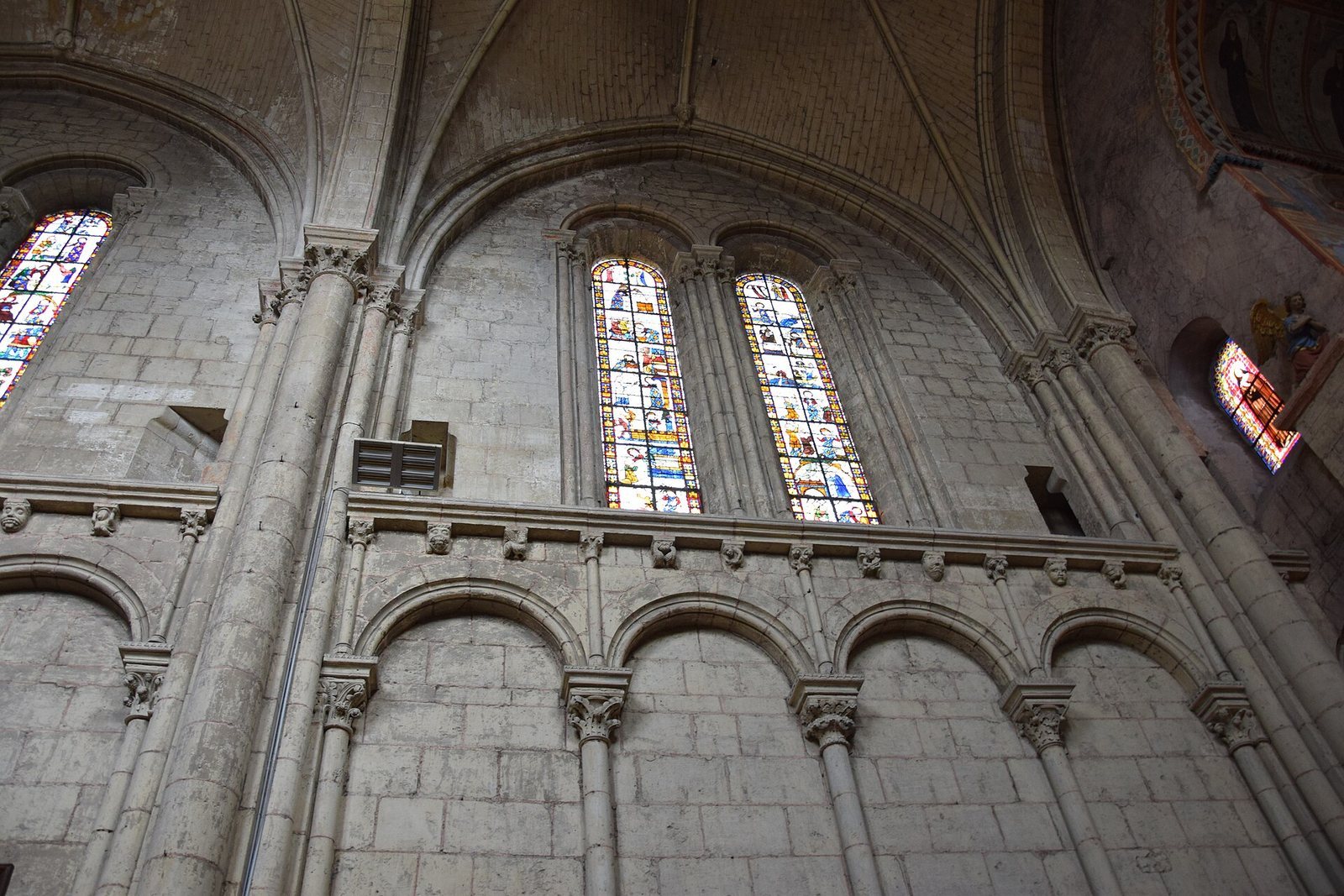
Rebuilt in the thirteenth century in the Angevin Gothic style, the nave is a single space divided into four structural sections. Its construction took place in two phases, reflected in the differing shapes of its windows; the vaulted ceiling was added in the fourteenth century. Wall arcades strengthen the structure and support a passage that runs within the walls around the main supports. The raised, domed vaults have diagonal, crosswise, and lengthwise ribs that spring from groups of columns and attached half-columns.
About a hundred carved supports hold up the passage. Their subjects range from demonic creatures and personifications of vices to realistic scenes drawn from fables.
Stained-glass windows
A window in the second bay of the north wall dates to 1270, although it was altered later. Eight narrow lower panels depict episodes from the life and Passion of Christ, while a large rose window above portrays the Last Judgment, the final divine judgment of humanity. The arms of France and Castile in the central triangular panel identify Alphonse of Poitiers, a count of Poitou and son of Louis VIII and Blanche of Castile, as the donor.
Other north-side windows show episodes from Radegund’s life and miracles, as well as the life of Saint Blaise. Part of Radegund’s window dates to the thirteenth century; Henri Carot restored it in the late nineteenth century. Its sixteen scenes include her consecration by Saint Médard, her care for the poor, exorcisms, and healings. They also show prisoners freed, a child revived by Radegund’s hair shirt, and the Virgin appearing to her.
Nave paintings
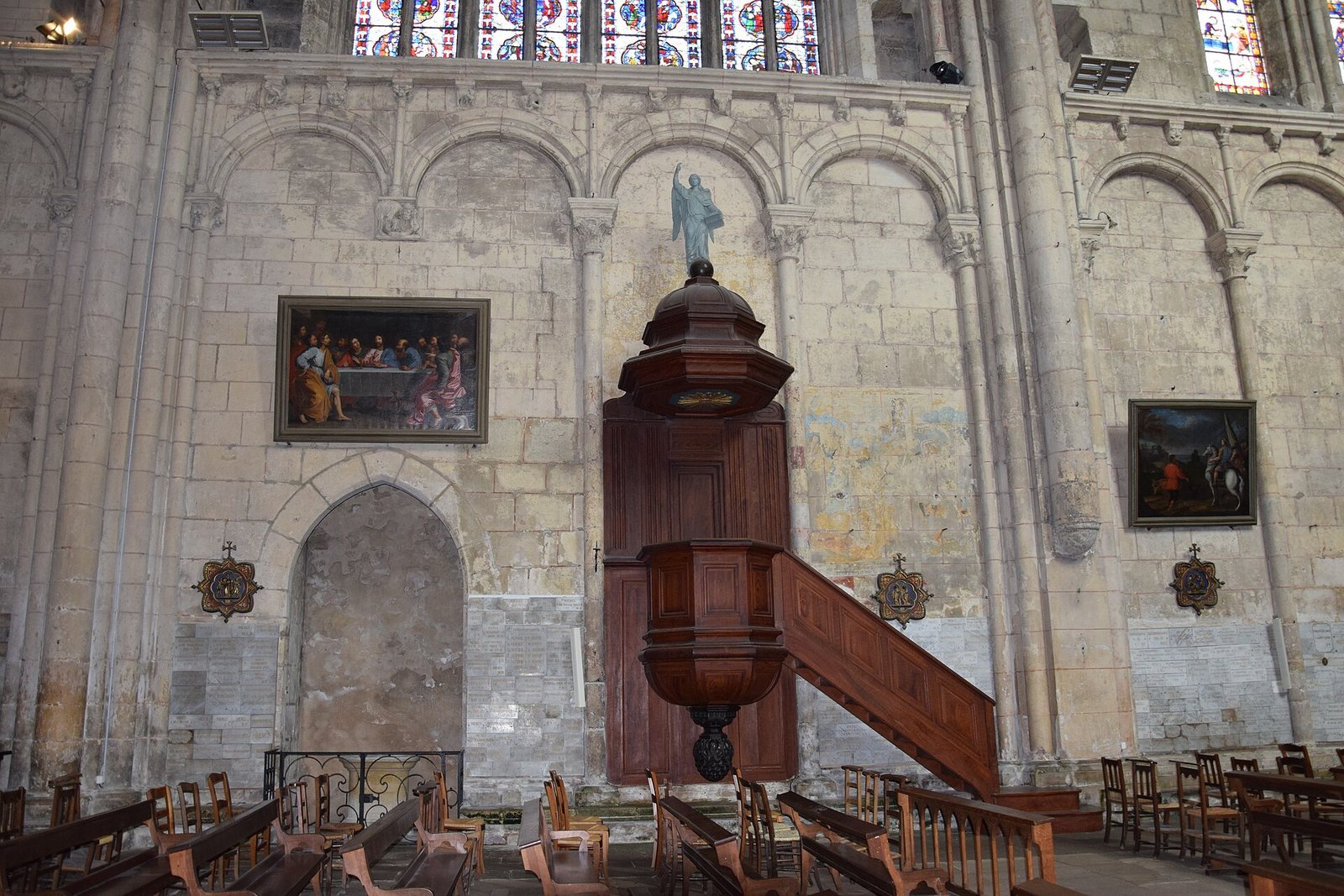
A series of paintings in the nave, mostly from the seventeenth century, depicts Gospel episodes and saints. Many have similar dimensions and may share an unidentified painter. Subjects include the Annunciation, the Adoration of the Shepherds, the Presentation in the Temple, the Last Supper, and the Crucifixion, alongside Saint Sebastian, Radegund’s Miracle of the Oats, and Saint Charles Borromeo with episodes from his life. The Saint Sebastian painting dates to the eighteenth century and came from the partition between the nave and chancel, which was destroyed in 1772.
Chapter room
A chapter room, also called the Chapel of Mary Magdalene, adjoins the south wall of the nave. Dating from the late twelfth or early thirteenth century, it has Angevin-style architecture and a vault with eight ribs. Carved supports depict figures, and the central stone of the vault shows Christ blessing. Canons used the room as an oratory; it also contains numerous busts of kings and queens.
Choir and crypt
Choir and apse
The seven-sided apse, the sanctuary’s eastern end, is encircled by an ambulatory and semicircular Romanesque chapels. The central chapel dates to the eleventh century and is dedicated to the Virgin Mary. Columns in the apse carry carved capitals with acanthus-leaf patterns, rearing four-legged animals, and lions. One narrative carving combines Original Sin, the Christian belief in a sinful condition inherited from Adam and Eve, with the biblical story of Daniel in the lions’ den. The prophet appears between Habakkuk and an angel as lions lick his feet. The choir ceilings have rounded arches.
Paintings in the choir were uncovered in 1849. In the nineteenth century, Honoré Hivonnait repainted them in a Neo-Gothic style rather than limiting his work to conservation, and the original painted surface was lost. Their arrangement in earthly and celestial registers remains coherent. The scenes include the Virgin, Radegund in a red robe with a pastoral staff, her companions from Sainte-Croix Abbey, and saints connected with her life. Christ in Majesty appears above, while episodes from Radegund’s life occupy the upper apse walls on either side of a bust of Christ.
Stained glass made by the Lobin workshop of Tours was installed in three campaigns: in the sanctuary from 1857 to 1859, the central chapel from 1867 to 1869, and the ambulatory and small radiating chapels from 1871 to 1872. Its coordinated subjects include Christ, the Virgin, and the saints, with Radegund central to the scheme. In the upper choir, the central window depicts the True Cross, traditionally identified as the cross of Jesus, with the mystical Lamb, a symbol of Christ as the sacrificial Lamb of God. Radegund and her friend and adviser Saint Fortunatus flank it. A mosaic at the entrance to the crypt displays the French royal fleur-de-lis arms, recalling Radegund’s royal status.
Crypt and tomb
A staircase beneath the choir descends to a small funerary chamber. The surrounding passage gives access to three radiating chapels dedicated to Radegund’s companions and disciples, including Saint Agnes and Saint Disciole. The present staircase dates to the nineteenth century and replaced two smaller stairs at the sides.
Radegund’s tomb stands at the presumed site of her burial in 587. The grey-black marble sarcophagus has been repaired with metal clamps and contains a lead casket holding charred human bones that may be hers. Near it is a white-marble statue of Radegund commissioned from Parisian sculptor Nicolas Legendre in 1653. Her face resembles Anne of Austria, and her clothing combines monastic and royal dress: veil, wimple, robe, prayer book, fleur-de-lis mantle, sceptre, and crown. A black-marble devotional offering at the crypt entrance recalls the silver lamp once hung above the tomb. Other offerings cover the staircase sides, and an urn near the statue receives prayer intentions to be passed to the nuns of Sainte-Croix Abbey.
The Footprint of God group
A tomb set into a wall niche contains the seventeenth-century terracotta group known as the Pas-de-Dieu, meaning Footprint of God. A workshop in Le Mans made the figures in the style of Gervais de la Barre, assembling them from separate pieces. Radegund kneels before a standing Christ in religious dress and a fleur-de-lis mantle. Beneath the figures, a stone bears a footprint-shaped hollow. Popular tradition holds that Christ made the mark during an apparition to Radegund a year before her death; the nun Baudonivie wrote about the apparition, while the footprint itself belongs to later tradition. The stone was first kept in a chapel at Sainte-Croix Abbey, where pilgrims touched and scraped it, prompting the installation of protective grilles around the stone and statues. After the chapel was destroyed in 1792, the group and stone were transferred to this church.
The Virgin and Child statue once installed in the chapel on Pont Joubert is now in the ambulatory.
Organ and bells
Organ
The church’s organ tradition dates to the Middle Ages. After earlier instruments were lost, a new organ was commissioned in 1892 and inaugurated in 1894. Architect Jean Formigé designed its metal gallery and Neo-Gothic case. The replacement instrument incorporates the earlier organ’s façade and has 53 stops and four keyboards.
Bells
The bell tower holds three bells. Radegonde, cast in 1803, weighs 454 kilograms. Its inscription invokes the unity of peoples in service to God and names the first year of Bishop Jean-Baptiste Luc Bailly’s episcopate. Marie was also cast in 1803. Louise, weighing 1.5 tonnes, was cast on 18 December 1613; its inscription refers to its fleur-de-lis and royal character and names the reign of Louis XIII.