Umm al-Amad: A Phoenician Religious Center in Lebanon
Site at a Glance
- Popularity
- Medium
- Country
- Lebanon
- Primary era
- Classical
- Eras represented
- Iron Age, Classical
- Civilizations
- Achaemenid, Phoenician, Ptolemaic
- Site type
- Religious
- Remains
- Sanctuary
On this page13 sections
History
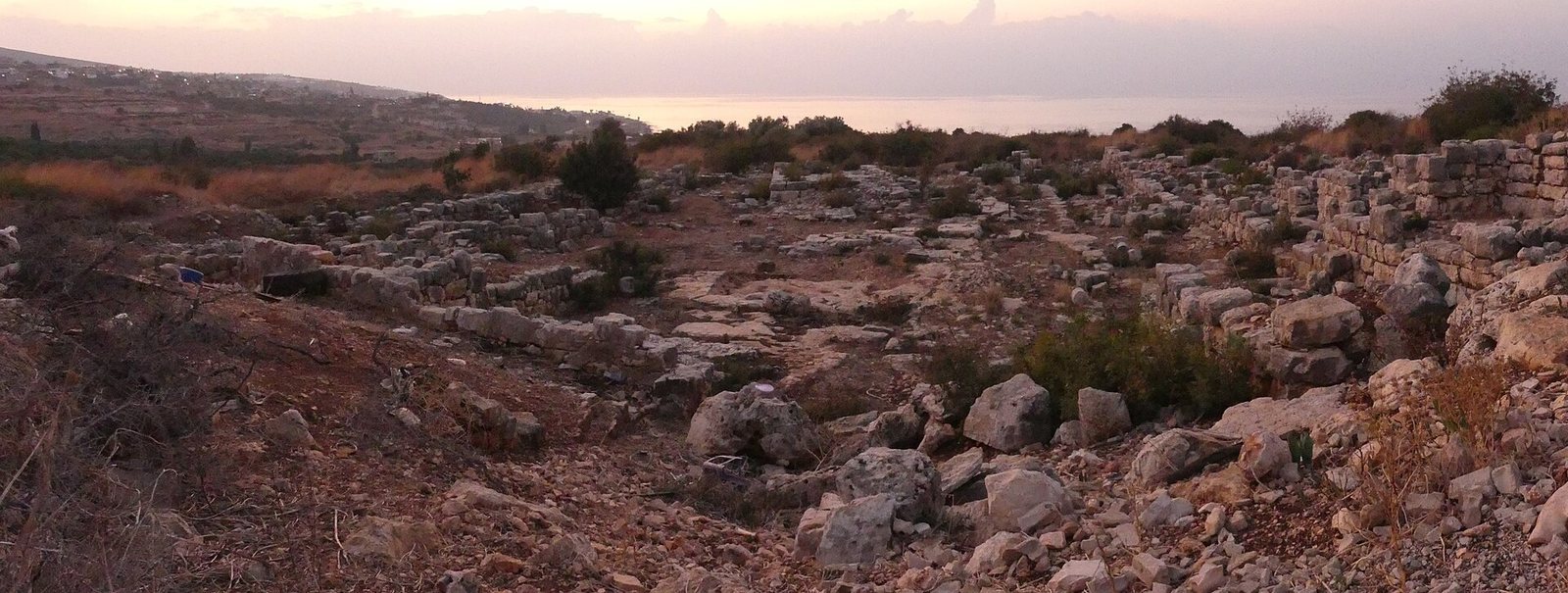
Umm al-Amad is an ancient Phoenician settlement near Naqoura in Lebanon. Its earliest excavated structures date to the Persian period, while its principal remains belong to the Hellenistic period, the era after Alexander the Great’s conquests when Greek political and cultural influence spread. The city served as a center of Phoenician worship, especially of Baal Hamon, a Phoenician deity. The date when the settlement was first built remains uncertain.
Early evidence and origins
Two finely serrated flint sickle blades from the Early Neolithic indicate that people cultivated fields in the area at that time. Imported pottery from Cyprus, dated to the eighth century BCE, points to activity during the Iron Age. The earliest excavated building remains belong to the Persian period and include foundations of the Temple of Milk‘ashtart.
The ancient name of the settlement is unknown. Hamon has been proposed as an identification because its position fits the sequence of towns in Joshua 19:28, assigned to the ancient Israelite tribe of Asher, and because nearby place names include Wadi Hamul, the village of Hamul, and a fortress ruin whose name also includes Hamul. Alexandrouskene is another proposed ancient name. Traditions link Asoros, described as the founder of Carthage, a Phoenician-founded city in North Africa, with Asher. An inscription from Umm al-Amad names a deity called Asser. Baal Hamon, an important Carthaginian deity, may have originated at Hamon and taken its name from the town. Inscriptions from the site point to a religious tradition combining Hebrew and Canaanite elements.
Temples and Hellenistic activity
The city’s initial construction is placed either in the Persian or the Hellenistic period, but its precise date has not been established. The temples are estimated to have been built between 287 and 222 BCE, and most of their known activity belongs to the Hellenistic era. Umm al-Amad represents a late phase of Phoenician culture under Greek rule. Its religious life included worship of Astarte, a major Phoenician goddess, as well as Baal Hamon.
Settlement activity may have ended before Rome conquered the region in 64 BCE. The site was later occupied again during the Byzantine period, when the region was under Byzantine imperial rule.
Exploration and excavation
European awareness of Umm al-Amad dates to the 1770s. French artist and architectural draughtsman Louis-François Cassas recorded the ruins in the late eighteenth century, and French archaeologist and diplomat Melchior de Vogüé explored them in 1853. Ernest Renan began excavations in 1861 as part of a French archaeological mission, but stopped after judging that the remains were Hellenistic or later.
Eustache de Lorey excavated at the site in 1921 and published photographs of the work. Maurice Dunand led further excavations from 1943 to 1945 and later published their results in a two-volume study. In 2024, during the Israeli invasion of Lebanon, UNESCO placed Umm al-Amad under enhanced protection as part of a group of 34 Lebanese cultural sites, with the aim of helping protect them from damage.
Remains
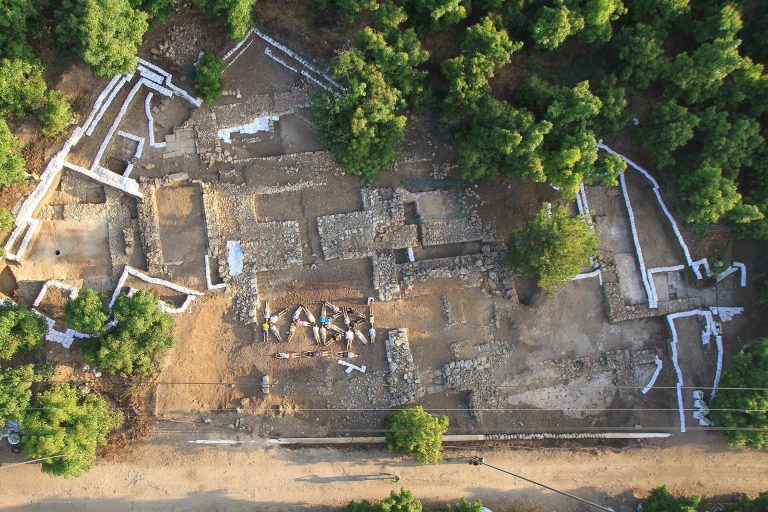
The site covers more than 60,000 square metres on sloping ground beside Wadi Hamul, a valley or watercourse, on a low hill above a rocky plain overlooking the sea. Its two temple complexes include courtyards, halls, porticoes, and associated rooms. The buildings’ surviving plans show different arrangements, from the grouped structures around the Temple of Milk‘ashtart to the courtyard layout of the Eastern Temple.
Temple complexes
Temple of Milk‘ashtart
At the southwestern end of the site, the Temple of Milk‘ashtart stood within a group of buildings that set it apart from the rest of the settlement. Its arrangement is characteristic of Semitic temples, meaning temples of ancient Near Eastern peoples, while the divided central hall differs from a Greek temple plan. A large hypostyle hall, whose roof was supported by rows of columns, stood to the north; residences and storerooms lay to the south, and a column-supported portico stood to the east. Entry was through a gate on the southeastern side. The complex measured 56 metres from north to south and 61 metres from east to west.
Eastern Temple courtyard and entrances
The Eastern Temple lies 160 metres west of the Temple of Milk‘ashtart. Its buildings and porticoes were arranged around a rectangular courtyard measuring 22 by 35 metres; the full complex measured 35 by 60 metres. A 4.40-metre lintel, a horizontal beam spanning an opening, was found at the complex’s eastern entrance. It bears a winged sun disk and cobra emblems. At either end, a figure in a long tunic and pointed headdress holds a staff topped by a ram’s head, above which appear a star and crescent. This motif has been compared with the horns of Hathor, an ancient Egyptian goddess often shown with cow horns. The entrance to the temple building also had a lintel decorated with a winged sun disk and cobra emblems.
Throne chapel
A room joined to the temple building at the complex’s northwestern corner is interpreted as a throne chapel, a temple room associated with a cult throne. Its surviving outline is L-shaped, although it may originally have been rectangular. The entrance opened from the inner courtyard at the northern end of the room’s eastern wall. Two columns framed the 1.10-metre-wide doorway and supported a 2.22-metre lintel with a winged sun disk and cobra emblems. Below these, a crescent partly encloses a smaller sun disk, a symbol of Baal Hamon.
At the opposite end of the chapel, a platform 1.20 metres high stood at the northwestern end, reached by five steps on its southern side. Fragments of a stone throne of Astarte were found between the platform and the north wall, and the throne may have stood on the raised surface. A smaller stand or platform beside the southern wall may have supported an altar, statue, ritual object, or another throne; it may also have had a decorated lintel.
Ritual images and objects
Thrones, figurines, and sculpture
Two thrones of Astarte were found at Umm al-Amad. Fragments from the Eastern Temple chapel are associated with the worship of Astarte and other Phoenician rites. Twelve terracotta figurines came from the Eastern Temple, including nine from the chapel; they may have been used in Astarte’s worship there. A lion or sphinx sculpture found near the Temple of Milk‘ashtart suggests that a pair of such figures may have stood beside its eastern staircase. A sphinx head associated with an Astarte throne is also among the site’s finds. Astarte-throne objects from the site are held at the National Museum of Beirut and the Louvre.
Stelae and inscriptions
Twenty-three upright stone slabs, or stelae, dated between 400 and 100 BCE show standing figures making an “adoration” gesture. Phoenician inscriptions on stelae relate to religious and family contexts, and one inscription is in Greek. Greek writing also appears on handles of imported storage jars from Rhodes, a Greek island.
Other finds and waterworks
Other finds include a Phoenician sundial discovered by Renan, funerary stelae, inscribed statues and statue bases, and a Greek architectural capital. An inscription from Umm al-Amad is held at the Ny Carlsberg Glyptotek in Copenhagen. A survey in 1881 noted traces of aqueducts at the site.