Akrotiri: A Prehistoric Settlement on Santorini
Site at a Glance
- Popularity
- Very High
- Country
- Greece
- Primary era
- Bronze Age
- Eras represented
- Stone Age, Bronze Age, Modern
- Civilizations
- Greek
- Site type
- City
On this page26 sections
History
Akrotiri is a prehistoric settlement and excavation site on Santorini, Greece, whose Bronze Age town flourished in Late Cycladic I, broadly contemporary with Late Minoan IA on Crete. The settlement’s earliest known occupation dates to the Late Neolithic, when metal tools were not yet widespread, and the town later became a center of trade and craft production in the Aegean.
Neolithic and Early Cycladic settlement
People lived at Akrotiri by about 4500 BC, when the settlement was a coastal village on a low peninsula beside a stream. The site takes its modern name from the nearby village; its ancient name is unknown. Early pottery resembles material from Naxos and Saliagos, while some decorative features have parallels on Rhodes and elsewhere in the Dodecanese, a group of southeastern Aegean islands.
The community expanded around 3000 BC, during Early Cycladic I, a phase of prehistoric island culture. A cemetery on the slope above the settlement provides evidence of this growth. Metalworking is evident from about 2500 BC, in Early Cycladic II. Similarities in pottery and other materials point to connections with the northeastern Aegean, although the suggestion that migrants brought new skills to Akrotiri remains uncertain.
Bronze Age growth and trade
After 2000 BC, in the Middle Cycladic period, Akrotiri developed into an urban settlement. Its growth is associated with Santorini’s position on sea routes between Cyprus and Crete and with the expanding copper trade. As the town spread up the slope, the earlier cemetery was filled in to provide more stable ground. Akrotiri then flourished in Late Cycladic I.
The town’s pottery and other objects reveal strong influence from Minoan civilization, which developed on Crete, alongside distinct local traditions. Imports from Crete made up an estimated 10 to 15 percent of the pottery during the transition to the Late Cycladic period, while Cretan styles gradually influenced local designs. This pattern points to cultural exchange rather than a sudden imposition of colonial rule. Minoan weights and measures were also used at Akrotiri.
Trade and production underpinned the town’s economy. Linear A, an undeciphered writing system used in Bronze Age Crete and related Aegean settings, appears on tablets from a building complex that record quantities of goods and point to trade in wool and olive oil. Loom weights and evidence of dyeing indicate substantial textile work, probably using wool and perhaps flax from neighboring islands. Buildings and finds also show metalworking, pottery making, wine pressing, milling, and weaving. Goods arrived from Crete, mainland Greece, and Asia Minor. A harbor, shipyards, and related trades are considered likely, though the harbor has not been excavated.
Excavated buildings and wall paintings have been interpreted as evidence of an elite involved in maritime commerce and craft production, rather than rule by a single monarch. The paintings may have served ritual purposes as well as displaying social standing. These interpretations apply to the excavated area and remain provisional.
Earthquakes, eruption, and aftermath
A major earthquake damaged the town several decades before its final destruction, an interval estimated at about 50 years. Residents returned and repaired or rebuilt structures, often reusing earlier foundations. Some rubble was used to raise street levels, and the settlement continued to be occupied and to expand.
A further earthquake appears to have occurred before the volcanic disaster. Residents seem to have evacuated, though some returned to clear streets, take down damaged walls, sort reusable materials, and gather household goods. The evacuation was incomplete when the Theran eruption began. The scarcity of valuables and costly tools has been interpreted as evidence that many people had time to leave with their possessions; what happened to those who fled is unknown.
The eruption buried Akrotiri in successive deposits of pumice, ash, and volcanic blocks. An early, relatively light layer brought down roofs but helped shield buildings from later, more destructive deposits. Blocks reached up to 5 m across at Akrotiri and up to 20 m elsewhere on Santorini. Heavy rain after the eruption carried mud and ash into some rooms, where rapid burial preserved their contents.
The eruption’s date remains disputed. Comparisons between pottery from Crete and Egypt have supported a date around 1530 BC, while radiocarbon and volcanic-ash evidence point to the 1620s BC. Another radiocarbon estimate places it between 1627 and 1600 BC, with 1613–1614 BC proposed as especially likely. The differing dates affect the chronology of other Mediterranean cultures.
Archaeologist Spyridon Marinatos initially argued that the eruption and its aftermath brought about the collapse of Minoan civilization on Crete, and connected the disaster with the Atlantis tradition. Later archaeological work substantially revised that view: Minoan society appears to have been disrupted, then to have declined over a longer period rather than being destroyed at once. The identification of Santorini with Plato’s Atlantis remains unsupported.
Later evidence for activity on Santorini is sparse. Isolated Mycenaean pottery of about 1200 BC was found near Monolithos. An ancient tradition describes a Phoenician settlement, but it has not been demonstrated archaeologically. In the ninth century BC, Dorians established an important settlement elsewhere on the island, at ancient Thera on Mount Messavouno, not at Akrotiri.
Medieval Akrotiri
During Latin rule, when Western European rulers controlled parts of Greece after the Fourth Crusade, the medieval settlement of Akrotiri was one of Santorini’s fortified centers. It was known as La Ponta. In 1336, Niccolò Sanudo, Duke of Naxos, granted it as a fief, land held from a superior ruler, to the Gozzadini family of Bologna. The family retained the fief after the Ottoman conquest of the rest of Santorini, partly because of its non-Venetian origins and the castle’s defenses. The area passed to Ottoman control in 1617. The Goulas fortress in the modern village above the prehistoric site was badly damaged in the 1956 earthquake.
Rediscovery and excavation
In 1867, while a French company extracted pumice and volcanic earth for the Suez Canal, geologist Ferdinand André Fouqué noted prehistoric walls and pottery on Santorini, including in a valley below Akrotiri. French archaeologists carried out further excavations in 1870. In 1899, Robert Zahn excavated a house and found fishing-net remains, a gold necklace, pottery, and a storage jar bearing an inscription later identified as Linear A.
Systematic excavation began on 25 May 1967 under Marinatos. After his death in an accident at the site in 1974, his former assistant Christos Doumas continued the work. Marinatos was buried at Akrotiri, where a memorial and bust commemorate him. Excavation has exposed about 1.4 to 2 hectares of a much larger town; most opened areas show the settlement near the time of the eruption, while limited trenches have reached earlier layers containing material from the Neolithic through successive Cycladic periods.
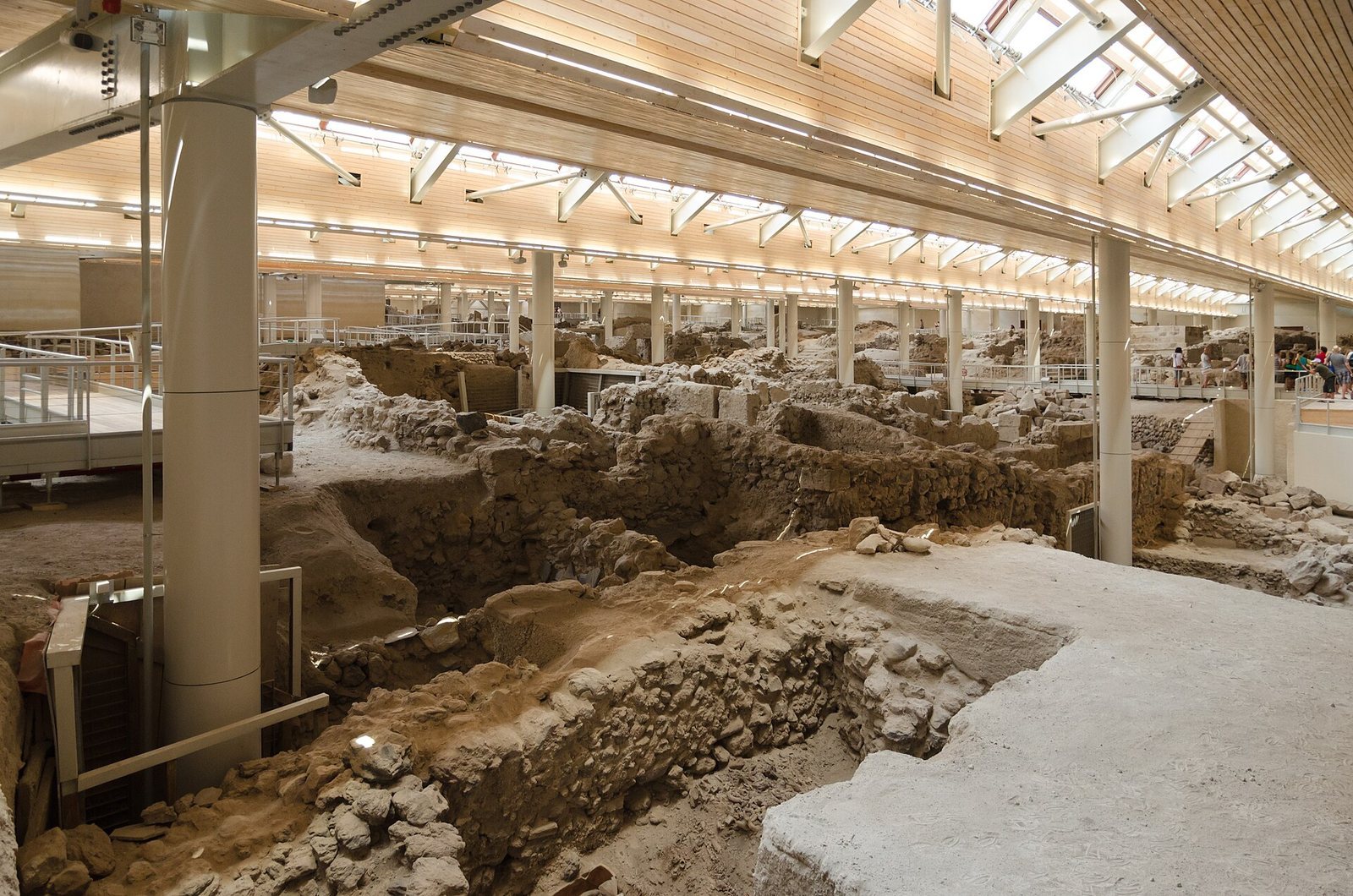
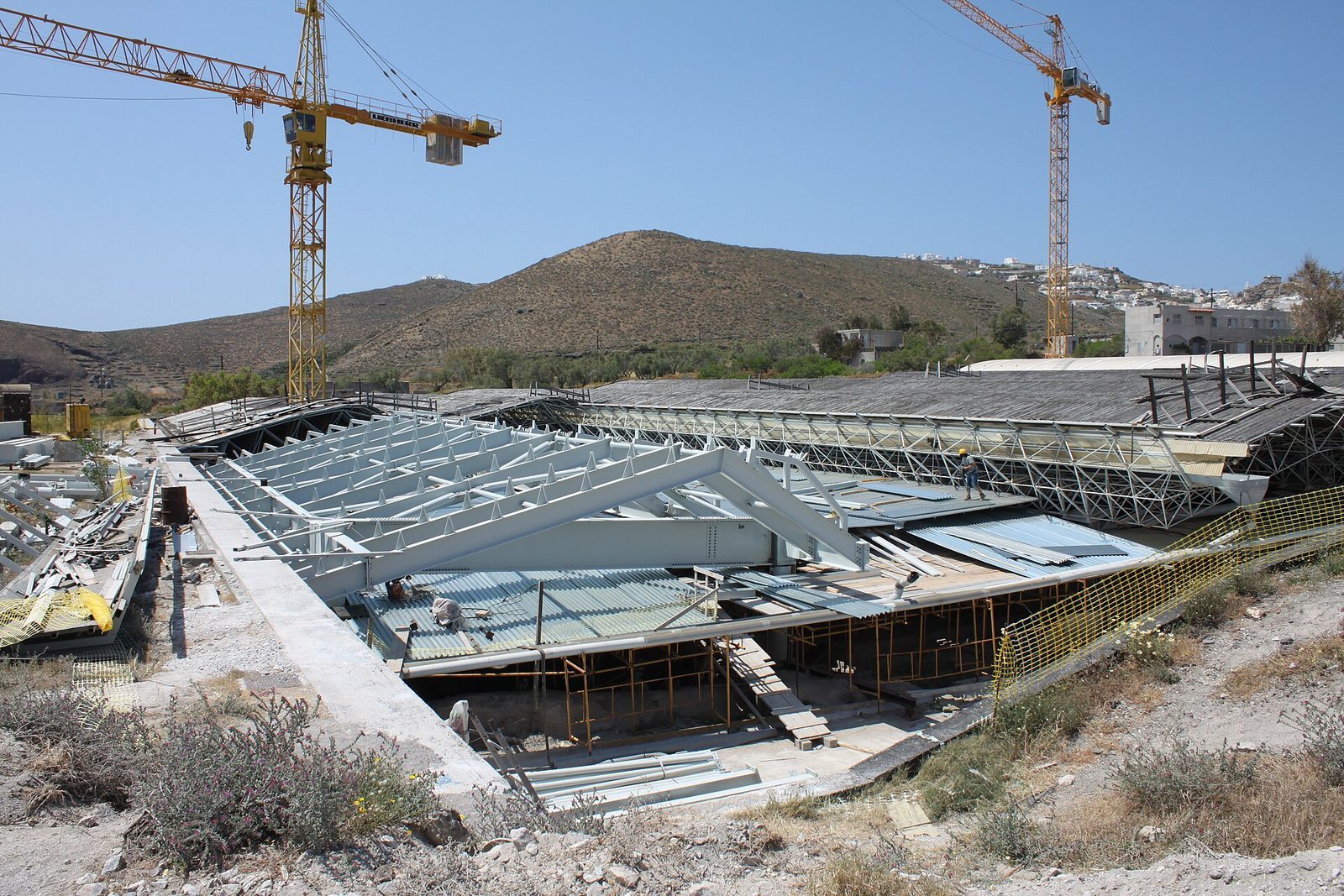
A protective roof was installed from 1968 to shelter the exposed remains. A replacement project begun in the late 1990s led to construction of a new structure in the early 2000s. Part of it collapsed in September 2005 before completion, killing one visitor and injuring six. The partly excavated Delta complex beneath the collapse largely survived, supported by its infill, earlier concrete consolidation, and the remaining older roof. A revised shelter was built in 2010–2011, and excavation resumed in 2011. Wall paintings were removed for restoration in Athens; most are now displayed in the National Archaeological Museum there, with others at the Museum of Prehistoric Thera in Fira.
Remains
The excavated Bronze Age town occupies a slope on a small peninsula that was formerly flat, about 200 m from the present coast. A stream beside the settlement still flowed in antiquity, and the terrain supported agriculture as well as access to the sea. The exposed town is densely built, with multistory houses, paved streets, open squares, workshops, storerooms, and drains. Its buildings commonly used volcanic stone, clay, timber, and cut stone.
Streets, squares, and construction
Street network and squares
Before the major earthquake, large stone slabs paved streets above drains laid at a steady gradient. In rebuilt areas, smaller stones raised the street surfaces over the earlier paving and drainage. Ramps and steps bridged changes in level, while retaining walls supported buildings, streets, and squares on different heights.
Telchines Street is the longest exposed stretch. It climbs northward from the south, bends around building corners, and measures about 2 to 2.2 m wide, widening at intervals into squares. Its name refers to a metalworking workshop beside the road. The street runs from the Square of Xeste 3 toward the Mill Square and appears to have continued toward the town’s harbor. Other excavated open spaces include the Triangle Square and the Cenotaph Square, formed as a square in Late Cycladic I.
Houses and infrastructure
Most houses had two or three storeys. Rough volcanic tuff, rock made from compacted volcanic ash and fragments, was bonded with clay and mud mixed with straw. Timber supported floors, lintels, and some wall frames; cut stone was used for corners, facades, stairs, and other elements. Some timber-framed walls may have helped buildings withstand earthquakes. Larger buildings with cut-stone facades were called Xestes by Marinatos, meaning stone-faced buildings.
Ground floors and basements commonly held workshops, shops, storage, and food-preparation areas, while upper floors included living rooms and decorated spaces. Entrances were generally near a corner, often with a small window beside the door, and a principal staircase stood behind the entrance. Large rooms could have a central wooden post resting on a stone base. Upper floors used lighter timber-framed walls, sometimes with rows of windows or built-in cupboards. Multi-door wooden partitions, called polythyra, could join adjoining rooms, leave a passage open, or close rooms off. A light well, an open shaft that brings light indoors, survives in the House of the Ladies.
Plain rooms generally had compacted-earth floors; ceremonial spaces could have slate paving or simple mosaics of stones and shells. Walls were plastered, usually with clay in work and storage rooms and lime in living rooms. Lime plaster ranged in color from pink to beige. Roofs were probably flat, made from branches or reeds beneath compacted earth and pebbles, though their original form is not fully preserved. Upper-storey bathrooms connected to the street drains by baked-clay pipes that ran through exterior walls. A short section of sturdy terracotta pipe may have carried spring water, while rainwater drained into the streets and sewers.
Public and ceremonial buildings
Delta complex
The four-building Delta complex stands on the northeast side of the Mill Square and was first called Xeste 1. The buildings are divided by walls. In the small semibasement room D2, a door and double window open onto a space whose south, west, and north walls carry the Spring Fresco. A bed stood before the south wall, with pottery beneath it. Room D15 held a flour millstone, while D16 contained substantial pottery remains and may have served as a pottery workshop. Fragments of two or perhaps three Linear A inscriptions came from D18A, and numerous clay sealings, probably of Cretan origin, came from D18B.
Xeste 3
On the southwest side of the excavation, Xeste 3 is a large two-storey building with 14 rooms on each floor. Some rooms connect through multi-door partitions, and the building contains more wall paintings than any other so far identified at Akrotiri. One ground-floor room has a sunken section reached by steps, interpreted first as a basin for ritual washing and later as a restricted sacred space. A niche in the room is understood as a shrine, where a pair of stone bull horns was found. Above the installation, a painted portal is topped by horns from which blood appears to flow.
Paintings in the building include three women, one holding an injured foot as two others present a necklace and a garment. A partitioned area shows four male figures, including a child. Upper rooms contain further richly painted spaces thought to have had religious use. The Saffron Gatherers scene extends along the north and east walls, although only parts survive. It depicts a seated woman with a griffin, a young woman apparently scattering crocus, a blue monkey offering a bowl, and two women gathering saffron. Their relationship has been interpreted as teacher and pupil, and the scene as an initiation rite, but the paintings’ full meaning remains uncertain.
Xeste 4
Southeast of the excavated area, Xeste 4 is the largest building found so far. It has three storeys and is not fully excavated. Rectangular blocks of carved volcanic tuff face all its sides, and the building may have served a public purpose. A fragment of a frieze in Room 2 shows life-size boar’s-tusk helmets. Its staircase contains the Spear-bearers painting, the largest painted composition found at Akrotiri so far. Kouretes Street runs south of the building, while Building IA, also known as the House of Fine Vessels, lies to its north.
Houses, workshops, and storage
West House
The West House has a perimeter of 49.65 m. Its ground floor contained food stores, workshops, a kitchen, and a miller’s area. On the first floor were a room with looms, a storeroom, a lavatory, and painted rooms. One room shows eight ships with cabins; another contains two paintings of fishermen, a young priestess near the southeast entrance, a river scene, and the Fleet Fresco, a small-scale composition that runs along all four walls. A short staircase suggests that the building may also have had a third storey or attic.
The wall paintings combine ceremonies, armed figures, landscapes, animals, and seafaring. The Fleet Fresco shows at least eight boats travelling between a smaller settlement and a larger decorated one. The interpretation of the scene as a spring celebration marking the start of sailing is conjectural. Painted townscapes depict buildings with large windows, flat roofs, and varied wall finishes. They also include a sacred precinct and a possible harbor installation with parallel chambers where boats could be sheltered and repaired. These are painted subjects, not excavated buildings.
Sector A and the northern storehouses
At the north end of the excavation, Sector A, also called the Storehouse of the Pithoi, contains three large rooms with numerous storage jars. Their contents included pulses, flour, and barley. A neighboring mill held milling equipment and a basket containing fish and sea urchins.
Other excavated houses and workshops
The House of the Ladies is a large two-storey building with a central light well. Its name comes from female figures painted in Room 1; paintings of papyrus were found in the room’s western part. Near Xeste 3, the House of the Benches takes its name from benches in the entrance hall. A small part of the House of the Thrania, which retains a built bench in its entrance hall, has also been excavated.
Building C stands on the west side of the beginning of Telchines Street, opposite Building B. Stoneworkers were repairing earthquake damage in rooms C1 and C2 before the eruption. Building B, which may comprise two attached structures, had at least two storeys; a watercourse along its east side caused considerable damage. Its paintings include the Boxers and Antelopes in Room B1 and Blue Monkeys and quadruped fragments in Room B6. The House of the Anchor, north of the Mill Square, takes its name from a dark stone weighing 65 kg, with a hole and interpreted as an anchor, assigned to the Middle Cycladic period.
Cemetery chambers and ritual deposits
Early cemetery
The early settlement’s cemetery occupied the slope above the peninsula. Its chambers were cut into relatively soft volcanic rock, an unusual form in the Cycladic Bronze Age, when graves built from stone slabs were more common. Suitable slabs were scarce locally. The cemetery was abandoned toward the end of Early Cycladic II, and its chambers were later filled with stones and collapsed wall debris as the town expanded uphill.
Cenotaph Square
Some chambers beneath the Cenotaph Square are shallow and open above; others lie more than a metre below ground, with rock-cut vaulted ceilings reached by a covered passage. They were filled with earth and gravel during the town’s flourishing period. One chamber contained the cremated remains of children and ash in vessels.
A mound of large flat stones, boulders, and smaller rocks gave the square its name. It was initially interpreted as a cenotaph, a symbolic tomb or memorial without the deceased. A small stone bowl with rounded pebbles lay at its edge, and a deposit of Cycladic figurines was found within it. Seventeen figurines came from the square; ten were placed together in a niche with a bronze knife and obsidian tools. Twenty more figurines were found elsewhere at Akrotiri. The deposit dates to Early Cycladic III, around 2200–2000 BC, centuries before the eruption.
Sacrificial Fire
Northeast of the Delta complex, at a deeper level than the mound, a floor area with pronounced burning, animal bones, horns, and pottery is known as the Sacrificial Fire. Finds include ash, goat horns, pottery figures of cattle, vessels, and a large storage jar containing beans. Nearby installations south of the square have been interpreted as possibly cultic. A low stone enclosure west of the burned area contained a portable hearth or oven and a roughly 1.3 m-high storage jar carved from a single piece of volcanic rock.
Paintings and movable finds
Wall paintings
Paintings survive in both domestic rooms and larger buildings, especially on upper floors. Their subjects include geometric patterns, daily and ritual activities, sports, seafaring, landscapes, plants, and animals. The West House’s Fleet Fresco is among the detailed maritime scenes: its boats carry five to 24 rowers on the visible side, with cabins or tents at the stern and sometimes the bow. Most are propelled by oars; one is shown under sail. The paintings also depict dolphins, fish, water birds, deer, cattle, griffins, monkeys, and a range of plants. Some animals and artistic conventions point to influences from outside the Aegean.
Painters generally began work on damp plaster and finished on a dry surface, leaving the paint unevenly attached in places. The palette includes white, yellow ochre, dark red, blue, and black, while green is rare. Blue pigments included Egyptian blue and minerals such as glaucophane or riebeckite. Analysis of details in the Saffron Gatherers scene identified purple made from processed murex shells, which were used to produce dye. The paintings’ colors could define forms and contrast rather than reproduce natural appearances.
Household and craft objects
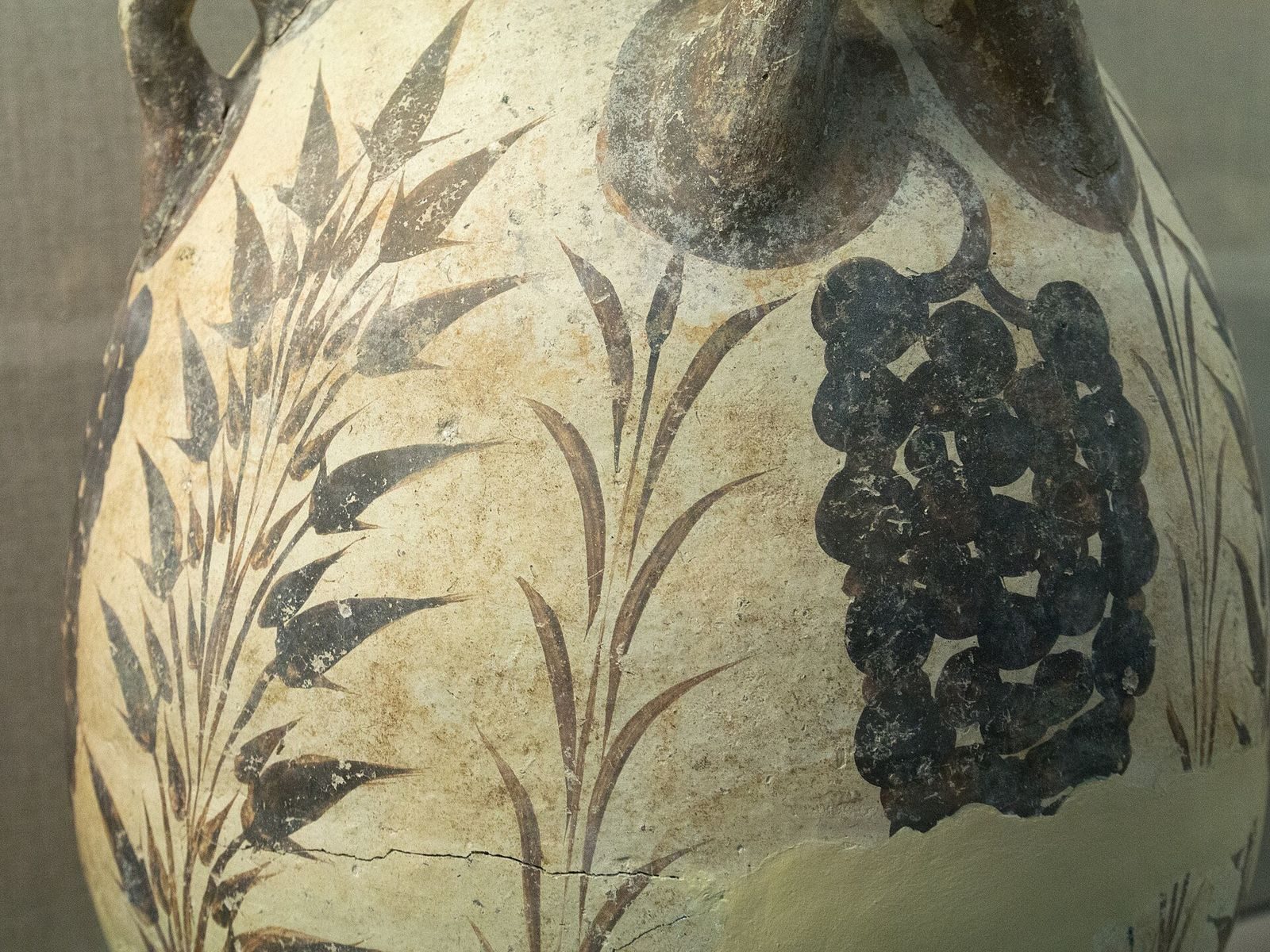
Excavated objects include stone hammers and mortars, bronze hooks, knives, chisels and sickles, lead weights, pottery for storage and daily use, loom weights, millstones, water containers, ovens, and other tools. Tablets and sealings from the Delta complex, along with a Linear A inscription on a storage vessel excavated by Zahn, add evidence for writing and the handling of goods. Wooden furniture and other perishable items were preserved as impressions in volcanic deposits and recreated as plaster casts. These finds include beds, tables, chairs, stools, baskets, mats, and wooden clappers from Xeste 4 decorated with birds and crocuses.
Figurines and the gold goat
The figurine finds include abstract forms shaped like naturally smoothed stones and more lifelike examples. The assemblage comprises 26 abstract and 11 figurative idols. Most abstract examples date to the fourth millennium BC, while canonical forms belong to the Early Cycladic period, up to about 2500 BC. Two marble harp-player figurines attributed to a tomb on Santorini are now in the Baden State Museum in Karlsruhe; their connection with Akrotiri is possible but uncertain.
A small clay container holding a gold goat figurine was found in 1999 near Xeste 3, beside a deposit of about 300 to 500 cattle, sheep, and goat horns. Most horns showed signs of fire and had their keratin coverings removed; some were painted with ochre. The goat is 11 cm long, 9 cm high, and weighs 180 g. Its head and body were made by casting metal around a wax model, while its legs, neck, and rectangular base were attached later with bronze solder. Impressions and pigment traces show that it had been kept in a red wooden box. The figurine is displayed at the Museum of Prehistoric Thera in Fira.