Abbey of Saint-Antoine-l’Abbaye: Mother House of the Antonine Order
Site at a Glance
- Popularity
- High
- Country
- France
- Primary era
- Medieval
- Eras represented
- Medieval, Early Modern, Modern
- Civilizations
- French, Holy Roman Empire
- Site type
- Religious
- Remains
- Monastery
On this page11 sections
History
The Abbey of Saint-Antoine-l’Abbaye is a religious complex in France that became the mother house of the Hospitaller Order of Saint Anthony. Its church developed from an early Romanesque foundation and underwent a major Gothic building campaign from around 1280.
Foundation, relics, and care for the sick
Tradition traces the abbey’s beginnings to the knight Jocelin de Châteauneuf. After recovering from illness through the intercession of Anthony the Great, an early Christian Egyptian ascetic whose example shaped monasticism, Jocelin was said to have fulfilled a vow by travelling to the Holy Land around 1074. He brought Anthony’s relics back from the Thebaid, a region of Upper Egypt associated with early Christian monastic life, and began a larger church. Jocelin died before much work had been completed, and his brother-in-law Guigues Didier continued the project.
In 1083, Guigues endowed monks from Montmajour Abbey to provide religious services at Notre-Dame parish and the church of Saint-Didier within the castle. Bishop Gontard of Valence, who was administering the vacant see of Vienne, approved a Benedictine priory at Saint-Antoine. The monks arrived in 1088 and began a priory and Romanesque church. Pope Urban II allowed them to keep Anthony’s relics there. Pope Callixtus II consecrated the first church on 20 March 1119. It was dedicated to the Trinity and the Virgin Mary and placed under Anthony’s patronage.
A separate tradition connects the beginnings of the hospital community to Guérin de Valloire. After recovering in 1089 from the illness then called the sacred fire, he vowed to serve the sick. Around 1095, he and his father, Gaston, established a charitable community of lay brothers, a hospice, and a house offering alms near the priory. The institutions cared for people with contagious diseases, including leprosy, bubonic plague, and the sacred fire, an illness caused by ergot toxins.
Anthony’s relics attracted pilgrims seeking his protection. The abbey also stood on a pilgrimage route between Germany and Provence associated with the Way of St James, a network of routes leading to Santiago de Compostela in Spain. Around 1200, Saint Hugh of Lincoln, an English bishop and saint, was the oldest notable visitor then recorded as praying at the relics.
Antonine growth and independence
The Antonines, a hospitaller order devoted especially to serving people afflicted by the sacred fire, initially attended services in the priory church. Disagreement with the Benedictines sharpened in 1191, when the Benedictines challenged the Antonine leader Pierre Soffred over the order’s right to collect donations in Anthony’s name. The Antonines sought a church of their own. On 29 January 1208/1209, their leader Falque I received permission from Humbert II, archbishop of Vienne, to build a church dedicated to Our Lady, subject to limits on its size.
By the late twelfth century, the Antonines had nine commanderies in Dauphiné. These were local houses or administrative units that managed an order’s property. One was Sant’Antonio di Ranverso, founded in 1188 in the Susa Valley, and the order had also spread to Hungary. In 1218, Pope Honorius III allowed the brothers to take the three religious vows. They became independent of the Benedictines around 1231, and in 1247 Pope Innocent IV directed them to follow the Rule of the Canons of Saint Augustine, a guide for clergy living a shared religious life.
Pope Alexander IV authorized the Antonines in 1256 to build a hospital near the Benedictine priory for people suffering from the burning sickness. Known as the Grand Hospital or Hospital for the Dismembered, it was gradually abandoned and demolished in 1655. Disputes between the two communities continued, including a case over Antonine gifts and bequests brought before the papal court in 1273.
At the end of the thirteenth century, the Benedictines began work on a new main church but left before completing it. In 1289, Antonine leader Aymon de Montagne obtained lifetime possession of the priory from Étienne de Sola de Montarene, abbot of Montmajour. Aymon had earlier bought the lordship from Aymar de Châteauneuf. An armed action led by Pierre de Parnans drove the Benedictines from the priory, and the Antonines took over parish services. Montmajour’s abbot appealed to the archbishop of Vienne in 1293 to restore the abbey’s presence at Saint-Antoine.
The communities also disputed the custody of Anthony’s relics. The abbey claimed them, while another claim held that Montmajour monks had deposited them at Saint-Julien church in Arles on 9 January 1490. On 10 June 1297, Pope Boniface VIII made the priory an independent abbey and the head house of the Antonine order. He required an annual payment to Montmajour as compensation. Aymon de Montagne became the first abbot.
Church building and the settlement
In 1317, Aymon’s successor, Ponce d’Alairac, found the community deeply in debt after negotiations to secure the lordship and priory and establish the abbey. He sought help from the townspeople to enclose the settlement with defences. The settlement below the abbey had grown around its hospitals and pilgrim hostels. It was first called La Motte-aux-Bois, later Saint-Antoine-en-Viennois, a name referring to Anthony’s tomb, and eventually Saint-Antoine-l’Abbaye.
Work on the great church resumed in 1337 under the third abbot, Guillaume Mitte, after a pause of more than 47 years. A bequest from his brother Ponce Mitte helped bring the east end to completion around 1342. The order’s houses and commanderies contributed to the costs, with encouragement from Pope Urban V. Guillaume Mitte’s nephew, who later became abbot Ponce Mitte (1370–1374), commissioned the great refectory.
Construction advanced toward the façade in stages. Work on the last two nave bays and the side aisles took place from 1343 to 1362; the fourth nave bay followed between 1389 and 1417. Vaulting of the nave began in 1400, and the side chapels were finished by 1484.
Conflict, reform, and dispersal
The French Wars of Religion, a period of conflict in France, brought repeated attacks on the abbey. Forces under Baron des Adrets looted it in May and June 1562. During an occupation in 1567, fire damaged the church, and further incursions in 1580 and 1586 left the abbey uninhabitable. Repairs began soon afterward. Seventeenth-century work renewed decoration and added convent buildings.
Efforts to renew the abbey continued in the eighteenth century. After no French novices entered between 1744 and 1746, a successor to abbot Nicolas Gasparini proposed promoting study in science, theology, literature, antiquities, and the arts. Under abbot Étienne Galland, carved woodwork was made for the new sacristy in 1754. In 1766, Louis XV established a Commission of Regulars to investigate problems in monastic orders and recommend reforms. Cardinal Loménie de Brienne influenced royal edicts issued in 1768 and 1773. At the Antonine general chapter held at Saint-Antoine in 1771, he attended as the king’s commissioner and warned that the order could not continue. A chapter in 1774 accepted a proposal to unite with the Order of Saint John of Jerusalem. With papal and royal consent, the union was accepted in 1775 and completed in 1777.
The Hospitallers of Saint John did not remain long at Saint-Antoine. They sold surplus property and entrusted the town with hospitals formerly administered by the Antonines. Canonesses from Tullins, women belonging to a religious community, occupied the abbey from 1787 to 1792. After they left, the convent buildings were sold as national property and the treasury was sealed during the Revolution. Many artworks went to Grenoble, while relics, reliquaries, and other objects stayed at the abbey.
Galland had assembled a cabinet of curiosities that included Egyptian natural-history objects on which the French scholar Jean-François Champollion worked in 1811 and 1812. He asked Jacques Deschamps to organize the collections. Deschamps established the medal collection in 1752 and completed its three-volume catalogue in 1761. In 1777, the Antonine canons gave the medals to Grenoble’s municipal library. On 25 September of that year, the last abbot, Jean Marie Navarre, transferred the cabinet to Grenoble’s natural-history collection, founded in 1773.
Restoration and changing status
Restoration began in 1844 to address damage from the Revolution and bring the church closer to its appearance before the Wars of Religion. Work continued through the nineteenth century, including the installation of stained glass. The church received historic-monument protection in 1840, followed by the entire abbey in 1981. In 1993, protection was extended to the forecourt, retaining wall, monumental portal, and great stair. The church was restored again from 2020 to 2022.
Remains
Site layout and church
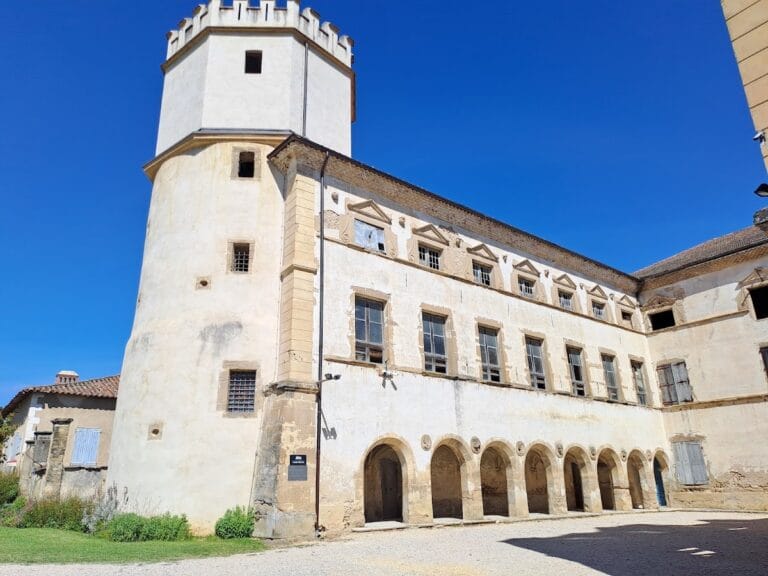
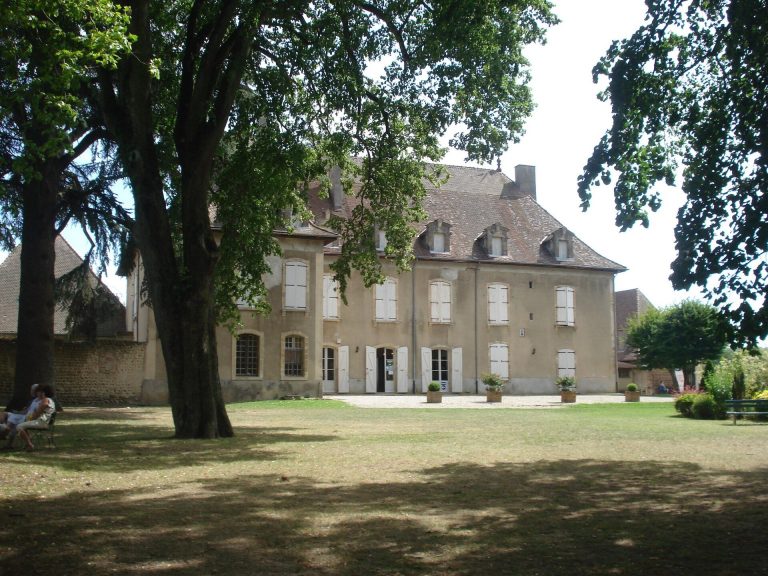
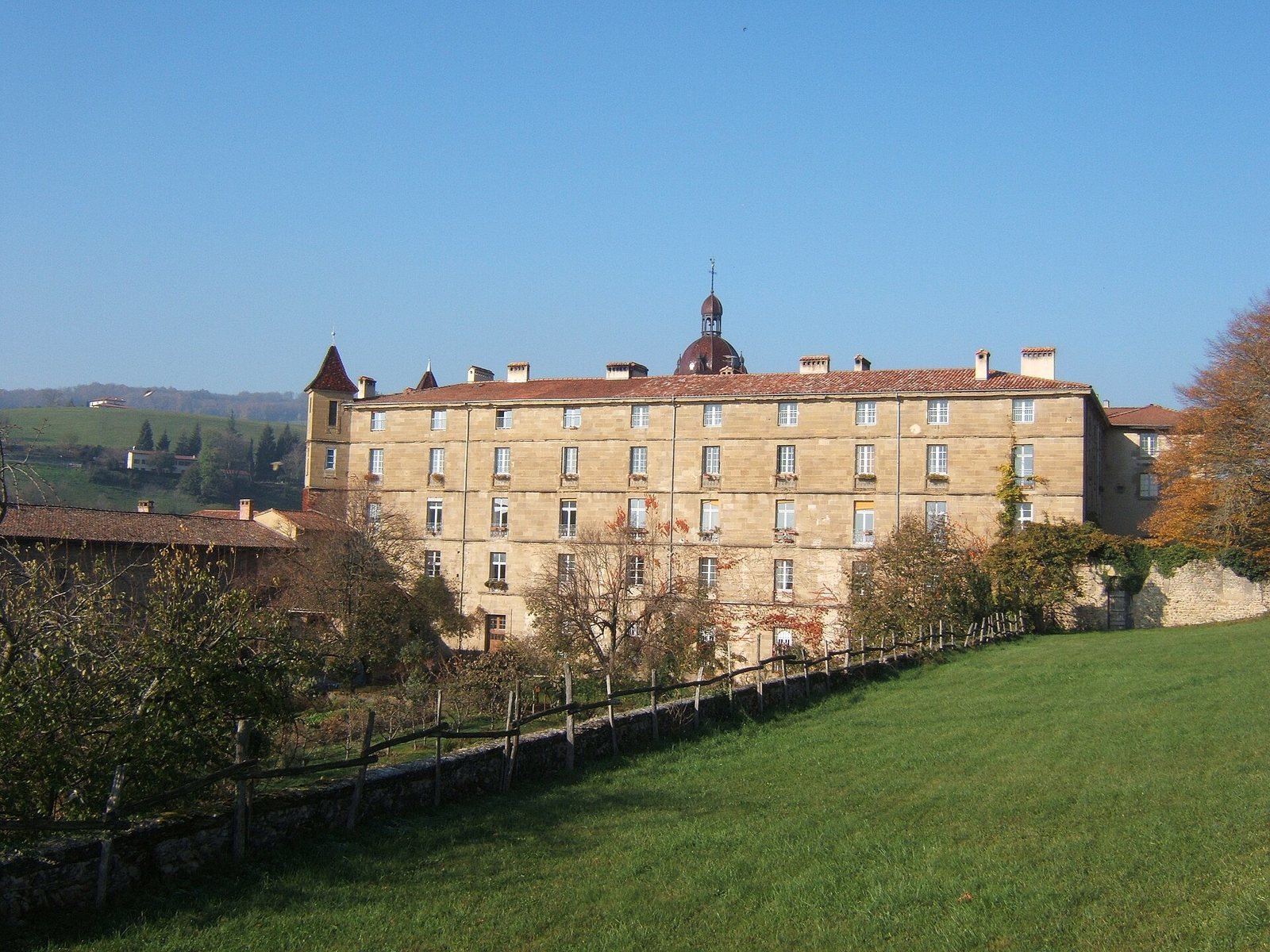
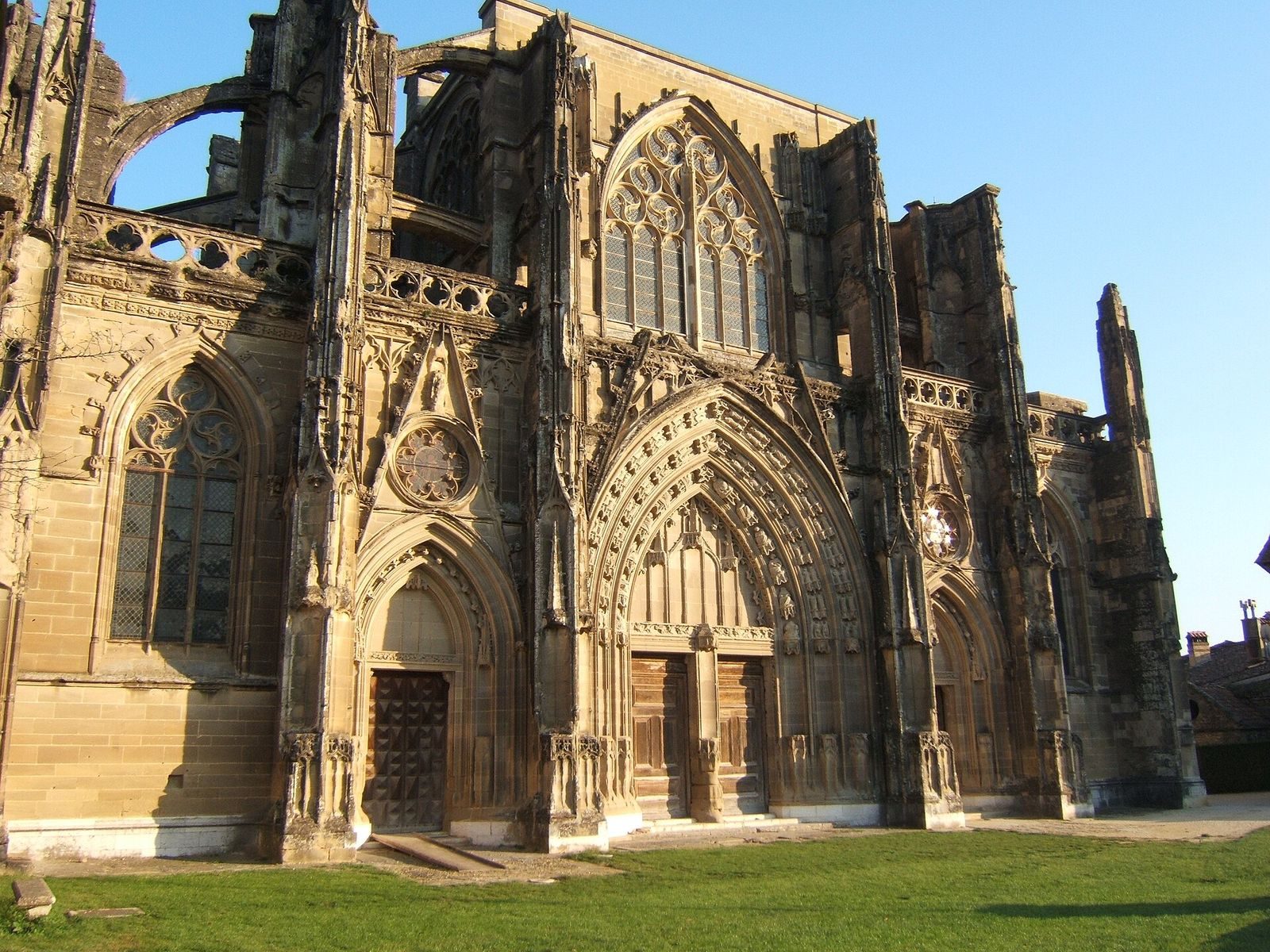
The complex occupies a small spur above the village. Its buildings and grounds include the abbey church, former monks’ accommodation, a substantial gateway, the abbot’s house, a convent wing, a former novitiate, and a monastic garden. The church is principally Gothic, with a change in architectural treatment beyond the triumphal arch that reflects the later building campaign. Its earlier church was Romanesque. The main body, or nave, is divided into bays between structural supports, with side aisles and chapels. The nave’s ceiling was vaulted as construction progressed.
The Wars of Religion left the church with major losses. The glazed-tile roof and bell-tower spire were destroyed, the façade was cut down and stripped of its external supports, and the portal sculptures and Anthony’s original shrine were lost. Repairs to the roof began in 1593 and work on the upper windows followed in 1605. Nineteenth-century restoration added stained-glass windows. Openings through the side-chapel walls created a passage for circulation.
Forecourt and entrance
A retaining wall built between 1405 and 1410 supports the raised ground in front of the church façade. Workers strengthened it from below in 1604 and extended it westward in 1710. The great staircase leading to the forecourt was repaired in 1711, and its portal dates to the seventeenth century.
Monastic and hospital buildings
The great refectory, commissioned by abbot Ponce Mitte, and the cloister were both demolished in the eighteenth century. The hospital near the former Benedictine priory was taken down in 1655; archaeological excavation has uncovered sections of its walls.
The former novitiate dates to the seventeenth and eighteenth centuries and now houses a departmental museum. Its permanent exhibition presents the abbey’s history and the medieval care of the sick. The wider complex also includes the town hall.
Sacristies and treasury
The sacristies contain woodwork in the Louis XV style made from walnut and Hungarian oak. Some of the carving was commissioned under abbot Étienne Galland in 1754. The church treasury comprises about 350 objects and furnishings, including paintings, tapestries, reliquaries, silverwork, and liturgical books. An inventory from 1696 listed 84 paintings, with 53 in the church and 31 in the sacristies. About ten were originals, including two later placed in the Grenoble museum; the rest were copies after Italian masters.
Aymar Falco, a historian of the Antonine order, wrote in 1534 that the church held the remains of more than 80 saints. Beneath the high altar stands the large shrine for Anthony given by Jean du Vache in 1648. The treasury also includes seventeenth- and eighteenth-century vestments, an ivory figure of Christ, and a silver-gilt chalice from the same period.