Nine Ladies: A Bronze Age Stone Circle in Derbyshire
Site at a Glance
- Popularity
- High
- Country
- United Kingdom
- Primary era
- Bronze Age
- Eras represented
- Bronze Age, Modern
- Civilizations
- British
- Site type
- Religious
- Remains
- Sanctuary
On this page13 sections
History
Bronze Age origins
The Nine Ladies is a prehistoric stone circle at the northern end of Stanton Moor in Derbyshire, United Kingdom. It is attributed to the Bronze Age, a prehistoric period associated with the growing use of bronze tools and objects. Archaeologist Aubrey Burl proposed an Early Bronze Age date. The circle may have been built in stages, perhaps beginning as an earthwork before stones were added. Its purpose is unknown, although it has been suggested that its builders regarded the stones as supernatural beings.
The name belongs to a tradition of giving stone monuments female identities. A local legend says that nine women were turned to stone after dancing on the moor on a Sunday.
Antiquarian study and state protection
Antiquaries began writing about the circle in the eighteenth century. In 1782, Hayman Rooke described it as a Druid temple. Thomas Bateman later used a similar label, reflecting a once-popular belief that Druids had built Britain’s prehistoric monuments. Druids were religious specialists known from parts of Iron Age western Europe, but the antiquarian theory associated them with much earlier monuments.
In 1883, archaeologist Augustus Pitt-Rivers drew and measured the circle, recording his view that its centre had been dug into. The Ancient Monuments Protection Act of 1882, an early law protecting ancient sites, included Nine Ladies among 28 scheduled monuments. The circle entered state care in 1883.
Modern investigation and care
Erosion and the drought of 1976 exposed the circle’s tenth stone, which was fully uncovered in 1977. Its place in the original design remains uncertain. A stone wall had been built around the circle by the 1870s, with a separate wall around the King Stone. Both were removed in 1985. In 1987, quarry waste that had been used to fill worn ground was cleared after it was found to threaten the archaeological integrity of the area.
English Heritage commissioned surveys between 1988 and 1997, followed by an excavation in 2000. The team opened six trenches: one at the circle, one at the King Stone, and four at features located through geophysical survey, which uses physical measurements to investigate the ground below. The excavation also prompted a modern religious gesture: someone placed a pentacle, a five-pointed symbol used in some Pagan traditions, on the circle. Pagans may have intended it to protect the land or bless the work.
Modern ritual use and quarry dispute
Modern Pagans have used the circle as a sacred place since at least 1980, and some regard Stanton Moor as a sacred landscape. Wiccans, members of a modern Pagan religion, modern Druids, and Heathens, who draw on pre-Christian northern European traditions, have held rites there to engage with spirits, deities, or ancestors. Some associate the site with a ley line, a supposed alignment between landscape features, or a spirit track. Practices have included seasonal observances, handfastings, which are marriage or commitment ceremonies, as well as chanting, singing, dancing, and pouring libations.
At the summer solstice in 1990, revels at the site caused the King Stone to break off at ground level. It was propped up with extra stones and repaired in 2000. The circle’s modern ritual use also became more prominent during opposition to nearby quarrying.
In 1999, a company applied to reopen the Lees Cross and Endcliffe quarries to extract 2.18 million tonnes of block sandstone over 42 years. Opponents raised concerns about noise, wildlife habitat, and harm to the moor’s archaeology; noise from Dale View Quarry can be heard at the circle. Five campaigners set up the Nine Ladies Anti-Quarry Campaign camp near the site in October 1999. By 2000, around 20 to 30 people were usually there.
In September 2001, Pagans from Birmingham, a Druid group from Dorset, and Druid activist King Arthur Pendragon held a rite intended to protect the stones. Members of the Dragon Network placed images of a design combining runes nearby for the same purpose. Attempts to evict the camp in 2003 and 2005 failed. In 2004, the High Court classified the quarries as dormant, and an appeal upheld the decision in 2005. Quarrying could not resume until the Peak District National Park Authority agreed to working conditions. Permission to quarry near the circle was revoked in 2008, and the camp disbanded in 2010.
Remains
The monument occupies a levelled patch of heathland, although the surrounding ground slopes down to the east and northeast. The circle is made from locally sourced millstone grit, a medium-grained sandstone, and a separate monolith stands to its southwest. The site lies about 297 to 298 metres above the standard reference level used to state elevations.
The stone circle
Ring and stones
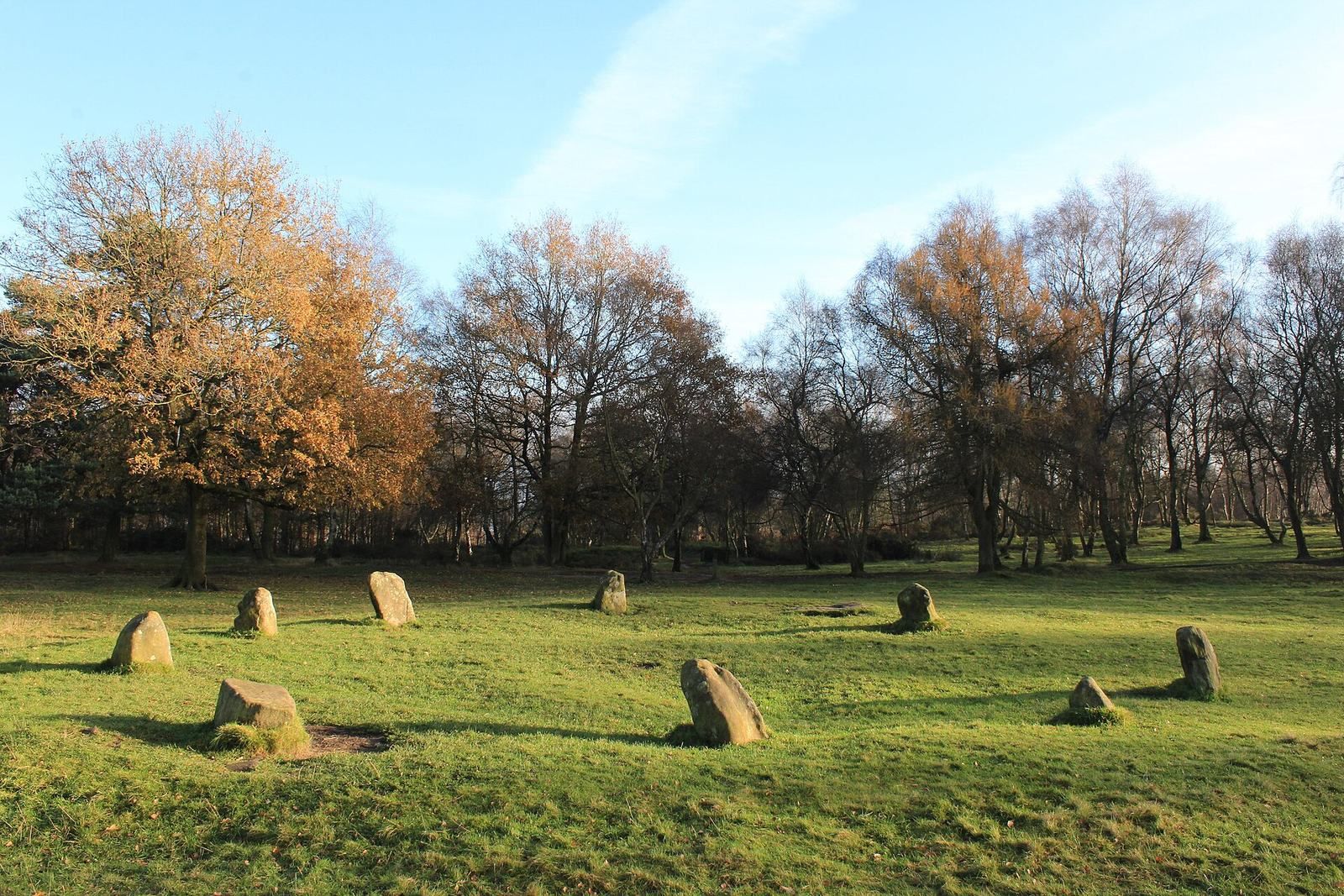
The ring measures about 11 metres across; another description gives a slightly oval shape of approximately 11.5 by 10.5 metres. Nine stones stand around it, with an opening on the south side, while a tenth stone lies flat on the eastern side. Some are roughly square blocks; others are elongated slabs set in line with the ring’s curve. The stones are low, and the northeastern stone reaches about 0.9 metres. Excavation showed that at least one upright stone had been secured in its hole with smaller stones. Whether the fallen stone belonged to the original arrangement or was added later is uncertain.
Outer bank and entrances
Earlier descriptions refer to a low bank about 3 metres wide and 0.6 metres high, with entrances to the northeast and southwest. Observers differed on whether it consisted of earth alone or earth mixed with stone. Excavation on the eastern side interpreted the raised edge as undisturbed subsoil beyond the stones, left higher than the lowered ground inside. The excavators proposed that the circle may originally have had a shallow, basin-like profile, comparable to a circular earthwork with a central depression and surrounding rim.
Interior
Descriptions of the interior have varied. Rooke’s sketch from 1780 appears to show a hollow; in 1782 he described a central stone, which also appears in an illustration he made in 1793. That image may show a stone later found at the site. Nineteenth- and early twentieth-century observers variously proposed an inner mound or described uneven ground. Burl suggested that a burial mound containing human remains might once have occupied the centre, while later digging by visitors may have contributed to disturbance there.
The King Stone
About 40 metres southwest of the circle, the King Stone is an oblong monolith of millstone grit. It measures 1.22 metres long, 0.60 metres wide, and 0.29 to 0.38 metres thick; about 58 centimetres of its length is visible above ground. The stone leans markedly to the southeast. Its prehistoric date and intended connection to the circle are uncertain. A nineteenth-century inscription reads "Bill Stumps" and is accompanied by a cross and a zero. The name may refer to a conman in Charles Dickens’s The Pickwick Papers. Edward Simpson, a seller of fake antiquities who often stayed nearby, has been suggested as the carver.
Nearby monuments and landscape
West of the circle is a cemetery of three large Bronze Age circular stone mounds. Nine Ladies is one of four prehistoric stone monuments on Stanton Moor; other stone circles there include Doll Tor and Park Gate. Fescue grasses dominate the surrounding heathland. Heather has been cleared and birch growth controlled to improve the monument’s visibility.
Ritual traces and erosion
Physical traces of modern ritual use around the circle include tea lights, flowers, coins, buried crystals, polished pebbles, a plastic comb, and a cigarette packet; human ashes have also been scattered there. Rags and ribbons have been attached to an oak used as a rag tree, and a nearby natural rock outcrop has been carved. Fires, especially repeated fires at the centre, have eroded the ground and formed a hollow. Touching and sitting on the stones have also contributed to their erosion.
The 2000 excavation recovered a flint fragment altered by intense heat, from a tool that had been retouched and may have been a long scraper or knife. It was considered probably prehistoric and came from disturbed ground near the King Stone, likely churned by animal burrowing.