Treskavec Monastery: An Orthodox Monastic and Pilgrimage Center in North Macedonia
Site at a Glance
- Popularity
- Medium
- Country
- North Macedonia
- Primary era
- Medieval
- Eras represented
- Classical, Medieval, Early Modern, Modern
- Civilizations
- Byzantine, Ottoman, Serbian
- Site type
- Religious
- Remains
- Fortified Monastery
On this page16 sections
History
Treskavec Monastery is an Eastern Orthodox monastery near Prilep in North Macedonia, in existence by the first half of the thirteenth century and founded no later than 1230. It developed into a regional pilgrimage destination and an important center of monastic and literary activity.
Ancient sanctuary and early church
The site was occupied before the Common Era. A large burial ground on the mountain was used from the fourth century BCE to the fourth century CE, while the ancient settlement of Kolobaisa served as a sanctuary of Apollo and Artemis. Inscriptions name both deities. One Roman-era dedication calls Apollo Etoudanos, meaning “Thunderer,” and the sanctuary attracted worshippers from distant places.
During late antiquity, the transition between the ancient world and the Middle Ages, a Christian church was built over the ancient temple. The medieval monastery later grew at this religious site.
Medieval foundation and patronage
The monastery was under the jurisdiction of the Ohrid Archbishopric for much of its history. This was an Eastern Orthodox church jurisdiction based in Ohrid. Serbian King Stefan Uroš II Milutin donated to the monastery and is said to have rebuilt and endowed an earlier Byzantine monastery near the end of the thirteenth century. That church was dedicated to the Virgin Mary as the Milk-Giver, a title for images of her nursing the infant Jesus. An inscription above the western entrance also associates the monastery with Byzantine Emperor Andronikos II and his son and co-emperor, Michael IX.
Serbian ruler Stefan Dušan became a benefactor of the monastery after his victory over Byzantium in 1334. Charters mention it in the 1330s and 1340s, and again in 1467/68. Dušan’s son, Emperor Stefan Uroš V, is also named as a patron. He reportedly visited as a young man, and a damaged inscription has led to the suggestion that he endowed the monastery.
Under Dušan, the monastery controlled extensive property, including churches, dependent religious estates, mills, and more than twenty settlements. The market at Prilep owed it an annual tax of 100 perpera, a medieval monetary unit, and a yearly fair provided additional income. During the unsettled late fourteenth century, the fortified complex also offered refuge to people from nearby communities.
Manuscript production and pilgrimage
A manuscript-copying workshop operated at the monastery from the fourteenth century and expanded its work in the sixteenth. It supplied liturgical books to nearby churches and added manuscripts to the monastery library. The last books copied by resident monks date to the first half of the eighteenth century. The collection was remembered as amounting to about twenty loads of manuscripts and as reflecting the Resava tradition, a Serbian practice of copying and translating books.
Treskavec was also a regional pilgrimage center. A register from the sixteenth to eighteenth centuries lists visitors and gifts brought on Marian feasts and other religious holidays. Pilgrims included members of guilds and ethnic communities, Christians and non-Christians, from places such as Prilep, Ohrid, Bitola, Veles, Kratovo, and Skopje, as well as more distant districts and neighboring countries. People continued to come seeking the Virgin Mary’s intercession, and an annual fair was held on a religious feast.
Local traditions offer different explanations for the monastery’s location and name. In one, a mysterious light repeatedly moved builders’ tools from a proposed site at Svetec to the present location. The light was said to appear in summer near the full moon before Saint Elijah’s feast. Another tradition connects the name with a thunderbolt that split a church dome. A separate legend tells that Empress Kala Marija, identified as Elena and described as Bayezid’s wife, ordered 300 monks killed after they refused her communion. A dragon then ruled the monastery for 160 years until lightning killed it. A version collected by Marko Cepenkov also describes a dragonlike creature destroyed by a thunderbolt.
A folk song describes the Virgin Mary and the saints establishing the monastery over a pre-Christian sanctuary, then sending seventy saints to build religious houses elsewhere. Local interpretations connect the thunderbolt stories with Apollo’s ancient association with thunder and with Saint Elijah, who is associated with lightning in some Christian traditions.
Decline and contested administration
The abolition of the Ohrid Archbishopric in 1767 reduced the monastic brotherhood and contributed to financial hardship. By the beginning of the nineteenth century no monks remained, and clergy and laypeople from nearby villages cared for the buildings. In the mid-nineteenth century, Bishop Gerasim of Pelagonia destroyed most of the monastery’s valuable works from the medieval Bulgarian literary tradition. From 1852, the Bulgarian community of Prilep administered the monastery, whose income also supported city schools.
Control was disputed in the late nineteenth and early twentieth centuries. In 1882, Bulgarian Exarchists, adherents of an Orthodox jurisdiction established in 1870, took control from local village managers and kept the displaced villagers inside the monastery for forty days. A court ruling in 1895 ordered management returned to the villagers. In 1911, Ottoman authorities transferred administration from the Bulgarian community of Prilep to neighboring villages that supported the Serbian church jurisdiction.
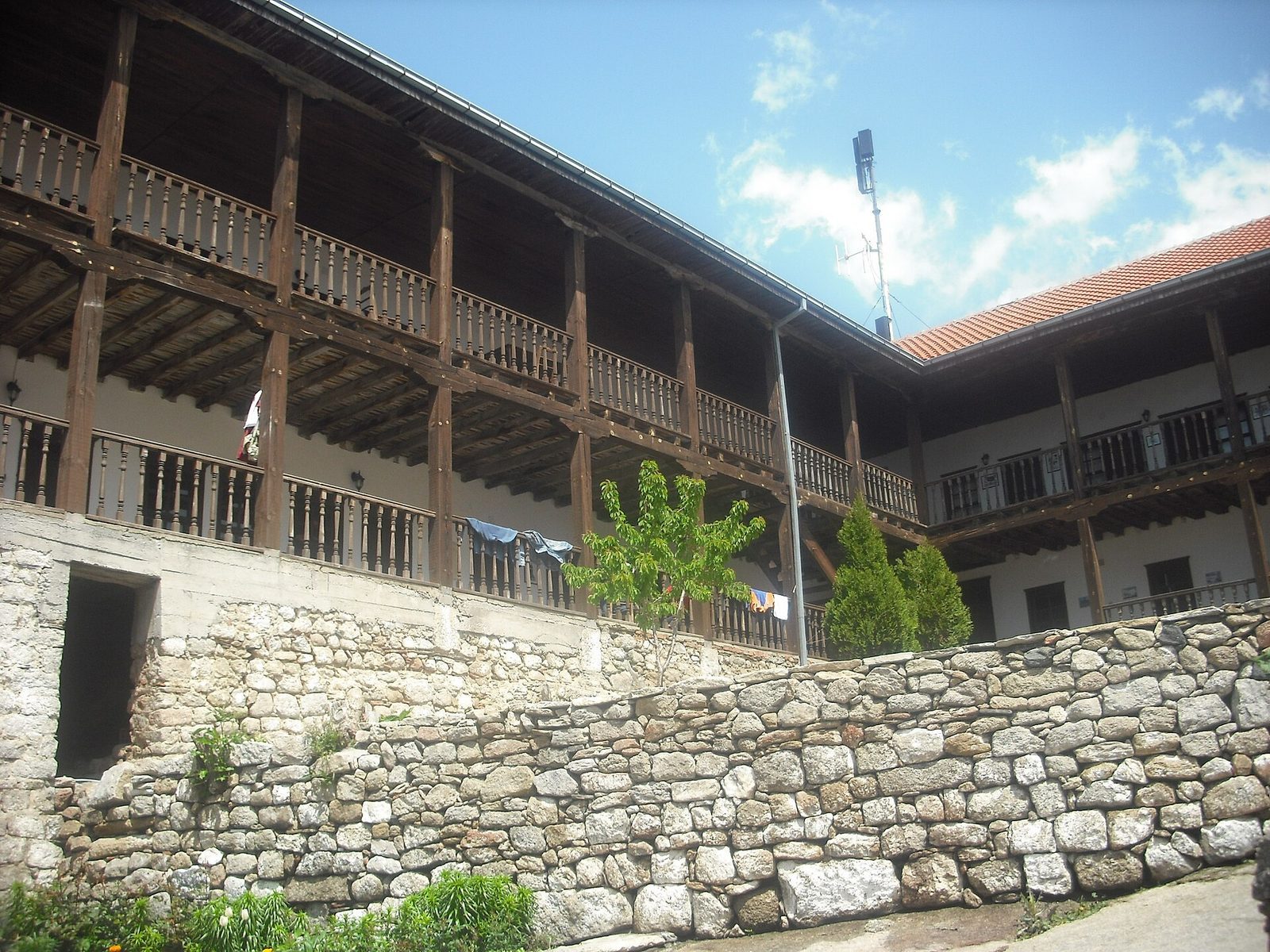
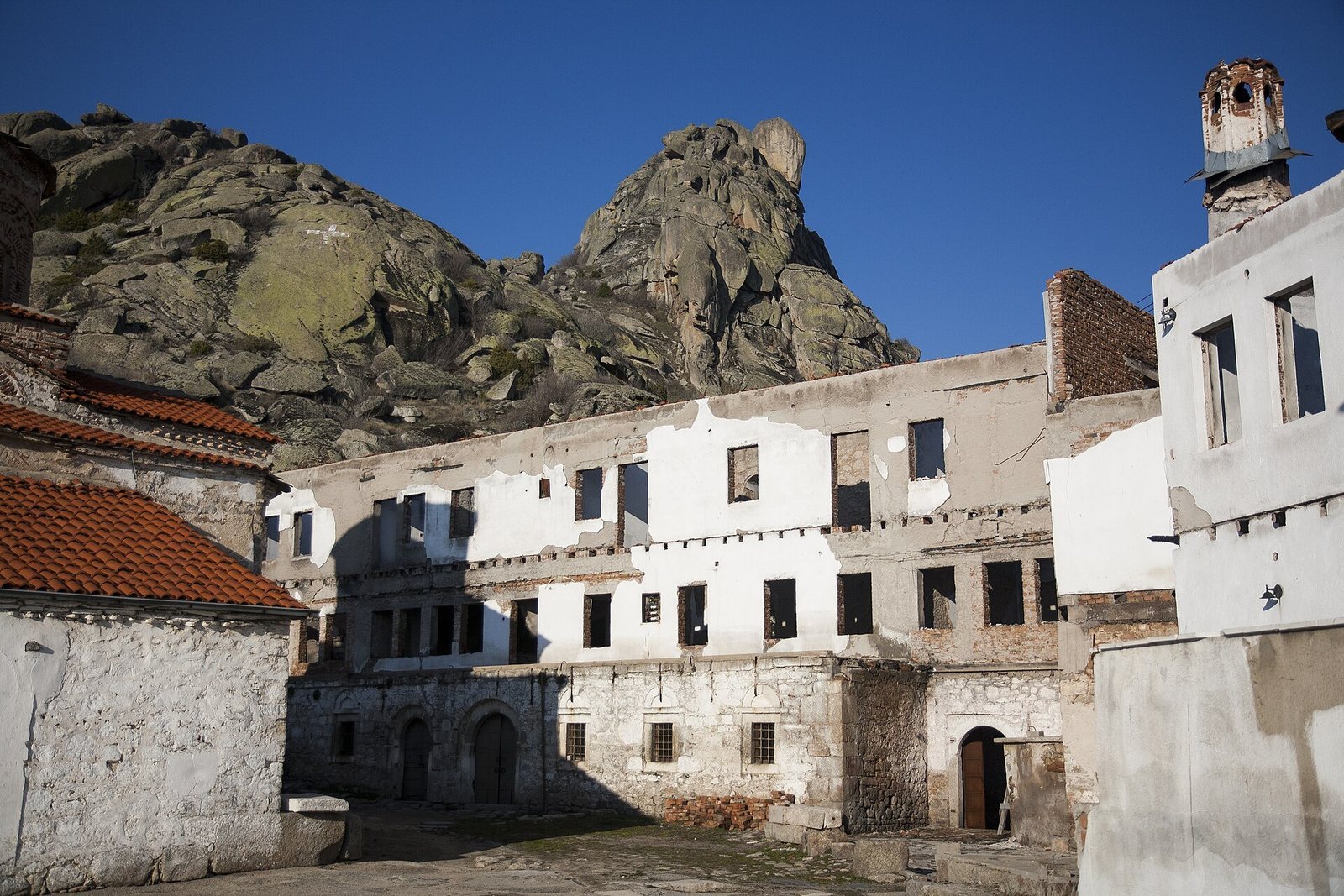
A fire in 1867 destroyed the residential quarters. Prilep guilds and nearby villages helped rebuild them under Abbot Hristo Poptrajkov and church steward Nikola Butlev. Another fire destroyed the quarters on 9 January 1990; donations supported their reconstruction in an authentic style. On 4 February 2013, a faulty heater caused a further fire that destroyed the quarters, while the church survived. The monastery is now affiliated with the Macedonian Orthodox Church–Ohrid Archbishopric.
Remains
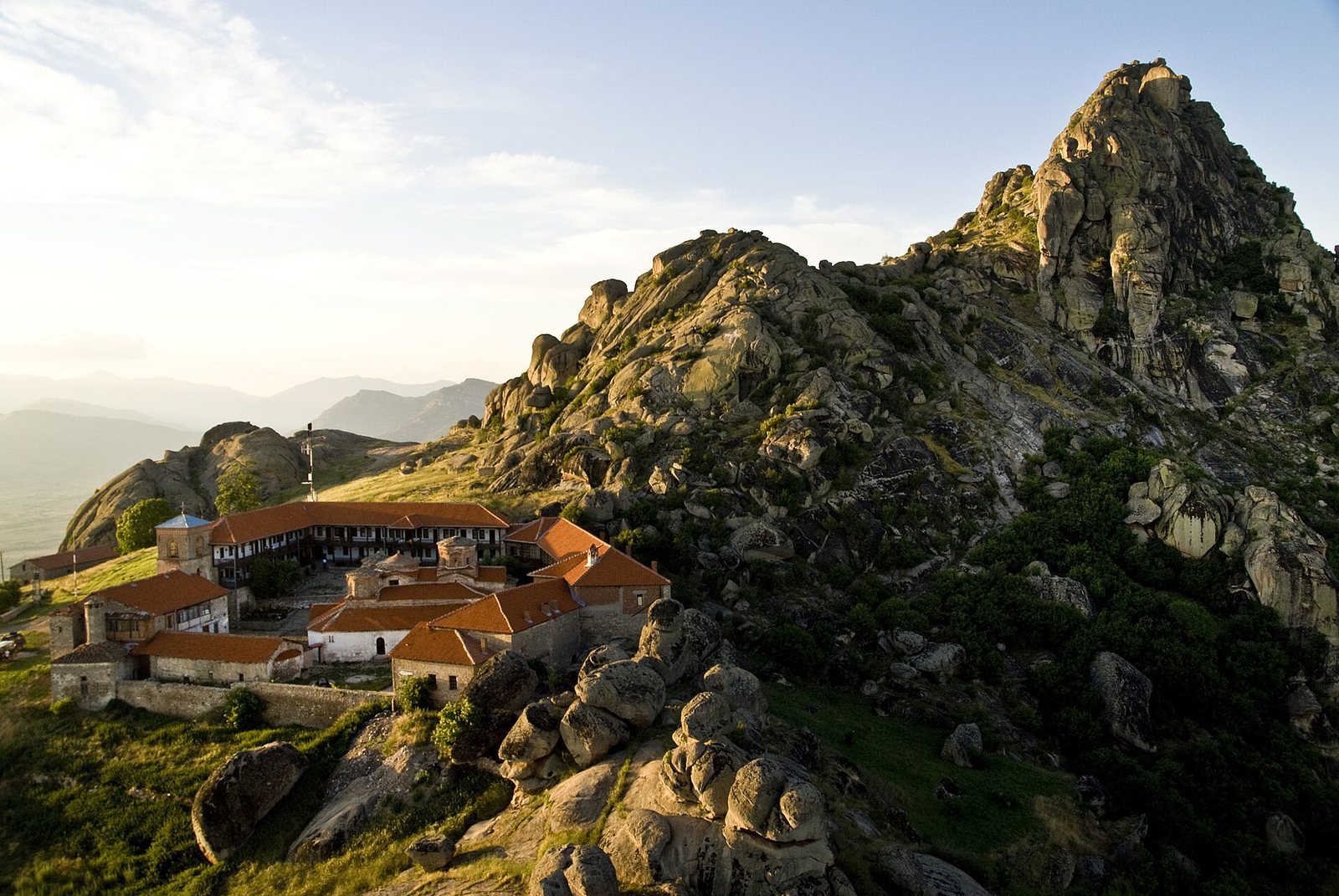
The monastery occupies a small level area among steep rock formations below Zlatovrh. Its fortified enclosure measures about 300 by 150 metres, an area described as roughly four hectares. The enclosure wall was built over older ruins. A separate late-antique wall of mortar masonry enclosed the flattened summit, church, associated buildings, and servants’ dwellings.
Mountain setting and enclosure
Approach and surrounding terrain
The monastery stands at about 1,280 metres above sea level, roughly ten kilometres from Prilep, beneath Zlatovrh, whose summit reaches 1,422 metres. The historic approach crossed steep, rugged ground. Travelers passed small shrines where they could pray and light candles, as well as steps and footprints carved into the rock. A local belief held that the stone shifted beneath a sinful pilgrim; the ascent was understood as a test and preparation before reaching the monastery.
Courtyard and buildings
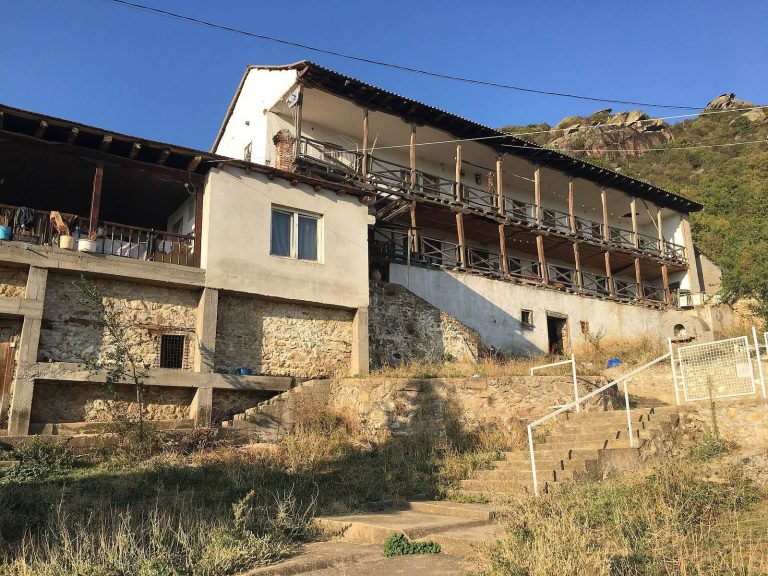
In his 1896 description, Gjorche Petrov recorded a narrow, roughly circular courtyard with the church at its center. Two-storey buildings stood around most of the court, while an old, low, single-storey building occupied the south side. A bell tower rose over the western entrance. Petrov described the church as small and having three domes, one of which had been split by lightning.
The monastery church
Plan and building phases
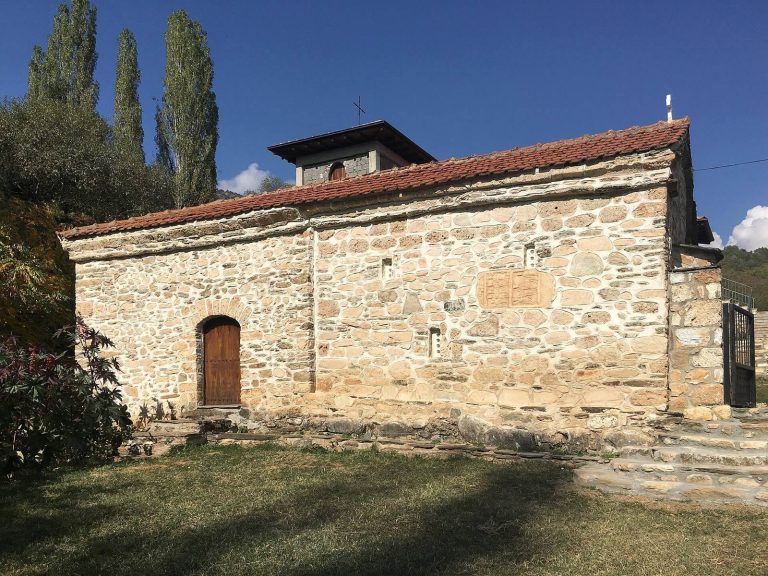
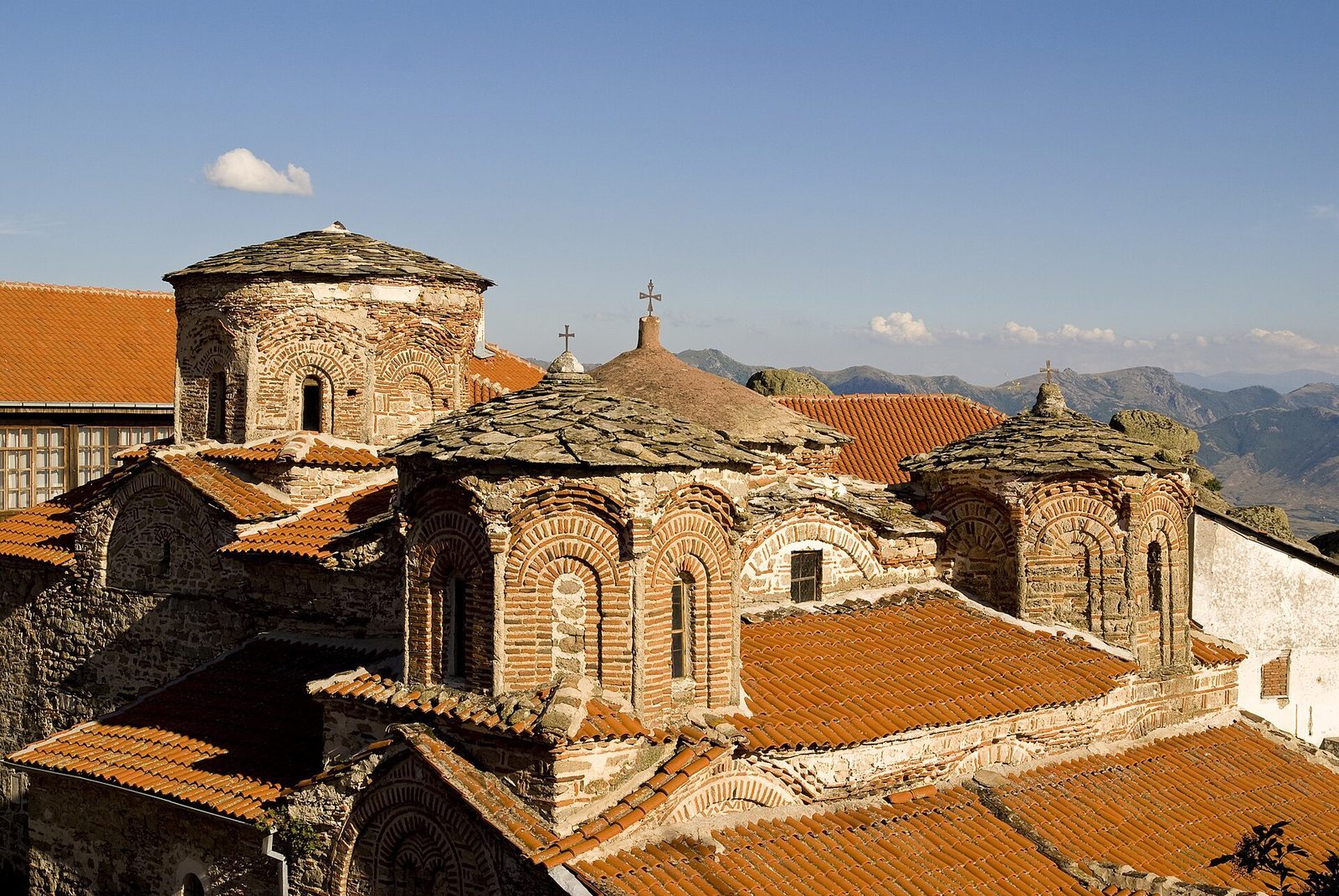
The church is dedicated to the Dormition of the Mother of God, the Christian feast commemorating Mary’s death. Its main body is a single nave, with a domed central space divided by pilasters, shallow supports attached to the walls. Side chapels flank the nave, and a three-sided apse, the projecting space at the altar end, stands to the east. The church developed through several building phases over earlier Christian remains.
A fourteenth-century entrance area, or narthex, has two domed towers. Wall paintings from the same century remain visible beneath a deep layer of plaster in the north chapel. In the 1830s, Abbot Visarion and the monk Ambrosij added a covered section to the main church; their portraits were painted in niches there. In 1854, Dicho Zograf painted a portrait of monk-priest Samuel, described as one of the last monks to live at the monastery.
Wall paintings and donor portraits
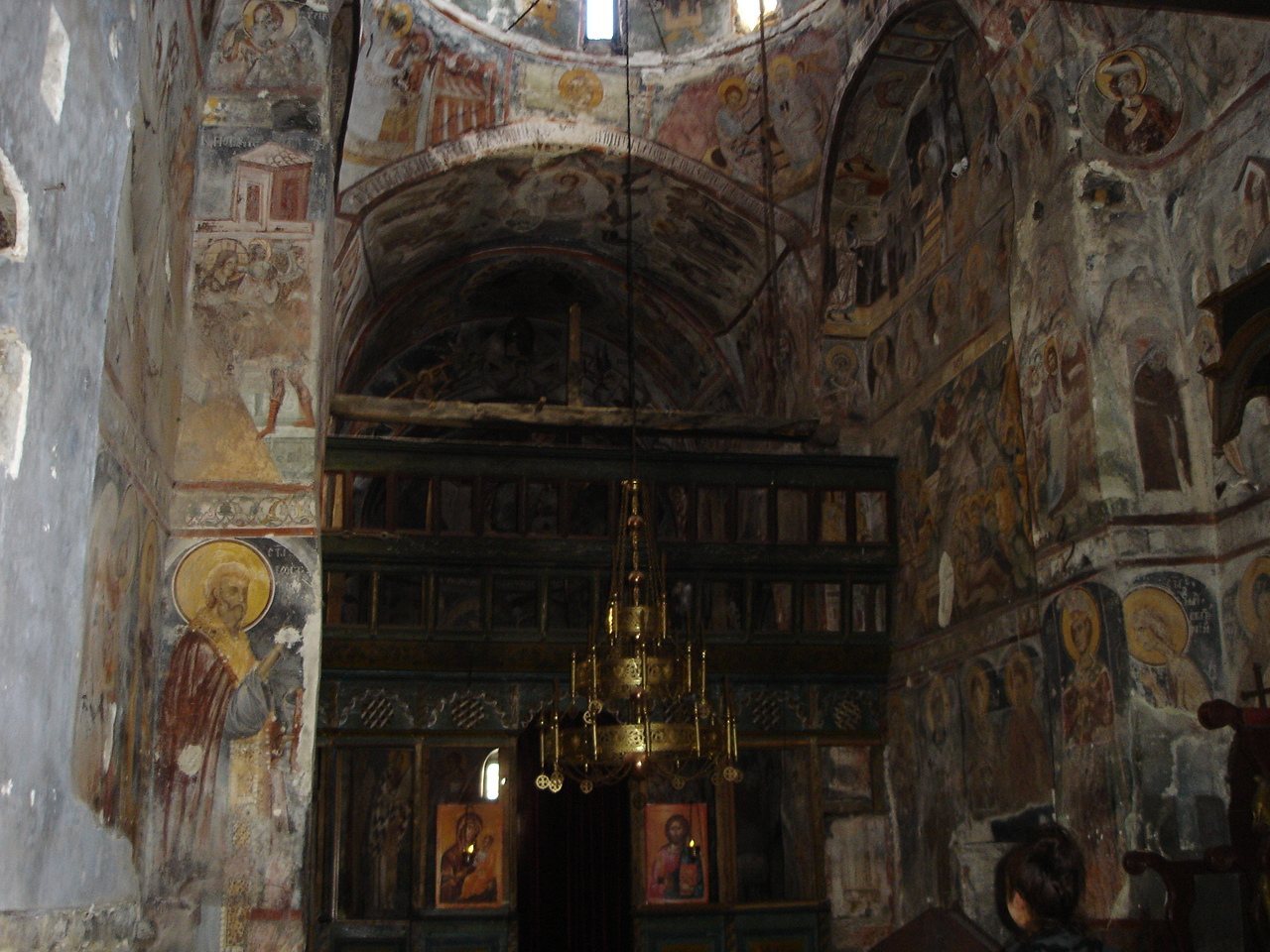
The oldest surviving church paintings date to 1334–1343 and are associated with Stefan Dušan’s patronage. They show calendar subjects and full-length saints, with verses by the Byzantine poet Christopher of Mytilene. Representations for about sixty calendar days survive. Donor scenes from the middle of the fourteenth century on the former facade of an added chapel include its donor, the court official Gradislav. Paintings on the outer entrance area’s facades followed shortly afterward.
In the northwestern dome, Christ appears as king of heaven, with a Gospel on his throne, the Virgin Mary to his left, and King David to his right. Cherubim, seraphim, archangels, and angels surround them. Eight holy warriors between the windows wear noble clothing rather than the soldier’s dress usual in such images. A painted scene above the western entrance included Andronikos II and Michael IX and was entirely repainted toward the end of the nineteenth century. A portrait of Stefan Dušan on the east wall of the outer entrance area was covered with plaster in the nineteenth century, and a portrait of Stefan Nemanja was painted over it.
Stone sculpture and inscriptions
A marble statue of a Roman soldier in a tunic is set into the upper western wall, reused as building material. Other marble decoration from the earlier Christian church was incorporated into the medieval building. Fragments of columns and other carved stone from the ancient temple lie around the late-antique church remains; a male torso in a toga was among the pieces found in the ground or reused in the church walls.
A marble slab on the church’s exterior bears an inscription associated with Dabiživ, a provisions officer under Emperor Uroš who died in 1362. The inscription is also connected with the monastery’s ties to the Nemanjić dynasty. Digging begun around the church in 1928 to address a threat from water exposed another inscribed marble slab. It records that the Serbian village of Bogomila paid for a chamber in 1873. The work also uncovered other marble fragments and decoration from the ancient temple.
Carved wooden doors
A wooden door in shallow relief combines figurative and geometric designs and is attributed to the Slepče school, a tradition of religious woodcarving. By the late nineteenth century, the walnut Royal Doors, the central doors in an Orthodox church’s altar screen, bore four white double-headed eagles associated with the Nemanjić dynasty. At the bottom was an eagle carrying a lamb.
Monastic facilities
The fourteenth-century refectory, or communal dining hall, has stone benches and long stone tables with recesses for diners’ feet. The table blocks weigh more than two tonnes. Wall paintings from the seventeenth and nineteenth centuries survive above remains of fourteenth-century painting. A kitchen is also identified among the monastery’s facilities.
Burial and retreat sites
The ancient burial ground lies on the saddle south of the summit. Rock-cut graves of monks were situated higher up, while remains of monastic hermitages and small cave churches survive in the massif around Zlatovrh and along the mountain ridge.