Cosquer Cave: A Prehistoric Cave-Art Site near Marseille
Site at a Glance
- Popularity
- Very High
- Country
- France
- Primary era
- Stone Age
- Eras represented
- Stone Age
- Civilizations
- Unclassified
- Site type
- Civic
- Remains
- Rock Art
On this page11 sections
History
Cosquer Cave is a prehistoric decorated cave in the Calanques near Marseille, France, visited by people between about 33,000 and 18,500 years before present (BP, conventionally measured from 1950). Its images belong to two phases of Upper Paleolithic art: an earlier Gravettian phase around 27,000 BP and a later phase around 19,000 BP, attributed to either the Solutrean or Epigravettian periods.
Prehistoric visits and the changing coast
During the last glacial period, sea level stood about 110 to 120 metres below its present level, leaving the Mediterranean shore more than eight kilometres from the cave. The exposed route made it possible to enter through the rising passage. People may have walked through it or followed a small underground stream, but the route they used is uncertain. The surrounding landscape may have been open steppe, and the cave lay at the foot of a cliff.
The remote location and evidence inside suggest that people visited briefly, likely to make images rather than live there. They may also have held ceremonies, but the idea that the cave served as a sanctuary remains a hypothesis. The purpose of the art is unknown.
Discovery and archaeological investigation
Professional diver Henri Cosquer found the underwater entrance in 1985 after another diver directed him to it. He explored the passage alone and with a diving-club friend, reaching a narrow bend toward an underground lake. On a later solo dive, a lamp failure forced him to turn back from the lake.
In June 1990, Belgian divers Bernard and Marc Van Espen followed Cosquer’s directions and reached the lake, but returned when their guide line ran out. On 24 June 1991, Marc Van Espen and Cosquer extended the line through the passage and briefly entered the first chamber beyond it. On 9 July, Cosquer returned with his niece Cendrine and diving-club members Yann Gogan and Pascale Oriol. Gogan noticed the outline of a hand, and Oriol recognized that it might be prehistoric art. Further dives in July and August revealed additional images, which the group photographed and filmed with help from Thierry Pelissier and Gilles Sourice. The cave’s existence became public in 1991.
On 1 September 1991, three divers from Grenoble died after losing their way in the access passage. Cosquer and Gogan helped recover their bodies. Cosquer reported the cave to the Maritime Affairs Department in Marseille two days later, bringing it to the attention of underwater archaeological specialists and then the Ministry of Culture’s regional archaeological service.
From 18 to 20 September 1991, an expert team aboard the archaeological research vessel Archéonaute examined the cave. Prehistorian and diver Jean Courtin and cave-art specialist Jean Clottes took part in the investigation. A thin calcite coating on some images helped counter early doubts about their authenticity. In 1998, examination of wood remains identified Scots and black pines, trees that had not grown locally for at least 10,000 years, as well as birch pollen. Radiocarbon dating of charcoal from the cave floor and carbon-rich pigment from the images established the main periods of artistic activity.
A second, narrow entrance was found in March 1992 and kept secret for safety reasons for more than three decades. Divers explored it during the 1990s; its existence became public in 2025. Archaeological operations led by Luc Vanrell took place five times from 2001 to 2005 and five more times from 2010 to 2015, with Michel Olive involved in the later work.
Protection and continuing study
Cosquer Cave was classified as a historic monument on 2 September 1992, along with the nearby Triperie, Figuier, and Renard caves. It also lies within Calanques National Park. Following the fatal diving accident, the underwater entrance was blocked with concrete. A metal grille replaced the blocks in 2015.
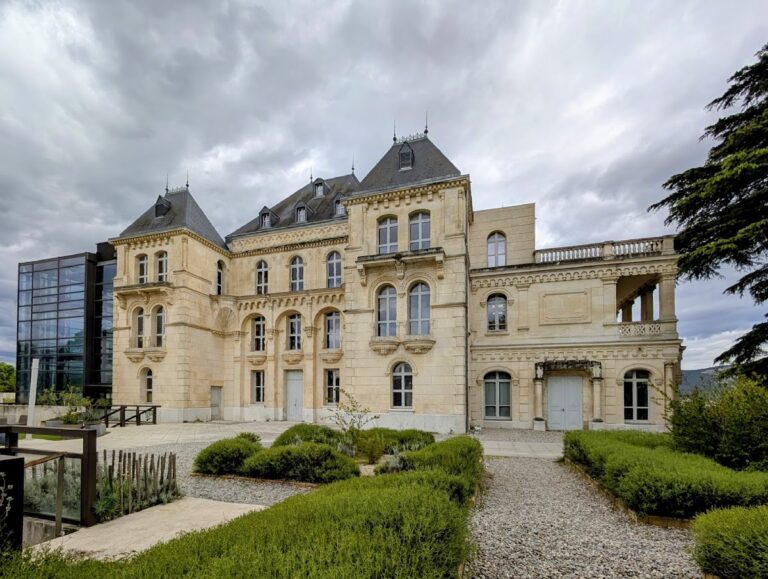
Progressive flooding prompted an interdisciplinary research team led by the Mediterranean Laboratory of Prehistory, Europe-Africa, to form in 2020. Work inside the cave began in 2022, with particular attention to how water moves through it. A proposal to reach the cave by an underground lift from land was rejected because changing the cave’s internal pressure could affect it. A partial replica opened to the public in Marseille in June 2022, presenting selected cave art while preserving the memory of the original site.
Remains
Geological setting and cave layout
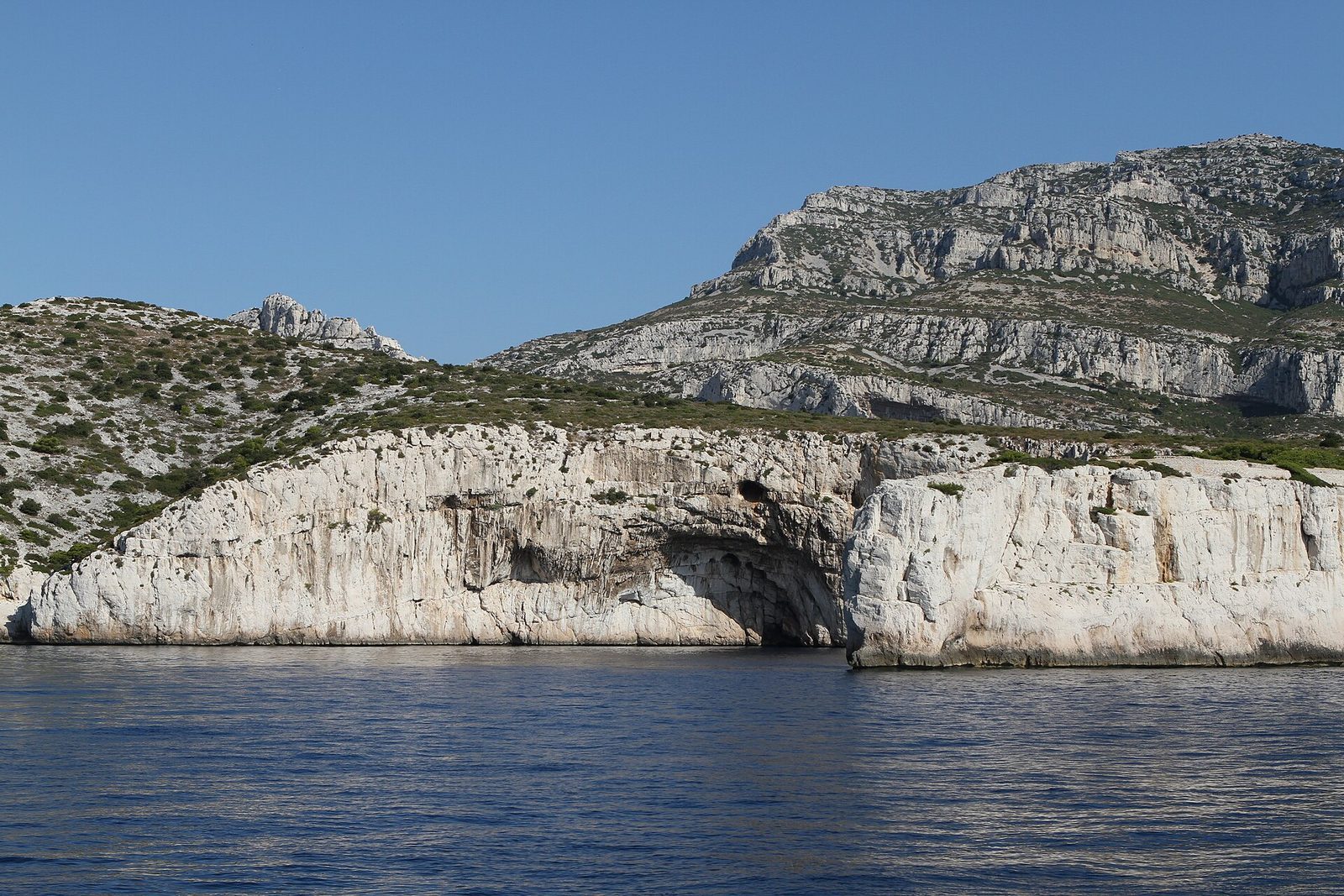
The cave is formed in limestone within a coastal cliff at the Calanque de la Triperie, below Pointe de la Voile and near Cap Morgiou. A calanque is a steep-sided coastal inlet. The limestone formed during the Early Cretaceous. The cave may have begun as an outlet for underground water, probably carved by a river when sea level was lower. As the watercourse shifted away, the access gallery became dry or emerged above water.
The main underwater passage is narrow and about 175 metres long, with its entrance 37 metres below today’s sea level. It leads to a partly flooded chamber containing an underground lake about 50 metres across and numerous stalactites, mineral formations hanging from the ceiling. Emerged areas include the North Room, Great Room, Beach, Arch, Chaos, and Feline Room. Submerged areas comprise the Small Flooded Pit, Lower Room, Great Flooded Pit, and Access Gallery.
Flooding and trapped air
About four-fifths of the cave is permanently or periodically underwater. Its emerged chambers hold trapped air, behaving like a sealed bubble. Air dissolved in seawater passes through long, nearly horizontal underwater cracks and collects inside; calcite deposits have made the walls effectively impermeable. The air pressure is equivalent to about 1.2 metres of water above normal atmospheric pressure, with recorded readings between 1,080 and 1,140 millibars.
The water inside rises and falls through the year, remaining about a metre below the outside sea level. Flooding has destroyed images in submerged parts of the cave, although some surviving paintings now lie below the waterline. Other images are at the water’s edge or only centimetres above it.
Prehistoric images
Hand stencils and early marks
The earlier art includes 65 negative hand stencils, images made by placing a hand against the rock and blowing pigment around it, leaving its outline unpainted. Forty-four are black and 21 red. Most appear against a black background made with carbon-rich pigment; red clay or ochre provides the backgrounds for others. Some stencils show one or more fingers missing. Ritual amputation and sign-like communication have both been proposed as explanations, but neither is established. The earlier phase also includes finger tracings and some incised animal forms.
Animals and signs of the later phase
The later art consists of painted or engraved animals and signs. The recorded animal figures include 63 horses, 28 ibex, 17 deer, 10 bison, and seven aurochs. Sixteen depict marine animals, including nine seals and three great auks, alongside images of jellyfish, fish, or cetaceans. One engraving has been interpreted as a wounded man. The inventory also includes 216 signs, among them eight sexual representations, two male and six female.
Ochre and charcoal were used in the artwork, and a thin layer of calcite covers some paintings. Cave visitors also worked calcite formations, though their purpose is unknown. Jean Clottes observed that many animal figures show their bodies in profile while presenting ears and paired feet frontally, a combination that suggests three-dimensional form.
Three-dimensional record and replica
A detailed three-dimensional survey using a rotating laser scanner and a surveying instrument recorded the cave at multiple levels of detail, down to micrometre scale. This record enabled a faithful partial replica of selected decorated areas. The replica reproduces parts of the cave rather than its full interior. Because it is smaller than the original, some dimensions were adapted, while the reproduced painted sections retain their original dimensions.