Gandzasar Monastery: An Armenian Apostolic Cathedral and Monastic Center
Site at a Glance
- Popularity
- High
- Country
- Azerbaijan
- Primary era
- Medieval
- Eras represented
- Medieval, Early Modern, Modern
- Civilizations
- Armenian, Mongolian, Russian, Safavid
- Site type
- Religious
- Remains
- Monastery
On this page14 sections
History
Gandzasar Monastery is an Armenian Apostolic monastery on a hill near Vank in Azerbaijan. Its main church was built between 1216 and 1238 by Hasan-Jalal Dawla, prince of Inner Khachen, in the Armenian church tradition. The complex later served as the seat of the Catholicosate of Aghvank, an Armenian church jurisdiction led by a catholicos, a senior Eastern Christian church leader, and as a center of religious and educational life in Karabakh.
Early monastery and cathedral
The name Gandzasar means treasure mountain. Tradition links it to a hill thought to contain silver and other metal ores. The monastery is mentioned by the mid-10th century in connection with Catholicos Anania of Moks, and a monk from Gandzasar attended a church council at Khachen in 949.
The main church replaced an older church referred to in 10th-century records. It was intended for worship and as a burial place for Hasan-Jalal’s family. An inscription about its construction relates that Hasan-Jalal’s father had entrusted the project to him and his mother. When construction reached the eastern windows, his mother travelled on pilgrimage to Jerusalem and stayed there as an ascetic until her death.
The church was consecrated on July 22, 1240, during the Feast of the Transfiguration. About 700 priests attended, including Nerses, Catholicos of Aghvank, and Vanakan Vardapet, a learned Armenian cleric. The 13th-century historian Kirakos Gandzaketsi wrote about the church and its consecration.
Princely monastery and church leadership
A gavit, an Armenian church entrance hall, was built in the mid-13th century and finished in 1266. Hasan-Jalal’s wife, Mamkan, is associated with the work after his death in 1261, and their son Atabek is also credited with completing it. Gandzasar served as the residence and family burial place of the Hasan-Jalalyan princes, who ruled the principality of Khachen.
In 1260, the Mongol official Argun captured Hasan-Jalal and took him to Qazvin after he refused to renounce his faith. He was executed in 1261. Atabek returned his father’s remains to Gandzasar and buried them in the gavit.
From the late 14th century, Gandzasar was the seat of the Catholicosate of Aghvank. In the 16th century, this church jurisdiction became subordinate to the Catholicosate of Etchmiadzin. Russian authorities abolished the Aghvank catholicosate in 1815 and replaced it with a metropolitan see. In 1836 the see moved to Shusha, and in 1857 the church jurisdiction was divided into the Karabakh and Shamakhi dioceses.
Learning and political activity
For centuries, the monastery supported religious teaching and the production of manuscripts. Works associated with Gandzasar include a 15th-century poetry collection containing a verse history of Alexander the Great and an 18th-century law code by Catholicos John II. Tradition also associated the monastery with Christian relics: the head of John the Baptist was said to have been brought from Cilician Armenia during a crusade. Other relics were linked to Zechariah, Gregory the Illuminator, Gregory’s grandson Grigoris, and Saint Pantaleon.
During the 17th and 18th centuries, Gandzasar became a center for the liberation efforts of Karabakh Armenian meliks, local hereditary rulers. Catholicos Yesayi Hasan-Jalalyan led the movement. In 1701, he joined other Armenian leaders in appealing to Peter the Great, the Russian emperor, for protection and military help against Persian and Ottoman rule. Armenian political activists Israel Ori and Joseph Emin also met with catholicoi at the monastery.
Decline, conflict, and restoration
By the late 19th century, Gandzasar had fallen into disrepair as the monastery was gradually abandoned. Soviet authorities had closed it by 1930. The Artsakh diocese, named for the Armenian historical term for Karabakh, was reestablished in 1989 under Archbishop Pargev Martirosyan. After six months of renovation, Gandzasar reopened on October 1 that year, becoming the first church in the region to reopen after decades of Soviet suppression. It served as the bishop’s seat until the diocese moved to Ghazanchetsots Cathedral in 1998.
During the First Nagorno-Karabakh War, a conflict over Karabakh, Soviet soldiers and special-police officers raided the monastery in July 1991 while searching for weapons. Fighting and a siege affected the area in 1992. Bombardment in August destroyed buildings outside the main monastic group; the attack was viewed as an attempt to target Armenian cultural heritage despite the monastery’s lack of apparent military importance. On August 31, Armenia’s defense minister Vazgen Sargsyan and Serzh Sargsyan, head of the Karabakh Armenian self-defense committee, met in a monastic cell.
On January 20, 1993, two Azerbaijani attack aircraft struck Gandzasar. The air strike seriously damaged the main church and destroyed another monastic building. People nearby were killed and a priest was wounded. Restoration followed in 1993–1997, with major refurbishment in 2000–2002 that included work on the altar and gavit and the installation of new floor tiles.
Heritage and changing control
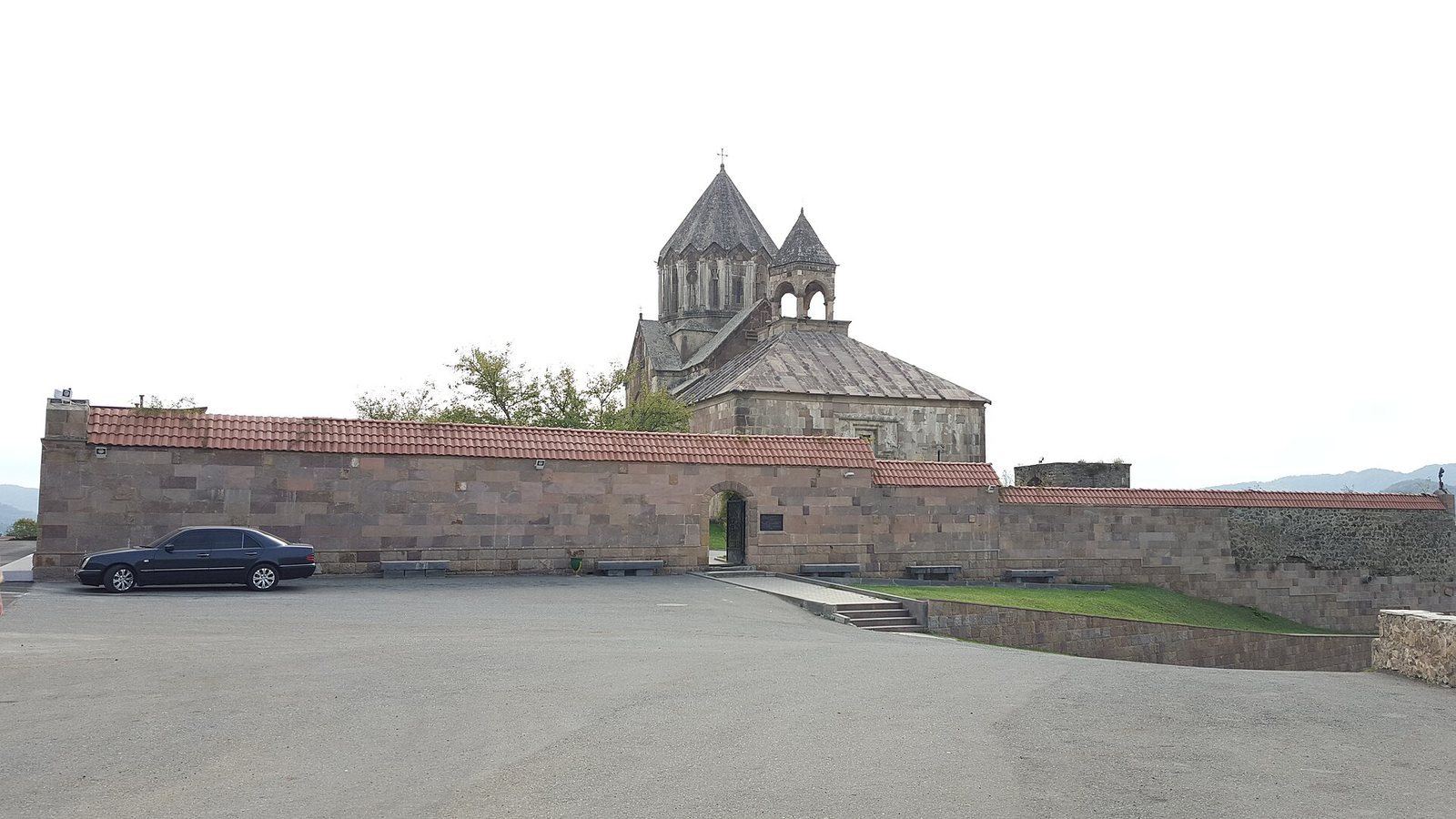
Azerbaijan placed Gandzasar on its state-protected list as an architectural monument of world importance in 2001. Tiling of the monastery’s surrounding wall in 2011 prompted disagreement over its treatment: Archbishop Pargev Martirosyan considered the wall non-medieval and of limited architectural importance, while critics viewed it as part of the historic complex. In 2015, a branch of the Yerevan Matenadaran manuscript institute opened at Gandzasar. During the 2020 Nagorno-Karabakh war, more than 100 manuscripts held there were moved to Yerevan and displayed at the Matenadaran in March 2021.
The monastery remained under Armenian control after the 2020 war. Following the dissolution of the Nagorno-Karabakh Republic in 2023, control of the territory returned to Azerbaijan. Its Armenian heritage has also been disputed: Azerbaijani claims promoted from the 1970s onward identify it as a monument of Caucasian Albania, a historical regional name used in this ecclesiastical context. Armenian historians point to the monastery’s Armenian inscriptions and architectural character.
Remains
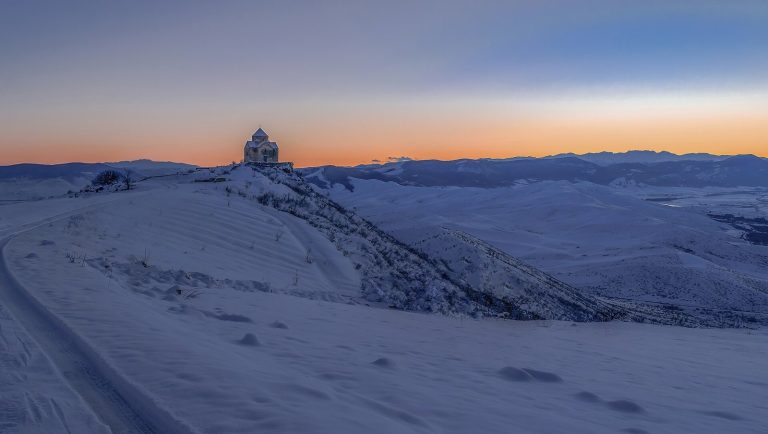
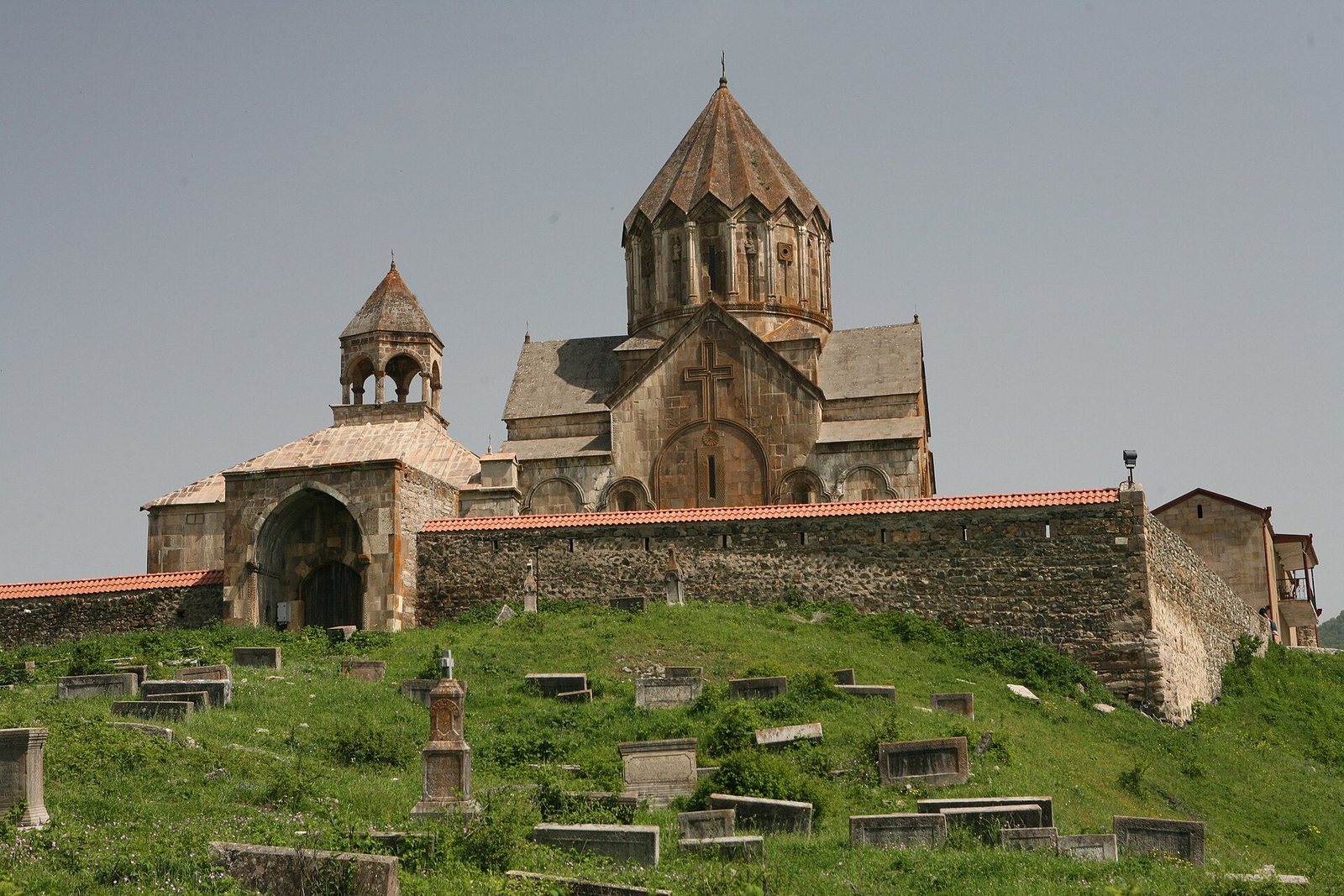
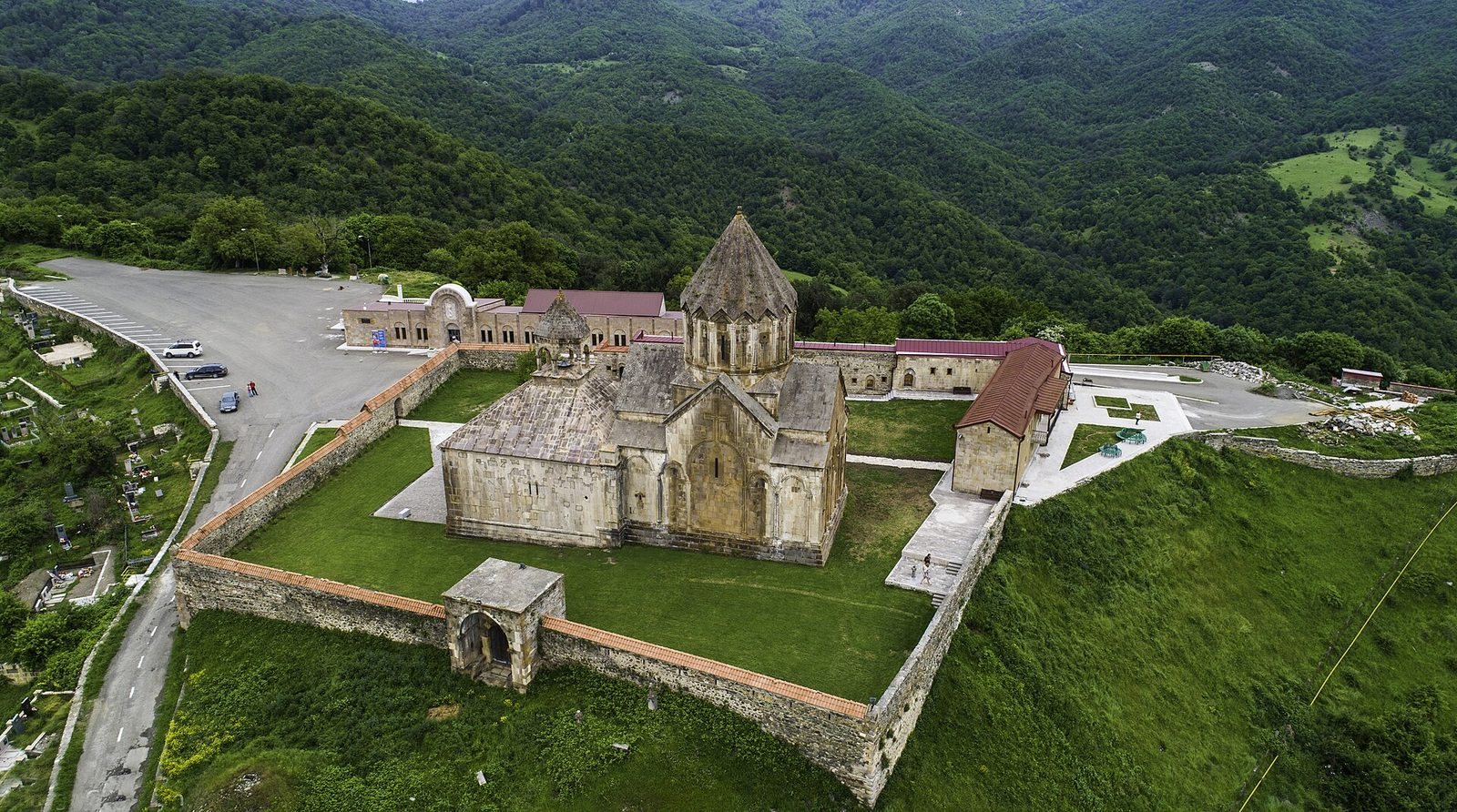
The walled complex stands about 1,270 metres above sea level, southwest of Vank and near the left bank of the Khachen River. It contains the main church and gavit, along with living quarters, a bishop’s residence, a refectory, and educational buildings. The church’s carved stonework and the complex’s surviving graves and cross monuments preserve evidence of its religious and dynastic roles.
Main church
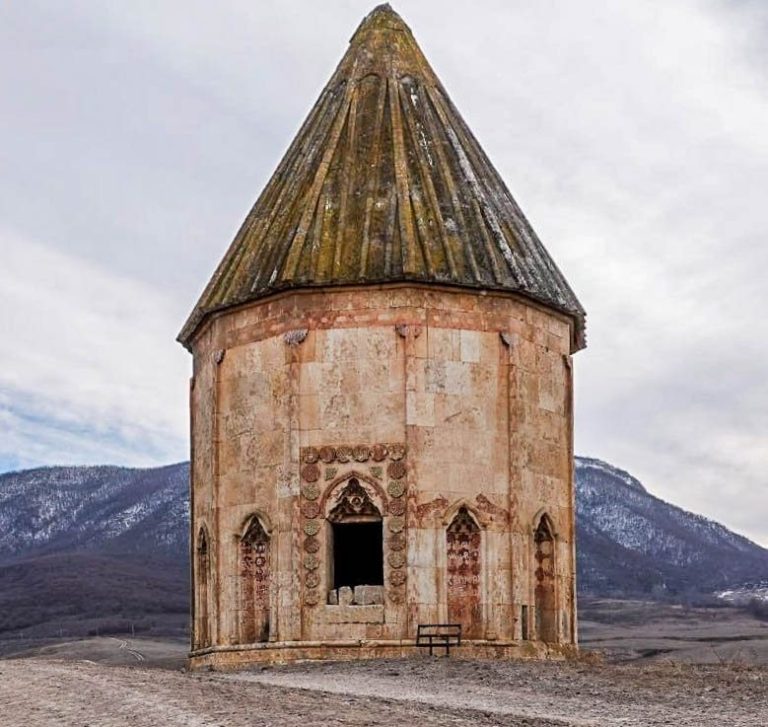
The church, dedicated to John the Baptist, measures 12.3 by 17.75 metres on the exterior. Its rectangular plan has cross-shaped arms around a domed central space, with two-storey sacristies, rooms for church vessels and vestments, at all four corners. This arrangement belongs to a form of Armenian church architecture established by the 10th century.
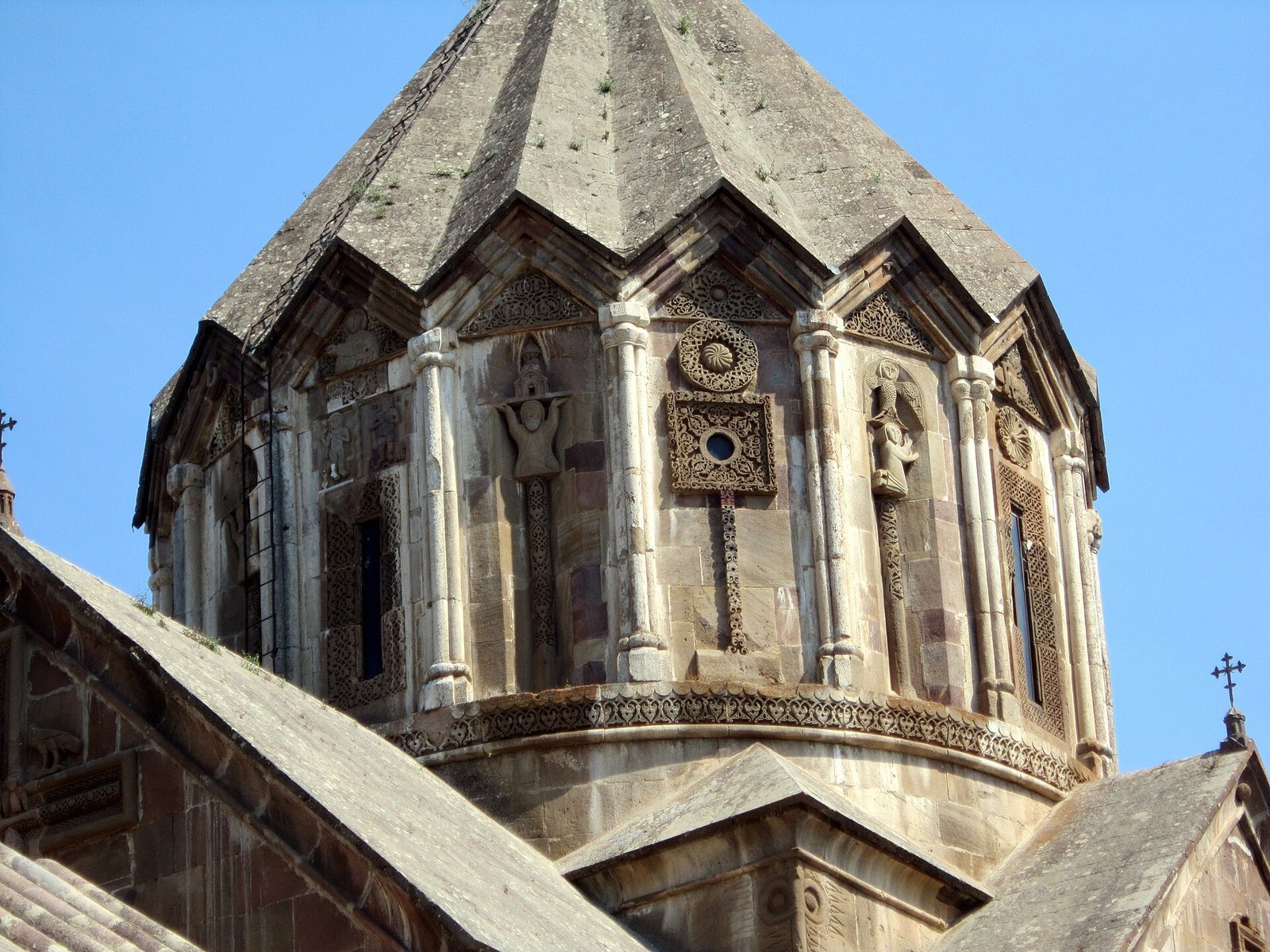
The dome rests on a 16-sided raised section, or drum, and has an umbrella-shaped roof. The drum carries intricate stone carving and varied ornament. This roof form was first used by architects at Ani in the 10th century and later spread elsewhere in Armenia. Exterior carved reliefs show the Crucifixion, Mary with the infant Jesus, Adam and Eve, and two patrons holding models of the church. Other carvings include geometric rosettes, a bull’s head, and an eagle; a sculpted Hasan-Jalal appears seated cross-legged on the drum.
Inside, curved supports called pendentives carry the dome above the square space. Their carved patterns include stars, circles, squares, spiral shoots, and palmettes. High-relief figures include a sheep’s head, bull’s heads, and human-like forms. The archaeologist and art historian Anatoli Yakobson interpreted the animal figures as protective motifs. He described Gandzasar as an encyclopedia of 13th-century Armenian architecture, while French art historian Charles Diehl included it among five masterpieces of Armenian monumental art.
Gavit and burials
The square gavit lies west of the church and measures about 11.8 by 13.25 metres. Two columns near its eastern wall support the roof, which is formed by intersecting arches. Its western doorway is richly carved.
Hasan-Jalal’s tomb
Hasan-Jalal’s tomb lies inside the gavit, in front of the entrance to the church’s main hall. Its white-marble slab bears an inscription dated 1431 and three carved spherical motifs. One combines a Star of David and a Wheel of Eternity with plant ornament, including two fleur-de-lis. Another is a 16-rayed star whose meaning is uncertain, while the third represents the sun.
Other church burials
The gavit also contains graves of catholicoi and other church leaders. Among them are Yesayi Hasan-Jalalyan, who held office from 1702 to 1728, and catholicoi whose terms ran from 1676 to 1700, 1763 to 1768, and 1810 to 1828. A metropolitan who lived from 1775 to 1854 and helped establish the Artsakh diocese is buried there, along with earlier catholicoi.
Monastic buildings
The living quarters on the northern side date to the 17th century and contain eight cells, each about 2.9 by 2.5 metres. An eastern refectory was built around 1689, and a two-storey school followed in 1898. The complex also includes a seminary and a reception building associated with the Catholicosate of Aghvank.
Courtyard monuments
The courtyard contains memorial monuments and numerous khachkars, carved stone cross monuments. One near the northern wall appears to mark the grave of an infant daughter of Hasan-Jalal and Mamkan. Its inscription says that her father erected the cross monument in her memory. Khachkars dated 1174, 1182, and 1202 have also been found around the monastery.
Cemetery
An old cemetery lies south of the monastery walls. Its graves belong to priests, bishops, and prominent laypeople, including local rulers known as meliks.