Əsgəran Fortress: An Eighteenth-Century Defensive Stronghold in Azerbaijan


Site at a Glance
- Rating
- 4.7
- Popularity
- Low
- Country
- Azerbaijan
- Primary era
- Early Modern
- Eras represented
- Early Modern
- Civilizations
- Unclassified
- Site type
- Military
- Remains
- Fort
On this page10 sections
History
Əsgəran Fortress is an eighteenth-century fortification in Askeran, Azerbaijan, built during the period of the Karabakh khanate to control approaches to Shusha. Its foundation is listed as 1751, although historical attributions place construction under Mehrali Khan around 1758–1760, Ibrahim Khalil Khan in 1783–1784, or in 1788–1789. Panah Ali Khan, the founder and first ruler of the Karabakh khanate, is credited with initiating the fortress. One interpretation holds that he planned it, that most construction took place under Ibrahim Khalil Khan, and that Mehdi Quli Khan completed its fortifications.
Origins and military purpose
A medieval fortress and an Armenian settlement called Mayraberd are said to have occupied the site before the eighteenth-century construction. Under the khans, the fortress served as a military base where troops could be stationed and as a defensive position controlling movement through the Karkar valley. Its location on the route toward Shusha led to the name “Gateway of Karabakh,” while its position in the valley provided a defensive shield for Shusha.
The Karabakh khanate was a regional state ruled by a khan, and its fortresses served defensive, administrative, and military purposes. Əsgəran Fortress formed part of the system protecting the khanate’s principal stronghold and the approaches through the surrounding mountain terrain.
The Russo-Persian War
In June 1805, during the Russo-Persian War of 1804–1813, a conflict between the Russian and Persian empires over territories in the South Caucasus, a Persian army of more than 40,000 soldiers passed through the fortress while advancing toward Shusha. An Armenian volunteer detachment commanded by Melik Vani and Akop Yuzbashi Atabekyan fought near Əsgəran. The title melik referred to an Armenian hereditary local ruler or noble, while yuzbashi was a military rank traditionally associated with a commander of roughly one hundred men.
At the same time, a 400-man Russian detachment under Colonel Karyagin was surrounded on a hill near Khramort. The Armenian volunteers helped the detachment withdraw northward toward Kusapat and Mokhratakh. A commemorative plaque erected by residents of Khramort names Russian and Armenian soldiers who died defending Shusha and Əsgəran in June and July 1805.
Twentieth-century conflicts
Between 1918 and 1920, a garrison commanded by Colonel Badalkokhyan occupied the fortress and guarded the Karkar valley. During the Askeran fighting of March and April 1920, an Azerbaijani detachment of about 50 soldiers held the position until Armenian forces captured it on 23 March. Fifteen survivors reached Agdam, while an Armenian force of up to 4,000 troops assembled in the Askeran area under Deli Kazara, described as a Dashnak leader who had arrived from Dilijan.
Azerbaijani forces commanded by Major General Habib Bey Salimov failed to retake the fortress in an initial assault on 29 March. After receiving reinforcements, they recaptured it on 3–4 April, and Deli Kazara was killed. The fighting and the loss of the fortress provoked political debate in the Azerbaijan Democratic Republic. The fortress was destroyed during the 1920 assault on Askeran by Musavatist forces.
During the Karabakh conflict of the early 1990s, Armenian armed formations occupied the fortress, which later came under the control of the unrecognized Nagorno-Karabakh Republic. Under the trilateral statement of 9–10 November 2020, the area passed under the control of Russian peacekeeping forces. Azerbaijan restored control of the fortress after the fighting of 19–20 September 2023.
Restoration and protection
Restoration began in 2002. Exterior sections were treated before 2016, and later work addressed the interior. One tower collapsed during the 1988–1994 Nagorno-Karabakh War. Further conservation and structural strengthening, archaeological excavation, and the creation of an open-air historical park have been planned. Əsgəran Fortress has been treated as a protected cultural-heritage monument in Azerbaijan.
Remains
The fortress occupies both banks of the Karkar River on the southern outskirts of Askeran, within a gorge and a partly wooded, partly rocky mountain landscape. It lies along the Agdam–Shusha route and is also described as standing on the route from Stepanakert toward Tigranakert. Its defensive walls follow a mountain slope for approximately 1.5 kilometres, forming two parallel lines of enclosure. The gorge, steep terrain, and double wall system reinforced the fortification’s control over movement through the valley.
Walls and enclosure
Defensive walls
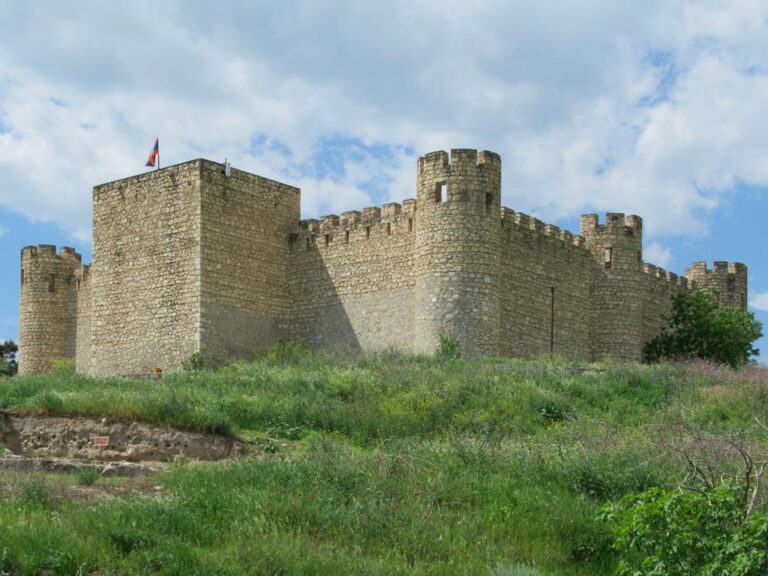
The walls are about 2 metres thick and 9 metres high. Builders used small pebbles and roughly cut limestone set in lime mortar. The entrance and long stretches of the defensive walls remain substantially preserved along the mountain slope. Restoration has repaired or reconstructed sections of both the exterior and interior, while the surviving fabric continues to show the scale of the enclosure.
Round towers
Round towers are integrated into the wall lines and served as observation posts. Narrow passageways along the walls connected the towers, allowing communication across the fortification. One tower collapsed during the late twentieth-century conflict, while the remaining towers and repaired sections form part of the surviving defensive structure.
Defensive features
Interior niches and loopholes provided positions from which defenders could observe and protect the approaches. Several vertical niches in the façades gave access to the tops of the towers and curtain walls. Together with the wall passages, these features supported the stationing of troops and the control of the route through the Karkar valley toward Shusha.