Ekron: A Canaanite and Philistine City in Israel
Site at a Glance
- Popularity
- Very High
- Country
- Israel
- Primary era
- Iron Age
- Eras represented
- Bronze Age, Iron Age
- Civilizations
- Babylonian, Canaanite, Philistine
- Site type
- City
On this page19 sections
History
Early settlement and Canaanite rule
Ekron was a Canaanite settlement and later a major Philistine city at Tel Miqne in Israel, where the city expanded around 1600 BCE and was re-established around the 12th century BCE. People lived at the site from the Chalcolithic period through the Early Bronze Age, though the settlement was small in those early eras. After a long interval, Ekron grew under Canaanite rule, and both its upper and lower cities were occupied during the Middle Bronze Age.
In the Late Bronze Age, settlement contracted to the upper city. The last Canaanite phase ended in the 13th century BCE, when a major public building burned amid the wider destruction associated with the Bronze Age collapse.
Philistine city on the frontier
Philistines re-established Ekron around the beginning of the Iron Age, about the 12th century BCE. The Philistines were associated with the Sea Peoples, groups involved in migration and conflict around the eastern Mediterranean at the end of the Bronze Age. Ekron developed into a planned, fortified city and became one of the five principal cities of the Philistine Pentapolis, alongside Gaza, Ashkelon, Ashdod, and Gath. During the Iron Age, it stood in a contested border region between Philistia and the kingdom of Judah.
Biblical texts associate Ekron at different times with the territories of Judah and Dan, while also describing it as a Philistine city ruled by one of five city lords. They recount that the Philistines brought the Ark of the Covenant to Ekron before sending it to Beth Shemesh, and connect a local sanctuary with Baal Zebub, a deity worshipped at the city. The texts also contain prophecies concerning Ekron’s destruction.
In the first quarter of the 10th century BCE, the lower city was destroyed and abandoned. People continued to live in the upper city, while the lower part remained unoccupied for about 270 years.
Assyrian rule and olive-oil production
Neo-Assyrian records call Ekron Amqarruna. The Assyrian king Sargon II captured the city in 712 BCE, an event depicted on a palace relief at Khorsabad. In 701 BCE, during the campaign of his successor Sennacherib, Ekron’s leaders rebelled and handed Padi, the ruler allied with Assyria, to Hezekiah of Judah. After defeating an opposing force at Eltekeh, Sennacherib took Ekron, killed the revolt’s leaders, and deported supporters of the uprising. He later recovered Padi from Jerusalem and restored him as ruler.
Ekron became an important city-state under Assyrian domination in the seventh century BCE, with olive oil as a major product for local use and trade beyond the Levant, especially to Mesopotamia and also to Egypt. Oil production declined late in the century as Assyrian rule ended and Egyptian influence grew. The decline may also have been affected by renewed use of a southern trade route and competition from Ionian traders in the oil and wine trade.
Babylonian destruction and later settlement
A letter in Aramaic attributed to Ekron’s king Adon, written late in the seventh century BCE and preserved in Egypt, appealed to Pharaoh Necho II for assistance against the advancing Babylonians. The Babylonian king Nebuchadnezzar II destroyed Ekron in 604 BCE. A small, short-lived settlement followed in the lower city during the first quarter of the sixth century BCE, after which the site was abandoned.
A settlement named Ekron existed in the Hellenistic period, but at another location, identified with Aqir rather than Tel Miqne. Around 150 BCE, the Seleucid ruler Alexander Balas granted that settlement to Jonathan Apphus, a leader of the Hasmonean dynasty. A later gazetteer described Ekron as a village. At Tel Miqne, finds indicate some activity in the Roman, Byzantine, and Islamic periods, but not large-scale resettlement.
Identification and excavation
The location of ancient Ekron was debated for many years. Edward Robinson identified it with Aqir in 1838, and later proposals included Khirbet Dikerin, Qatra, Tel Batash, and Caesarea. Following an earlier suggestion from a member of Kibbutz Revadim, archaeologists Joseph Naveh and Kallai proposed Tel Miqne in 1957–1958. A royal dedicatory inscription found there in 1996 confirmed the identification.
Archaeologists Trude Dothan and Seymour Gitin led 14 excavation seasons at Tel Miqne from 1981 to 1996. Their research examined interactions among Philistines, Israelites, Phoenicians, Assyrians, and Egyptians during the Late Bronze Age and Iron Age.
Remains
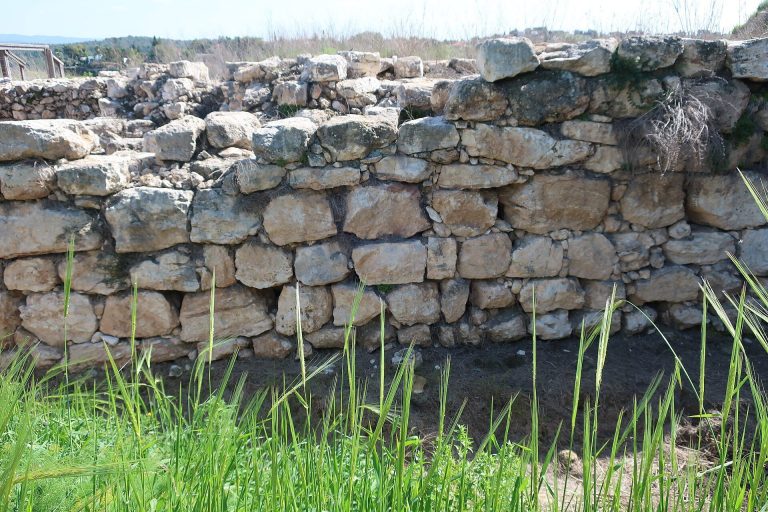
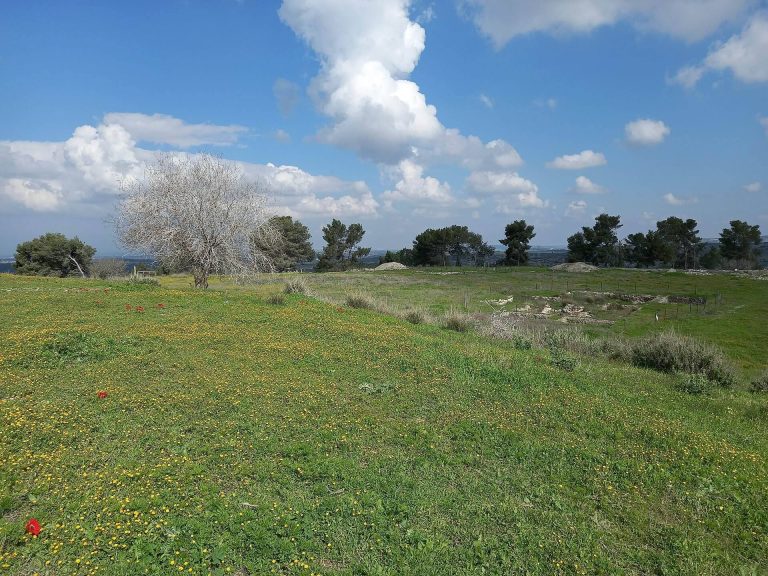
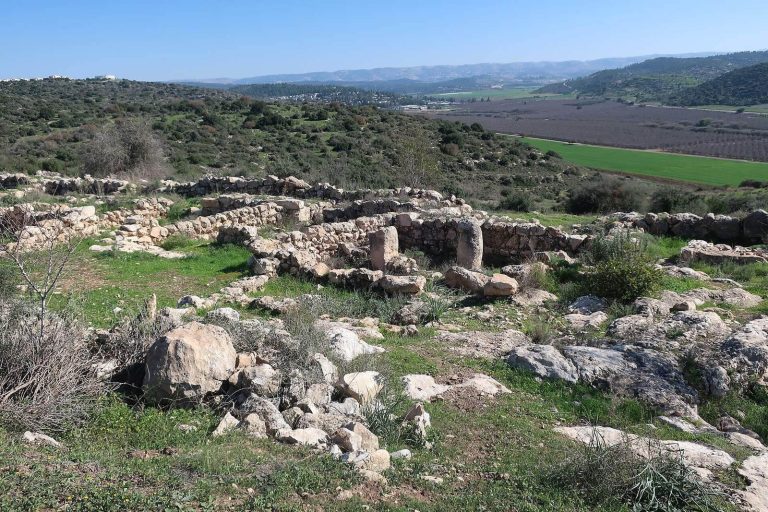
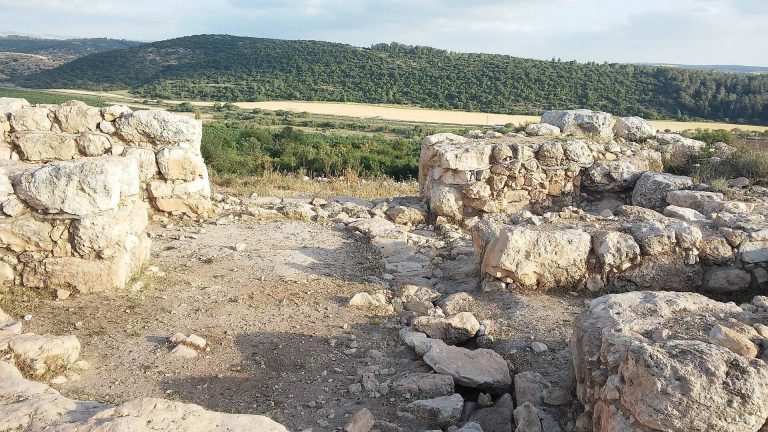
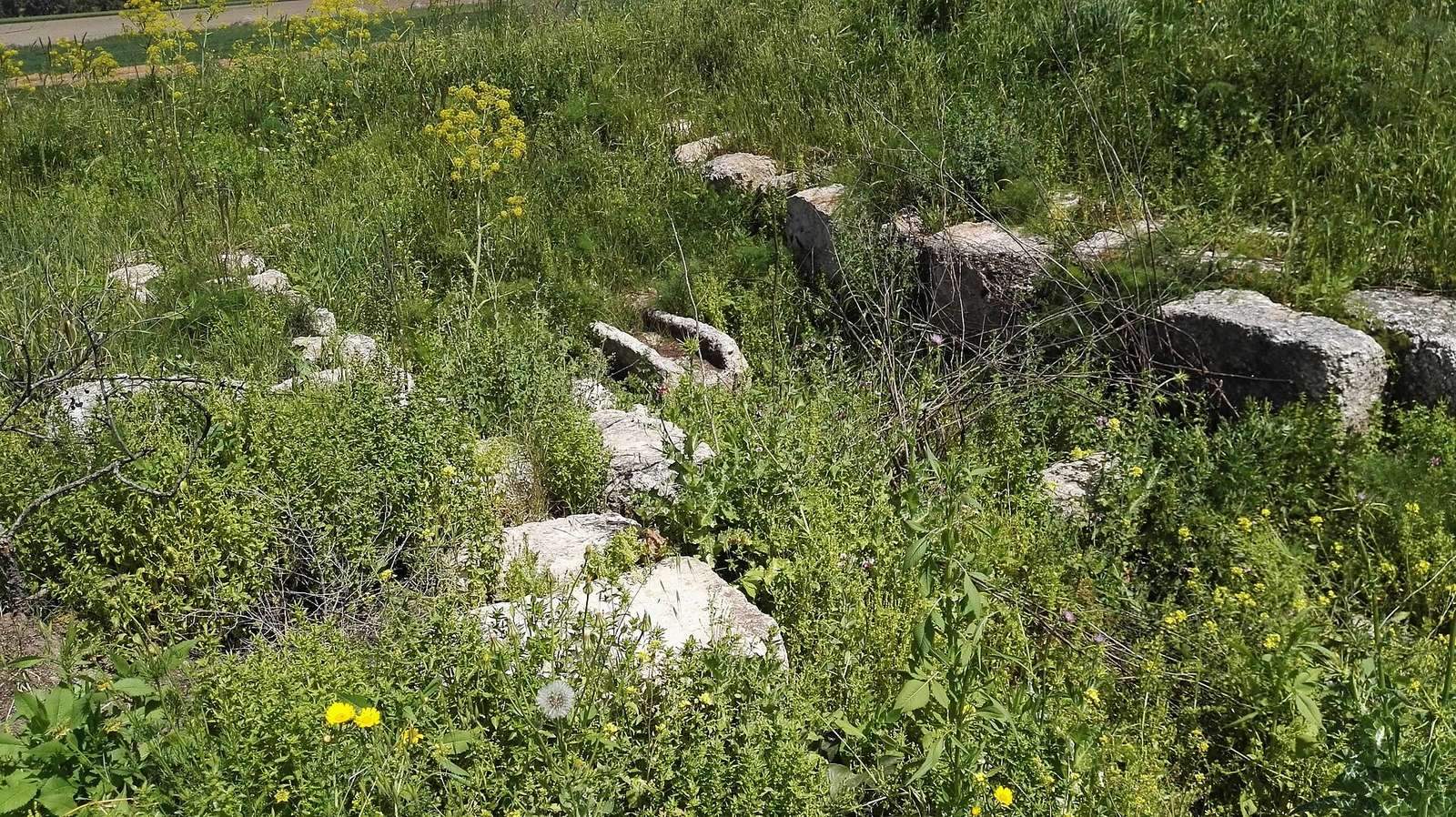
Tel Miqne lies on the eastern edge of Israel’s coastal plain, on the grounds of Kibbutz Revadim, about 35 kilometres west of Jerusalem and 18 kilometres north of Tel es-Safi. The low mound rises only a few metres above the fertile plain. It has a smaller upper mound and a larger lower mound to the south, corresponding to the city’s upper and lower areas. Remains include mudbrick walls and buildings, stone architectural features, industrial installations, and successive occupation layers.
Bronze Age remains
Middle Bronze Age fortifications
Middle Bronze Age defenses appear to have enclosed both the upper and lower cities. Excavated sections of the ramparts include large platforms in the lower city. Pottery, fragmentary building remains, and three infant burials in jars were found in the lower city as well.
Late Bronze Age occupation
Late Bronze Age buildings were confined to the upper city and were not protected by fortifications. Finds include imported pottery from Cyprus and the Mycenaean world, an ancient Greek civilization, as well as polished grey pottery associated with Anatolia. One burial contained a seal and a scarab from Egypt’s 19th Dynasty. A scarab bearing the name of Amenhotep III, made in the 14th century BCE and dedicated to the “Lady of the Sycamore Tree,” was kept and reused during a later Philistine phase. A badly burned storeroom contained jars with carbonized grain, lentils, and figs.
Philistine urban remains
Upper-city buildings and pottery
The upper city’s early Philistine phase included a mudbrick city wall, large halls organized around principal rooms, hearths, a limestone bathtub, and an area with industrial kilns. Its pottery sequence includes locally made wares known as Philistine 1, followed by Philistine 2 pottery decorated in red and black over a white clay coating. Later pottery, labelled Philistine 3, included simplified forms and a tradition dominated by red-coated, polished vessels. In later early Iron Age phases, builders added a sloping mudbrick defensive bank. A room associated with ritual use contained an incised shoulder blade.
Lower-city domestic area
On the lower city’s southern slope, architectural units stood behind the early mudbrick wall. Finds from this area include a bull-shaped vessel, an incised ivory tube, and a bronze pin and needle. A large building was comparable in scale to one in the city’s elite zone. Objects recovered there include a painted and incised bone plaque showing a horse’s hindquarters, a female figurine of Mycenaean type, a gold spiral hair ring, a stamp seal carved with two gazelles, and an iron knife with an ivory handle. Two small pebble hearths and two goat skulls were also found. Domestic buildings continued in a later phase without substantial changes, and an incised shoulder blade came from that level too.
Lower-city elite zone
The elite area developed through several building phases. Early remains include rectangular hearths, followed by a large public building with circular hearths and an ivory lidded container decorated with animals fighting. A later hall with a principal room had pebble hearths built one above another, three rooms with benches and raised platforms for ritual use, and a monumental entrance hall with two mushroom-shaped stone pillar bases. One room held 20 spherical loom weights. Other finds include three miniature bronze wheels from a ritual stand, a two-faced bronze chariot-wheel pin, and an iron knife with a pierced, spool-shaped ivory handle fixed by three bronze nails.
The same complex included a large stone bath, a single upright stone, two stone pillar bases, and several hearths. In a later phase, the building plan and ritual use continued. Finds from this period include a cache of ivory, glazed siliceous material, and stone objects, decorated earplugs, and a ring depicting the Egyptian goddess Sekhmet.
Iron Age defenses, industry, and sanctuary
City walls, gate, and public buildings
In the upper city, later Iron Age remains include a mudbrick wall and a mudbrick tower seven metres wide. The tower was faced with squared stone blocks laid with alternating short ends and long sides visible. Later monumental buildings included rooms, probably shops or market stalls, opening onto a street that had been repaved. A stone-lined central drain was added in a subsequent phase.
The lower city had a wall and a gate with three entries, protected by a gatehouse. East of the gate, a row of buildings about 80 metres long stood between the city wall and an outer screening wall. These buildings have been interpreted as stables or storehouses, and a large public building stood nearby. The final Iron Age occupation in this area is represented by a single building unit.
Olive-oil factories
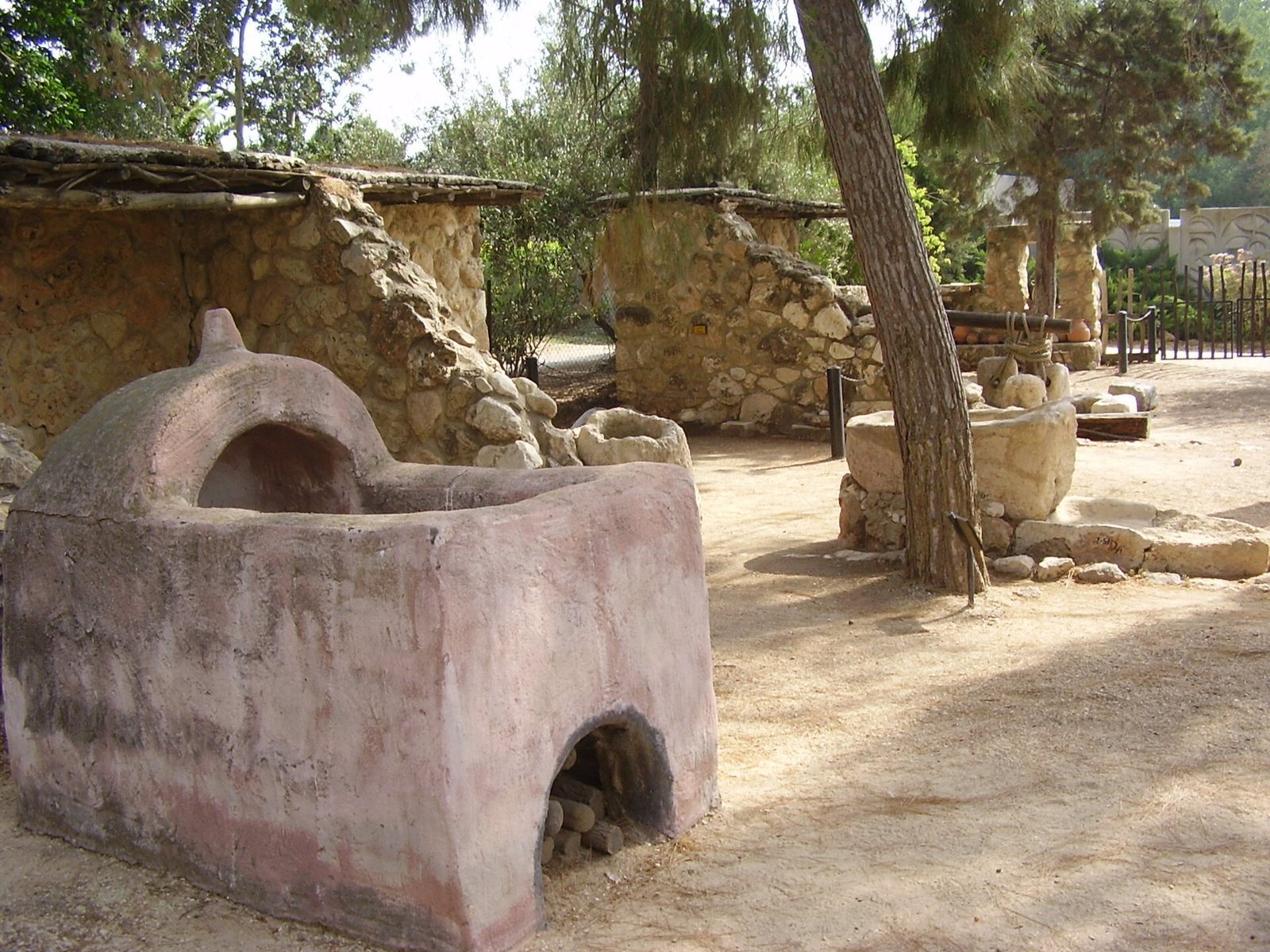
An industrial belt for olive-oil production ran along the inner face of the lower city wall. Archaeologists identified about 115 presses, with estimated capacity of 500–1,000 tonnes; annual production has also been estimated at no less than 500 tonnes. A typical factory had three rooms: one for crushing olives, one for separating and storing oil, and a room opening onto the street that was used for textile work. Factories operated for about four months each year for oil production and eight months for textiles.
Workers crushed olives with a cylindrical stone in a large rectangular basin. They put the crushed fruit into fibre baskets stacked on boards over vats, then pressed the baskets with a heavy wooden beam. One end of the beam fitted into a wall niche; perforated stone weights pressed down on the other. The oil collected in the vats and was transferred to jars to separate it from residual water. One jar fragment carries a black-ink mark meaning “oil.” Finds from the industrial area also include seven large iron agricultural tools and nine limestone altars with four projecting horns.
Temple Complex 650
The lower-city elite zone contained Temple Complex 650, measuring about 57 by 38 metres. Its Assyrian-style plan arranged rooms around a courtyard, with a large entrance hall containing a raised platform and a columned sanctuary. The hall may have served as a throne room. The sanctuary’s design has also been compared with the Phoenician Temple 1 of Astarte at Kition, an ancient city on Cyprus.
The sanctuary’s innermost room held a rectangular limestone block bearing a five-line royal inscription. It names Ekron and five of its rulers, including Ikausu, son of Padi, who built the sanctuary for Ptgyh, described in the text as his lady. Ptgyh has been interpreted as a Greek goddess, though the identification is uncertain. Sixteen shorter inscriptions from buildings in the elite zone include phrases meaning “dedicated to Asherat” and “for the shrine,” as well as a mark that may refer to 30 units of produce set aside as an offering.
Side rooms yielded gold, silver, and bronze objects, including a gold cobra and ivory objects linked with ritual use. The ivory finds include a woman’s figure, perhaps representing a royal person, a knob bearing the royal name of Ramses VIII, a large head probably from a harp, and a large object with male and female figures alongside the royal name of Merneptah. Hoards of silver were also recovered from buildings in the elite area.
Destruction deposits and later remains
A destruction layer from 604 BCE contained concealed valuables, including silver jewellery, gemstones, carved silver objects, and silver ingots. The substantial building preserved from the brief resettlement afterward is an Assyrian-style courtyard building. Fragmentary remains from the Roman, Byzantine, and Islamic periods have also been found at the site.