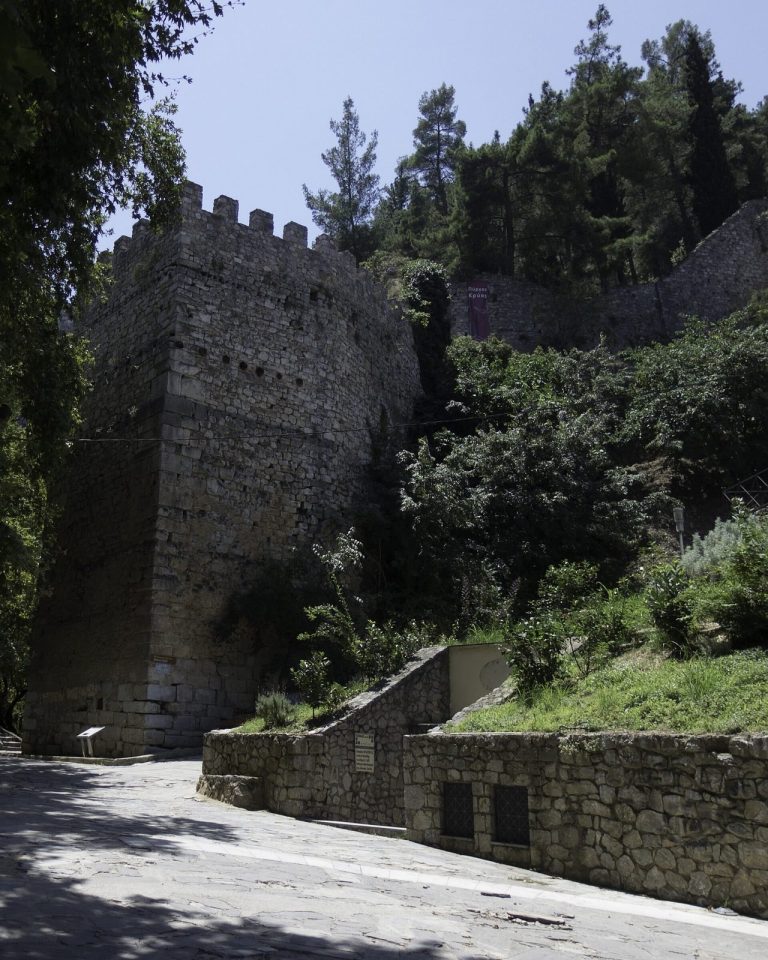
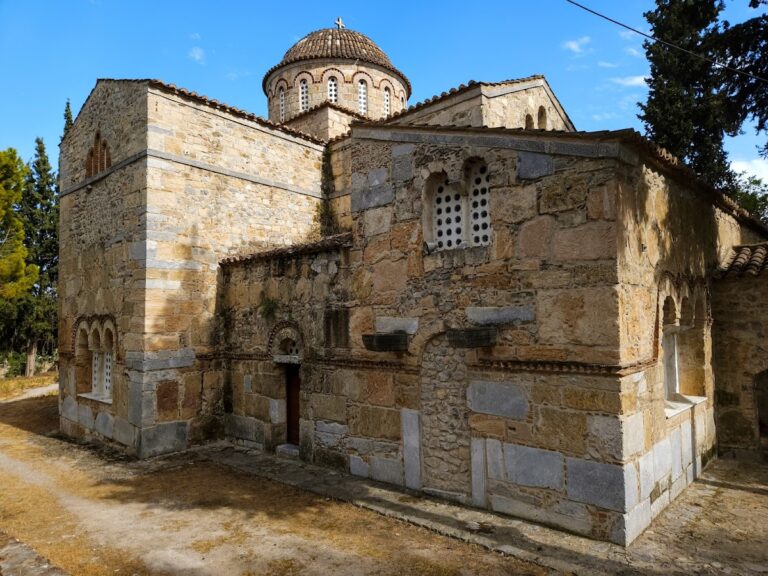
Temple of Apollo in Delphi: Center of the Delphic Oracle
Site at a Glance
- Popularity
- Very High
- Country
- Greece
- Primary era
- Classical
- Eras represented
- Bronze Age, Iron Age, Classical
- Civilizations
- Ancient Greek, Kingdom of Pergamon, Mycenaean, Roman
- Site type
- Religious
- Remains
- Sanctuary
On this page23 sections
History
The Temple of Apollo in Delphi is an ancient Greek temple at Delphi, Greece, whose surviving fourth-century BCE building is Doric. Its sanctuary had become a major Greek religious center by the eighth century BCE, and the temple served as the home of Apollo’s oracle.
Early occupation and sacred traditions
People lived at Delphi in the fifth and fourth millennia BCE. Stone tools and pottery from the Early and Middle Helladic periods, phases of prehistoric Greek history, have been found around the sanctuary. Rectangular buildings with rounded ends date to the thirteenth and twelfth centuries BCE. A large chief’s residence, or megaron, has been proposed for the site of the later temple, but this interpretation is unconfirmed. Graves and signs of religious activity were found west of the sanctuary, toward Marmaria. The worship there may have involved an earlier earth goddess, Gaia. Finds include figurines, among them a woman seated on a three-legged stand, and a Cretan-style vessel for drinking or ritual pouring. Occupation continued through the Sub-Mycenaean, Protogeometric, and early Geometric periods, but when Apollo’s worship began at Delphi is uncertain.
Greek traditions describe Apollo arriving from Crete with sailors from Knossos, whom he made priests near Crisa. Other myths tell of Gaia as an earlier divine presence and of Apollo defeating a dragon called Python or Typhon to take control of the sanctuary. These stories belong to mythology rather than established events. The travel writer Pausanias recounted four temples before the historical building: a hut of laurel branches, a structure of beeswax and feathers or, in another version, ferns, a bronze temple attributed to the god Hephaestus, and a stone building associated with the legendary builders Trophonius and Agamedes. The stories disagree about how the bronze temple ended, and the existence of an earlier sanctuary of Gaia remains debated.
The oracle and religious life
By the eighth century BCE, Delphi was linked with the Amphictyony, a league of Greek communities organized around a shared sanctuary. Its members gathered around the sanctuary of Demeter at Thermopylae, and the league later administered Delphi. Visitors from Greek communities and lands beyond sought the oracle’s advice on matters including colonization, marriage, children, and health. Apollo’s priestess, known as the Pythia, delivered prophecies that priests interpreted. The process and the intelligibility of her utterances remain uncertain. A tradition says that priestesses had to be at least fifty years old after a Pythia was assaulted by Echecrates of Thessaly.
Consultants commonly brought a gift, often a goat, sheep, or bull, and purified themselves at the Castalian Spring before entering the sanctuary. The Pythia may have used spring water and a laurel branch, and important prophecies could be written by a priest on a laurel leaf. Apollo was worshipped for nine months of the year. In winter, oracular activity paused and attention turned to Dionysus, a god associated with wine and ecstatic rites. Women known as the Thyiades celebrated him in festivals. Traditions connect these rites with Dionysus’s return to divine status and with his mortal remains being kept at Delphi, though the details of the worship are unclear. Apollo was also called upon as a healer, and people came to the sanctuary for help during epidemics.
Gifts from rulers and communities made Delphi exceptionally wealthy. The Greek historian Herodotus described offerings to Apollo from Croesus, king of Lydia, and a silver bowl with an iron stand dedicated by Alyattes, Croesus’s father. The precise locations of some such gifts within the temple or in nearby treasuries are uncertain.
Archaic and Classical periods
Around 600 BCE, the First Sacred War began after the people of Cirrha imposed heavy charges on pilgrims passing through their port on the way to Delphi. The Amphictyony fought Cirrha, destroyed the town, and confiscated its territory for the sanctuary. The Delphians gained control of the oracle while the league administered the sanctuary. The older stone temple burned in 548 BCE. The influential Athenian family known as the Alcmaeonidae financed its replacement. That temple was completed around 510 BCE and was in use by about 490 BCE.
During the Persian invasion of 480 BCE, forces sent by Xerxes I attempted to reach Delphi. A tradition credits storms, thunder, falling rocks, and the appearance of two armed heroes with driving the Persians away. Herodotus later said he saw two rocks at the sanctuary of Athena Pronaia that people identified with the stones in this story. In 448 BCE, Phocians took control of Delphi with Athenian support, beginning the Second Sacred War. Spartan intervention the following year did not dislodge them, and the Athenian statesman Pericles supported their hold. Delphi had regained its independence by 421 BCE, after the Peace of Nicias.
An earthquake and rockfall from the Phaedriades cliffs partly destroyed the temple in 373 BCE. Rebuilding began in 369 BCE and was under way again around 352 BCE, but the work was not completed until about 330 BCE. Meanwhile, the Third Sacred War began around 357 BCE after the Phocians refused an Amphictyonic fine over the cultivation of sacred land. They seized and plundered the sanctuary, holding the oracle for about ten years and using its wealth to pay their forces. Philip II of Macedon expelled them. The Phocians paid a heavy indemnity and lost their votes in the Amphictyony, while Macedonia gained a place in the league.
The Fourth Sacred War began in 339 BCE over cultivation of the Cirrhaean plain and a proposed charge on pilgrims. Philip II intervened, and the conflict ended in 328 BCE. In 279 BCE, Celtic forces under Brennus invaded Greece. Winter conditions on Mount Parnassus and support from the Aetolians and Phocians helped protect the temple. Tradition attributes the Celts’ retreat to divine intervention and falling rocks; before withdrawing, they plundered sanctuaries at Marmaria.
Hellenistic and Roman rule
The Aetolian League, a Greek political confederation, controlled the sanctuary from the third century BCE until 168 BCE. Delphi continued to receive gifts, including support from the kings of Pergamon, and the Aetolians and Pergamene rulers built a portico. Rome gained control after its victory over Perseus in 167 BCE. In 86 BCE, the Roman general Sulla compelled the Delphians to surrender gold offerings to help fund his war against Mithridates, king of Pontus. In 83 BCE, the Thracian Maedi plundered the sanctuary and burned its roof.
Under Augustus, the temple regained some prominence despite plundering in the first century CE; about 3,000 statues remained at the sanctuary. In 67 CE, Nero removed nearly 500 statues and distributed the Cirrhaean plain among his legionaries. The temple was restored in 87 CE under Domitian. In the second century CE, Roman emperors, especially Hadrian, supported the sanctuary. The Greek benefactor Herodes Atticus paid for stone seating at the stadium. The oracle was in decline as cities that had once consulted it were increasingly joined by individuals seeking answers to personal questions.
Late antiquity and modern investigation
Constantine, honored at Delphi with two statues, removed the Tripod of Plataea and took it to Constantinople. The tripod had been dedicated after the Greek victory of 479 BCE. Julian later tried unsuccessfully to revive the temple. An order for the temple’s destruction came in 390 CE, and the oracle closed in 394 CE after Theodosius I prohibited pagan worship. Most statues and artworks were destroyed or removed. Delphi became the seat of a bishop, and a basilica was built west of the abandoned sanctuary in the following century.
Modern excavations began in 1838, including investigations by Laurent and Heinrich Nikolaus Ulrichs. The French School of Athens received excavation rights in 1891, and Jean Théophile Homolle directed excavations from 1892 to 1894. French work continued intermittently through 1939. The Athenian Treasury was restored in 1905, and the temple underwent partial restoration in 1938, 1939, and 1950. Delphi was inscribed on the UNESCO World Heritage List in 1987.
Remains
Sanctuary setting and route
Terraces and enclosure
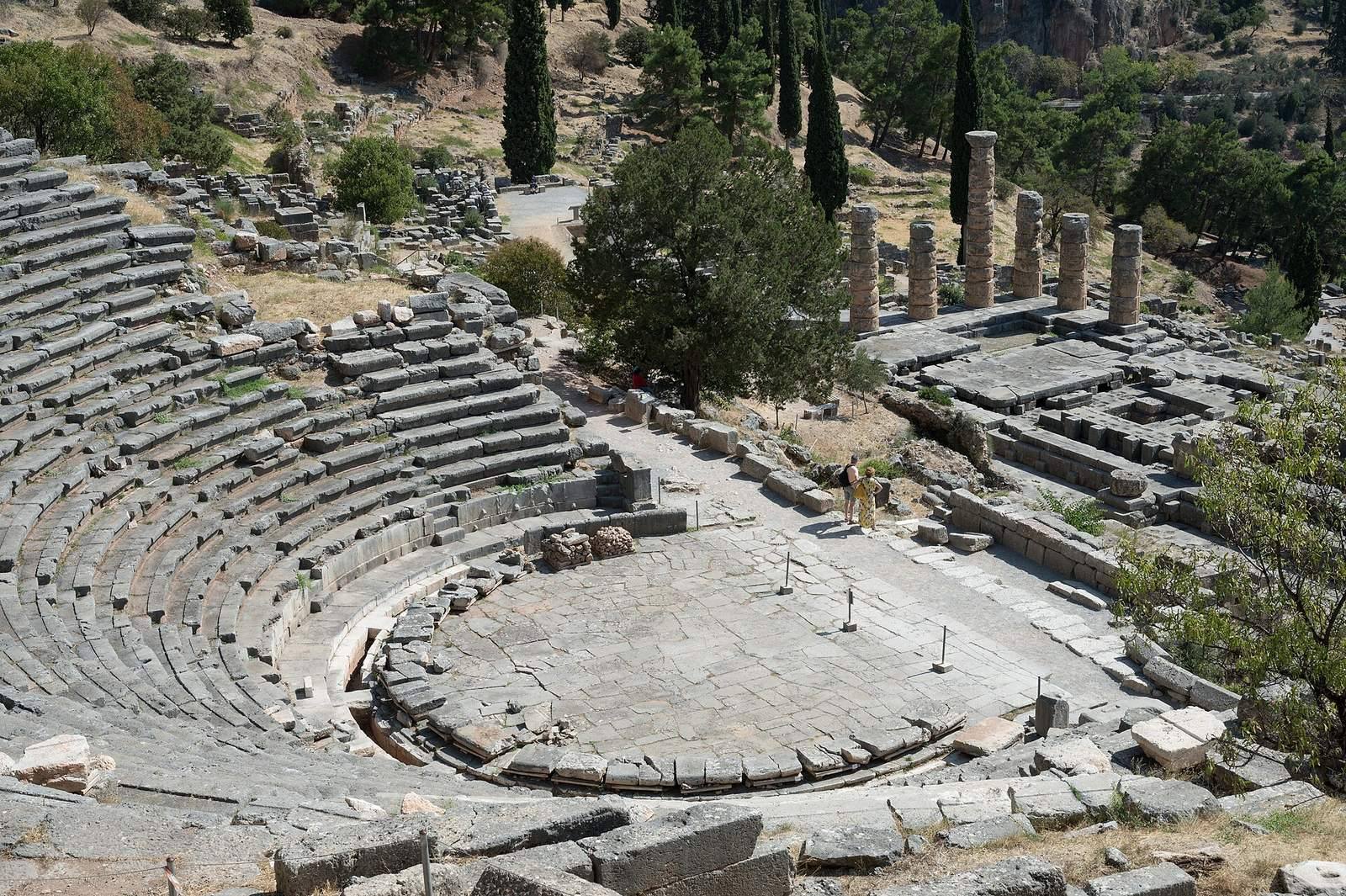
The sanctuary occupied a steep slope of Mount Parnassus, beneath the Phaedriades cliffs and north of the Gulf of Corinth. The ground level varied by as much as 70 metres, so retaining walls and terraces shaped the site. Buildings and monuments developed irregularly around the temple within an enclosure roughly rectangular or trapezoidal in outline, about 195 by 135 metres. A boundary wall had several entrances on its eastern and western sides. The main entrance lay to the southeast, reached by way of a Roman agora, while an Ionic-columned portico stood along the north side. The sanctuary also contained a theater, altars, treasuries, and sanctuaries dedicated to Gaia, Dionysus, and Neoptolemus, alongside other buildings and monuments.
The Sacred Way
From the southeastern entrance, the Sacred Way wound for about 400 metres toward the temple. It was approximately four to five metres wide and had votive monuments and treasuries along both sides. Greek communities built these treasuries to house offerings, as the accumulated gifts exceeded the space available within the temple itself.
Temple of Apollo
Fourth-century building
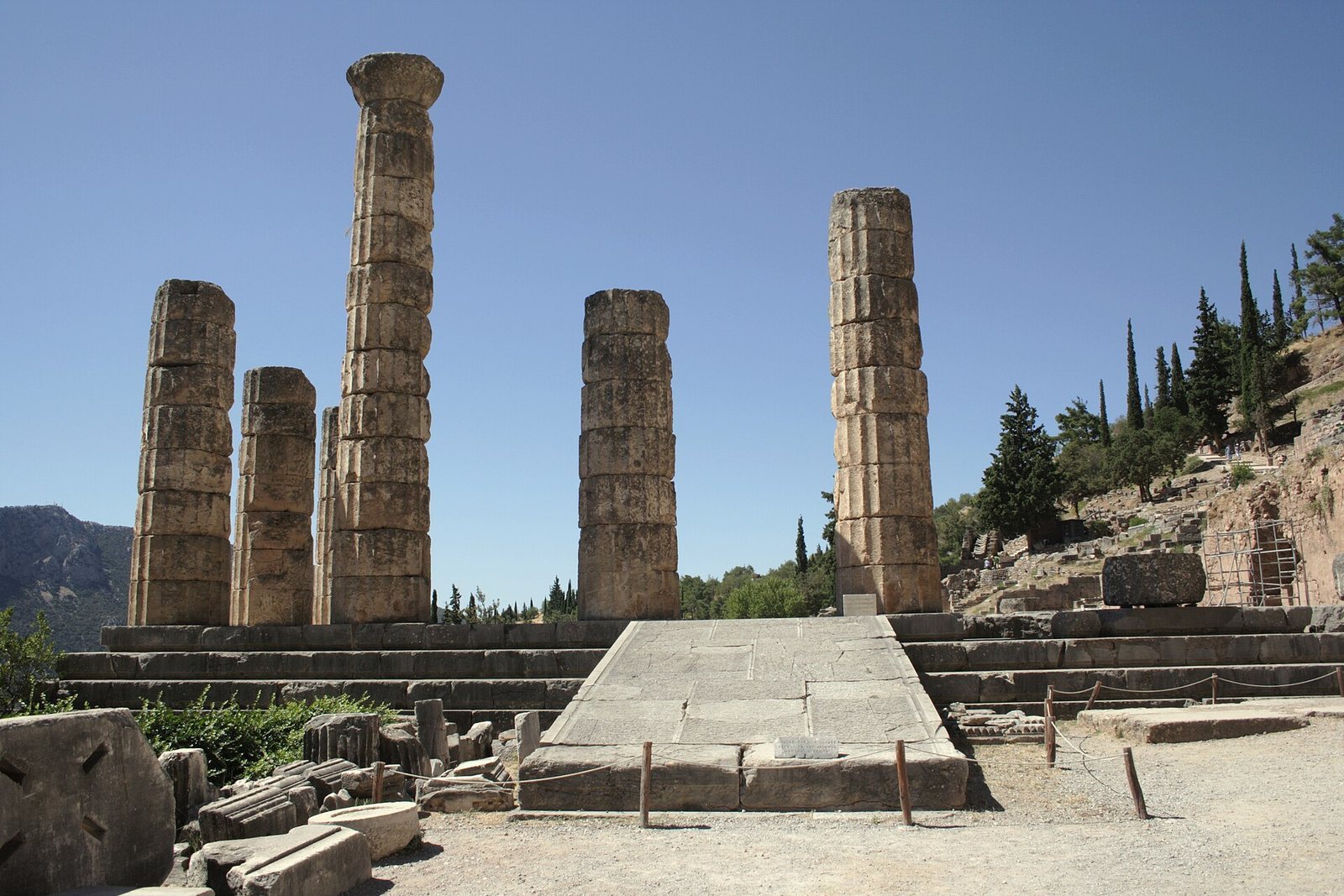
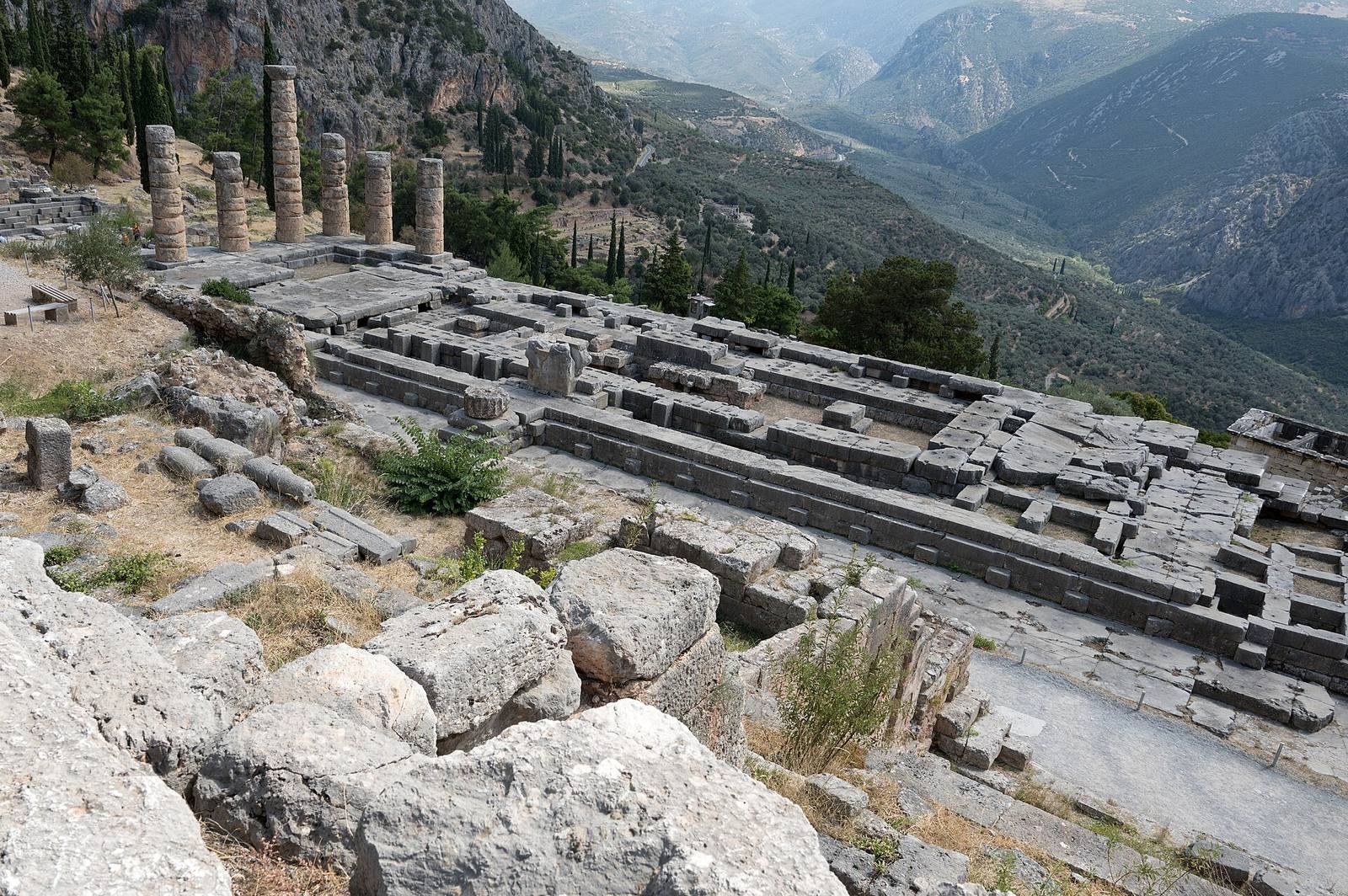
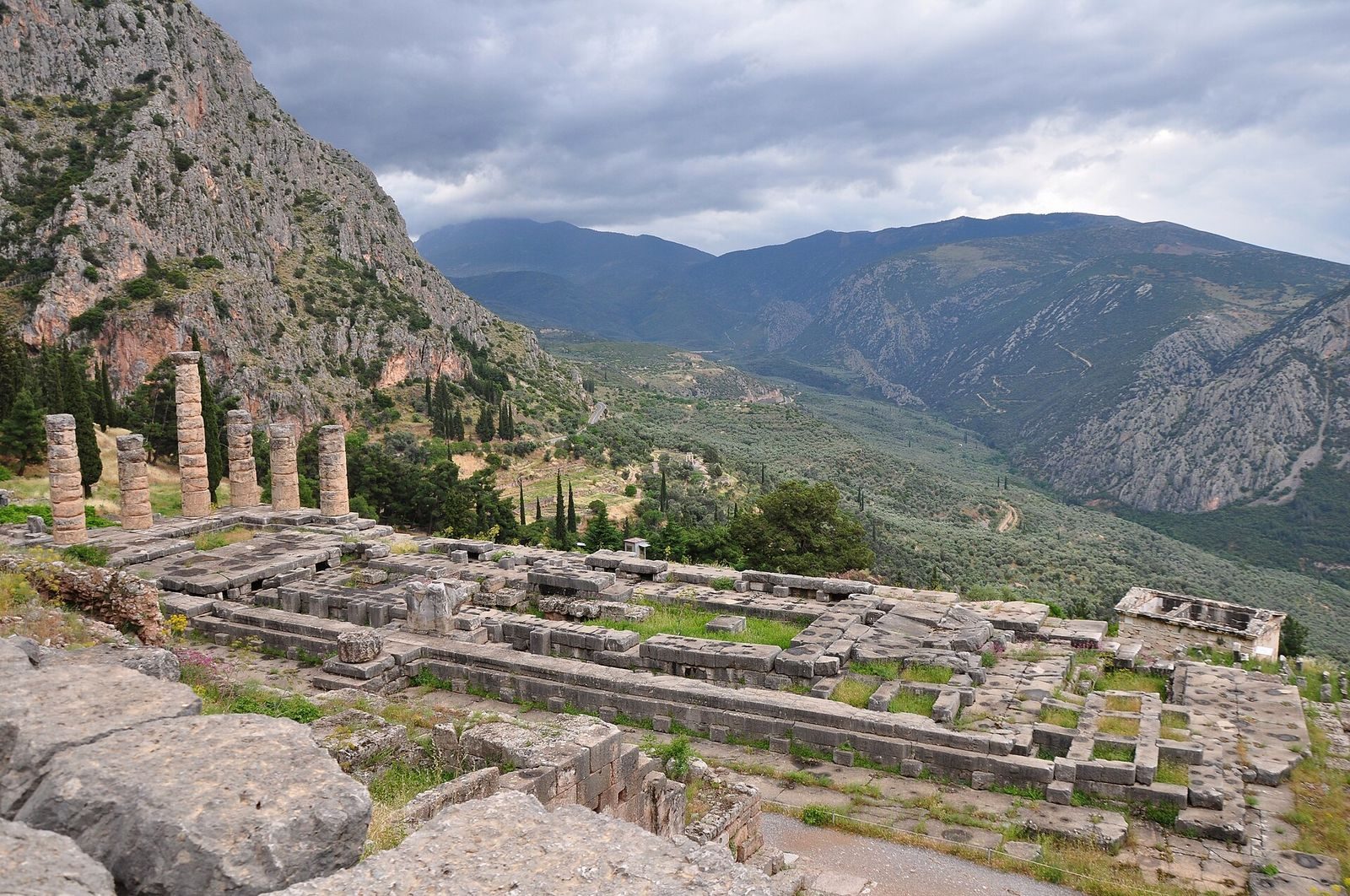
The visible ruins belong to the fourth-century BCE temple, rebuilt after the earthquake and rockfall. It was a Doric building surrounded by columns, with six across the front and fifteen along each side. The columns were made of tufa; a building contract specified limestone, and white Parian marble may also have been used for columns. Three steps rose to the temple platform, which stood on a slope running north to south. The southern side rested against a wall above a lower terrace, supported in turn by a retaining wall of polygonal stonework.
Foundations and inscriptions
Small stone chambers lay beneath the temple, within larger walls built from many-sided blocks. Inscriptions on these walls include Amphictyonic decrees granting privileges, public honors for benefactors, references to the Pythian Games, and records freeing people dedicated to Apollo. The Pythian Games were a festival and athletic competition held at Delphi in Apollo’s honor. Some inscriptions date to the third century BCE; others belong to the Roman period under Hadrian.
Interior and oracular chamber
The temple’s internal arrangement is only partly clear. It included a front porch, a cella, the principal enclosed room, and an adyton, the restricted inner sanctuary associated with the oracle. A rear room may have held offerings and valuables, and an oracular chamber or vault probably lay below the temple. The cella floor was made of blue-grey limestone slabs that were sometimes washed with water from the Castalian Spring. Wall paintings were attributed to Aristoclides.
The adyton was reserved for Apollo’s priests. The omphalos, an oval stone representing the navel of the earth, and a tripod used by the Pythia are associated with this inner space. It may also have held a golden statue of Apollo, sacred armor, an altar with a pine-wood fire, and other offerings. The exact arrangement of the objects is uncertain. The omphalos was described as wrapped with snakes; in myth, Zeus sent two eagles around the world in opposite directions, and they met at Delphi. Two golden eagles may have accompanied the stone.
Sculpture and exterior fittings
The temple’s eastern and western triangular end spaces carried sculpted scenes. The east showed Apollo, Artemis, and Leto with the rising and setting sun; the west presented Dionysus among the Thyiades, women who celebrated him in ritual. Praxias began the sculptures and Androsthenes completed them after his death. Panels in the Doric frieze showed Heracles and Iolaus fighting the Lernaean Hydra, Bellerophon and Pegasus overcoming the Chimera, Zeus defeating Mimas, Athena defeating Enceladus, and Dionysus striking a giant with his ritual staff. The sculpted figures had gilt-bronze accessories. Persian shields taken by the Athenians at Marathon in 490 BCE and Gallic shields associated with the defense against the 279 BCE invasion were fixed to the temple’s exterior.
Three sayings linked with the temple are “Know thyself,” “Nothing in excess,” and “Surety brings ruin.” Tradition attributed them to the Seven Sages. The porch was also associated with an enigmatic dedicatory letter E. The exact original positions of these sayings and the letter are uncertain.
Votive monuments and dedications
Sphinx and Corcyrean bull
The Sphinx of Naxos, made around 560 BCE, stood on a tall column in the sanctuary. Its head, found in 1893, is now in the Delphi Archaeological Museum. Near the main entrance and the Sacred Way, a bronze bull stood on a rectangular base. The people of Corcyra, the ancient name for Corfu, dedicated it around 480 BCE. Made by Theopropus of Aegina, it recalled a bull whose bellowing was said to have led fishermen to a large catch of tuna.
Greek victory monuments
An Arcadian dedication farther along the road stood on an elongated base carrying nine bronze statues. Dedicated after an incursion into Spartan territory in 370/369 BCE, the group showed Apollo, Nike, the ancestral hero Arcas and his sons, and other figures. Several sculptors worked on it. The Spartans’ monument, on the opposite side of the entrance, had a long base that survives. It carried 37 bronze statues made by nine Peloponnesian artists from spoils taken after Sparta’s victory over Athens at Aegospotami in 404 BCE. Among the figures were Zeus, Apollo, Artemis, Poseidon, the Dioscuri, Lysander, and other Spartan commanders; Poseidon was shown crowning Lysander.
The Athenians’ monument stood beyond the Spartan group. Its base bears an inscription identifying sixteen statues paid for with a tenth of the spoils from Marathon. The figures also included Athenian kings and heroes associated with the city’s tribal names, among them Erechtheus, Cecrops, Pandion, Aegeus, and Acamas. The dedication is attributed to Phidias and may date to Cimon’s period. Statues of Antigonus, Demetrius, and Ptolemy were later additions.
Argive and Tarentine dedications
A bronze horse made by Antiphanes of Argos stood near the enclosure wall to the left of the Spartan monument. Dedicated after an Argive incursion into Thyrea in 414 BCE, it was modelled on the wooden Trojan Horse. Farther west, a group of the Seven against Thebes showed seven mythical Argive leaders and the chariot of Amphiaraus, driven by Parthenopaeus. Several artists made the monument, which was associated with spoils from the battle at Oenoe in 460 BCE. The Argive monument of the Epigoni, sons of the Seven against Thebes, stood on a semicircular base at the left of the Sacred Way. It portrayed their campaign, which captured and destroyed Thebes; Aegialeus, son of Adrastus, was the only leader killed. This dedication was also associated with spoils from Oenoe.
A second semicircular niche held ten bronze statues of Argive kings and heroes, including Danaus, his daughter Hypermnestra, and her husband Lynceus. The group was linked to Argive and Theban participation in the founding of Messene in 369 BCE and was made by Antiphanes. Beyond it, the people of Tarentum, a Greek city in southern Italy, dedicated bronze horses and captured women from the neighboring Messapian people on an elongated stone base. The offering commemorated a Tarentine victory.
Treasuries and offerings
The treasuries and votive monuments gave physical form to gifts made by Greek communities. Individual cities built treasuries to hold their offerings, while statues and other dedications occupied spaces along the Sacred Way and across the sanctuary.
Excavated finds and geological evidence
Statues and deposits beneath the temple
Excavations brought to light bronze and marble statues and other votive offerings. The Charioteer of Delphi survives from a larger bronze group dedicated by Polyzalos of Gela after a victory at the Pythian Games. The three-figure sculpture called the Dancers of Delphi is another notable find. Both are now in the Delphi Archaeological Museum. Cavities beneath the temple excavated in 1938 contained ivory, bronze, and gold fragments thought to come from gold-and-ivory human figures, as well as gold sheets showing animals and mythological figures.
Faults beneath the temple
Fractures and fault zones lie beneath the temple. They may have allowed spring water to enter the structure and, during tectonic activity, released hydrocarbon gases with intoxicating or mind-altering effects. Such gases have been proposed as one possible explanation for ancient descriptions of the Pythia’s altered state, although the ritual process remains uncertain.