Porte d’Auguste, Nîmes: A Roman City Gate



Site at a Glance
- Rating
- 4.4
- Popularity
- Medium
- Country
- France
- Primary era
- Classical
- External website
- Open
- Eras represented
- Classical
- Civilizations
- Roman
- Site type
- Military
- Remains
- Gate
On this page7 sections
History
The Porte d’Auguste is a Roman city gate in Nîmes, France, built around 16 BC during the first century BC as part of the colony’s fortifications. It was one of the principal entrances to Nemausus, the Roman name for Nîmes, and marked the point where the Via Domitia, the major road linking Italy with southern Gaul and the Iberian Peninsula, entered the city.
Roman foundation
The gate was formerly called the Porte d’Arles. An inscription above its arches states that Augustus, Rome’s first emperor and the adopted heir of Julius Caesar, gave the gates and walls to the colony. The inscription names him as the son of the deified Caesar. Its references to his eleventh consulship and eighth renewal of tribunician power, an imperial authority renewed annually and used for dating, place it around 16 BC.
Medieval fortification and rediscovery
In 1389, during conflicts between nobles and bourgeois, King Charles VI ordered a fortress to be built on the site. The new defenses incorporated the ancient remains and concealed the Roman gate for centuries. The fortress was ordered to be demolished in 1790, allowing the Porte d’Auguste to reappear.
The monument has been classified as a French historical monument since 1840 and is owned by the City of Nîmes.
Remains
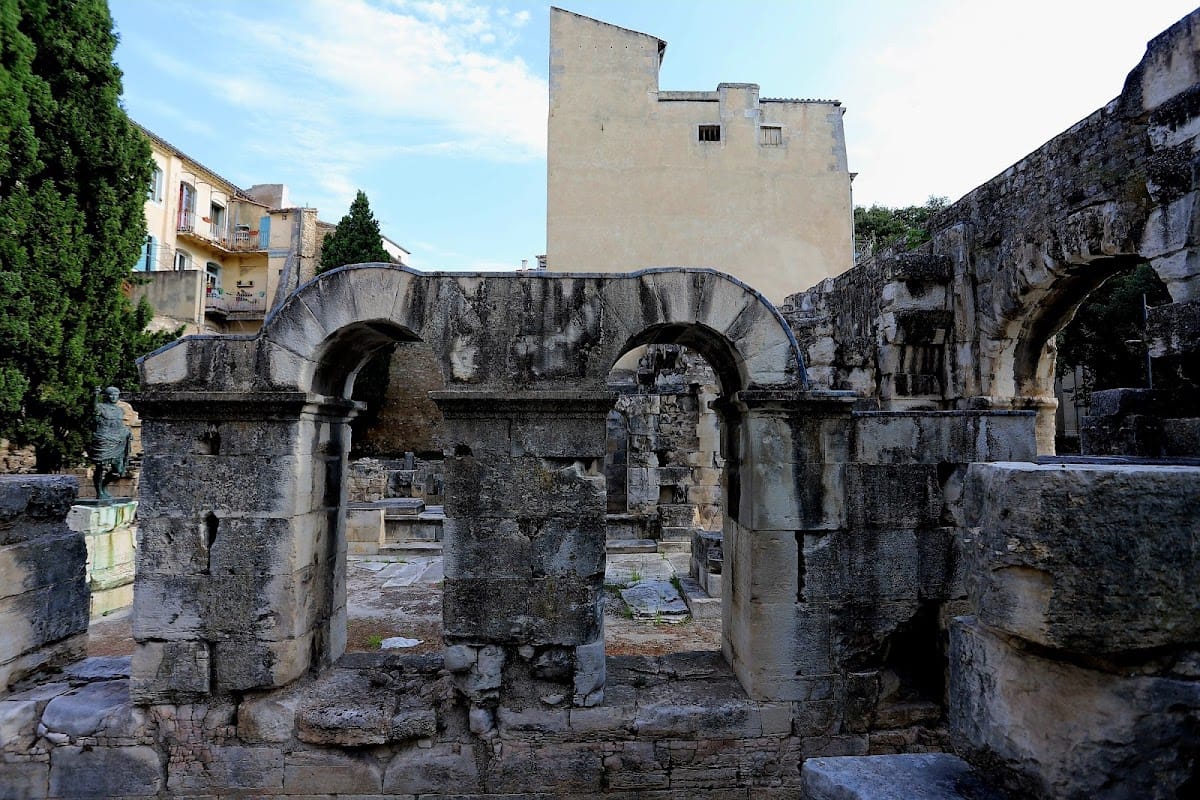
The surviving gate forms part of the former Roman fortifications of Nîmes. It is constructed from stone quarried at Barutel and is organized around four arched passages, with the larger central openings set between narrower pedestrian entrances.
Gate structure
Arched passages
Four semicircular-arched openings define the gate. Two broad central passages were intended for vehicles, while two smaller openings at the sides served pedestrians. A surviving portion of the original inscription remains above the arches.
Flanking towers
Two semicircular towers formerly stood beside the entrance as part of the Roman defensive arrangement. Their positions are marked today on the pavement by circles formed from large, flat stones.