Museo Archeologico Regionale Paolo Orsi: Syracuse’s Archaeological Museum


Site at a Glance
- Rating
- 4.3
- Popularity
- Medium
- Country
- Italy
- Primary era
- Classical
- External website
- Open
- Eras represented
- Stone Age, Bronze Age, Iron Age, Classical, Medieval
- Civilizations
- Ancient Greek, Byzantine, Roman
- Site type
- Museum
On this page22 sections
History
The Museo Archeologico Regionale Paolo Orsi is an archaeological museum in Syracuse, Italy, developed from collections that began in the late eighteenth century and now cover Sicily from prehistory through the Byzantine era. Its history reflects the growth of archaeological research in eastern Sicily, from early ecclesiastical collections to a modern institution organized around systematic regional study.
From ecclesiastical collection to public museum
The museum’s earliest predecessor was the Museo del Seminario, inaugurated by Bishop Alagona in 1780. In 1808 it became the Museo Civico and was moved near the archbishop’s residence. Three years later, the archaeologist Saverio Landolina, supported by Bishop Filippo Maria Trigona, began a first museum that enlarged the earlier collection.
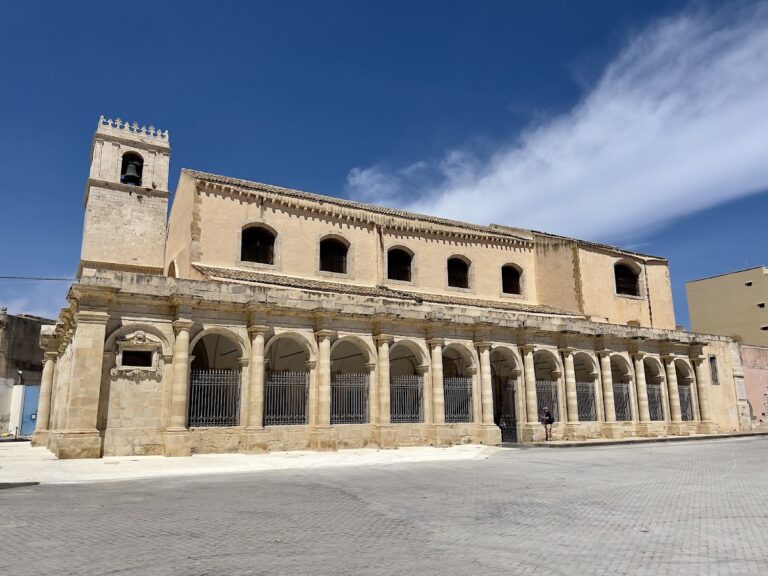
The discovery of the Sarcophagus of Adelphia in the catacombs of San Giovanni in 1872 strengthened the argument for a larger public archaeological museum. Francesco Saverio Cavallari directed the excavations in which the sarcophagus was found. A royal decree of 17 June 1878 established the Museo Archeologico Nazionale di Siracusa, which opened on 11 April 1886 in a former church building identified as San Giovanni di Dio on Piazza Duomo.
Paolo Orsi and the expansion of research
Paolo Orsi joined the museum in 1888 and directed it from 1895 to 1934. An Italian archaeologist whose excavations greatly advanced knowledge of prehistoric, Greek, and Roman Sicily, Orsi led extensive campaigns across eastern Sicily. These investigations brought large numbers of finds into the museum and helped establish it as a scientifically oriented institution with an international reach.
Wartime protection and the search for a new building
In 1940 and 1941, Superintendent Giuseppe Cultrera ordered archaeological material to be concealed in galleries of Eurialo Castle to protect it from possible bombing during the Second World War. The castle was one of four secure storage locations selected in Sicily. The museum reopened in 1946, but its nineteenth-century building soon became too small for the growing collections, and laboratories and storage areas were placed in other buildings.
Luigi Bernabò Brea succeeded Cultrera as superintendent in 1941 and later directed the museum. He promoted a new institution based on systematic and comparative displays, explanatory panels, captions, and reconstructions. Plans to enlarge the Piazza Duomo building were abandoned in favour of a new museum in the grounds of Villa Landolina, a nineteenth-century historic residence associated with the Landolina family.
The museum at Villa Landolina
Planning for the new museum’s sections began in 1961 under the scientific direction of Luigi Bernabò Brea and Gino Vinicio Gentili. By 1967, the architect Franco Minissi had been commissioned to design the building. The new museum opened at Villa Landolina in January 1988 and was named after Paolo Orsi.
The collections contain tens of thousands of archaeological finds, principally from Syracuse and its province, together with material from Gela, Agrigento, and other parts of eastern and central-eastern Sicily. The museum presents archaeological research carried out in Syracuse and Sicily from the late eighteenth century onward. Its displays are arranged in seven sectors, supplemented by an external presentation in the historic garden of Villa Landolina.
Continuing development
The upper-floor exhibition on the Hellenistic and Roman periods opened in 2006. In 2014, another upper-floor expansion added the Rotunda of Adelphia and displays on the catacombs and early Christian Syracuse; the presentation of that early Christian sector was completed in 2018. The numismatic collection moved from Piazza Duomo to the new museum in 2010. In 2015, the museum became the first Sicilian museum to offer its rooms through Google Street View, and the virtual mapping was placed online in 2016.
Remains
The modern museum building
Designed by Franco Minissi, the museum occupies about 12,000 square metres on three levels, including the basement. Approximately 9,000 square metres are given to exhibitions arranged around a central circular auditorium. The building uses a flexible, largely open plan based on a strict grid of equilateral triangles. This geometry appears in the ceiling construction and is repeated in some display cases and plinths. Skylights and windows opening onto internal courtyards provide natural light.
The free-standing circular auditorium is the complex’s central educational space and has been used for lectures and audiovisual presentations. The basement contains laboratories, storage areas, and the numismatic collection, whose coins are kept in a secure room.
Prehistoric and protohistoric Sicily
The prehistoric and protohistoric sector follows Sicily from the Upper Palaeolithic and earlier prehistoric periods through the Iron Age. It combines geological and palaeontological material with an introduction to the geology of the Mediterranean and the Hyblaean zone. Sicilian Quaternary fauna associated with gigantism and dwarfism is represented alongside casts of two dwarf elephants.
Neolithic objects from the Stentinello culture present evidence for early villages and pottery. Copper- and Bronze-Age material from the Castelluccio culture includes door slabs and finds from settlements and tombs. Objects from Thapsos, Pantalica, Cassibile, the Marcellino Valley, Sant’Angelo Muxaro, and Polizzello trace changes in pottery and bronze-working through the middle of the seventh century BC and relate to the arrival of the Siculi.
Thapsos and Pantalica
Thapsos is represented by large storage vessels, or pithoi, that were also used as funerary containers. They date from the late fifteenth or early fourteenth century to the early thirteenth century BC. Material from Pantalica includes a footed olla, a pottery vessel, from Pantalica I, dated 1250–1050 BC. Pantalica II contributes bronze arched fibulae, a knife, and a dagger from 1050–850 BC, while the southern necropolis is represented by a four-handled bowl with engraved decoration.
Castelluccio and later prehistoric finds
Among the Castelluccio objects is a bone item with globular projections dating from the twenty-second to the fifteenth centuries BC. The prehistoric displays also contain a funerary stele from the same broad period and a bronze Greek votive horse dated to about 710 BC.
Archaic and classical Greek Sicily
The sector devoted to archaic and classical Syracuse and the Greek colonies of eastern Sicily brings together material from Naxos, Leontinoi, Katane, Megara Hyblaea, and Zankle. Finds from Syracuse come from Ortigia, Acradina, Piazza Vittoria, and the city’s cemeteries, including Fusco and Giardino Spagna. This funerary material spans approximately the eighth to fifth centuries BC.
Megara Hyblaea and its sculpture
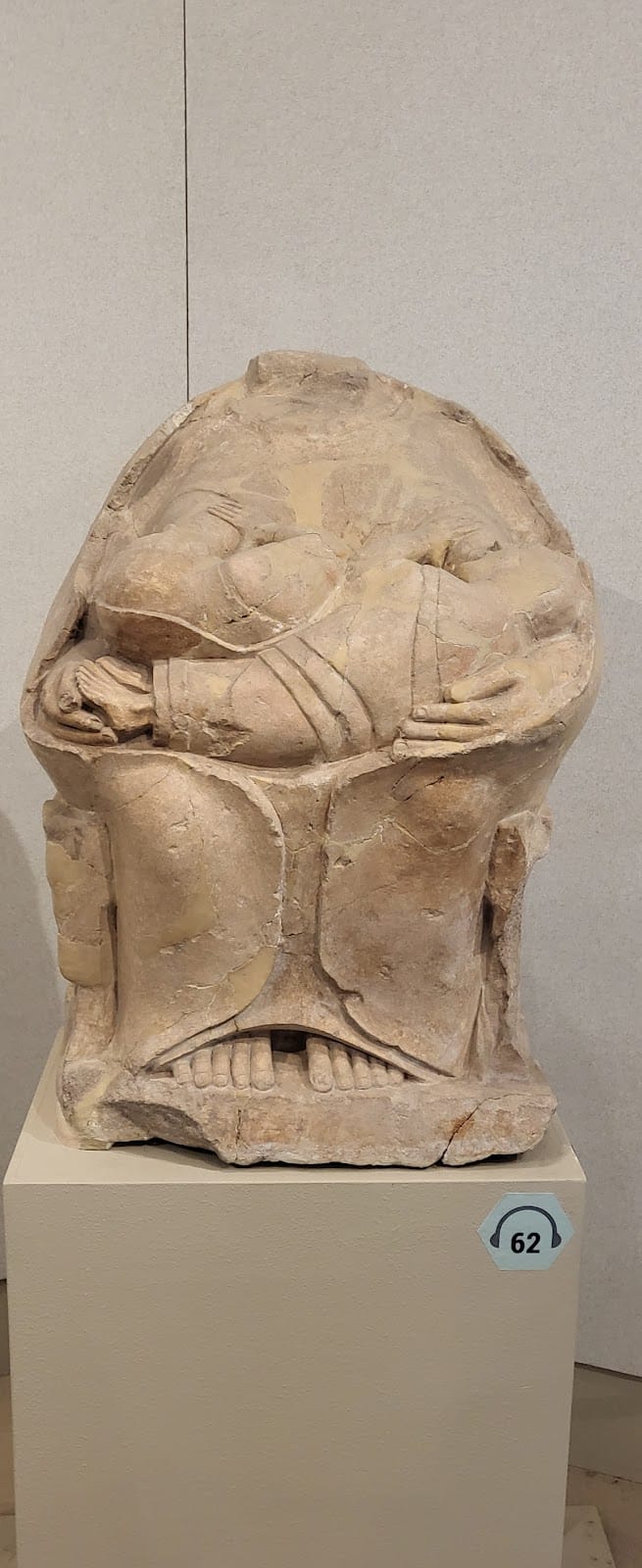
Megara Hyblaea is represented by ceramics, votive statues of Demeter and Kore, a gorgon, and the limestone Kourotrophos, a female figure associated with nurturing or nursing children. Found in the western necropolis, the Kourotrophos dates to about 550 BC. Other objects include a bronze ram protome, possibly a fitting for a chariot pole, from about 520 BC, a Silenus from about 520–480 BC, and a bronze cuirass from Tomb 5 of the Fosso Necropolis, dated about 370–340 BC.
Syracuse and the eastern colonies
A painted terracotta metope from the area of the Athena temple on Ortigia shows a running Gorgon holding Pegasus and dates to about 620–570 BC. An Attic red-figure pelike from Gela, showing an armed mounted Amazon, dates to about 440–430 BC. The displays also include a kouros head from Centuripe. A kouros is an archaic Greek statue representing a young male figure.
Syracuse’s sub-colonies and inland centres
A separate sector presents finds from the Syracusan sub-colonies of Eloro, Akrai, Casmene, and Kamarina, together with material from the Hellenized centres of Grammichele, Monte San Mauro, Francavilla di Sicilia, and Adrano. Akrai, Casmene, and Kamarina are associated with foundation dates of 664, 644, and 598 BC respectively.
Kamarina and Grammichele
Kamarina contributes rich grave goods from its cemeteries, a rider-shaped acroterion, an ornamental element placed at the edge or apex of a classical roof, from the sixth century BC, and a Peplophoros dated about 470–480 BC. Grammichele is represented by kouroi and other statues, including a votive statue from the second half of the sixth century BC, a male head dated about 550–525 BC, and the torso of a kouros from the early fifth century BC.
Megara Hyblaea, Gela, and Agrigento
A marble kouros from the southern necropolis of Megara Hyblaea is made of Naxos marble and dates to the middle of the sixth century BC. An inscription identifies it as Sombrotides, son of Mandrokles. The Gela and Agrigento displays include architectural terracottas from Gela’s Temple of Athena, grave goods with fine Attic vases, and material from the archaic sanctuary of Bitalemi. Agrigento is also represented by terracotta busts from the sanctuary of Demeter and Kore and three rare wooden statuettes in a Daedalic style from Palma di Montechiaro.
Francavilla di Sicilia contributes a large group of ceramic vessels and relief plaques depicting the worship of Demeter. These objects extend the museum’s presentation beyond the major coastal cities to the communities and sanctuaries that shaped the wider archaeological landscape of Sicily.
Hellenistic and Roman collections
The Hellenistic and Roman displays include material from residential quarters in Syracuse, evidence of cults associated with Demeter, Cybele, Isis, and Mithras, and lion-headed architectural water spouts from several sites. Portraits range from the Julio-Claudian period to the later Roman imperial period. Funerary furnishings from the Syracuse necropolises of Tor di Conte, Canalicchio, San Giuliano, and Grotticelle accompany the settlement and religious material.
Major sculptures
Major sculptures include a statue of Priapus, a Heracles attributed to the school of Lysippos, and the Venus Landolina. The Venus is a Roman copy from the second century AD of a Greek original from the second century BC. Saverio Landolina discovered it in Syracuse in 1804, and it became important to the development of a museum in the city. The sculpture is also described as a Roman variation of the Aphrodite pudica type, derived from the Aphrodite of Knidos.
Portraits, votive objects, and vessels
Other objects include a head of Asclepius, an Augustan-period copy of a Hellenistic original by Phyromachus, glass-paste vessels for perfumed oil, and a limestone votive relief showing a mounted hero from the third century BC. A marble head of Plato dates to about 340–300 BC, while a head of Augustus was found at Centuripe.
Early Christian and Byzantine Syracuse
The early Christian and Byzantine sector centres on a reconstruction of the Rotunda of Adelphia in the catacombs of San Giovanni. At its centre stands the marble Sarcophagus of Adelphia, made during the Constantinian period in the fourth century AD. This period belongs to the era associated with Constantine the Great and the transformation of Christianity within the Roman Empire.
Additional material comes from the catacombs and Christian burial places of Syracuse, including Vigna Cassia, Santa Lucia, and Cappuccini. Architectural elements and finds from hypogea, underground burial chambers or complexes, and Christian graves in Syracuse and its surrounding area complete the presentation.
Coins and the Villa Landolina garden
The numismatic collection covers currency from the Greek period through the Bourbon period, with particular emphasis on Syracusan coins and coin hoards from various localities. In the historic garden of Villa Landolina, one external route presents domestic objects, marble statues, underwater archaeological material, and sarcophagi from the Greek and Roman periods.
A second route includes the non-Catholic cemetery and the tomb of the German poet August von Platen-Hallermünde. Together, the garden displays extend the museum’s archaeological presentation beyond its interior galleries and place objects from different periods within the historic grounds associated with the modern institution.