National Archaeological Museum, Cagliari: Sardinia’s Principal Archaeological Museum


Site at a Glance
- Rating
- 4.5
- Popularity
- Medium
- Country
- Italy
- Primary era
- Classical
- External website
- Open
- Eras represented
- Stone Age, Bronze Age, Iron Age, Classical, Medieval
- Civilizations
- Byzantine, Carthaginian, Nuragic, Phoenician, Roman
- Site type
- Museum
On this page14 sections
History
The National Archaeological Museum, Cagliari, is Italy’s principal archaeological museum of Sardinia, with institutional origins in 1800 and collections spanning the island’s history from prehistory and the Neolithic to the Byzantine period and early Middle Ages. Its foundation began when Charles Felix, viceroy of Sardinia and a member of the House of Savoy, established a Cabinet of Archaeology and Natural History in a room of the Viceroy’s Palace after a proposal by Lodovico Baylle. The cabinet was placed in the care of De Prunner, who enlarged its holdings.
From royal cabinet to university collection
At first, the institution was a wunderkammer, or cabinet of curiosities, bringing together unusual and valuable antiquities, minerals, and animals rather than arranging them according to the systematic classification expected of a modern museum. It opened to the public in 1802. In 1805, Charles Felix gave the collection to the Royal University of Cagliari, which moved it in 1806 to premises in Palazzo Belgrano.
The university expanded the archaeological, zoological, and mineralogical spaces in 1857. The following year, the mineralogical holdings were distributed among university offices, while additional space was assigned to antiquities. The archaeological collection continued to grow through donations, including the Spano, Castagnino, Timon, Caput, and Cara collections, as well as through excavation campaigns. A lapidary cabinet was created for the expanding stone objects, and in 1895 the museum moved into rooms in Palazzo Vivanet on Via Roma.
Twentieth-century reorganization
In 1904, the former mint in Piazza dell’Indipendenza was converted into a museum according to a design by Dionigi Scano. From 1901 to 1931, Antonio Taramelli, superintendent of antiquities in Sardinia and an archaeologist, organized the installation. The displays arranged archaeological material by historical period and place of origin. They included sections devoted to pre-Nuragic, Roman, Punic-Roman, and Christian Sardinia, together with a statue gallery, a medal collection, a Roman lapidary garden, and a medieval lapidary garden. Medieval paintings and objects were shown on the first floor of the Palazzo delle Seziate.
The acquisition of 1,500 objects from the Gouin collection in 1914 brought further changes and additions based on excavation material. This period established the museum’s role as a setting for presenting Sardinia’s archaeological cultures in an ordered historical sequence rather than as a general collection of curiosities.
The museum in the Citadel of Museums
In 1993, the museum moved to its present location in Cagliari’s Citadel of Museums. Piero Gazzola and Libero Cecchini designed the current museum spaces. The building had previously served as an armory and was rebuilt by Cecchini after falling into disrepair. The museum is an Italian national archaeological museum and a classified Italian cultural institution. Its exhibition area is reported as 2,188 square metres, and its collection comprised approximately 4,000 objects in 2018.
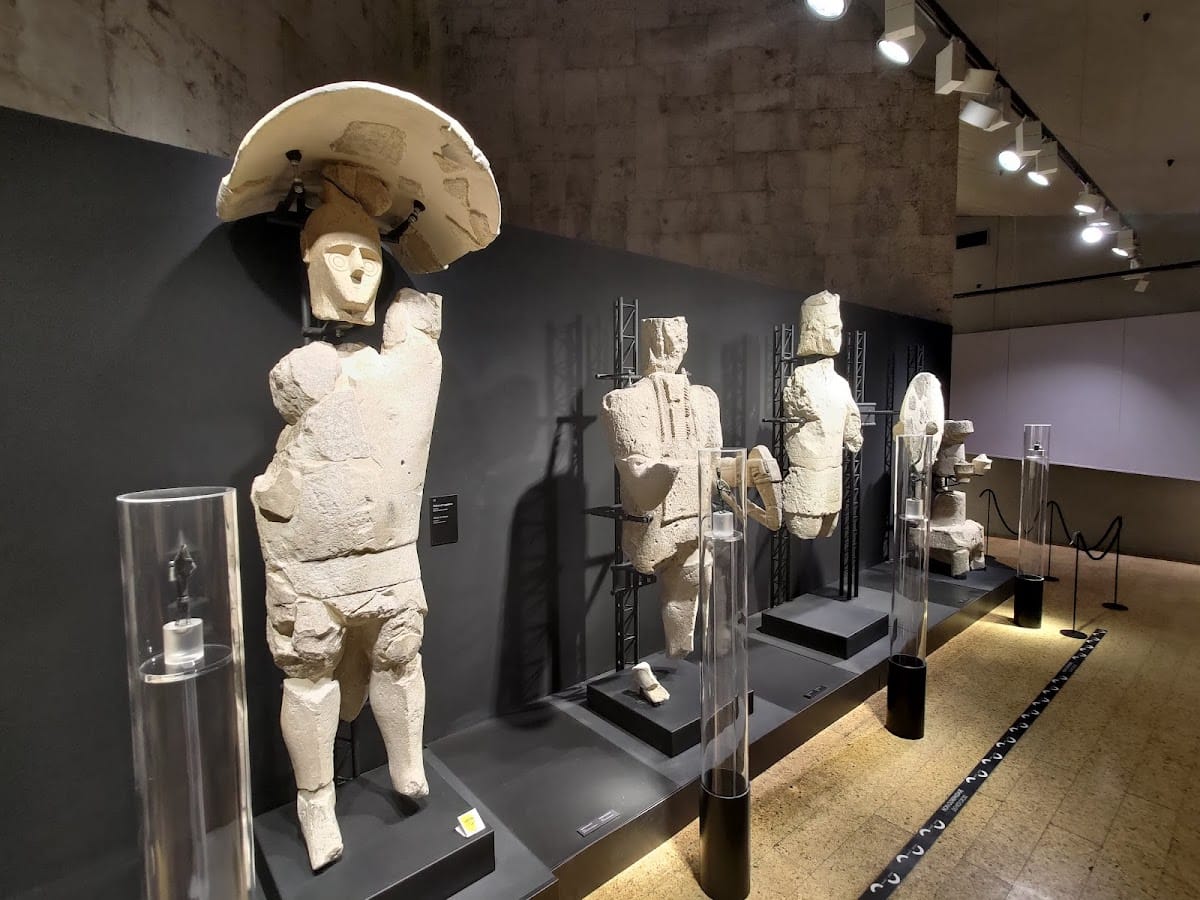
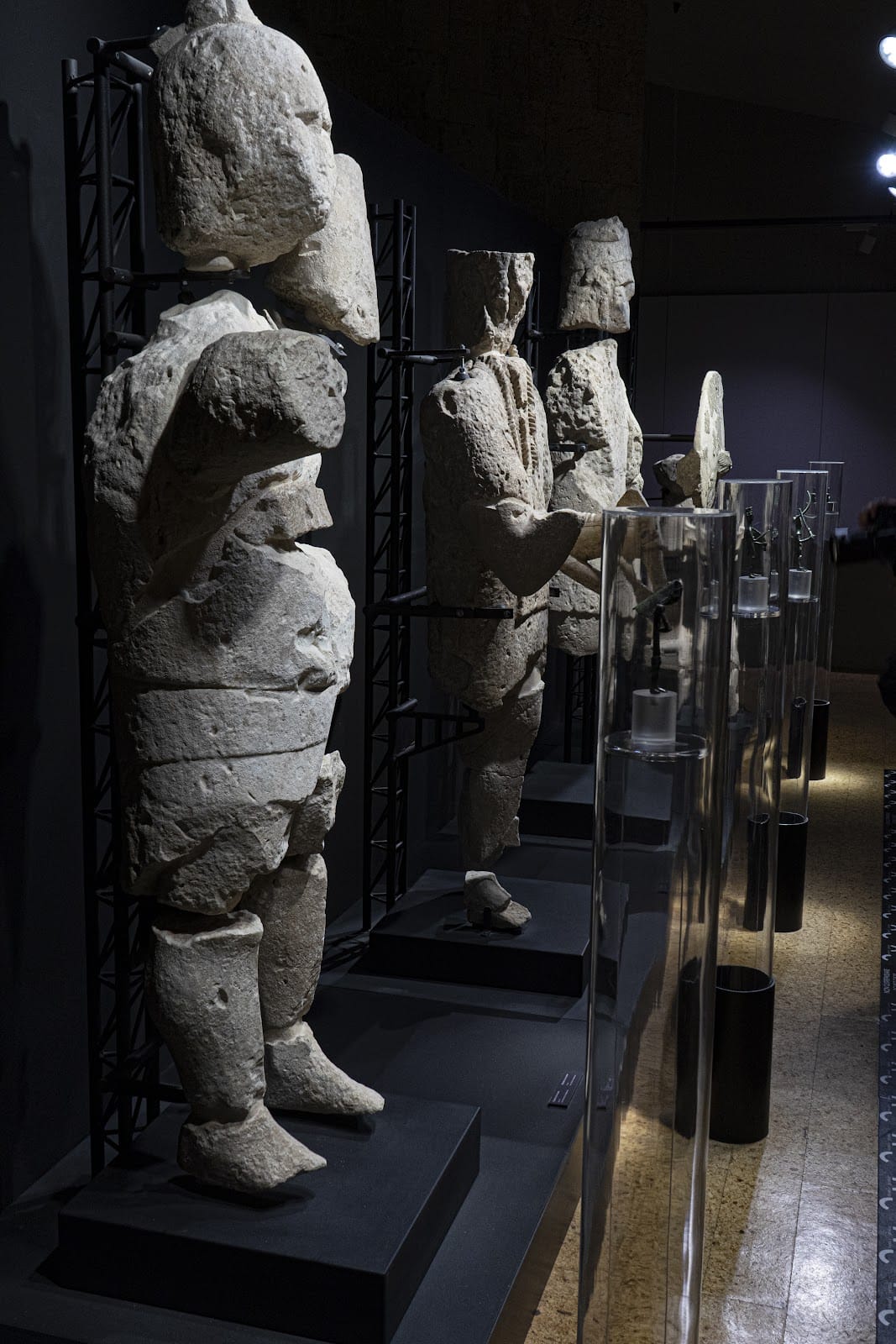
Today, the museum preserves material from excavations across Sardinia, chiefly from the provinces of Cagliari and Oristano, as well as from the island’s other provinces. Since March 2014, it has also housed the exhibition Mont’e Prama 1974–2014, dedicated to the Mont’e Prama statues.
Remains
Building and exhibition layout
The present museum occupies four floors within the Citadel of Museums. Its exhibition design combines chronological and topographical organization. The first floor follows Sardinia’s principal cultural phases in chronological order, while two floors installed later present important archaeological sites from the provinces of Cagliari and Oristano according to their locations. The fourth floor is used for temporary exhibitions.
The chronological displays extend across the pre-Nuragic and Nuragic periods, the Phoenician and Carthaginian periods, the Roman and Italic periods, and the Byzantine age. The Byzantine period represents the era when Sardinia was connected to the Eastern Roman, or Byzantine, Empire after the Roman imperial period. The museum also contains a reconstruction of a Phoenician settlement and a substantial reconstruction of the tophet at Tharros. A tophet was a sacred enclosure associated with Phoenician and Punic communities, containing urn burials and commemorative or votive monuments.
Prehistoric and Nuragic collections
Nuragic bronze figurines
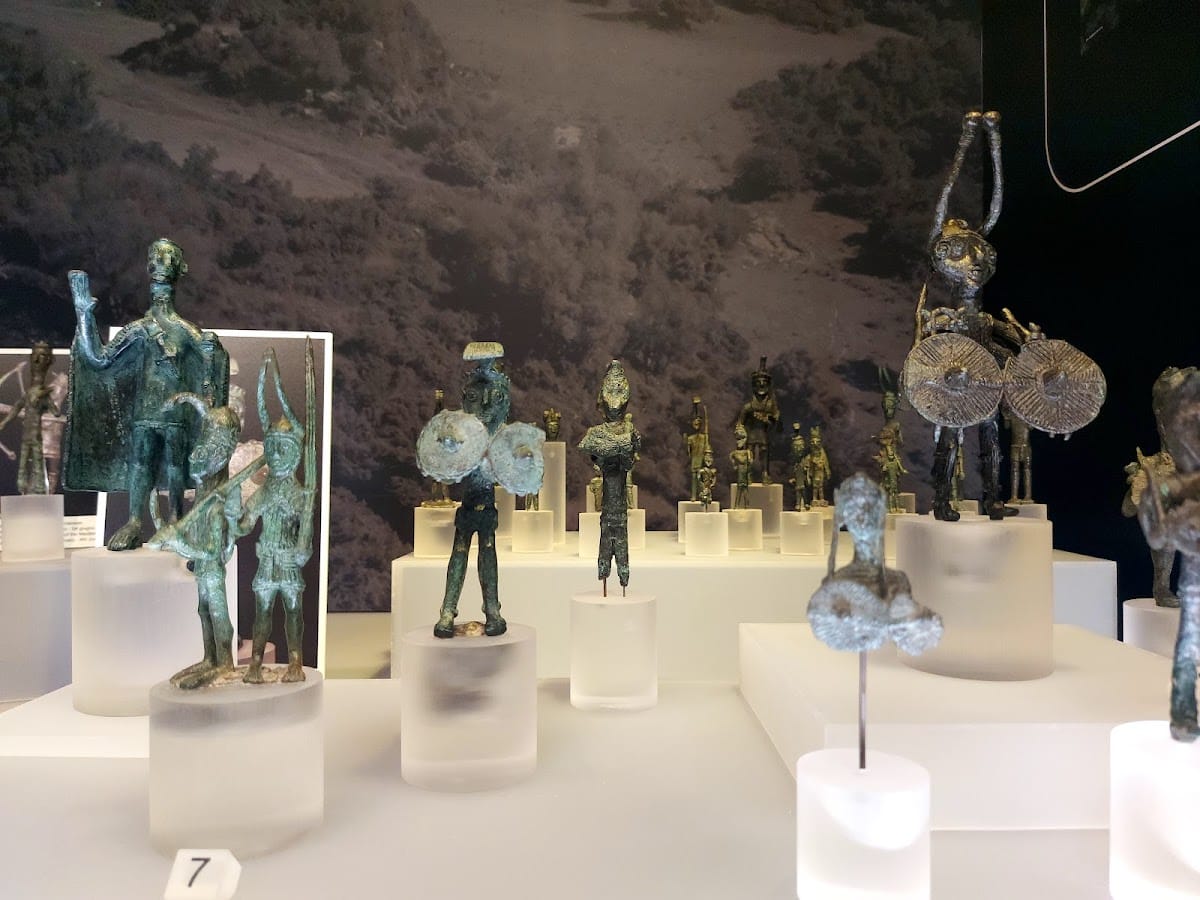
The museum’s Nuragic material includes bronze statuettes showing men, women, and animals. The Nuragic culture was Sardinia’s prehistoric and protohistoric civilization, known especially for its stone tower monuments and distinctive bronze figures. Many of the statuettes are about 15 centimetres high and were made particularly from around the ninth century BC onward by lost-wax casting. In this process, an object is shaped in wax, enclosed in a mould, and replaced with molten metal after the wax melts away. Examples include a Nuragic bronze from Abini. Earlier stone statuettes representing female divinities are also displayed.
Objects from Sardinian archaeological contexts
Objects from specific sites and excavation contexts include finds from Santa Anastasia at Sardara and a Nuragic boat from Orroli. The boat has a bull protome, or sculpted representation of a bull’s head and upper body, together with duck figures along its parapet. These pieces form part of the museum’s presentation of Nuragic material culture through objects connected to named Sardinian settlements and sites.
Phoenician, Punic, Roman, and Byzantine material
Nora inscriptions and stelae
The museum displays the Nora Stone and other stelae from Nora, the ancient Punic city south of Cagliari. Among them is a stele dated to the ninth or eighth century BC. Together with the reconstruction of the Tharros tophet, this material represents the Phoenician and Carthaginian phases presented in the museum’s chronological displays.
Classical and later objects
The collections include examples of Carthaginian goldsmithing, Roman and Italic ceramics, and Byzantine jewellery. Other identified objects are a statue of the god Bes from the third century BC, a Roman goddess holding a cornucopia, a young Bacchus from the reign of Hadrian, and a bust of Trajan from Olbia. The objects connect the museum’s island-wide archaeological collections with the changing religious, artistic, and political cultures represented in Sardinia.
Mont’e Prama statues
The Mont’e Prama statues are displayed in the museum’s dedicated exhibition. Among them is a giant represented either as a warrior carrying a shield or as a boxer. Their presentation forms part of the museum’s coverage of Sardinia’s Nuragic heritage and of the modern history of archaeological discovery on the island.
Anatomical wax models
A separate collection consists of anatomical wax models made in Florence by the sculptor Clemente Susini from dissections performed by the anatomist Francesco Antonio Boi between 1801 and 1805. The models are housed in a pentagonal room. Charles Felix financed their preparation, and they originally belonged to his Museum of Natural History and Antiquities. The collection passed to the University of Cagliari in 1858 and was transferred to the archaeological museum in 1991.
Nearby sites