Tower of London: A Norman Royal Fortress and State Prison


Site at a Glance
- Rating
- 4.7
- Popularity
- Very High
- Country
- United Kingdom
- Primary era
- Medieval
- External website
- Open
- Eras represented
- Medieval, Early Modern, Modern
- Civilizations
- British, English, Norman
- Site type
- Military
- Remains
- Castle
On this page26 sections
History
The Tower of London is a historic royal fortress in the United Kingdom, built by the Normans in late 1066 after their conquest of England. Located on the north bank of the River Thames in London, it was established to control the city, its prosperous port, and movement along the river. Its central White Tower, begun probably around 1078 in the Norman architectural tradition, made the fortress both a military stronghold and a royal residence. The completed complex later became a prison, armoury, treasury, royal mint, menagerie, administrative centre, and repository for the Crown Jewels.
Norman foundation
After William the Conqueror defeated Harold Godwinson at the Battle of Hastings on 14 October 1066, Norman victories isolated London. The city’s leaders surrendered in December without a fight. William then established a fortress at the south-eastern corner of the Roman city walls, where it could face Saxon London and oversee the Thames. The position formed part of a broader Norman programme in which castles served as fortifications, administrative centres, and residences. Baynard’s Castle and Montfichet Castle were founded in London at approximately the same time.
The earliest defences consisted of a ditch and timber palisade, probably with accommodation suitable for William. William assigned Gundulf, Bishop of Rochester, responsibility for constructing the White Tower. Work probably began around 1078, although the exact date is uncertain, and the building may not have been finished before William’s death in 1087. Construction was probably complete by 1100 at the latest. William II ordered a stone wall around the fortress in 1097, probably replacing the timber defences on the northern and western sides between the Roman wall and the Thames. The fortress consequently became a prominent expression of Norman control over London.
By about 1100 the Tower was probably being used as a prison, although imprisonment was not its original or principal purpose. Ranulf Flambard, Bishop of Durham, was the first documented prisoner and the first recorded person to escape. Imprisoned by 1100, he escaped on 2 February 1101 with the help of a rope smuggled inside a wine container.
Royal authority and medieval expansion
The Tower remained a royal residence and administrative centre as well as a stronghold. Its functions included an armoury, treasury, royal mint, menagerie, office for public records, and repository for the Crown Jewels. From the early fourteenth century until the reign of Charles II, coronation processions began at the Tower and continued to Westminster Abbey.
The Constable of the Tower, the monarch’s senior officer responsible for the fortress and its garrison, also exercised important civil powers in London during earlier periods. These duties included taxation, law enforcement, and maintaining order. A subordinate Lieutenant of the Tower assisted with administration. The creation of the office of Lord Mayor of London in 1191 removed much of the Constable’s civil authority and sometimes produced conflict between the two offices.
The succession crisis following the death of Henry I in 1135 demonstrated the political value of the fortress. Geoffrey de Mandeville used control of the Tower to shift allegiance between Empress Matilda and Stephen of Blois. Stephen eventually arrested him and appointed a loyal successor. After this episode, the Constable’s authority was controlled by the monarch rather than becoming hereditary.
William Longchamp, Richard I’s Lord Chancellor and regent while the king was on crusade, strengthened the fortress. Between 3 December 1189 and 11 November 1190, expenditure on the Tower amounted to about £2,881. Longchamp dug a ditch around the fortress and tried, unsuccessfully, to fill it with water from the Thames. The defences were first tested in October 1191, when the Tower underwent its first recorded siege. Longchamp surrendered to Prince John after three days during the conflict between John and Richard I.
In 1214 Robert FitzWalter led an army into London and besieged the Tower while King John was at Windsor. The garrison resisted until the siege was lifted after John accepted Magna Carta, the charter imposed by his barons in 1215. During the First Barons’ War, the garrison joined the baronial forces, while FitzWalter retained control of London and the Tower until support for the young Henry III became dominant.
Henry III expanded the complex between 1216 and 1227, spending about £10,000. He sought both an imposing stronghold and a more comfortable royal residence. His court met at the Tower on several occasions, and Parliament was held there in 1236 and 1261. In 1258, barons led by Simon de Montfort forced Henry to accept reforms that included regular parliamentary meetings and the surrender of the Tower. Henry occupied the fortress in 1261 with the support of mercenaries, regained political control after his victory at the Battle of Evesham in 1265, and retained the Tower after Gilbert de Clare, Earl of Hertford, failed to take it during a siege in April 1267.
Edward I substantially remodelled the fortress between 1275 and 1285, spending about £21,000. He filled Henry III’s ditch, built a new curtain wall and outer ditch, rebuilt the western section of Henry’s wall, replaced the earlier gatehouse with Beauchamp Tower, and added an entrance with two gatehouses and a barbican, an outer defensive structure protecting an entrance. Two watermills improved the fortress’s self-sufficiency. Edward’s expansion carried the Tower beyond the former Roman settlement.
The Tower’s history also reflects the persecution of England’s Jewish communities. In 1278, 600 Jews were imprisoned there on charges of coin clipping. Persecution had begun in 1276 and culminated in Edward I’s expulsion decree of 1290. During threats of anti-Jewish violence, Jewish communities also used the Tower as a place of refuge.
Prison, palace, and political fortress
Under Edward II, the Privy Wardrobe was established at the Tower as a government institution responsible for aspects of the royal household. The fortress remained a principal prison for high-status prisoners. Margaret de Clare, Baroness Badlesmere, was the first recorded woman imprisoned there, after resisting Queen Isabella’s entry into Leeds Castle.
Roger Mortimer escaped from the Tower in 1322 with help from the Deputy Lieutenant. Associates entered the fortress and made a hole in Mortimer’s cell wall. Mortimer later seized the Tower and released its prisoners when he returned to England. Edward III captured and imprisoned him there in 1330. Under Edward III, the fortress held many noble prisoners of war captured during England’s renewed military successes against France and Scotland, including John II of France and David II of Scotland. Edward ordered repairs and improvements because the Tower had deteriorated and become uncomfortable during Edward II’s reign.
Richard II led his coronation procession from the Tower to Westminster Abbey in 1377. During the Peasants’ Revolt of 1381, the king was inside the fortress when a crowd entered without resistance and looted the Jewel House. Archbishop Simon Sudbury took refuge in the Chapel of St John, but he was removed and beheaded on Tower Hill.
In 1399 Henry Bolingbroke imprisoned Richard II in the White Tower, where Richard abdicated before Bolingbroke became Henry IV. The Tower later served as Henry IV’s refuge during a revolt by Richard’s supporters. James I of Scotland, then heir to the Scottish throne, was captured while travelling to France in 1406 and imprisoned at the Tower.
Wars of the Roses and the Tudor transformation
During the Wars of the Roses, the dynastic conflicts between Lancaster and York over the English throne, Yorkist forces besieged the Tower in 1460 and damaged it with artillery fire. Henry VI was captured after the Battle of Northampton and later imprisoned in the fortress. He was probably murdered there in 1471 after Edward IV regained power.
The Tower was adapted to resist gunpowder weapons during the same period. Gun and hand-gun ports were added, and an artillery enclosure was created south of Tower Hill. The disappearance and presumed murder of Edward V and his younger brother Richard, later known as the Princes in the Tower, is traditionally placed in the fortress in 1483. The princes were last seen publicly in June 1483, and their disappearance is most probably explained by their murder in the late summer of that year. Bones believed to belong to them were found in 1674 when a twelfth-century structure near the White Tower entrance was demolished.
Richard III was defeated by Henry Tudor at the Battle of Bosworth in 1485, after which Henry became Henry VII. The beginning of the Tudor period marked the decline of the Tower as a royal residence and its increasing use as an armoury, storehouse, and prison. During Henry VIII’s reign, Thomas Cromwell spent £3,593 on repairs in 1532 and imported nearly 3,000 tons of Caen stone. These works did not bring the fortress up to the standards needed to withstand contemporary artillery.
After Henry VIII’s death, the palace buildings deteriorated and became effectively uninhabitable. From 1547, the Tower was used as a royal residence mainly for symbolic purposes. Edward VI, Mary I, and Elizabeth I stayed there briefly before their coronations. Charles II was the last monarch to maintain the procession from the Tower to Westminster Abbey, in 1660, although the royal lodgings were then in such poor condition that he did not spend the night there before his coronation.
The prison and the military establishment
The Tower reached its peak as a prison during the sixteenth and seventeenth centuries. It generally held prominent religious, political, and aristocratic prisoners rather than ordinary criminals. Prisoners could purchase improved food and furnishings, and high-status inmates sometimes lived in comparatively comfortable conditions. The fortress became associated with figures including Anne Boleyn, Catherine Howard, and Lady Jane Grey, who were imprisoned and executed in connection with the Tower.
After Lady Jane Grey’s execution on 12 February 1554, Mary I imprisoned her sister Elizabeth at the Tower because Elizabeth was suspected of involvement in Wyatt’s rebellion. Elizabeth was later released and became queen. Executions normally took place on Tower Hill rather than inside the fortress. About 112 people were executed there over approximately 400 years, while seven executions took place inside the Tower before the twentieth century, at Tower Green.
The Tower’s reputation for systematic torture was amplified by sixteenth-century religious propagandists and nineteenth-century Romantic writers. Torture required permission from the Privy Council and was used relatively rarely. Forty-eight documented cases occurred between 1540 and 1640. The rack, later known as the Duke of Exeter’s Daughter, was among the principal instruments.
In the fifteenth century, the Office of Ordnance and Armoury Office assumed responsibility for the royal arsenal and valuables formerly overseen by the Privy Wardrobe. These institutions were based at the Tower by the mid-fifteenth century and later moved into the Inner Ward. The fortress became an important professional centre for supplying weapons and equipment during wartime, before the creation of a standing English army in 1661.
Political tensions between Charles I and Parliament led to preparations to secure the Tower and its stores. The London Trained Bands were stationed there in 1640, while gun platforms and defence plans were prepared. The Trained Bands changed sides during the political crisis of 1642, and by the outbreak of the English Civil War the Tower was under parliamentary control.
Stuart, Hanoverian, and modern military phases
Under the Stuarts, the Office of Ordnance reorganised and rebuilt parts of the fortress. A stone storehouse, later called the New Armouries, was built in 1663, and the Irish Barracks, the first purpose-built soldiers’ accommodation, was added in 1670. Under the Hanoverian monarchy, concerns about possible Scottish rebellion prompted further repairs, although eighteenth-century defensive work was intermittent.
The ditch was cleared in 1830, but disease in the garrison in 1841, partly associated with poor water supply, led to the decision to drain and fill it. The work began in 1843 and was largely complete two years later. Construction of Waterloo Barracks began in 1845, and separate officers’ accommodation was built north-east of the White Tower. Further military improvements prompted by civil unrest between 1828 and 1858 formed the last major programme of fortification.
Between 1845 and 1885, institutions including the Royal Mint moved out of the Tower, leaving many post-medieval buildings vacant. The Office of Ordnance was gradually removed after the War Office assumed responsibility for weapons manufacture and storage in 1855. During the nineteenth-century restoration programme, many post-medieval buildings and interiors were demolished or removed to produce what Anthony Salvin and John Taylor regarded as a more medieval appearance.
The Tower was used during both world wars. In the First World War, 11 people accused of espionage were tried and executed by firing squad there. During the Second World War, the fortress again held prisoners of war. Rudolf Hess, Adolf Hitler’s deputy, was held there for approximately four days in 1941 and was the last state prisoner held at the Tower. The last person executed there was the German spy Josef Jakobs, shot on 14 August 1941.
One First World War bomb fell into the moat without causing damage. During the Blitz, Germany’s sustained bombing campaign against Britain in the Second World War, bombs damaged the fortress on 23 September 1940 and destroyed several buildings, narrowly missing the White Tower. The damage was repaired after the war, and the Tower reopened to the public. Its principal twentieth-century function then became tourism, although military activity continued in ceremonial form. The Royal Regiment of Fusiliers retained a ceremonial headquarters and museum, while a detachment associated with the Queen’s Guard continued to provide security.
Heritage, traditions, and public memory
A bomb exploded in the White Tower’s mortar room in 1974, killing one person and injuring 35. No organisation claimed responsibility, although police suspected involvement by the Irish Republican Army, a republican paramilitary organisation.
The Tower has been managed by the independent charitable organisation Historic Royal Palaces and receives no financial support from the British government or the Crown. UNESCO, the United Nations Educational, Scientific and Cultural Organization, added it to the World Heritage List in 1988 for its international importance and protection value. Nearby high-rise development later prompted concern that the site might be placed on the list of World Heritage in Danger.
The medieval palace remains were opened to the public in 2006. The Tower has retained ceremonial traditions including the daily Ceremony of the Keys, the presence of at least six ravens, and occasional gun salutes of 62 rounds for royal occasions and 41 rounds for other occasions. Yeoman Warders, ceremonial and custodial officers associated with guarding the fortress, continue to conduct the ceremony and provide guided tours.
Stories about the Tower include traditions concerning ghosts, particularly those associated with Anne Boleyn, Henry VI, Lady Jane Grey, Margaret Pole, and the Princes in the Tower. Reports from 1816 and 1817 described an alleged bear apparition and a luminous apparition near the Crown Jewels. These accounts belong to the Tower’s traditions and reported sightings rather than established historical events. William Harrison Ainsworth’s historical novel also reinforced the fortress’s dark reputation by creating an influential image of underground torture chambers and passages that do not exist in reality. His proposal to open Beauchamp Tower helped make prisoners’ inscriptions accessible to the public.
The Tower has appeared in literature, theatre, film, television, and popular fiction, including Shakespeare’s Richard II and Richard III, Gilbert and Sullivan’s 1888 opera The Yeomen of the Guard, and later screen productions. Such cultural representations have shaped the site’s reputation, but their fictional events are not evidence that those events occurred at the Tower.
Remains
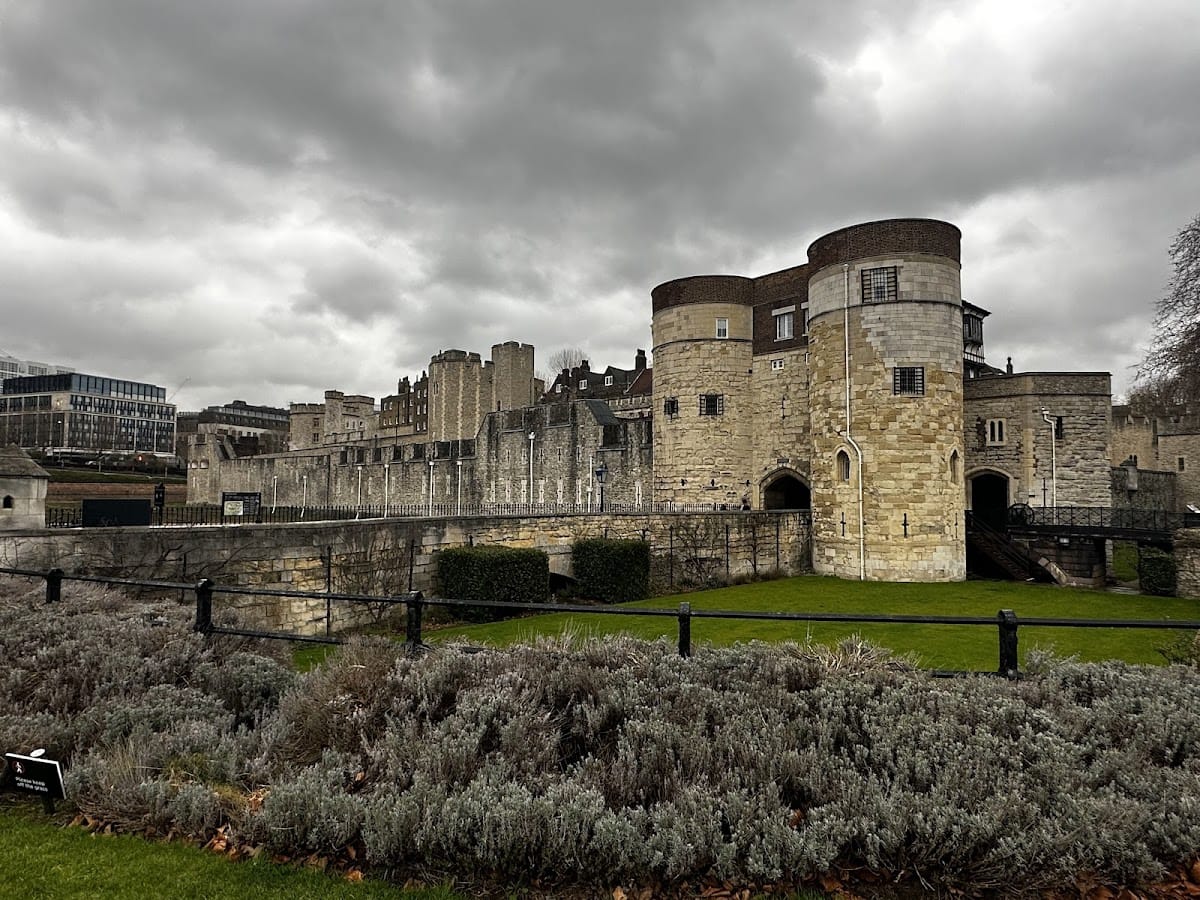
The Tower is a concentric fortress, meaning that successive defensive circuits enclose one another. Three wards are protected by two principal rings of defensive walls and a moat. The innermost ward contains the White Tower, the Inner Ward surrounds it to the north, east, and west, and the Outer Ward encloses the entire complex. Edward I’s works established the general plan by 1285, and that arrangement has survived through later alterations. The fortress occupies about 12 acres, with an additional six-acre area known as the Tower Liberties, which was kept clear for military purposes after Henry III ordered the surrounding land to be cleared.
The strongest and most imposing defences faced Saxon London and controlled movement along the Thames, while the river protected the southern side. The Tower Wharf was built on the Thames during Edward I’s reign and expanded to its present size under Richard II. A southern gateway linking the wharf with the Outer Ward was added in 1774. The moat was originally deeper than its later condition. Edward I’s outer moat was approximately 50 metres wide and about 4.5 metres deeper at its centre when first constructed. It was drained and largely filled during the 1840s.
The central keep and inner palace
The White Tower
The White Tower is the central keep, the principal fortified tower of a medieval castle, and the oldest major building in the fortress. It combined defensive strength with residential and administrative rooms for the monarch or a senior representative. Excluding its corner towers, it measures approximately 36 by 32 metres at its base and rises about 27 metres above the southern surrounding ground.
The building originally had three levels, comprising a basement, an entrance level, and an upper level. Each level was divided into three rooms. The largest lay to the west, a smaller room occupied the north-east, and a chapel occupied the south-east part of the entrance and upper levels. Square towers stand at the western corners, a round stair tower occupies the north-east corner, and a large semi-circular projection at the south-east contains the chapel apse, the curved end of the chapel.
The original entrance stood above ground level on the southern side and was reached by a removable wooden staircase that could be taken away during an attack. Further defences were added to the southern entrance during Henry II’s reign. The entrance was blocked in the seventeenth century and reopened in 1973. Wall-built latrines and four fireplaces reflect the building’s intended use as a secure but habitable royal residence. The entrance level was probably intended for the Constable and senior officials.
The lower level served for storage and contains a well. Its internal arrangement was substantially altered in the eighteenth century, when the floor was lowered, earlier timber vaulting was replaced with brick vaulting, and small openings were made to provide light. A recess in the northern wall has been interpreted as a secure room for royal valuables and important documents.
The upper level contains a great hall to the west, a residential chamber to the east, and St John’s Chapel to the south-east. The hall and chamber were originally open to the roof and bordered by galleries built into the walls. An additional upper floor and the present roof were added in the fifteenth century.
St John’s Chapel was not part of the original White Tower design. Its present open and largely undecorated appearance recalls Norman interiors, although Henry III decorated it in the thirteenth century with a gilded cross and stained-glass windows showing the Virgin Mary and the Holy Trinity, the Christian doctrine of God as Father, Son, and Holy Spirit.
The White Tower was built mainly from Kentish ragstone, with local mudstone and imported Caen stone from northern France used for facing and architectural details. Much of the Caen stone was replaced with Portland stone during the seventeenth and eighteenth centuries. Most windows were enlarged in the eighteenth century, while two remodelled original windows survive in the southern wall at gallery level.
The innermost ward and royal apartments
The Innermost Ward lies immediately south of the White Tower and formerly extended towards the Thames. Timber buildings probably occupied the area from the foundation of the fortress. Royal accommodation began to extend from the White Tower into this ward during the 1170s and was renewed and enlarged during the 1220s and 1230s.
Wakefield Tower and Lanthorn Tower were begun around 1220 at the river-side corners of the ward. They probably served as private royal apartments for the king and queen. The queen’s chamber under Henry III was whitewashed and decorated with painted imitation stonework and floral designs. A great hall stood between the two towers on the southern side, while a postern gate near Wakefield Tower provided private access to the royal apartments. A defensive ditch around the ward was filled during the 1220s, when a kitchen was also built.
Between 1666 and 1676, the ward was extensively altered. The palace buildings were removed and the area around the White Tower was cleared, creating an open approach. The Jewel House was demolished, and the Crown Jewels were moved to Martin Tower before later transfers through several display locations.
Inner Ward towers and chapels
The curtain wall and its towers
The Inner Ward was created under Richard I when a defensive ditch was dug west of the Innermost Ward, effectively doubling the fortress’s area. Henry III built its northern and eastern walls, whose dimensions have largely survived. The wall between Wakefield and Lanthorn Towers served as the Inner Ward’s curtain wall, a fortified enclosing wall. Its principal entrance passed through a gatehouse in the western wall near the site of Beauchamp Tower, and Edward I rebuilt the western curtain wall.
Beauchamp Tower dates from the thirteenth century and is an early major example of brick construction in Britain after the Roman departure in the fifth century. It forms one of 13 towers incorporated into the curtain wall. Proceeding anticlockwise from the south-west corner, these are Bell, Beauchamp, Devereux, Flint, Byward, Brick, Martin, Constable, Broad Arrow, Salt, Lanthorn, Wakefield, and Bloody Tower.
The towers provided positions for crossfire and also contained accommodation. Bell Tower housed a bell used to warn of attack. The royal bowyer, responsible for longbows, crossbows, catapults, and other siege and hand weapons, had a workshop in Byward Tower. A small turret above Lanthorn Tower served as a signal or beacon for traffic approaching the fortress at night.
St Peter ad Vincula
St Peter ad Vincula, meaning St Peter in Chains, was a Norman chapel formerly outside the fortress and incorporated into the Tower during Henry III’s expansion. Henry added stained-glass windows and royal seats for himself and his queen. Edward I rebuilt the chapel at a cost of more than £300, and Henry VIII rebuilt it again in 1519.
The present chapel was built for Henry VIII by Sir Richard Cholmondeley in 1519-1520, replacing the earlier building on the same site. Its small western tower contains a bell house, while the main structure has a nave and a short northern aisle. Crescent-shaped windows provide light, and the largely undecorated design is characteristic of the Tudor period. The chapel was refurbished in the nineteenth century and is the parish church of the Tower under the authority of the British monarch rather than the local bishop.
Monuments include a memorial to John Holland, Duke of Exeter and Constable of the Tower, who died in 1447; a monument to Sir Richard Cholmondeley, Deputy Constable, who died in 1521; and memorials to Sir Richard Blount and Sir Michael Blount, Tudor deputy keepers associated with many executions. The seventeenth-century organ is decorated with carvings by Grinling Gibbons. Burials associated with the chapel include Anne Boleyn, Catherine Howard, Lady Jane Grey, George Boleyn, Edmund Dudley, Richard Empson, Guildford Dudley, Thomas More, John Fisher, and Philip Howard, whose body was later moved to Arundel.
The Bloody Tower
The Bloody Tower was built beside the western side of Wakefield Tower at the same time as the Inner Ward curtain wall. It contained a water gate from the Thames protected by a portcullis, a vertically sliding defensive gate, and a gate. Its sixteenth-century name derives from the belief that it was the place where the Princes in the Tower were murdered.
Outer Ward and river entrances
Outer defences
Edward I created the Outer Ward as a narrow enclosed circuit around the entire fortress. Legge’s Mount was built at the north-west corner, while Brass Mount at the north-east corner was added later. Three rectangular towers along the eastern wall, spaced about 15 metres apart, were demolished in 1843. Archaeological investigation places Legge’s Mount in the Edwardian period rather than the Tudor period sometimes associated with the bastions.
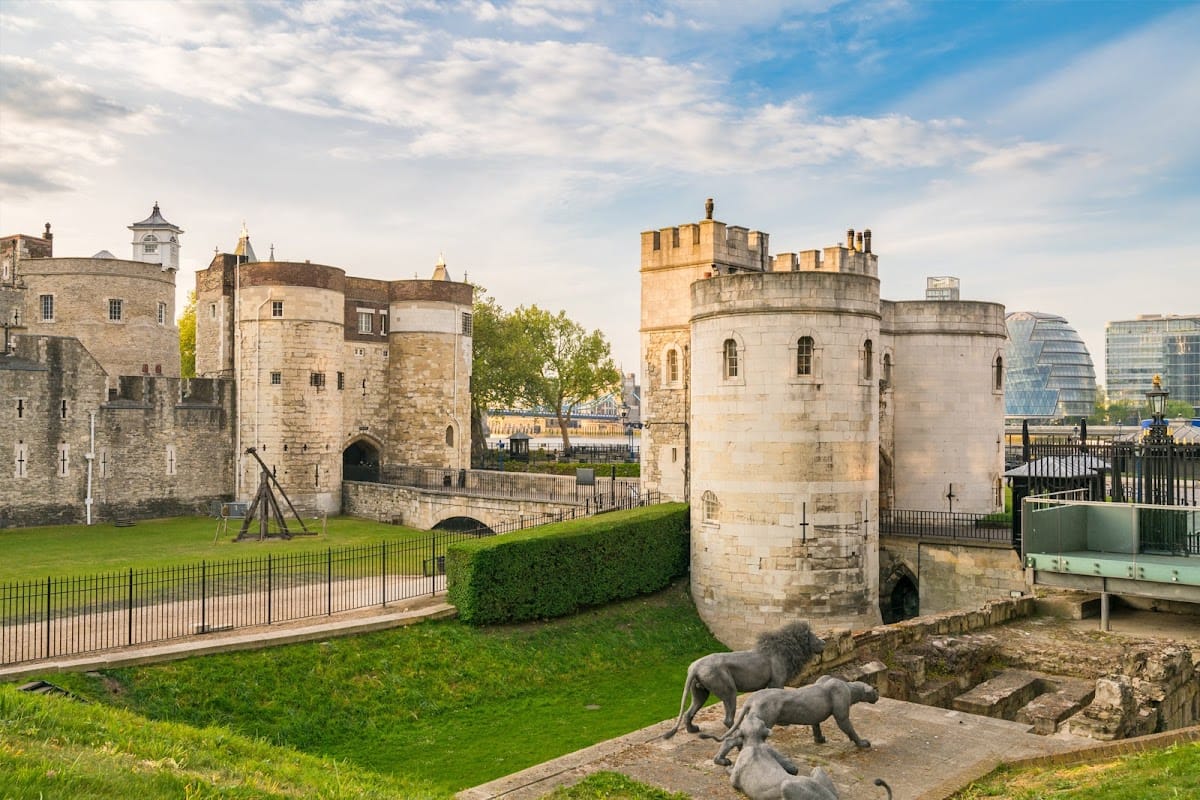
The blocked medieval crenellations on the southern side of Legge’s Mount are the only surviving medieval battlements at the Tower, while the other battlements are Victorian replacements. Edward I’s new outer entrance complex included inner and outer gatehouses and a barbican. It later became known as the Lion Tower because of its association with the royal menagerie. The royal animals were kept in buildings associated with the Lion Tower, while the tower’s keeper’s residence remained in use after the animals had moved elsewhere.
Traitors’ Gate and the river side
The southern expansion extended the fortress onto land previously flooded by the Thames. St Thomas’s Tower was built there between 1275 and 1279 and later became known as Traitors’ Gate, replacing Bloody Tower as the principal river entrance. Arrow slits covered the river approach, a gate mechanism controlled entry, and luxurious chambers occupied the first floor. The water gate was an unusual English design, with a parallel at the Louvre in Paris.
Cradle Tower, a second water gate, was added east of St Thomas’s Tower between 1348 and 1355 for the king’s private use. The Royal Mint was moved to the Tower under Edward I. Its early location is uncertain, but by 1560 it occupied a building in the Outer Ward near Salt Tower.
Military and post-medieval buildings
Armouries, barracks, and storehouses
The Inner Ward contained Tudor ammunition-storage buildings and was remodelled under the Stuarts, principally through the Office of Ordnance. The New Armouries, a new storehouse, was built in 1663. Construction of the Grand Storehouse north of the White Tower began in 1688 on the site of Tudor storehouses. Fire destroyed the Grand Storehouse in 1841, and Waterloo Barracks was later built on the site. Waterloo Barracks survives as the repository of the Crown Jewels.
The Irish Barracks, built in 1670, provided the first purpose-built soldiers’ accommodation, although other accommodation remained poor. New Horse Armoury was built against the southern face of the White Tower in 1825 in the Gothic Revival style, a nineteenth-century movement that imitated or reinterpreted medieval Gothic architecture. Its design incorporated features such as crenellations. Waterloo Barracks was described as a fifteenth-century castellated Gothic building.
Surviving historic fabric
The surviving fabric includes medieval walls, towers, gates, curtain walls, the filled moat, the wharf, the White Tower, royal and military buildings, and remains of the medieval palace. Armour and weapons once displayed at the Tower were largely transferred in 1996 to the Royal Armouries Museum in Leeds and Fort Nelson, although medieval and royal objects remain displayed in the White Tower.
Crown Jewels and the menagerie
The Crown Jewels
The Crown Jewels, the royal regalia used in coronations and other state ceremonies, were probably kept at the Tower from the reign of Henry III. During the English Civil War, the Jewel House contents were disposed of with other royal property in 1649. Metal objects were sent to the mint for melting and reuse, while the crowns were broken and damaged.
After the Restoration in 1660, surviving coronation objects included a twelfth-century spoon and three ceremonial swords, while other regalia were remade. The Jewel House was demolished in 1669, and the Crown Jewels were moved to Martin Tower for public display. Colonel Thomas Blood and associates attempted to steal them two years later, but the keeper’s son raised the alarm. The jewels later passed through several display locations and are now housed in Waterloo Barracks.
The royal menagerie
The Royal Menagerie is first documented under Henry III. In 1251, sheriffs were ordered to pay four pence a day for the king’s polar bear, which attracted Londoners when it fished in the Thames. In 1254, they were ordered to fund an elephant house. The collection grew through diplomatic gifts, including animals presented by the Holy Roman Emperor.
The menagerie opened to the public in the eighteenth century. The remaining animals were moved to Regent’s Park in 1835 after a lion was accused of biting a soldier. The Lion Tower was retained as the keeper’s residence until the last keeper died in 1853. The exact location of the medieval menagerie is uncertain, while the association between lions and the Lion Tower remains part of the site’s physical and historical identity.
Ravens and ceremonial continuity
The Tower’s ravens remain living elements of a longstanding royal tradition. A popular tradition holds that the Crown and England will fall if the ravens leave the fortress. At least six ravens are maintained there, traditionally including a reserve bird. Each has a name and a coloured leg ring, and the birds are supervised by a Yeoman Warder.
The earliest known reference to a raven at the Tower dates from 1883, while the beginning of the tradition remains uncertain. Alongside the ravens, the Ceremony of the Keys and the ceremonial presence of the Royal Regiment of Fusiliers connect the surviving fortress with its continuing royal and military functions.