Muncaster Castle: A Medieval Castle and Family Estate in Cumbria



Site at a Glance
- Rating
- 4.7
- Popularity
- Medium
- Country
- United Kingdom
- Primary era
- Medieval
- External website
- Open
- Eras represented
- Medieval, Modern
- Civilizations
- British, English
- Site type
- Domestic
- Remains
- Castle
On this page9 sections
History
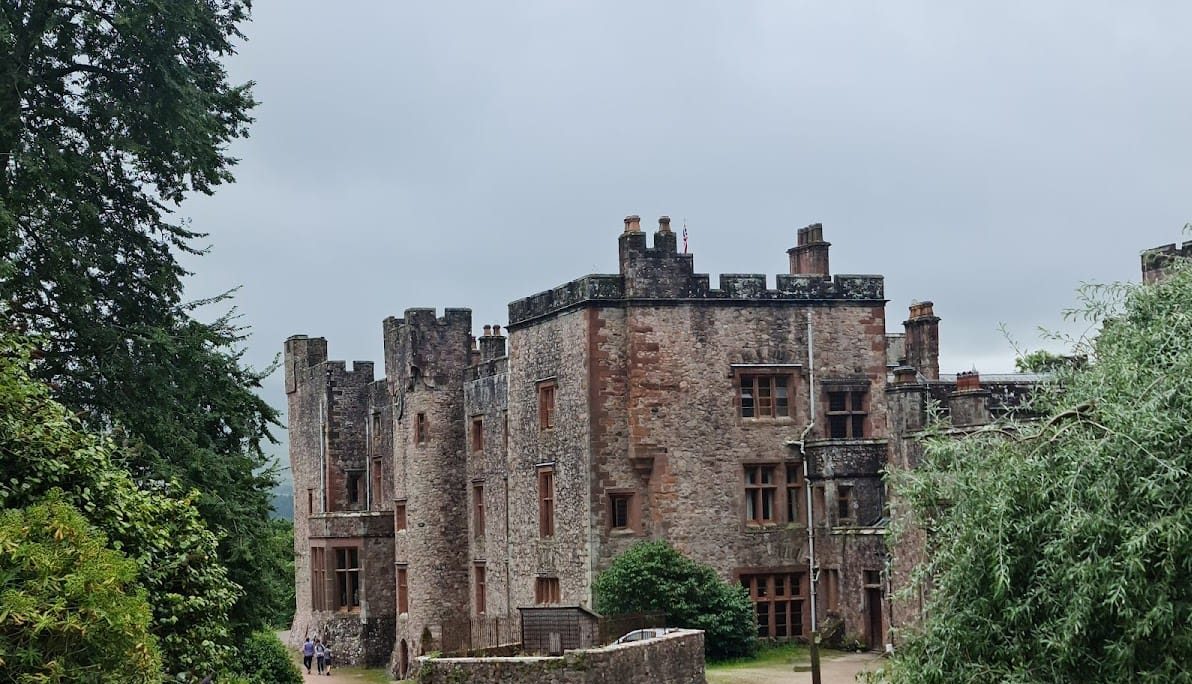
Muncaster Castle is a medieval castle in the United Kingdom, standing in Cumbria about one mile east of Ravenglass above the River Esk. Its construction probably began around 1258, and the surviving building combines medieval phases with extensive nineteenth-century remodelling. The castle remains a privately owned family residence and is listed at Grade I, the highest category for historic buildings in England, a designation granted on 7 September 1967.
Roman and medieval origins
The site may have Roman foundations. One possibility is that it included a castellum, a small fortified installation or military outpost, associated with the Roman fort of Glannoventa at nearby Ravenglass. The existence and exact character of these Roman remains remain uncertain.
The surrounding estate was granted to Alan de Penitone in 1208. Castle construction probably began during the tenure of Gamel de Mulcastre around 1258. The Pennington family has lived at Muncaster for at least 800 years, maintaining a long association with the estate. The place-name appeared as “Mulcaster” in the Cumberland pipe rolls around 1150, followed by forms including “Molecaster” and “Mulecaster”. “Muncaster” first appears in a Cumberland church register in 1577. The name includes castra, a Latin term meaning an encampment or fort.
Medieval traditions and later use
The oldest surviving parts of the castle include the Great Hall and a fourteenth-century pele tower. A pele tower was a fortified watchtower used for observation and defensive shelter, especially in the border region between England and Scotland. The Great Hall was converted into a dining room in 1780, while the library ceiling also dates from that year.
A long-standing tradition connects Muncaster with Henry VI, the English king who ruled during the Wars of the Roses, a dynastic conflict between rival royal houses. After the Battle of Hexham in 1464, Henry is said to have taken refuge at the castle, where Sir John Pennington sheltered him. According to the tradition, Henry gave Sir John a Venetian glass drinking bowl with a blessing that the Pennington family would not be driven from Muncaster while the bowl remained unbroken.
Thomas Skelton, a seventeenth-century jester employed by the Pennington family, became associated with stories of murder, misdirected travellers, and hauntings at the castle. Some people later claimed that he was the original “Tom Fool” and inspired the fool in King Lear, but that proposed connection has been disproved. His memory continues through an annual jesting competition held at the castle.
Nineteenth- and twentieth-century transformation
Anthony Salvin, an English architect known for restoring and remodelling medieval castles and churches, extensively remodelled or rebuilt Muncaster Castle for the Barons Muncaster between 1860 and 1866. Proposed changes were discussed with Edwin Lutyens from 1916, but they were never carried out. Lutyens later designed the Muncaster War Memorial for Sir John Frecheville Ramsden, which was constructed in 1922.
The death of the fifth and last Lord of Muncaster in 1917 led to the estate’s inheritance by the Ramsden family through his mother’s side. The Pennington family nevertheless remained associated with the castle. During the Second World War, about 700 works from the Tate Gallery were moved to Muncaster for safekeeping, including paintings by J. M. W. Turner, Édouard Manet, and Vincent van Gogh.
Phyllida Gordon-Duff-Pennington and her husband, Patrick Gordon-Duff-Pennington, spent three decades restoring the castle. Since 2021, ownership has belonged to Peter and Iona Frost-Pennington, with their elder son Ewan serving as operations director.
Remains
Muncaster Castle stands within an estate of approximately 77 acres beside the River Esk. The surviving complex brings together medieval fortified elements, later domestic interiors, an extensive terrace, gardens, and associated estate buildings. Its physical character reflects both its origins as a border stronghold and the major remodelling carried out in the nineteenth century.
Castle buildings and interiors
Great Hall and pele tower
The Great Hall and the fourteenth-century pele tower form the oldest surviving phases of the castle. The pele tower is a fortified watchtower characteristic of the English-Scottish border region, providing observation and defensive shelter. The Great Hall was altered in 1780 and became a dining room, retaining its place within the castle’s later domestic arrangement.
Library and historic furnishings
An octagonal library contains approximately 6,000 volumes, beneath a ceiling dating from 1780. The interiors also retain furnishings from the sixteenth and seventeenth centuries, portraits of members of the Pennington family, and a portrait of Thomas Skelton holding his will. The Venetian glass bowl traditionally linked with Henry VI, known as “The Luck of Muncaster,” remains intact at the castle.
Estate grounds and associated features
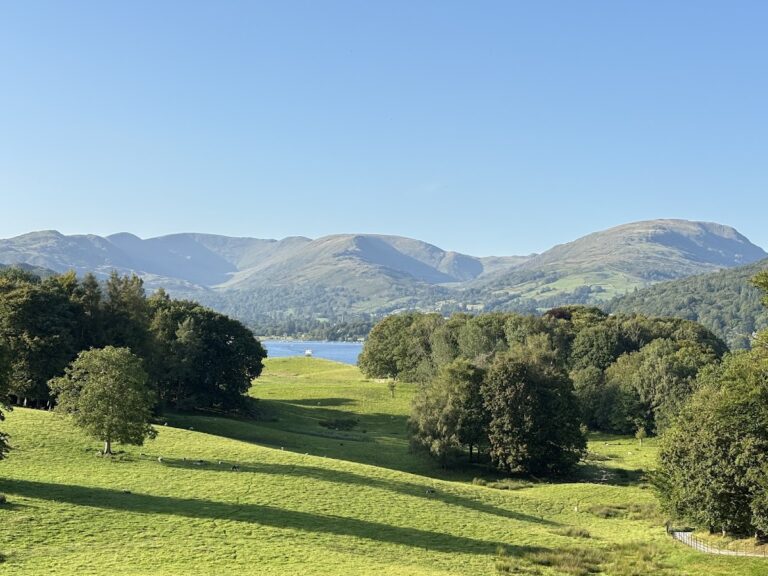
The grounds include an eighteenth-century terrace approximately half a mile long, laid out to provide views across the Lakeland Fells and the valley of the River Esk. John Ruskin described it as “the gateway to Paradise”. The gardens contain azaleas and rhododendrons collected during Himalayan expeditions in the 1920s. An aviary holds owls and other birds of prey from Britain and overseas, while an indoor maze is themed around the life of a field vole.
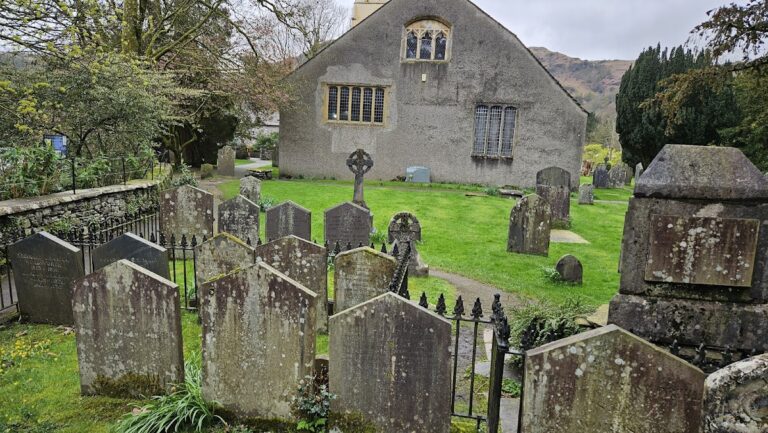
Muncaster Church, a twelfth-century church remodelled by Anthony Salvin, forms part of the estate surrounding the castle. Together with the castle, terrace, gardens, and surviving medieval fabric, it represents the accumulated development of the Muncaster estate across several centuries.
Nearby sites