Larochette Castle: A Medieval Administrative Fortress in Luxembourg


Site at a Glance
- Rating
- 4.4
- Popularity
- Medium
- Country
- Luxembourg
- Primary era
- Medieval
- External website
- Open
- Eras represented
- Medieval
- Civilizations
- Holy Roman Empire
- Site type
- Military
- Remains
- Castle
On this page12 sections
History
Larochette Castle is a medieval fortress in Luxembourg, in the municipality of Larochette. Archaeological investigations place the documented castle in the first half of the twelfth century, while references to the site extend back to the late eleventh and twelfth centuries. A charter of 1176 confirms its existence. Built on a defensible rocky spur, the castle became an administrative center for the surrounding territory and was later divided among several noble families.
Origins and strategic setting
The castle occupied a sandstone spur protected by steep rock slopes, a position chosen primarily for defense. Its location also reflected the economic and territorial importance of the surrounding landscape. An early medieval regional road between Luxembourg and Diekirch passed through the Ernz Valley, while another route linked Mersch with Echternach. The White Ernz supported fishing and mill operations, giving the site access to resources as well as routes of movement.
The earliest lords of Larochette served as standard-bearers of the counts of Luxembourg. A standard-bearer was a senior military and court officer associated with a lord’s banner. Over time, the castle and its lands were shaped by the Fels, Homburg, and Criechingen families, whose authority made Larochette a center from which the surrounding territory was administered. The origins of the noble Fels family and the reasons for its settlement at Larochette remain uncertain. A possible connection with the family of Ouren, south of St. Vith, has been considered.
The Fels and Homburg lords
Under Johann II of Fels, the youngest son of Arnold IV of Fels, the Fels dynasty reached its greatest power. Johann II remained a loyal vassal of the House of Luxembourg, the medieval ruling dynasty and political house to which the counts of Luxembourg belonged. He combined the offices of standard-bearer, steward, and chief judicial officer. A steward managed household or administrative affairs, while the chief judicial officer exercised senior judicial authority.
Johann II did not possess the entire castle. After the death of Johann I, his aunt Jeannette and her husband, Johann von Homburg, received part of the complex. Between 1338 and 1345, Johann II’s sisters Irmgard and Mathilde and their husbands, Friedrich and Conrad von Homburg, also acquired shares. Fels and Homburg interests consequently became closely connected through joint ownership.
Larochette experienced economic growth during Johann II’s lordship. On 25 March 1343, Johann the Blind, King of Bohemia and Count of Luxembourg, authorized the installation of four looms at Larochette. The privilege was valuable because inhabitants of other settlements were required to share a single loom. Johann the Blind was a fourteenth-century ruler of the House of Luxembourg who held both the Bohemian crown and the county of Luxembourg.
Johann II died without descendants in 1359. His death ended the first Fels line and led to a succession dispute, as Friedrich and Conrad von Homburg claimed substantial portions of his inheritance. His cousin Johann III, the son of Johann I and Jutta of Reuland, succeeded him and continued the older Fels line.
Inheritance, residence, and the Criechinger connection
After Johann III’s death, his son Johann IV, also known as Johann the Younger, became lord of Larochette. He fought alongside Wenceslas I, Duke of Luxembourg. Wenceslas II later mediated a dispute involving Johann the Younger, Friedrich of Fels, and Count Arnold of Homburg over their rights to reside within the castle.
Financial dealings between Johann the Younger and Arnold von Pittingen made Arnold the principal owner of a new palas, the principal residential or representative building of a medieval castle. Arnold built a chapel dedicated to Saint Peter of Milan, a thirteenth-century Dominican saint and Christian martyr, and it was consecrated on 13 July 1386. Through the marriage of Arnold’s daughter Irmgard von Pittingen to Johann von Criechingen, the palas passed to the lords of Criechingen.
The houses of Fels, Homburg, and Manderscheid entered into a family pact that produced repeated inheritances and divisions among the Fels, Homburg, Pittingen, and Criechingen families. These arrangements gradually weakened the castle’s unity. A further agreement known as the Castle Peace was concluded under Johann V in 1399 and supplemented in 1415.
Johann V married Elsa von Heffingen. Their eldest son, Georg I, became Lord of Fels-Heffingen but retained only one-eighth of the castle after the repeated divisions of ownership. Georg II of Fels-Heffingen and Contern, the grandson of Georg I and son of Arnold VI, tried unsuccessfully in 1534 to restore the honor and power of the former Fels feudal lords.
Fire, ruin, and preservation
A major fire destroyed Larochette Castle in 1565, after which it remained a ruin. Oswald von Fels-Heffingen attempted to purchase the remains, but his early death prevented the plan. His brother Paul von Fels-Heffingen and Mersch continued the effort, yet the purchase failed because the property had so many co-owners. The castle was not rebuilt and later suffered from stone robbing.
The Luxembourg state acquired Larochette Castle in 1979. Extensive restoration, consolidation, photogrammetric recording, and archaeological investigation followed, with excavations continuing across the complex. Severe storms in autumn 1990 felled most of the trees on the Elsebeth Plateau. Exposed roots near the former castle chapel revealed human bones and well-preserved skulls, prompting further exploration and excavation across the castle area.
The archaeological work of 1990 was interpreted as evidence for an earlier prehistoric fortification in the area, dated to around 5000 BC. The restored complex remains the emblem of the municipality of Larochette. The Criechinger House contains exhibitions, and the castle is protected as a historical monument under Luxembourg state ownership.
Remains
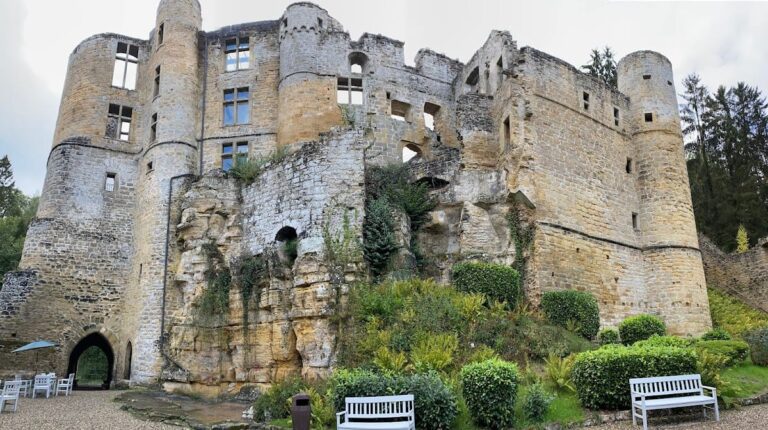
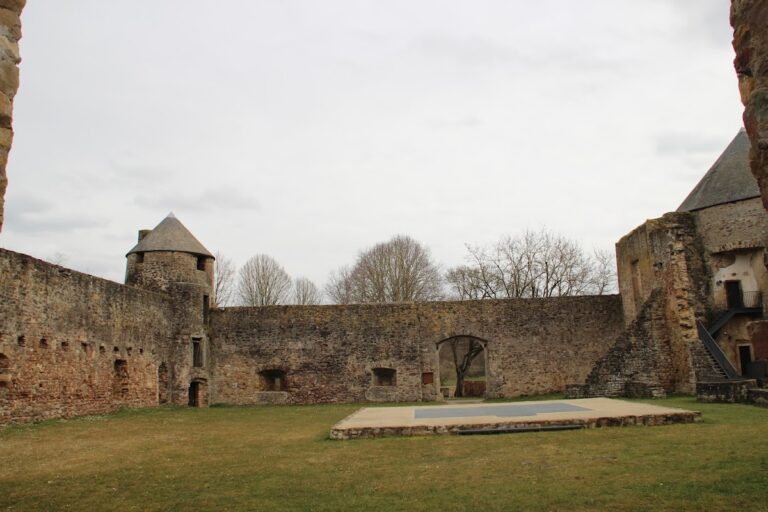
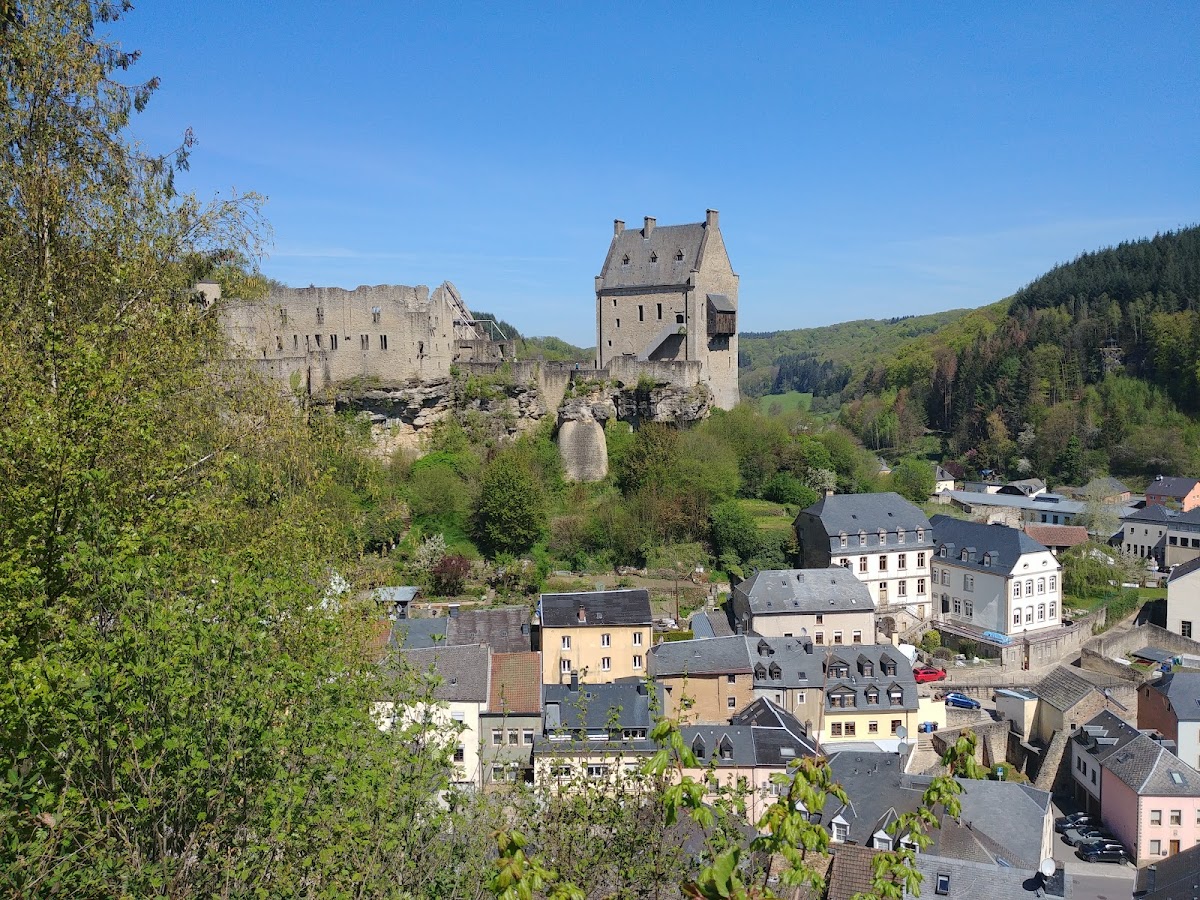
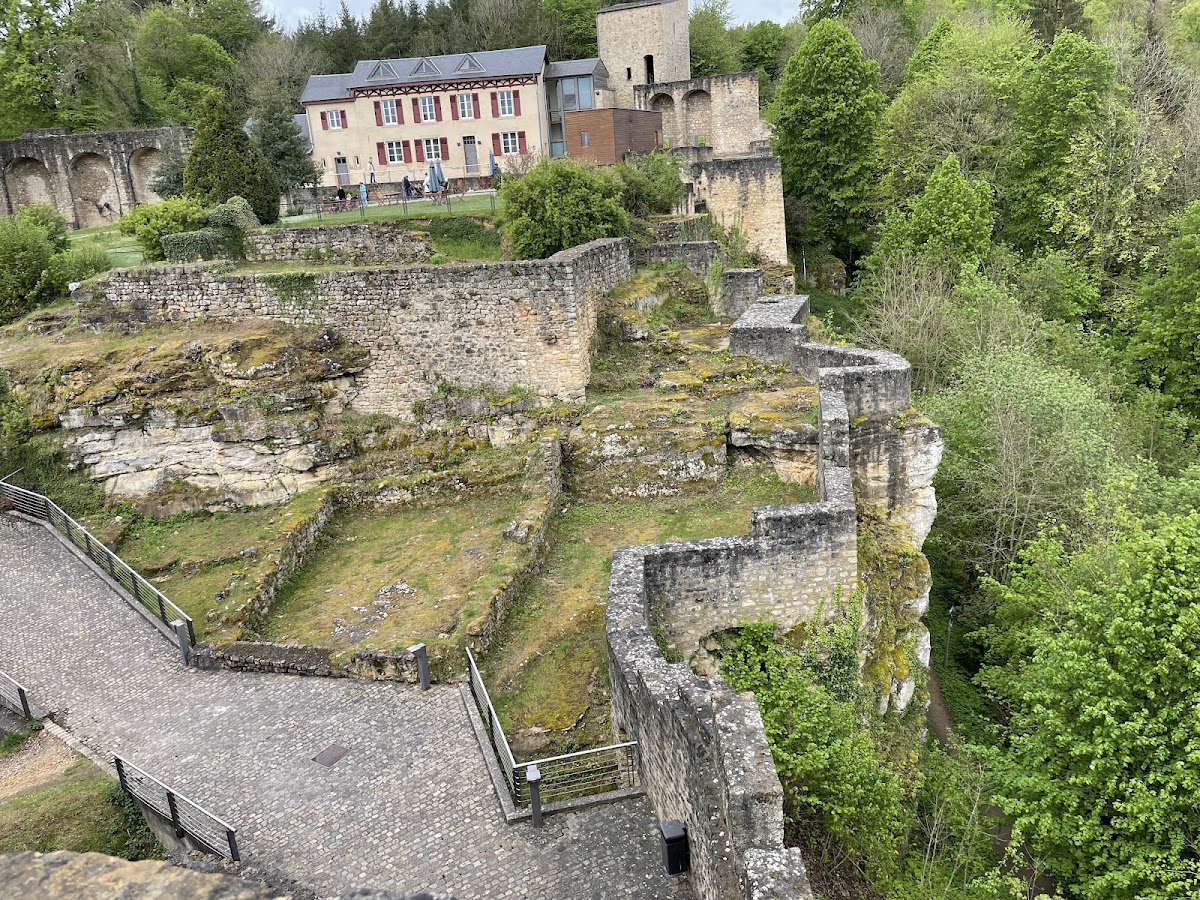
Larochette Castle occupies a rocky sandstone spur on the Elsebeth Plateau, approximately 150 metres above the valley of the White Ernz, a tributary of the Sûre. The approach from the west crosses a large farmyard with fortified earthworks. A partly destroyed enclosing wall surrounds the main building area, while a deep ditch, partly natural in formation, separates the complex into two sections. Several aristocratic manor houses stand at the eastern end of the promontory, reflecting the growth of resident noble families.
Manor houses
The complex originally contained five separate manor houses. Their remains display high-quality construction and an elaborate aristocratic character. The buildings developed as different resident families expanded their accommodation and domestic facilities within the wider fortified enclosure.
Homburg House
Homburg House was built during the 1340s or around 1350, following the marriages that brought Friedrich and Conrad von Homburg into possession of shares in Larochette. It probably consisted of two sections, one associated with each of the two Homburg marriages. The building was destroyed in the fire of 1565. Restoration and stabilization work took place in 1987 and 1988.
Criechinger House
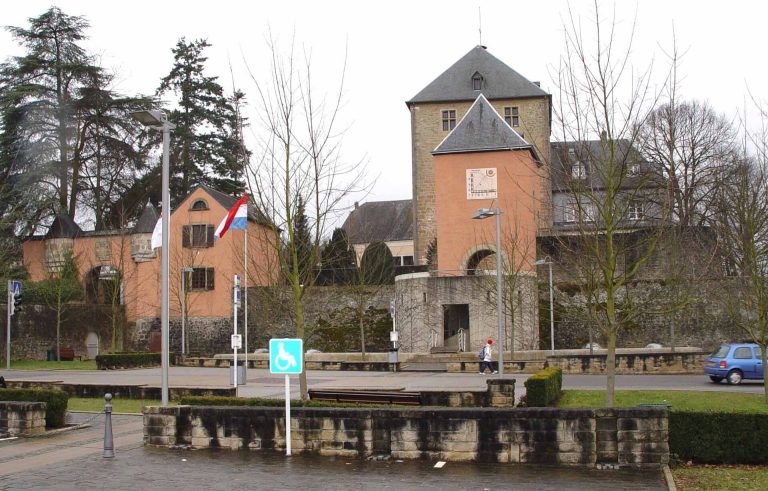
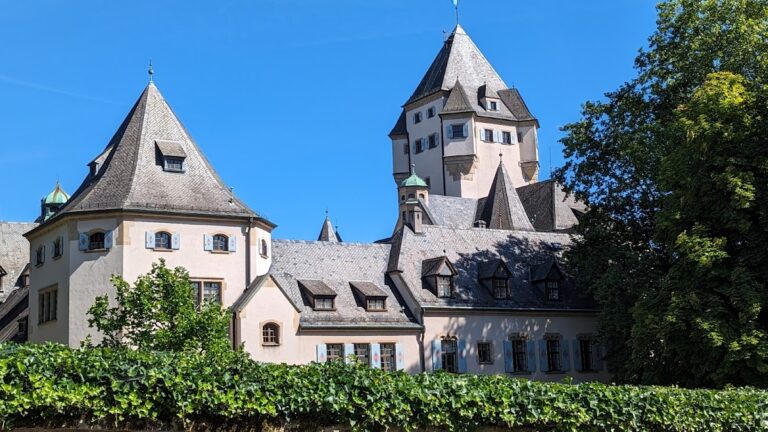
The Criechinger House, also called the Créhange House, was built around 1385 and is the only manor described as completely restored. It has three floors and a basement. A stairwell rises through five levels, linking several small chambers and storage rooms. A wooden extension projects from the eastern side at first-floor level.
The ground floor contains the castle bakery and kitchen. The bakery oven has an unusual flue arrangement: smoke or steam passes through a bend before traveling horizontally outward rather than rising directly through a vertical chimney. The lord’s sleeping corner lay immediately above this horizontal section.
A well approximately two metres in diameter stands in the kitchen and is said to provide access to a water spring. It is associated with the Chriechinger legend. According to the story, a castellan’s wife and child jumped into the well during an attack. After rescuing the woman, the attackers allegedly threw the castle steward into the well for treason, and he was said to reappear as a dragon every Good Friday.
The Criechinger House contains period artworks and exhibition spaces. Together with selected other remains, it forms part of the restored portion of a complex that is otherwise partially ruined.
Chapels, towers, and archaeological evidence
Castle chapels
The former castle chapel stood near the area where storms exposed human bones and skulls in 1990. A separate chapel was built by Arnold von Pittingen in 1386 and dedicated to Saint Peter of Milan. The two chapel references belong to different parts of the castle’s history and physical development.
Verlorenkost watchtower
The watchtower known as Verlorenkost stands on the southern side of the complex. Its name means “lost food” and is linked to a local legend about a cook carrying pots of food who stumbled at the location and spilled their contents.
Excavation and exploration extended across the castle area after the 1990 discovery near the former chapel. The exposed human remains and the interpretation of an earlier fortification around 5000 BC added prehistoric evidence to the long sequence of occupation associated with the rocky spur.