Kumhrar: Excavated Remains of Ancient Pataliputra in India
Site at a Glance
- Rating
- 4.8
- Popularity
- Very Low
- Country
- India
- Primary era
- Classical
- Eras represented
- Iron Age, Classical
- Civilizations
- Mauryan
- Site type
- City
On this page13 sections
History
Kumhrar is an archaeological area in Patna, India, containing the excavated remains of ancient Pataliputra and material dating from approximately 600 BCE to 600 CE. Its best-known remains belong to the Mauryan period, the era of the Maurya Empire from about 322 to 185 BCE. The site is associated with the capital linked to Ajatashatru, a fifth-century BCE king of Magadha, and to the Mauryan rulers Chandragupta Maurya and Ashoka.
Ancient Pataliputra and the Mauryan period
Pataliputra developed as the political center of Magadha and later served as the capital of the Maurya Empire. Kumhrar forms part of the archaeological investigation of this ancient city, whose material remains extend across many centuries. The site’s principal Mauryan structure is an 80-pillared hall, although its original purpose remains uncertain.
Some historians have proposed that the hall was the setting for the Third Buddhist Council, a major assembly traditionally associated with Ashoka that addressed Buddhist doctrine and monastic discipline in 250 BCE. Another interpretation identifies it as a pleasure hall outside the city walls rather than part of the Mauryan palace. The hall was thought to have stood about 350 metres south of the wooden palisades of Pataliputra identified at Bulandi Bagh, beside the former Son River. Altekar considered the compound relatively isolated from the city and proposed that it had been burned during the Sunga period, when the Sunga dynasty ruled parts of northern India after the Mauryan Empire.
Excavation and interpretation
Laurence Waddell’s work in the 1890s, including excavation at nearby Bulandi Bagh in 1895, preceded later investigations of Kumhrar and related remains. David Brainard Spooner excavated at Kumhrar in 1912 and 1913, while Archaeological Survey of India excavations began in 1913. K. P. Jaiswal directed subsequent excavations from 1951 to 1955.
Spooner initially believed that the missing pillars of the assembly hall had sunk into the ground. Later, the Indian archaeologist Altekar concluded that local people had removed and reused them in construction. Excavations also revealed the foundations of Anand Vihar, a Buddhist monastery, and identified Arogya Vihar, an institution associated with medical practice under Dhanvantari. Ayurveda, the traditional Indian system of medicine, was conducted at Arogya Vihar.
Stupa sculpture and later worship
Waddell’s excavations in the 1890s uncovered a carved stone railing belonging to a stupa. Its sculptural remains later became associated with the Durakhi Devi Temple. The figures were subsequently moved to Naya Tola in Kankarbagh, about 1 kilometre west of Kumhrar, where they are worshipped in a temple-like structure. This later religious association forms part of the continuing history of objects recovered from the ancient Pataliputra area.
Remains
Kumhrar preserves excavated foundations, stone architectural fragments, wooden remains, clay figures, and sculpture from the ancient Pataliputra area. The principal remains belong to the Mauryan-period hall and to later or separately associated Buddhist, medical, and sculptural features.
Mauryan assembly hall
Columned hall
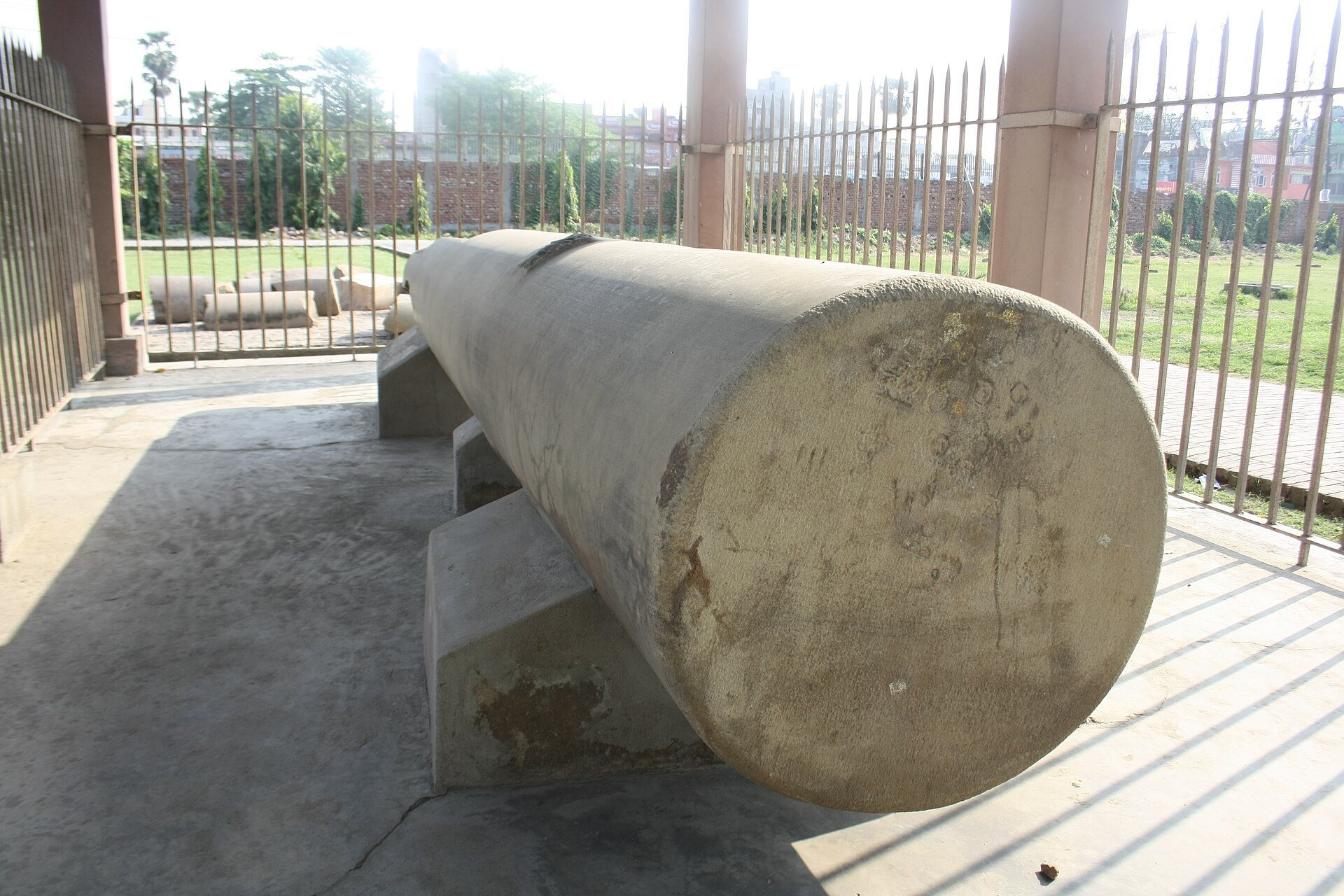
The main Mauryan structure is a hypostyle hall, meaning a large roofed space supported by rows of columns. Its reconstructed plan contains 80 pillars arranged in eight rows of ten, with the pillars spaced 4.57 metres apart. The shafts were monolithic, made from black-spotted buff sandstone, and each stood approximately 9.75 metres high. About 2.74 metres of each shaft was set below ground to provide support.
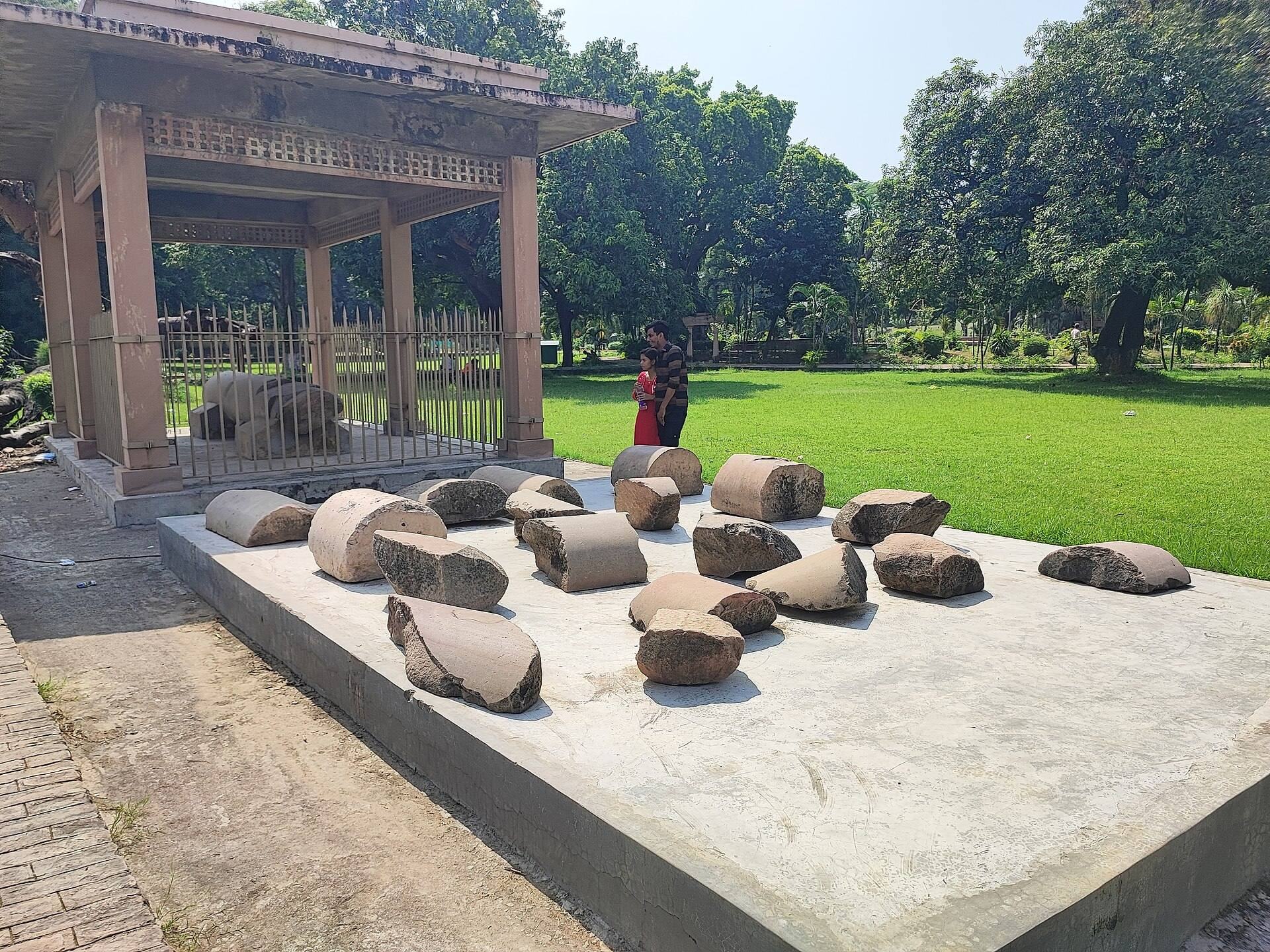
Spooner recovered one polished stone pillar and numerous fragments during the 1912 to 1913 excavation. Excavators traced 72 pits containing ash and rubble, marking the positions of missing pillars. Jaiswal’s later excavation revealed eight additional pits and established the hall’s conventional name. Since no other stone architectural elements were recovered, the pillars are thought to have supported a wooden roof. The hall is therefore interpreted as open-sided, without surrounding walls.
Southern platforms and canal
Seven wooden platforms were excavated south of the pillared hall. They are thought to have supported a staircase leading into a canal, possibly for receiving guests. Their position and construction form part of the surviving evidence for features associated with the hall.
Surviving architectural pieces
The surviving architectural material includes a standing pillar, pillar fragments, polished pillar pieces, and a coping stone decorated with a vine-scroll design. Altekar dated the coping stone to approximately 150 BCE to 100 CE.
Buddhist and medical complexes
Anand Vihar
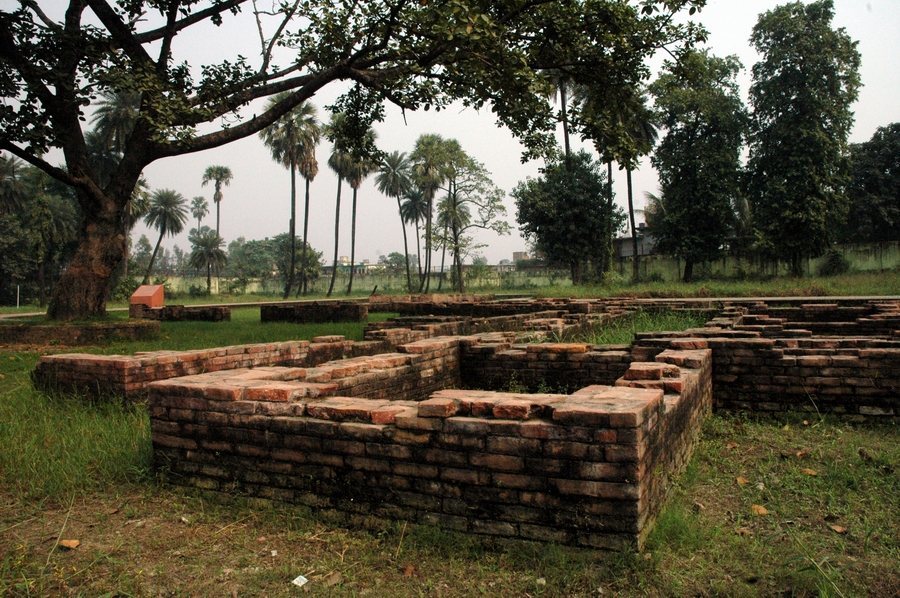
Anand Vihar is represented by the foundations of a brick-built Buddhist monastery. Excavations recovered wooden beams and clay figures connected with the complex, and these objects are displayed in the surrounding park.
Arogya Vihar
Arogya Vihar is represented by an excavated structural complex associated with ancient medical practice. The institution was headed by Dhanvantari, a figure traditionally associated with Ayurvedic knowledge and healing.
Durakhi Devi stupa railing
The Durakhi Devi remains include a detached carved stone section from a stupa railing. Female figures appear on both sides of the stone and date to the second or first century BCE. They are examples of Sunga-period art and are identified as salabhanjikas, female figures shown touching or breaking a tree branch and associated with fertility symbolism.
The figures were moved to Naya Tola in Kankarbagh, where they are worshipped in a temple-like shelter. A replica is preserved at Patna Museum.