Yinqueshan Han Slips: Western Han Military Texts from Linyi
Site at a Glance
- Rating
- 3.9
- Popularity
- Very Low
- Country
- China
- Primary era
- Classical
- Eras represented
- Classical
- Civilizations
- Han
- Site type
- Burial
- Remains
- Necropolis
On this page9 sections
History
Yinqueshan Han Slips are a group of Western Han bamboo texts from tombs at Yinqueshan, southeast of Linyi in Shandong, China. The burials date broadly to around 140–134 BC and 118 BC, during the early phase of the Han dynasty, which ruled much of China from 206 BC to AD 9. The bamboo slips had been written before they were placed in the tombs.
Discovery of the tombs
The tombs were found accidentally on April 10, 1972, after Meng Jihua, a worker with an interest in archaeology, reported what appeared to be an ancient burial. Archaeologists initially regarded it as an ordinary Han tomb, but inscribed bamboo pieces led to a larger investigation. A military unit was assigned to protect the excavation, and Tombs 1 and 2 were excavated later that year. The occupant of Tomb 1 was identified as a military officer surnamed Sima.
Tomb 1 contained a large body of writing, including portions of known classical works and previously unknown texts on warfare, divination, administration, and other subjects. Tomb 2 held a Western Han calendar for 134 BC. Because bamboo slips were narrow strips prepared for writing and then arranged or bound into texts, their recovery preserved evidence of a major writing practice used in ancient China before paper became dominant.
Military writings and historical importance
The texts were arranged into nine groups and 154 sections after conservation and study. They included 13 chapters of The Art of War, traditionally associated with Sunzi, also known as Sun Wu, as well as five further chapters whose authorship was not determined. They also contained 16 chapters of Sun Bin’s Art of War, seven original or lost chapters of The Six Strategies, five chapters of Weiliaozi, 16 chapters of The Annals of Master Yan, and anonymous writings.
The recovery of Sun Bin’s Art of War, which had been considered lost for more than a millennium, was especially important. Its discovery in the same tomb complex as The Art of War provided evidence for studying early Chinese history and military thought, including the historical relationship between Sunzi and the later military thinker Sun Bin. Other recovered works included Mozi, Guanzi, Tang Le, writings on military defense and administration, and material associated with the Yuan’guang era, whose first year was 134 BC.
Conservation and preservation
The slips emerged from muddy, polluted water in severely damaged condition. Staff from the local cultural-relics group began their treatment, followed by work involving the Shandong Provincial Museum, a cultural-relic conservation institute, Peking University, and the Institute of History of the Chinese Academy of Sciences. Their work included cleaning, conserving, interpreting, and collating the texts.
The conserved slips are held by the Shandong Archaeological Research Institute, while the Yinqueshan Han Tombs Bamboo Slips Museum keeps replicas for display. The excavation and writings were published in the multivolume Bamboo Slips from the Yinqueshan Han Tombs, issued in 1985, 2010, and 2021. Yinqueshan became a Shandong provincial cultural-relic protection unit in 1977, among the province’s first group of protected cultural sites. A museum was built on the tomb site in 1981 and opened in 1989.
Remains
Yinqueshan is a small earthen hill southeast of central Linyi. Its name was associated with the silver-sparrow flower that formerly grew extensively on the slopes, while the name of neighboring Golden Sparrow Mountain referred to its own flowering vegetation. The tombs were cut into a mountainside or cliff, and the museum occupies the hill’s southwestern foothill.
The Han tombs
Tomb 1
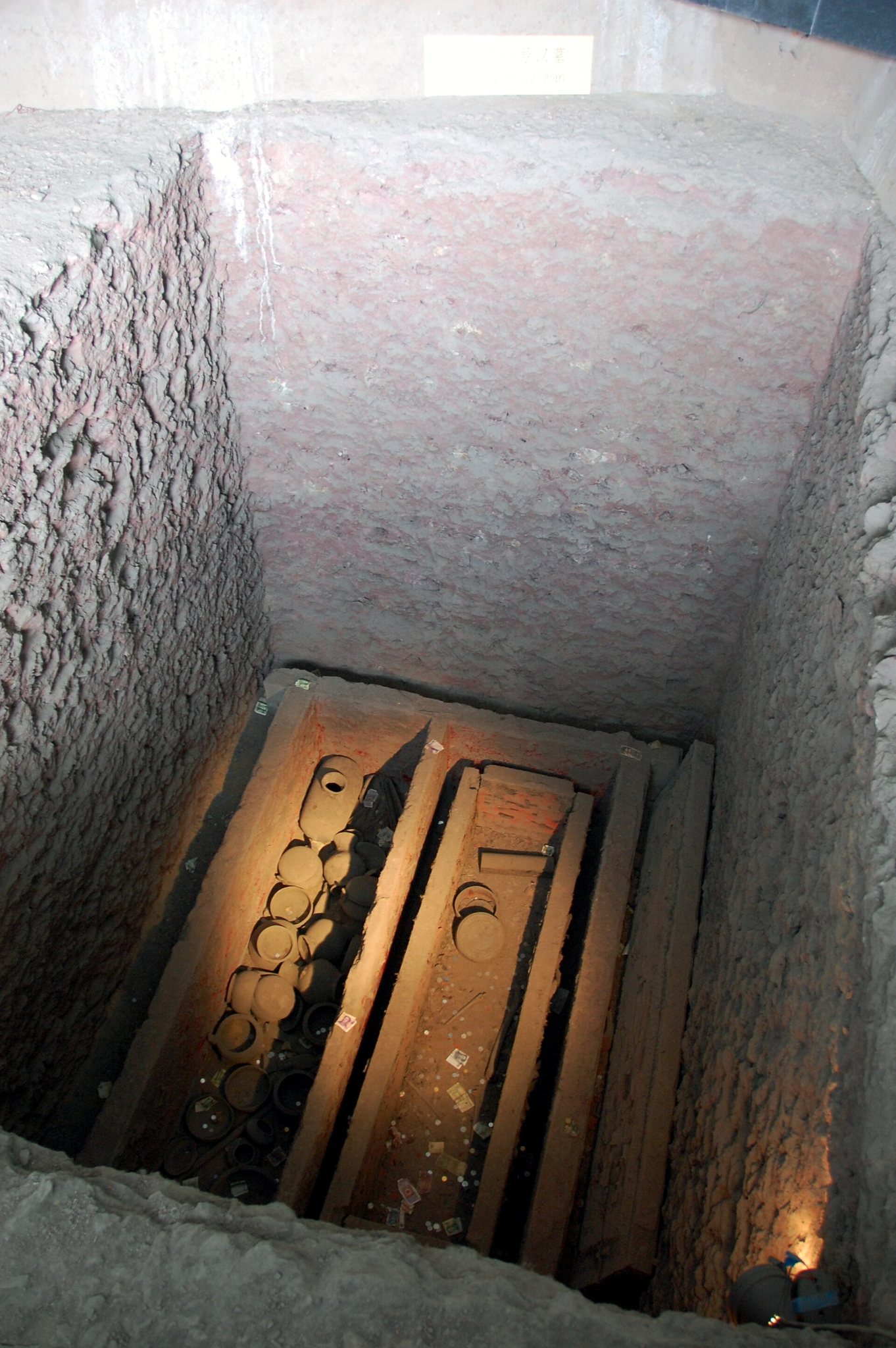
Tomb 1 had a rectangular vertical shaft containing an outer-coffin structure and a coffin. An internal partition separated the coffin from a side compartment for burial goods. The burial produced 4,942 bamboo slips, including 105 slips from The Art of War, with more than 1,000 characters, and 232 slips from Sun Bin’s Art of War, with more than 6,000 characters. More than 38 percent of the slips, or 1,887 pieces, were heavily damaged, complicating the reconstruction of the texts.
Tomb 2
Tomb 2 followed essentially the same plan, with a rectangular shaft, an outer-coffin structure, a coffin, and a partitioned side compartment for burial goods. Its 32 bamboo slips preserved a Western Han calendar for 134 BC, providing a chronological record associated with the first year of the Yuan’guang era.
Objects and museum buildings
Excavated materials include pottery jars, tripods, plates, cocoon-shaped pottery jars with square feet, and pottery figures. Bronze objects include cauldrons, mirrors, three-bead coins, and half-liang coins. The burials also yielded painted lacquer plates, lacquer earrings, lacquer pillows, painted lacquer cups, Western Han silk paintings, wooden pillows, handles, combs, doors, and staffs, together with organic remains such as chestnuts and walnuts.
The Yinqueshan Han Tombs Bamboo Slips Museum is a classical palace-style building covering approximately 10,000 square meters, with about 2,400 square meters of building area. Its five exhibition sections concern the Han tombs, Sunzi, Sun Bin, bamboo slips, and cultural relics. Displays include replicas of the bamboo texts, a storytelling figurine, an agate seal, and ancient coins.