Vaishali: An Ancient Republican Capital and Buddhist-Jain Pilgrimage Site
Site at a Glance
- Rating
- 4.2
- Popularity
- Low
- Country
- India
- Primary era
- Classical
- Eras represented
- Classical, Medieval
- Civilizations
- Gupta, Kushan, Mauryan
- Site type
- City
On this page22 sections
History
Vaishali was an ancient city and archaeological site in present-day Bihar, India. It developed as the capital and stronghold of the Licchavi-led Vajjika League, a confederation of republican or aristocratic communities, and its urban history is conventionally dated from around the fifth century BCE. The city became an important political, commercial, and industrial centre before declining and being substantially deserted around 600 CE.
From monarchy to the Vajjika League
Literary traditions preserve memories of an earlier monarchical phase associated either with King Vishal or with Nābhānediṣṭha of the Ikshvaku, or Solar, dynasty. The traditional explanation of the name Vaishali connects it with repeated expansions of the city’s enclosed area. These traditions place the city within the former Videha region, where the Licchavikas established their republic before moving their political centre to Vaishali.
The Licchavikas made Vaishali their largest city, capital, and principal stronghold. Their political system was a gana-sangha, a state governed through an assembly rather than by a single hereditary monarch. The wider Vajjika League included the Licchavikas, Vaidehas, Nayikas, and Mallakas. Tradition associates the city’s government with 7,707 ruling members and with a Santhagara, or assembly hall, where political and administrative matters were discussed.
Chetaka, also known as Ceṭaka or Ceḍaga, was the sixth-century BCE head of the Licchavika republic and the council of the Vajjika League. Under this political order, Vaishali became the league’s principal centre. The city remained a major urban and industrial settlement during the period when the Mauryan and Gupta dynasties developed Pataliputra as their capital.
Buddhist history
Gautama Buddha was closely associated with Vaishali and visited the city repeatedly. He stayed at Kutagarashala during his fifth rainy-season retreat, the annual period when monks traditionally remained in one place during the monsoon, and preached at several locations in and around the city. Buddhist tradition also connects Vaishali with the beginning of the order of Buddhist nuns, when the Buddha permitted Mahaprajapati Gautami and 500 Sakya women to enter the order.
The city is linked in Buddhist tradition with the preaching of the Ratana Sutta and with the removal of a threefold calamity, famine, hostile spirits, and disease, through a recitation led by Ananda. Three months before his death, the Buddha announced at Vaishali that he would attain parinirvana, the final passing beyond the cycle of rebirth. Before leaving for Kushinagara, he looked back at the city for the last time and left his alms bowl with its inhabitants.
Vaishali hosted the Second Buddhist Council in 383 BCE under King Kalashoka. This early assembly of Buddhist monastics was convened to resolve disagreements over monastic discipline. The council considered ten disputed practices attributed to monks of the Vajji region and was presided over by 700 arahants led by Mahayasa.
After the Buddha’s parinirvana, Buddhist tradition states that the Licchavis received one of the eight shares of his bodily relics and enshrined it at Vaishali. The city is also associated with the Buddha’s final discourse before his departure for Kushinagara, although traditions arrange the chronology of these final events differently.
Magadhan conquest and later decline
Buddhist tradition attributes the conquest of Vaishali to the Magadhan king Ajatashatru. His minister Vassakara is said to have undermined the unity of the Vajjika rulers, after which the city came under Magadhan authority. Another traditional account places the destruction of Vaishali about three years after the Buddha’s parinirvana.
The settlement continued through later historical phases, with construction and occupation extending from the Mauryan period into the post-Gupta period. When the Chinese pilgrim Xuanzang visited in the early seventh century, he described the capital as ruined and the remaining settlement as a village or town. The Chinese pilgrim Faxian also mentioned Vaishali in his travel account.
Jain traditions and modern identification
Vaishali is also a major Jain pilgrimage centre. Mahavira, regarded by Jains as the twenty-fourth and final Tirthankara, was born and raised at Kundagrama or Kundalpur, identified as a suburb or nearby locality of Vaishali. Jain traditions state that he spent approximately twelve of his forty-two rainy-season retreats there, while another tradition says that he lived in the area until the age of 22.
Chetaka adopted Jainism and helped establish Vaishali as a stronghold of the religion. Jain tradition identifies Mahavira’s parents as Siddhartha and Trishala, with Trishala described as Chetaka’s sister. Chetaka’s daughter Cellaṇa married the Magadhan king Bimbisara, who is also called Shrenika in Jain tradition.
Faxian and Xuanzang helped preserve knowledge of Vaishali through their travel accounts. In 1861, Alexander Cunningham used those accounts when identifying the modern village of Basarh in Vaishali District with ancient Vaishali. Archaeological investigations later revealed remains from the Mauryan period through the post-Gupta period. The Archaeological Survey of India established the Vaishali Museum in 1971 to preserve and display antiquities recovered from the surrounding sites. Parts of the archaeological area, including the relic stupa and Ashokan pillar, have been on India’s tentative list for UNESCO World Heritage designation under the Silk Roads category since 2010.
Remains
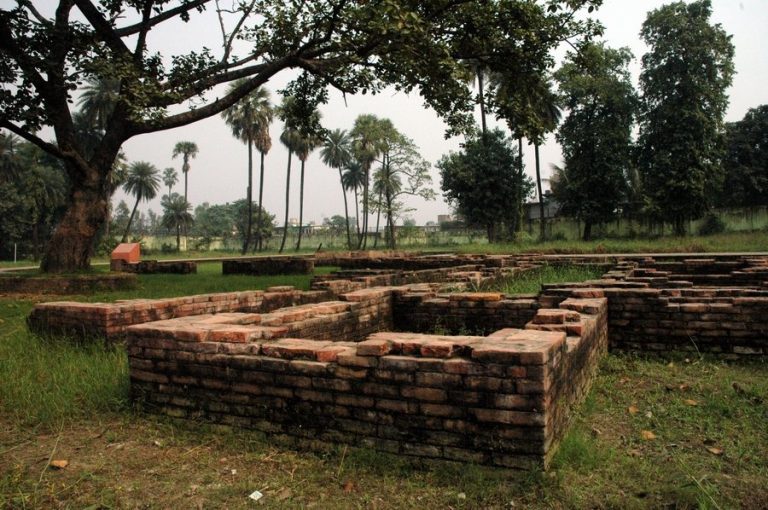
Vaishali’s ancient built remains are distributed across several modern villages in Vaishali District. The surviving archaeological landscape includes successive fortification walls, stupas, tanks, pillars, monastic structures, and associated artefacts rather than a continuous standing city. Traditional descriptions attribute three expansions to the city’s defensive perimeter and give its circuit as approximately 14 miles.
Fortifications and civic centre
Fort of Raja Vishal
The ruins known locally as the Fort of Raja Vishal lie near Basarh. They form a mound with an approximately one-kilometre circumference, enclosed by a wall about two metres high and a moat approximately 43 metres wide. Excavations produced Northern Black Polished Ware-period material dating from about 500 to 200 BCE. The remains have been interpreted as a citadel or palace complex belonging to the Vajjika League period, although both their identification and date remain interpretive.
Santhagara and traditional city layout
Traditional descriptions place a central Santhagara, or assembly hall, within Vaishali, where the Licchavi rulers deliberated. They also describe 7,707 palaces, 7,707 towers, 7,707 gardens, and 7,707 ponds. These accounts present the city as an extensively enclosed urban centre whose defensive perimeter was expanded in successive stages.
Relic monuments and sacred waterworks
Relic stupa
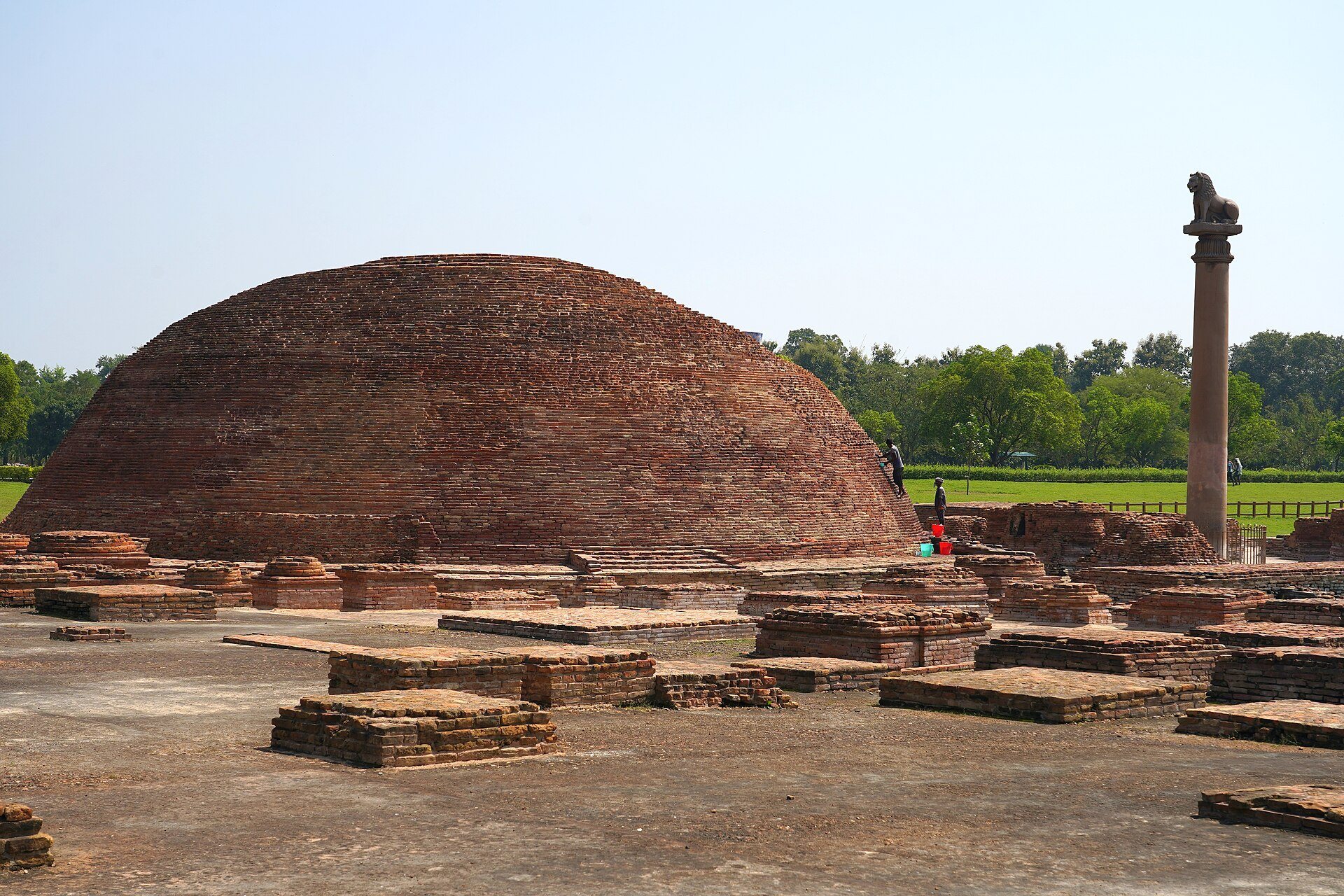
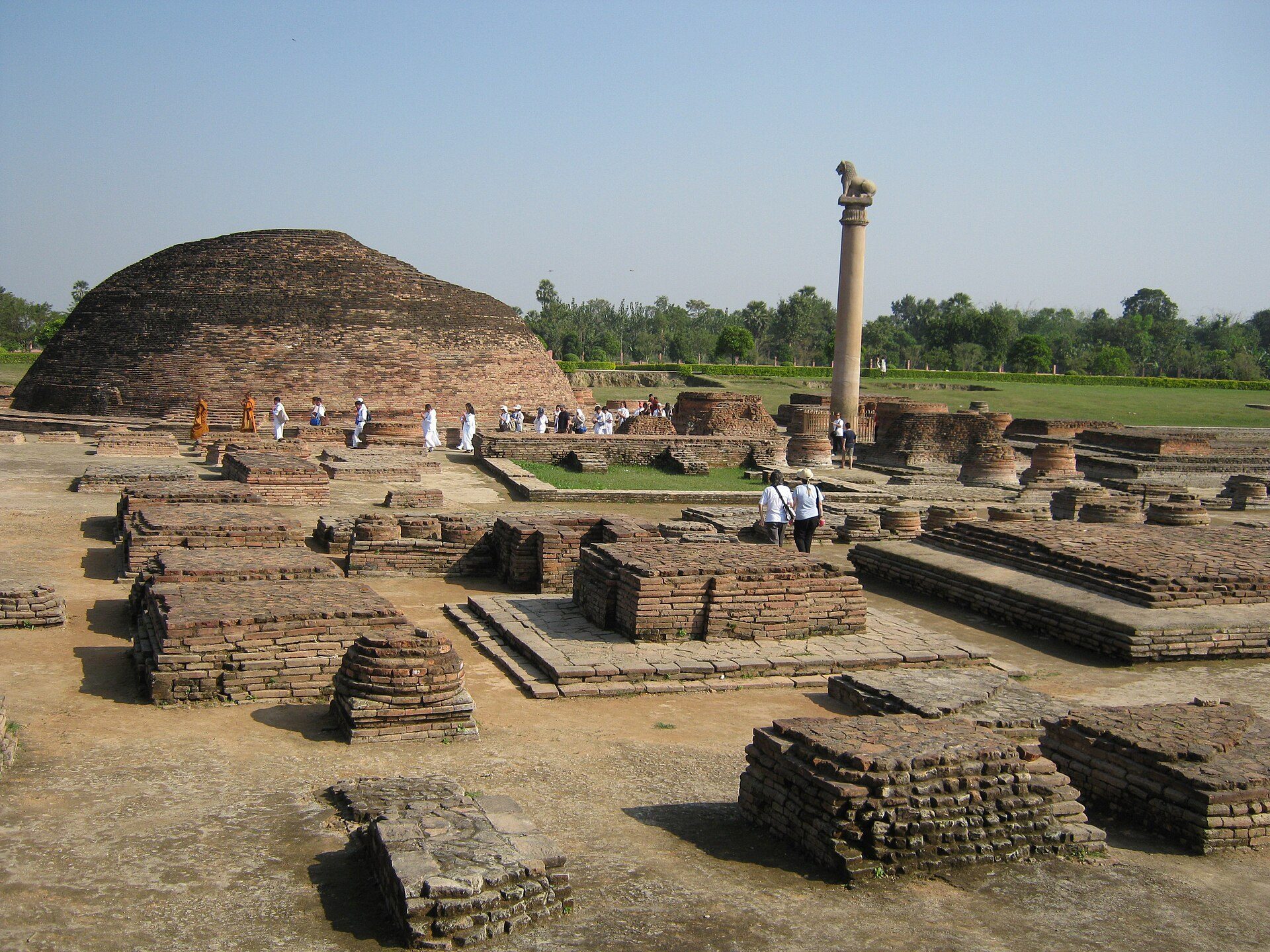
The relic stupa is associated with the share of the Buddha’s bodily relics received by the Licchavis. Its earliest form was an earthen stupa about 8.07 metres in diameter, probably dating to the fifth century BCE. During the Mauryan, Shunga, and Kushan periods, it was repeatedly covered and enlarged with baked brick until it reached a diameter of about 12 metres. It is regarded as potentially one of the earliest archaeologically known stupas.
Licchavi coronation tank
The Licchavi coronation tank, also called the Abhisheka Pushkarini, lies near the relic stupa. Tradition says that newly elected Licchavi rulers were consecrated in its waters before taking their seats in the republican assembly. Another tradition associates the tank with Mallika, the wife of the general Bandhula, who is said to have entered it despite its guards.
World Peace Pagoda
The World Peace Pagoda, or Viśvā Śānti Stūpa, stands beside the coronation tank with a Japanese Buddhist temple. Nipponzan-Myōhōji, a Japanese Nichiren Buddhist organization, built the pagoda. A small portion of Buddha’s relics found at Vaishali is enshrined in its foundation and umbrella finial.
Kolhua archaeological area
Ashokan pillar
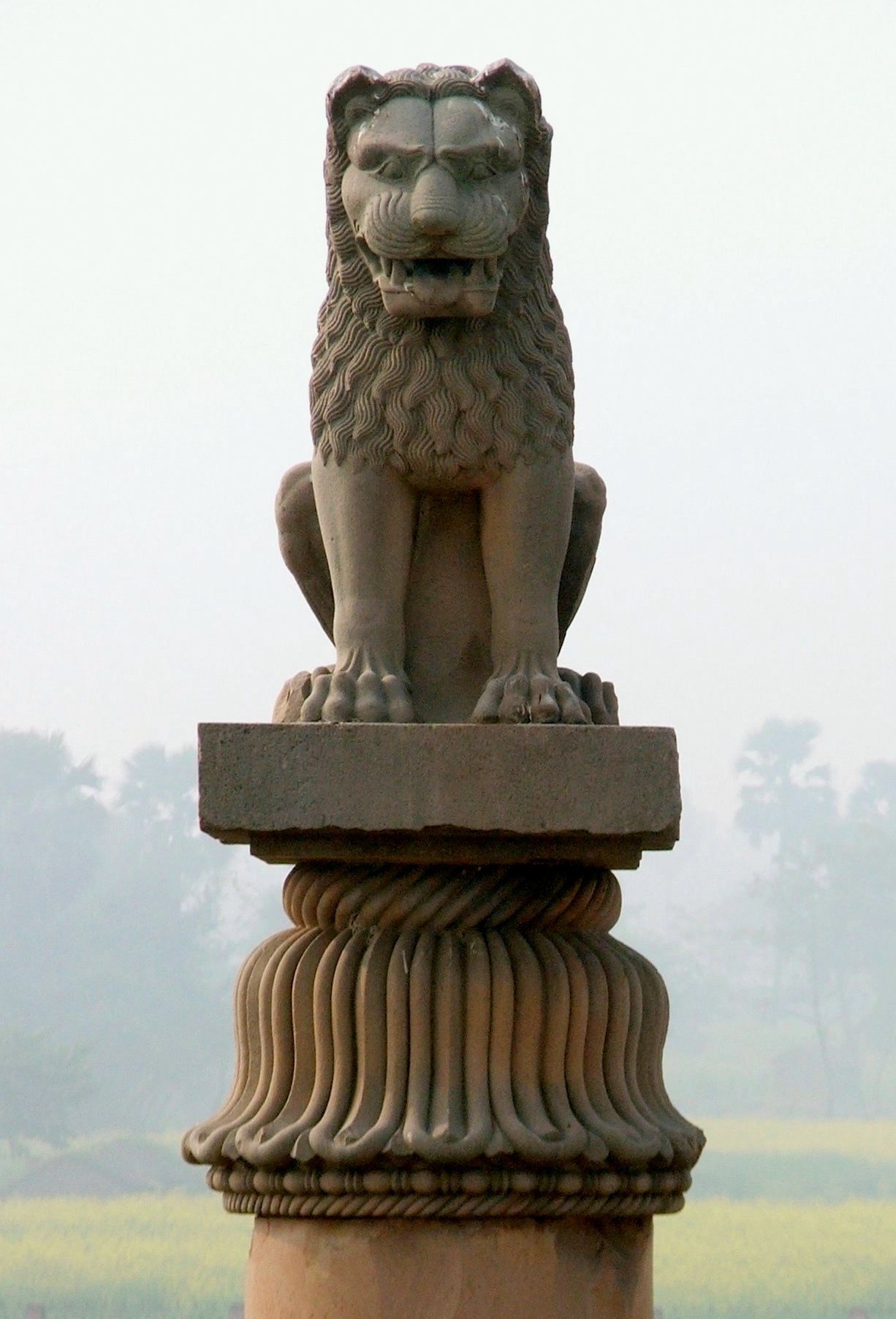
Kolhua contains a polished sandstone Ashokan pillar about 11 metres high. An Ashokan pillar is a monumental stone column erected under Ashoka, the Mauryan emperor of the third century BCE. This example is topped by a single Asiatic lion capital. It carries Gupta-period inscriptions but has no surviving edicts, and it is considered possibly one of the earliest Ashokan pillars.
Principal stupa and monkey stupa
A brick stupa at Kolhua preserves a Buddhist tradition in which a monkey chief offered honey to the Buddha. It was first built during the Mauryan period, enlarged with a circumambulatory path, a passage for ritual walking around a sacred monument, during the Kushan period, and modified again during the Gupta period. The Kolhua area also contains a principal stupa and votive stupas.
Markat-Hrad tank
The brick-lined Markat-Hrad tank has seven levels and bathing ghats. It measures approximately 65 by 35 metres. Buddhist tradition attributes its excavation to monkeys for the Buddha. The tank lies within the Kolhua archaeological area in spatial relation to the principal stupa and Kutagarashala.
Kutagarashala
Kutagarashala is identified as a seasonal residence of the Buddha. Its remains represent three architectural phases: a small chaitya from the Shunga-Kushan period, a larger temple of the Gupta period, and a post-Gupta monastery divided by partition walls. The surrounding Kolhua remains span the Mauryan period, beginning in the third century BCE, through the post-Gupta period and up to about the seventh century CE.
Gupta-period monastery
A Gupta-period monastery at Kolhua has a swastika-shaped plan, a central courtyard, an eastern entrance, twelve rooms, and a toilet. It may have served as a residence for nuns. Finds from the building include semi-precious beads, terracotta figures, seals, inscribed pottery, and a distinctive crowned terracotta monkey. These objects are displayed in the local Archaeological Survey of India museum.
Other religious remains
Monastic and shrine sites
Vaishali’s traditional sacred landscape included Kutagarashala, Valikarama, Ambapalivana, Udena Shrine, Gautamaka Shrine, Sattambaka Shrine, Bahuputta Shrine, Sarandada Shrine, and Chapala Shrine. An additional monastery stood in a woodland west of the city, although its name has not been preserved. The archaeological areas containing these traditions include enclosed and conserved remains of stupas, tanks, walls, pillars, and related structures.
Bawan Pokhar Temple
The Bawan Pokhar Temple stands at the northern end of Bawan Pokhar. It is a Pala-period temple containing images of Hindu deities, adding a later Hindu architectural and religious layer to Vaishali’s wider archaeological landscape.