Mound 72: A Mississippian Mortuary Mound at Cahokia
Site at a Glance
- Rating
- 4.8
- Popularity
- Very Low
- Country
- United States
- Primary era
- Medieval
- External website
- Open
- Eras represented
- Medieval
- Civilizations
- Unclassified
- Site type
- Burial
- Remains
- Burial Mound
On this page8 sections
History
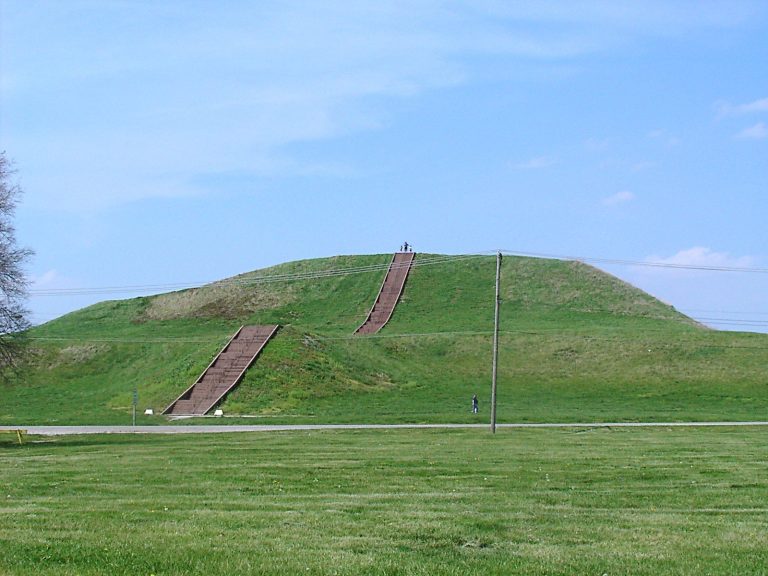
Mound 72 is a ridgetop mound at Cahokia near Collinsville, Illinois, United States, built by the Middle Mississippian culture during the early Mississippian period. Its development began with a ceremonial timber circle around 950 CE and continued through several construction and burial stages around 1000–1050 CE. The mound became a mortuary complex for elite individuals, retainers, and sacrificial victims, reflecting the religious authority and social divisions of Cahokia.
The ceremonial circle and first mounds
The earliest feature at the site was a woodhenge, a circular arrangement of large upright timber posts used for ceremony and for marking the sun’s position. The circle contained 48 posts and was approximately 126 metres in diameter. At least one post dates to about 950 CE. Four posts marked the cardinal directions, while others indicated the positions of the summer and winter solstices at sunrise and sunset.
The woodhenge was later dismantled, but its layout continued to shape the site. Near the end of the late Emergent Mississippian Edelhardt Phase, or at the beginning of the early Mississippian Lohmann Phase, two small platform mounds were built around several of the posts. These early mounds were later enlarged, joined, covered, and reshaped into Mound 72. The process preserved the connection between the mound and the earlier solar-marking circle even after the timber posts had been removed.
A mortuary complex at Cahokia
Mound 72 was used for six burial episodes over roughly a century. About 272 people were placed within the mound, including elite individuals, retainers, secondary bundle burials, and people buried in mass graves. Researchers estimate that nearly 62 percent may have been sacrificial victims, based on evidence such as ritual execution, burial arrangements, and other archaeological factors.
The principal elite interment, called the Beaded Burial or Birdman Burial, is thought to have belonged to a ruler or another high-ranking person at Cahokia. Numerous retainers and sacrificial victims accompanied the burial. Other episodes included groups of women, young men, and people who appear to have died violently. One interpretation connects a mass burial to warfare or rebellion against Cahokia’s rulers, perhaps involving resistance to earlier sacrificial practices, but this explanation remains inferential.
The treatment of retainers at Mound 72 has been compared with a 1725 burial among the Natchez after the death of the war chief Tattooed Serpent. In that later event, people associated with the chief, including family members, warriors, servants, and other members of his household, were killed or died to accompany him. Their bodies were placed in and around a temple mound, and some were later reduced to bundle burials. The comparison helps archaeologists consider possible Mississippian funerary practices, but it does not establish that the same event occurred at Mound 72.
Excavation and interpretation
Archaeologist Melvin L. Fowler began excavating Mound 72 in 1967. He had proposed that a large post should lie along an alignment linking the mound with Monks Mound and other Cahokia features. Excavation exposed the predicted post pit, additional postholes, and the major burial complex. Fowler also identified Mound 96, a previously unnoticed mound southwest of Mound 72.
During the 1970s, Fowler recognized that Mound 72, Mound 96, and their associated postholes corresponded closely to the dimensions and circumference of Woodhenge III. Later excavations in the 1990s tested predicted posthole locations and investigated parts of Mound 96. Several post pits were located, including one at the position of the winter-solstice sunset. The proposed southern woodhenge was not accepted by every Cahokia archaeologist at the time, and flooding, low-lying ground, weather, and other practical difficulties complicated the later work.
Mound 72 has since been reconstructed following the major excavations. Its excavated burials and associated features continue to shape interpretations of Cahokia’s political hierarchy, ritual life, solar observations, and connections with communities far beyond the central Mississippi River region.
Remains
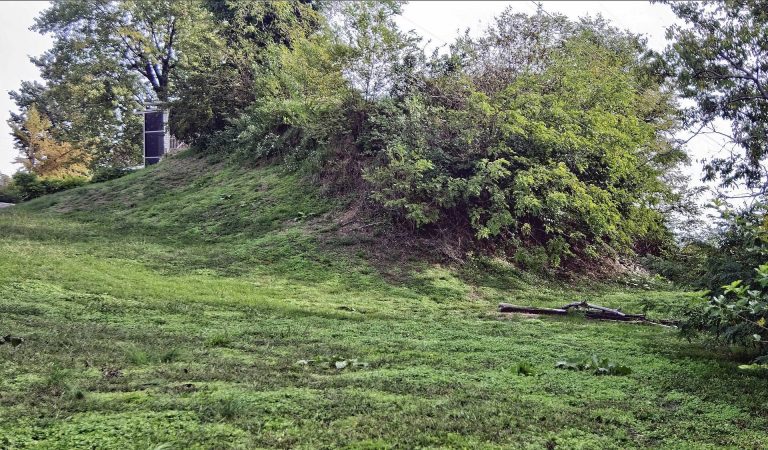
Mound 72 occupies a raised ridge and is one of only six recorded ridgetop mounds at Cahokia. Its orientation differs from the site’s more usual east–west and north–south arrangements, lying about 30 degrees off the east–west line. This orientation matches the summer-solstice sunrise and winter-solstice sunset for the site’s latitude. The mound’s features remain within the arc once defined by the earlier woodhenge.
Woodhenge and early mound stages
The woodhenge was a timber circle about 126 metres across, formed by 48 large posts. Four posts marked the cardinal directions, while other posts indicated the solstitial sunrise and sunset positions. Its diameter and arrangement closely resembled Woodhenge III, which was approximately 0.61 metres smaller. The circle had religious and ritual meaning as well as an astronomical function, and its form appears in a cross-in-circle design on ceremonial beakers associated with black-drink ceremonialism.
The early platform mounds were positioned in relation to the solstice-marking posts. Mound 72sub1 was oriented east–west, with an eastern ramp and another ramp extending west toward the summer-solstice sunset post. The summer-solstice sunrise post stood at the centre of its eastern side and had been replaced several times, including at least once after construction began. The post also aligned north–south with a point on the southwest corner of Monks Mound.
Elite and mass burials
About five metres west of the summer-solstice sunrise post lay the Beaded Burial. A male and female elite were placed on an elevated platform above approximately 10,000 marine-shell disc beads arranged as a bird. The bird’s head lay beneath and beside their heads, while its wings and tail extended under their arms and legs. The woman was buried face down beneath the man. The image has been interpreted through the Mississippian falcon-warrior, or Birdman, motif, which is also represented by two small stone tablets with avian-human imagery found elsewhere at Cahokia.
Another group, known as the Exotic Cache Burial, contained seven women and 1,674 marine-shell beads, along with a large quantity of mica, copper-covered wooden scepters, 15 chunkey stones, and 709 finely made arrowheads. Chunkey stones were polished objects used in a game in which a disk or stone was rolled and players threw spears or sticks toward its path. The arrowheads came from Tennessee, southern Illinois, Wisconsin, and the Caddoan Mississippian region of Oklahoma, demonstrating long-distance exchange connections.
Mound 72sub2 was built over the remains of a dismantled charnel house, a structure where bodies were temporarily kept before later treatment or burial. It contained two recently deceased men and several bundle burials, consisting of bones gathered and reburied after decomposition. A two-level platform approximately 14 metres square was then built above the first phase, with a ramp on its eastern side. A later pit held grave goods, while a large rectangular pit in the southeastern corner contained 24 women. The mound was subsequently enlarged toward Mound 72sub1, creating a ramp or extension over the burial.
In the western part of the mound, the Shell Bead Cache was placed above 19 probable women. It contained 35,361 shell beads, including 32,789 lightning-whelk columella beads, 2,327 seed beads, and 245 whole shells. A lightning-whelk columella is the central spiral axis of the shell, which could be shaped into beads or cups. The cache also held the largest lightning-whelk cup found, approximately 39 centimetres long, together with a stone effigy of a woman holding such a cup. These objects point to the importance of lightning-whelk cups and the women who probably made them. The assemblage is among the most numerous marine-shell collections from Mississippian sites, exceeded only by that from Spiro.
A later stage included a small platform near the southeastern ramp, where four young men were laid out with their arms interlocked. Their hands and skulls were missing, and some researchers interpret the group as a possible representation of the four cardinal directions. Nearby, 53 females aged approximately 15 to 30 were placed in two layers separated by matting. Evidence indicates that they had been strangled before burial. Dental traits suggest that many came from outside the Cahokia area, while isotopic evidence and skeletal pathologies indicate poorer health, greater nutritional stress, lower social status, and heavier reliance on maize than among the elite individuals in the mound.
Mound 72sub3 covered and extended the earlier mound toward Mound 72sub1. A separate mass burial southwest of it held 39 men and women who appear to have been violently killed. The pit was lined with white sand. Some victims were incompletely decapitated, had fractured skulls or jaws, or had arrowheads lodged in their backs. The vertical position of some fingers suggests that certain people may have been buried alive while trying to escape. Fifteen elite individuals were placed above this burial on litters made from cedar poles and cane matting. Radiocarbon dating of the cedar places that burial around 1030 CE.
Numerous secondary bundle burials were inserted into the mound, followed by additional intrusive burials along its southwestern edge. The submounds were then covered with earth to create the final ridgetop form. The surviving arrangement therefore combines earlier ceremonial alignments, successive platform constructions, elite interments, mass burials, and later additions within the former woodhenge circle.
Mound 96
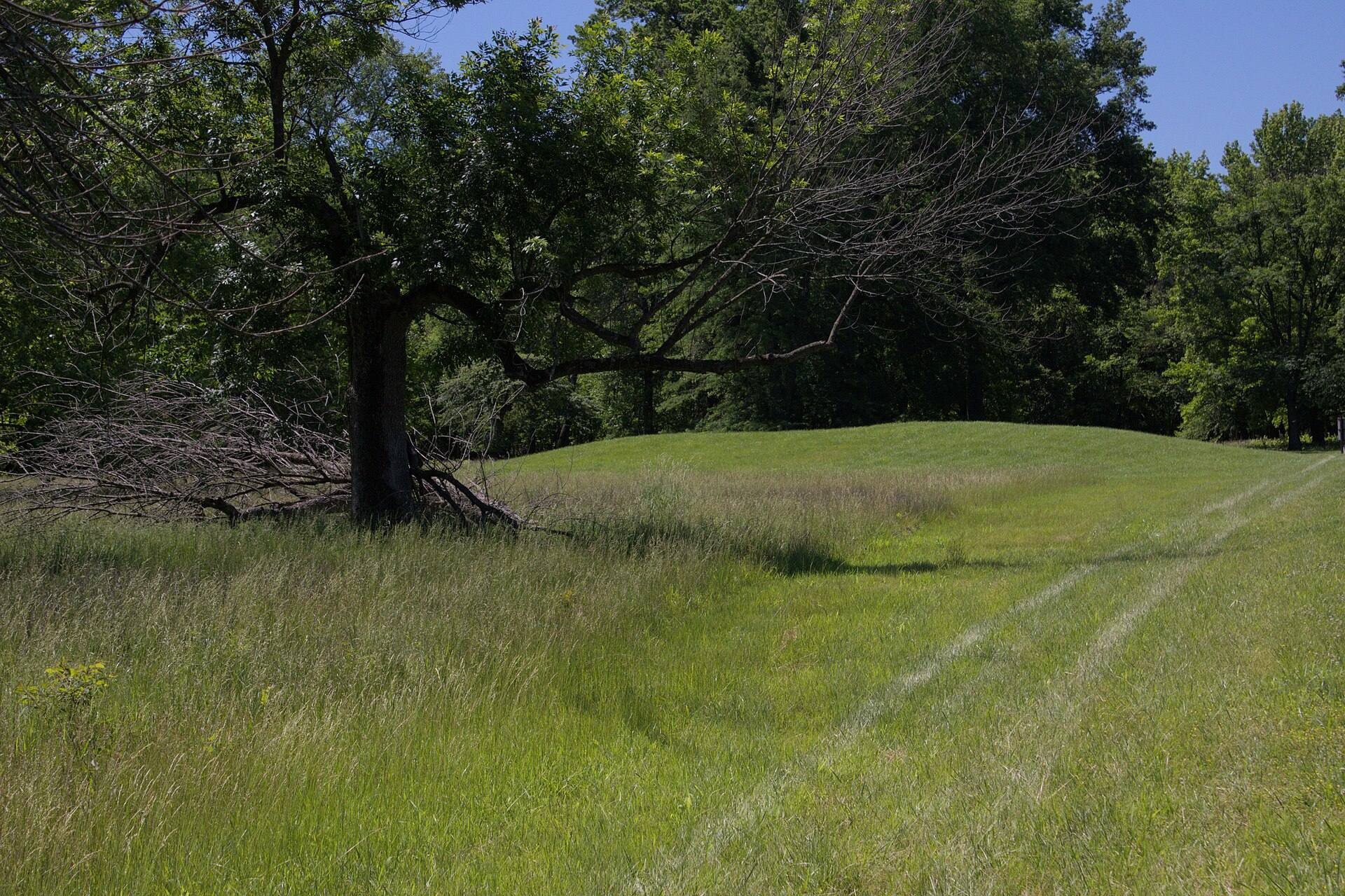
Mound 96 is a related small platform mound southwest of Mound 72. It is approximately 15 metres wide at its base and nearly square, with an eastern ramp that gives it a T-shaped plan. The mound was built around the winter-solstice sunset post and follows north–south and east–west alignments. Its ramp faces the winter-solstice sunrise post, narrowing from about 5 metres wide at the base to approximately 0.5 metres at the top.
Radiocarbon dating and ceramic analysis place the beginning of Mound 96’s construction in the Lohmann Phase, around 1000–1050 CE, roughly contemporary with Mound 72. Its surface was finished with a hard black-clay cap, probably to limit erosion. Parts of the mound believed to contain burials have not been excavated because federal legal restrictions govern the excavation of Native American remains.