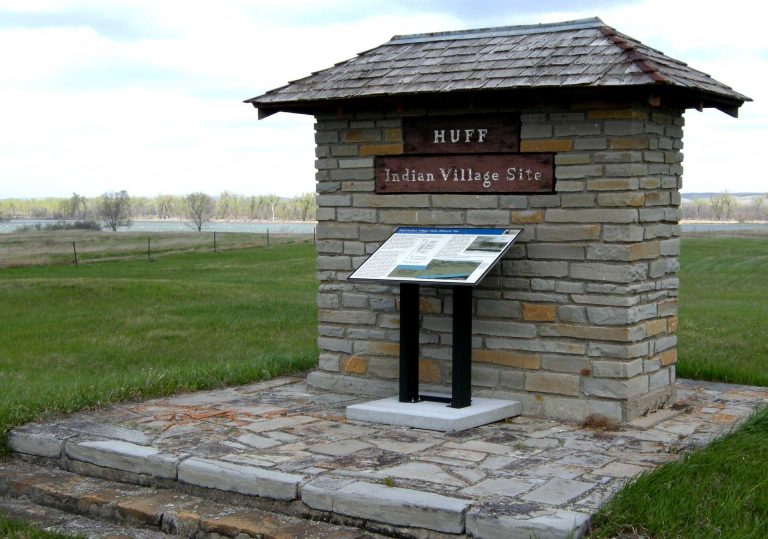
Menoken Indian Village Site: A Prehistoric Fortified Settlement in North Dakota
Site at a Glance
- Rating
- 4.6
- Popularity
- Very Low
- Country
- United States
- Primary era
- Medieval
- Eras represented
- Medieval, Modern
- Civilizations
- Unclassified
- Site type
- Military
- Remains
- Fortified Town
On this page11 sections
History
Menoken Indian Village Site is a prehistoric fortified settlement on a terrace beside Apple Creek near Bismarck, North Dakota, United States. Probably occupied between approximately AD 1100 and 1300, it is among the earliest known fortified Indigenous settlements in the region and helps establish the prehistoric sequence that preceded communities more clearly associated with the historic Mandan, Hidatsa, and Arikara peoples.
Origins and occupation
The settlement was probably used by the ancestors of one of the major Indigenous groups of the region. One interpretation holds that the community’s descendants later joined other populations and eventually became part of a northern Mandan division. The precise chronology remains uncertain. Estimates extend from before AD 1000 to about AD 1300, while archaeological investigations generally place occupation between roughly AD 1100 and 1300. Another estimate places the end of occupation no later than about AD 1240.
Menoken was probably a semi-permanent community whose residents hunted bison and other wildlife. Its position and defensive earthwork distinguish it from many later village sites along the Missouri River, which are more closely associated with established agricultural communities.
Changing interpretation
The site was long identified with a village visited by the French explorer La Vérendrye in 1738. La Vérendrye was an eighteenth-century French explorer involved in French exploration and the fur trade across the northern Great Plains. Excavations and later archaeological work overturned that identification, showing that Menoken is older and cannot be securely connected with his visit.
Initial excavation took place in the 1930s. Investigations during the 1990s and early 2000s refined the site’s earlier chronology and cultural interpretation. They also brought attention to houses that had been completely burned, although the reason for those fires remains unresolved.
Preservation and historical recognition
North Dakota acquired Menoken in 1937, and the property is preserved as the Menoken Indian Village State Historic Site. It became a National Historic Landmark in 1964 and was added to the National Register of Historic Places in 1966. The original landmark interpretation relied substantially on the former La Vérendrye association, but the site retains importance for its archaeological evidence and its role in clarifying regional prehistoric chronology.
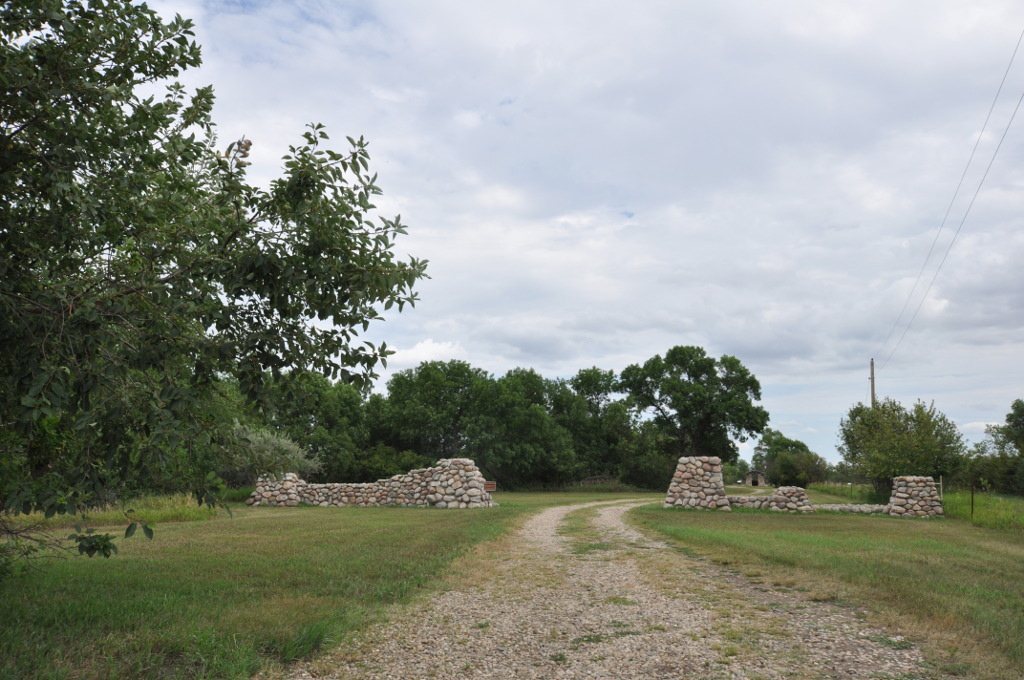
Work-relief improvements made during the Great Depression were added to the National Register in 2010. The Works Progress Administration, a federal employment program that supported public construction during the Depression, carried out the improvements approximately between 1931 and 1943. Designed by Russell Reid, the surviving listed group includes one building and two objects within a 1.9-acre listed area of the 13.7-acre parcel.
Remains
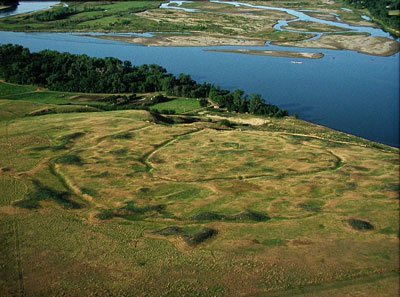
The settlement occupies a terrace on the south side of Apple Creek, a tributary of the Missouri River, approximately 10 miles east of Bismarck. Its principal remains consist of a curved defensive earthwork enclosing an interior area of about 1.5 acres, together with partly underground residential structures and artifacts associated with daily life.
Defensive earthwork
Ditch and palisade
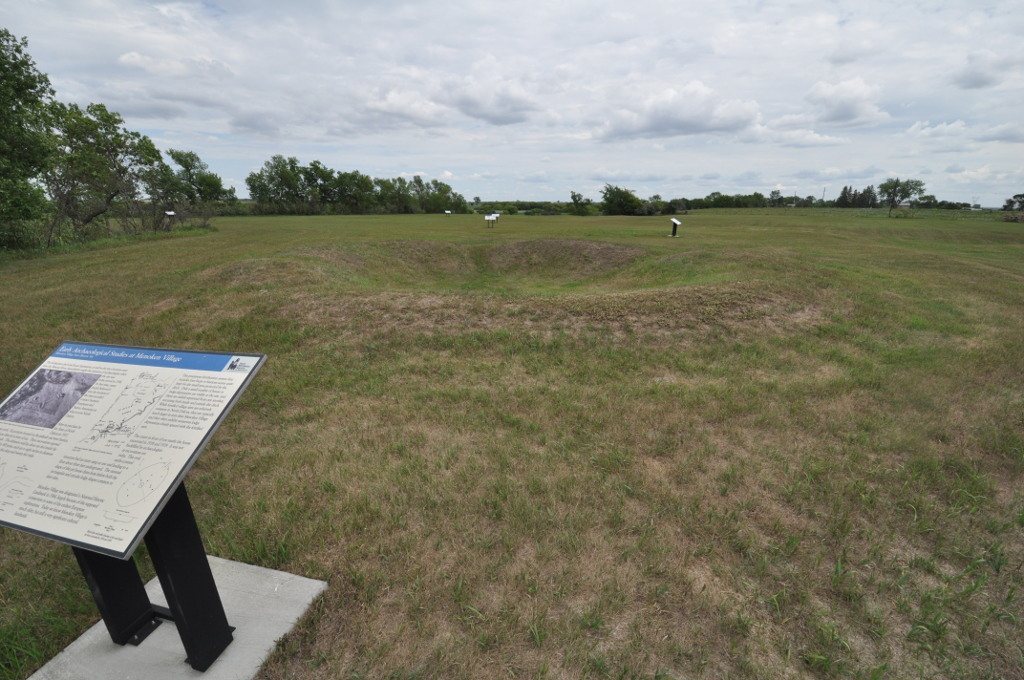
The main defense is a curved ditch approximately 245 metres, or 804 feet, long. It follows about 100 degrees of a circle, reaches approximately 1.5 metres, or 4.9 feet, in depth, and varies from 6 to 7 metres, or 20 to 23 feet, in width. An original palisade, a defensive fence made from upright posts, stood inside the ditch. Its surviving post holes trace the position of that barrier.
Bastion loops
Four bastion loops project outward from the ditch at approximately equal intervals. A bastion is a projecting defensive structure that allows defenders to protect the outside of an enclosure. At Menoken, these features formed part of the settlement’s defensive circuit and strengthened the earthwork’s outward-facing perimeter.
Residential area and artifacts
Semi-subterranean dwellings
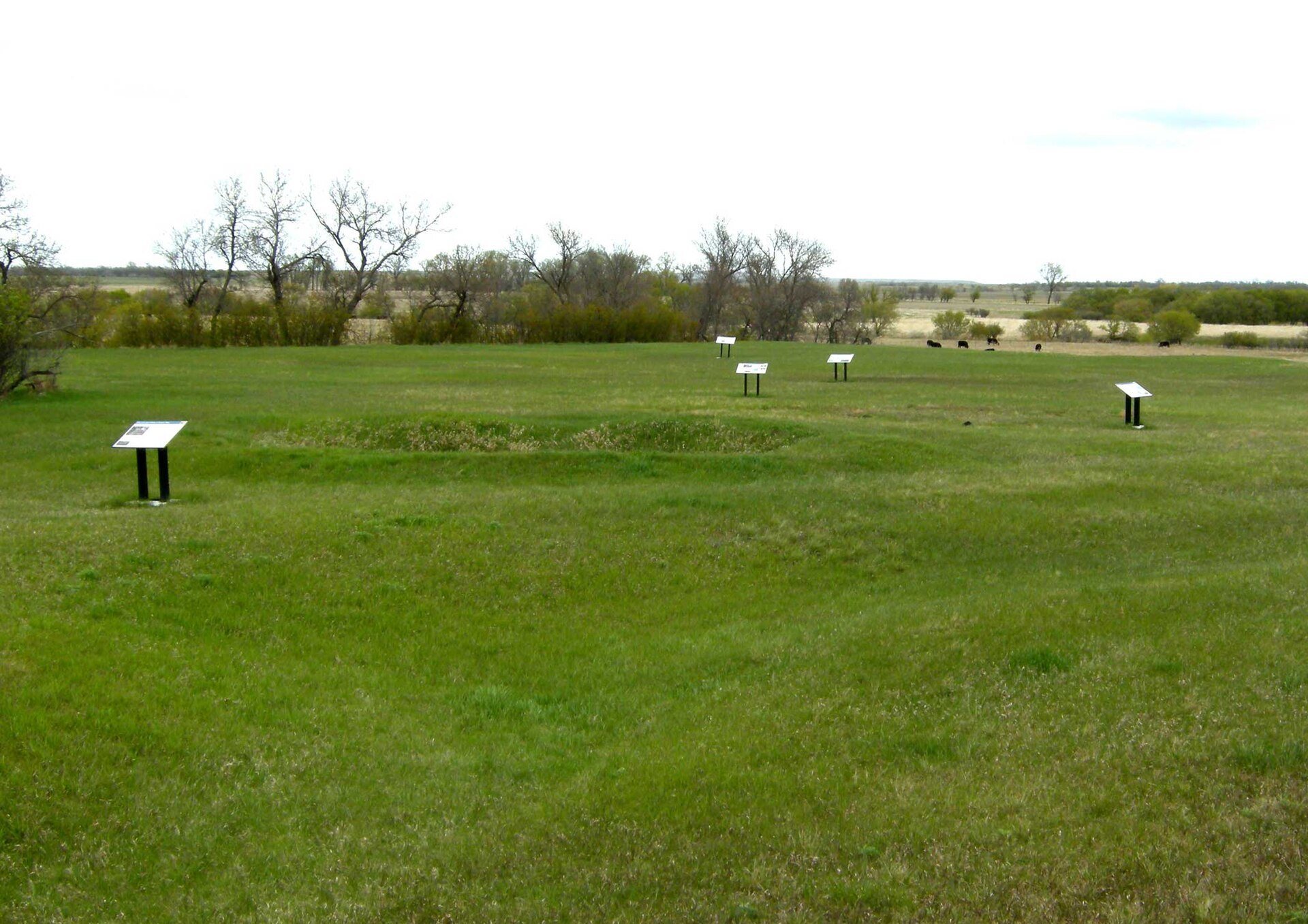
The enclosed interior contained oval residential structures set partly below ground. Estimates of their number range from 11 to 13 structures to more than 18 earth lodges. These semi-subterranean dwellings had floors excavated approximately 60 centimetres below the surrounding ground, an interior entrance, and a central hearth. An earth lodge is a substantial dwelling built partly below ground and covered with earth over a supporting framework.
Tools and pottery
Recovered materials include numerous stone tools, ceramic pottery fragments, and bone tools. Many of the stone tools were made from material quarried near the Lynch Quarry to the west. Together, these finds indicate the range of domestic and subsistence activities carried out within the settlement.