Mahilara Sarkar Math: A Leaning Hindu Temple in Bangladesh
Site at a Glance
- Rating
- 4.2
- Popularity
- Very Low
- Country
- Bangladesh
- Primary era
- Early Modern
- Eras represented
- Early Modern
- Civilizations
- Mughal
- Site type
- Religious
- Remains
- Temple
On this page6 sections
History
Mahilara Sarkar Math is an eighteenth-century Hindu temple and archaeological site in Mahilara village, Gournadi, Barisal District, Bangladesh. Built between 1740 and 1756 during the Bangla Nawab era, when Nawab Alivardi Khan ruled Bengal, it was founded by the locally influential Sarkar Rup Ram Das Gupta. The monument is known for its unusual leaning form and is also called Mahilara Math, Sarkar Bari Math, Radha-Krishna Math, Bakla Math, Helano Math, and the Leaning Tower of Mahilara.
Foundation and religious tradition
The shrine was originally dedicated to Shiva, a major Hindu deity. Local tradition identifies the site as the burial place of Rup Ram Das Gupta’s mother. According to the associated legend, the temple tilted immediately after the founder declared that he had repaid all his debt to her. Harlal Gosambi interpreted the event as a divine reminder that a mother’s debt cannot be repaid.
The temple initially stood within jungle. Harlal Gosambi, a religious practitioner and disciple of Nigamananda Saraswati, later recognized the site’s importance and began religious practice there. The shrine remains connected with Durga Puja, a festival honoring the goddess Durga, as well as Nagar Kirtan, or public devotional singing. Ritual fire offerings take place on Akshaya Tritiya, an auspicious Hindu observance, and Rath Yatra, a chariot festival associated with the public procession of a deity, is also held there.
Damage, protection, and heritage status
Mahilara Sarkar Math was attacked several times during the 1971 war and was later targeted by local anti-Hindu militants. Attempts were made to destroy its spire with explosives, but the temple remained standing. The Department of Archaeology of Bangladesh protects the monument and classifies it as an archaeological monument. Inadequate conservation has diminished its condition and heritage significance, creating a need for further government assistance.
The temple’s tilted form gives it a distinctive place in Bangladesh’s architectural heritage. It is described as one of eight documented temples in Bangladesh with similar architectural styles and as one of three tilted temples in the Indian subcontinent, with one of those three located in Bangladesh.
Remains
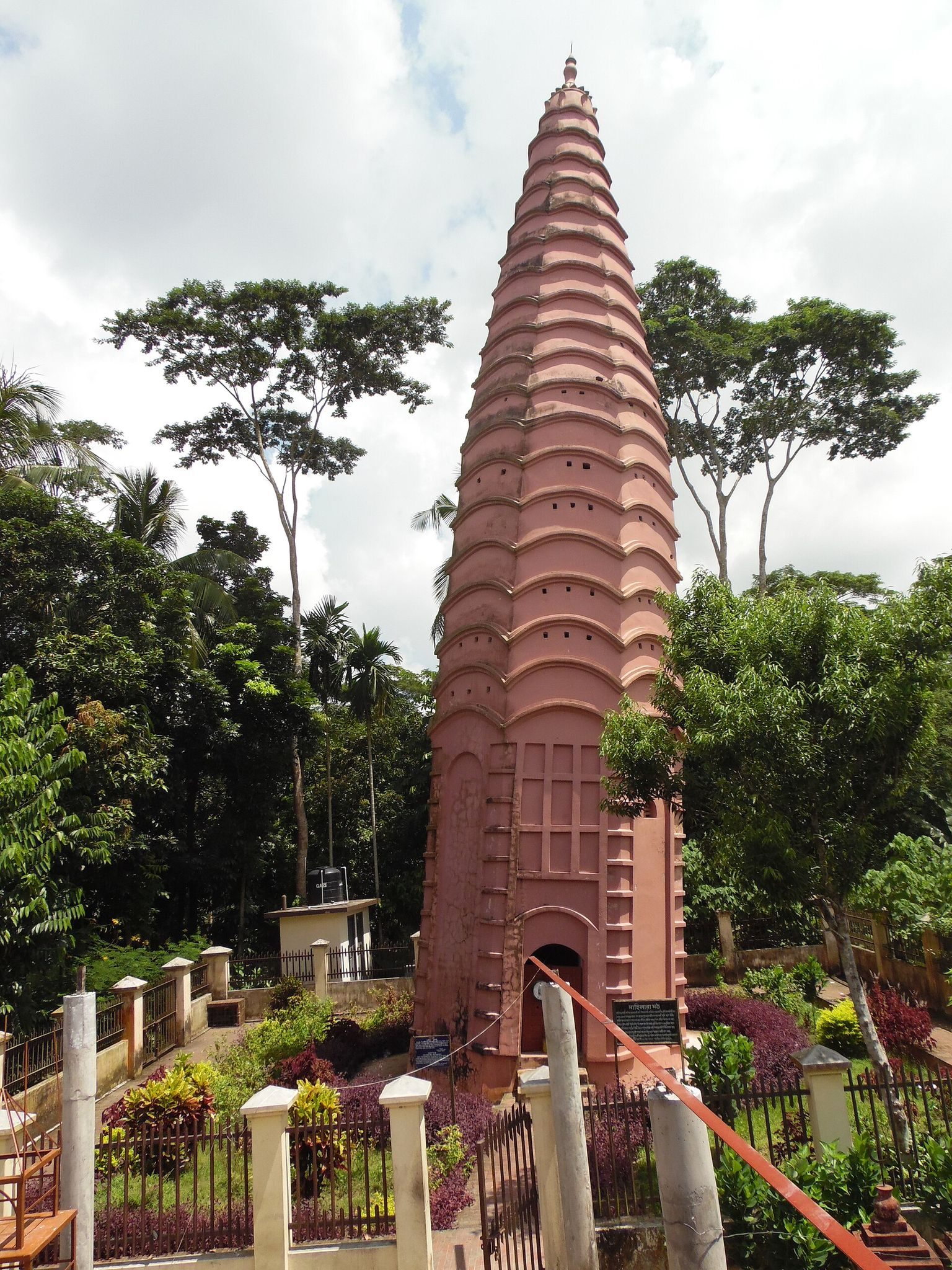
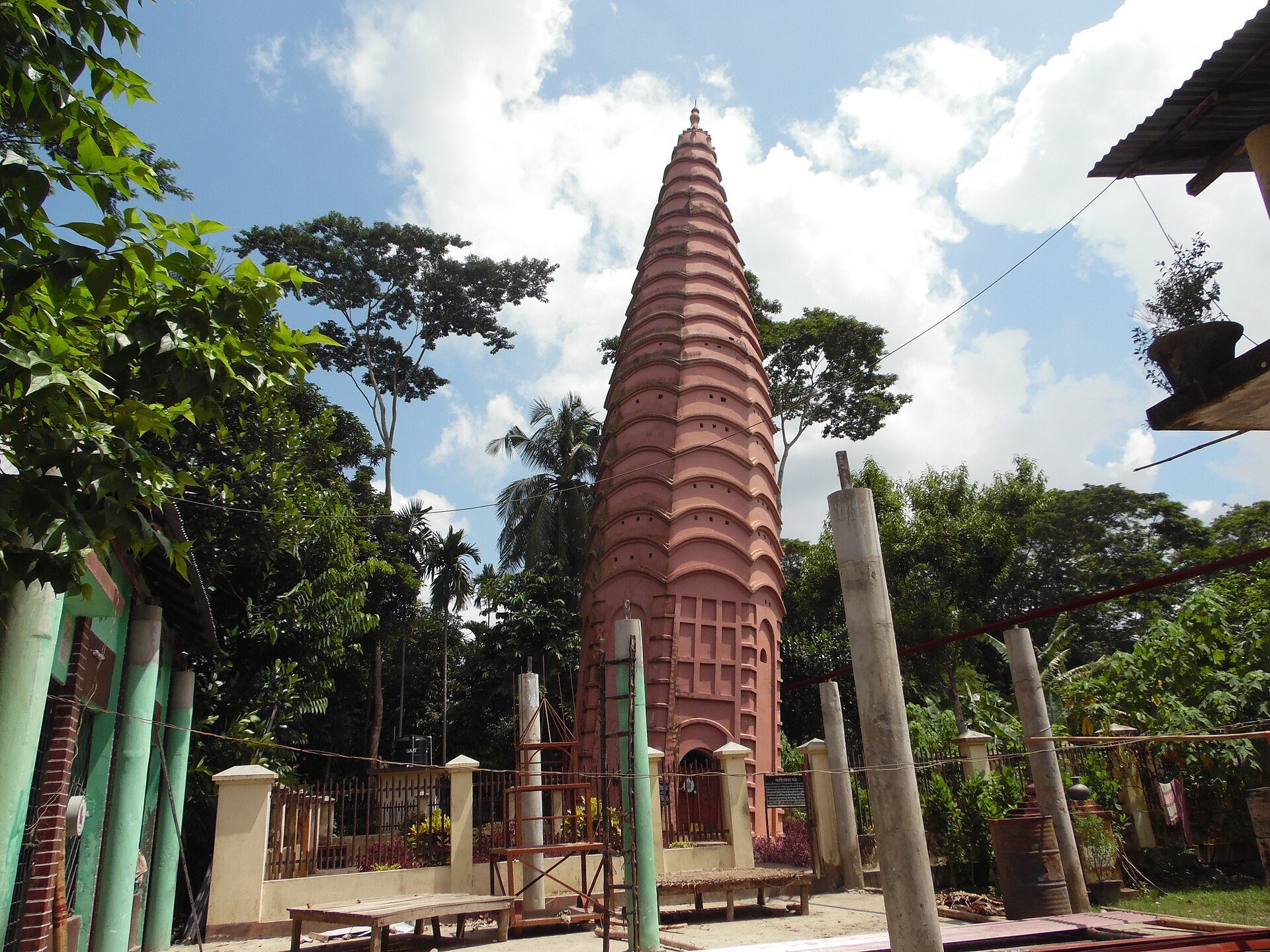
Mahilara Sarkar Math is a south-facing Shikhara-style temple, using a rising tower-like superstructure above its sanctuary. The monument stands on a square base with an octagonal lower structure approximately 3.84 metres high. Above this base, the temple rises about 27.43 metres. Its pointed octagonal spire leans southward by approximately 5.5 degrees, a condition associated with its construction style and damage accumulated over the decades.
Structure and exterior decoration
The temple was built from brick set with cement-based mortar and finished with stucco, a plaster-like coating used to cover or decorate masonry. Stucco roofing and terracotta, or fired-clay, patterns contribute to its exterior treatment. The upper section narrows toward a peak and carries repeated bow-shaped cornices. Four or more small spired turrets occupy the lower structure’s corners, creating a composition influenced by the panch-ratna and navaratna patterns, arrangements based respectively on five and nine jewel-like elements. The octagonal main spire may also reflect the influence of European church architecture.
Entrance and interior
A small interior chamber contains installed idols. The entrance is set in the west wall, with a segmental-arch panel above it filled with geometric designs. Comparable geometric decoration appears on the opposite side of the temple. The octagonal shaft rises to the cornice through several panels, while the interior carries images of Radha and Krishna, central figures in Vaishnava Hindu devotion.