Nuri: A Royal Necropolis of the Kingdom of Kush in Sudan
Site at a Glance
- Rating
- 4.5
- Popularity
- Very Low
- Country
- Sudan
- Primary era
- Classical
- External website
- Open
- Eras represented
- Iron Age, Classical
- Civilizations
- Kushite
- Site type
- Burial
- Remains
- Necropolis
On this page17 sections
History
Nuri is an ancient Nubian royal necropolis near Marawi in Sudan, built by the rulers of the Kingdom of Kush from the late seventh century BCE. Located near the Fourth Cataract of the Nile, it served Napata, the first capital of Kush, and became the second of three major Napatan royal burial grounds. The cemetery developed over more than three centuries, from approximately 670 BCE to about 310 BCE.
Foundation of the royal cemetery
King Taharqa established Nuri after the older cemetery at El-Kurru could no longer accommodate new royal burials. Taharqa ruled Egypt and Kush from 690 to 664 BCE and was one of the leading rulers of the Twenty-fifth Dynasty, the period when Kushite kings controlled Egypt. His pyramid became the earliest and largest monument at Nuri. Although his successor Tantamani returned to El-Kurru for burial, later Napatan kings, queens, and royal children were interred at Nuri.
The cemetery continued to receive royal burials until the tomb of King Nastasen, around 315 BCE. Its position near Jebel Barkal, an important political and religious center of Napata, linked the burial ground to the wider royal landscape. At its greatest extent, Nuri probably contained 80 or more pyramids.
Later use and archaeological investigation
During the Christian period, a church was constructed at Nuri. Builders reused stone from the pyramids, including blocks from pyramid chapels and several earlier upright inscribed stones. The royal tombs were later looted, apparently after holes dug from above allowed access to the underground chambers.
George Reisner partially excavated the pyramids in the early twentieth century. The Harvard University–Boston Museum of Fine Arts Expedition carried out important work in 1916, recovering funerary objects and fragments of Napatan red ware pottery. A new archaeological expedition began at Nuri in 2018 under the direction of Pearce Paul Creasman. Nuri, Jebel Barkal, and related archaeological sites in the Napatan region were inscribed together on the UNESCO World Heritage List in 2003.
Remains
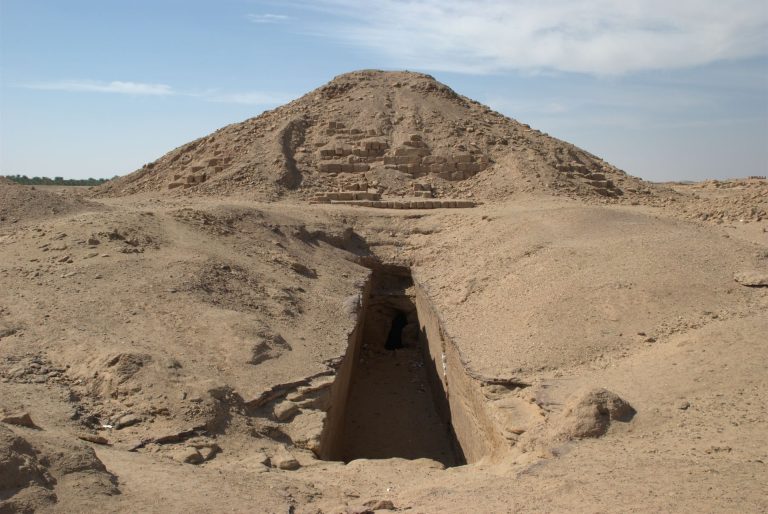
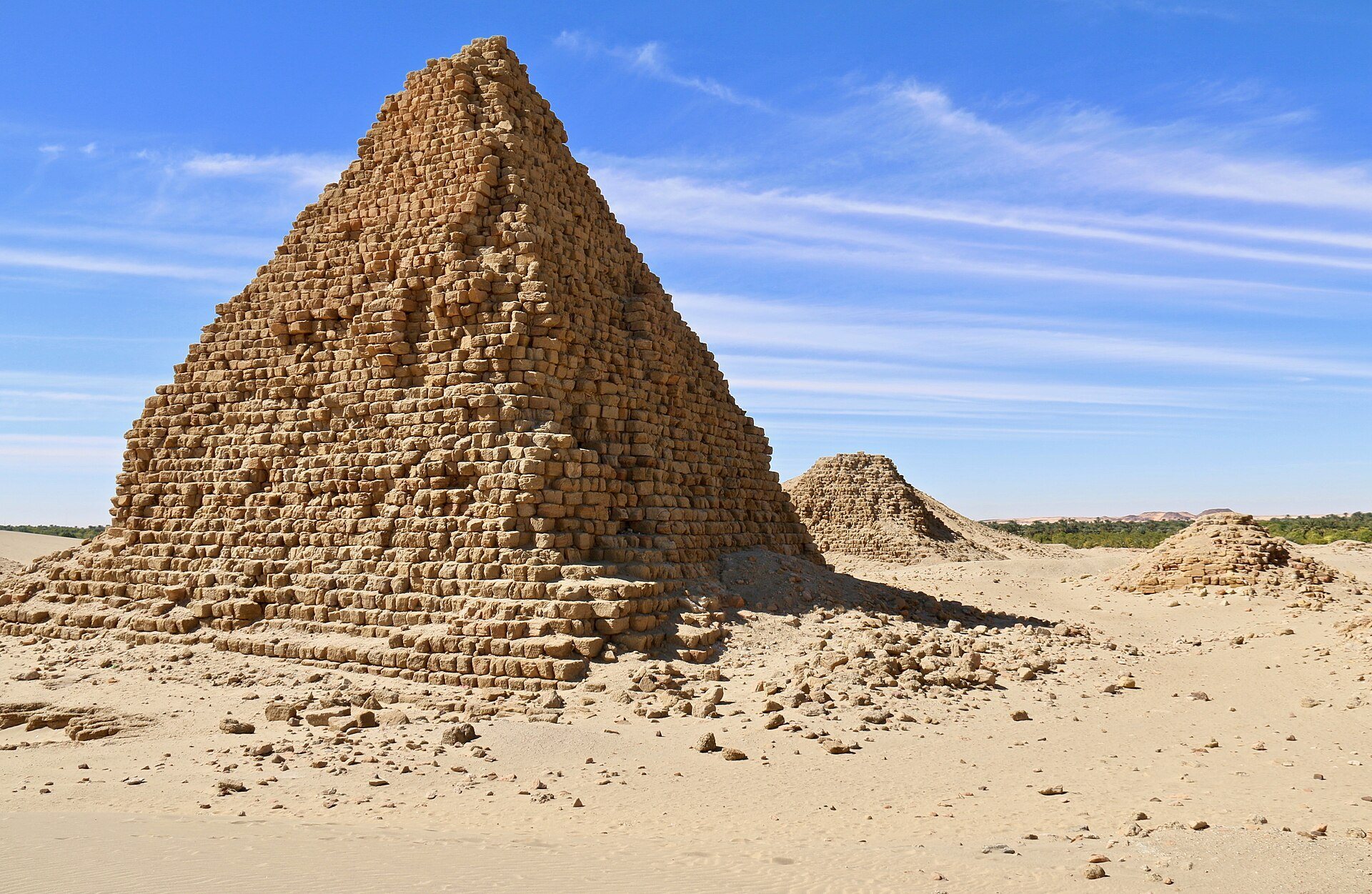
The pyramids stand on two plateaus divided into several cemetery groups. Taharqa’s monument occupies the highest point of the western plateau, while most of the other royal pyramids are on the eastern plateau. Many pyramids belonging to royal women stand near Taharqa’s monument. The surviving structures are generally smaller than Egyptian pyramids, and more than 20 remain standing, though extensive human damage and natural erosion have left many in a severely degraded condition.
Cemetery layout
Southern and western groups
One principal group extends south and west, or northwest, of Taharqa’s pyramid. It included royal mothers but was not reserved exclusively for them. A second arrangement consists of two parallel rows north of Taharqa’s monument, containing mainly the pyramids of queens and royal wives. Farther north, a group of very small pyramids or tombs probably belonged to royal women of lower rank.
Underground burial chambers
The pyramids contained rock-cut burial chambers beneath their sandstone superstructures. These chambers generally lie about 6 to 9 metres below ground. Rising groundwater has flooded many of them, while windblown sand is gradually wearing away the sandstone surfaces. Archaeological and conservation work has monitored these conditions and addressed threats linked to the changing climate.
Taharqa’s pyramid
Nuri 1
Nuri 1, the pyramid of Taharqa, has a square base measuring 51.75 metres and originally stood about 40 to 50 metres high. It was built in two stages. The smaller first pyramid remains visible above the collapsed upper portion of the enlarged monument. The pyramid’s burial complex included chambers cut into the rock below the sandstone structure.
The monument was positioned so that, when seen from Jebel Barkal at sunrise on the Egyptian New Year, the sun appeared above its apex. Taharqa’s pyramid is the earliest and largest pyramid at Nuri and the largest pyramid built for a Kushite ruler.
Royal pyramids
Kings and princes
The numbered royal pyramids preserve the burial sequence of many Napatan rulers. Nuri 2 belonged to Amaniastabarqa, Nuri 3 to Senkamanisken, Nuri 4 to Siaspiqa, and Nuri 5 to Malonaqen. Nuri 6 was built for Anlamani, son of Senkamanisken, while Nuri 7 belonged to Karkamani. Other royal monuments include Nuri 8, the pyramid of Aspelta, and Nuri 9, built for his son Aramatle-qo.
Nuri 10 belonged to Amaninatakilebte, Nuri 11 to Malewiebamani, and Nuri 12 to his son Amanineteyerike. Later pyramids include Nuri 13 for Harsiotef, Nuri 14 for Akhraten, Nuri 15 for Nastasen, Nuri 16 for Talakhamani, Nuri 17 for Baskakeren, son of Malewiebamani, Nuri 18 for Analmaye, Nuri 19 for Nasakhma, and Nuri 20 for Atlanersa, son of Taharqa.
Queens and royal women
Early groups of royal women
The women’s pyramids include Nuri 21, possibly built for Takahatenamun, wife of Taharqa, and Nuri 22, possibly for Amanimalel, wife of Senkamanisken. Nuri 23 belonged to Masalaye, possibly another wife of Senkamanisken. Nuri 24 was built for Nasalsa, daughter of Atlanersa and wife of Senkamanisken. Other tombs in this group include Nuri 25, possibly for Maletaral II, Nuri 26 for Amanitakaye, and Nuri 27 for Madiqen, wife of Anlamani.
Nuri 28 belonged to Henuttakhebit, wife of Aspelta, and Nuri 29 to Pi’ankhqew-qa, possibly wife of Siaspiqa. Further royal women were buried in Nuri 31, for Saka’aye, Nuri 32, for Akhrasan, Nuri 34, for Henutirdis, and Nuri 35, possibly for Abar, wife of Piye and mother of Taharqa.
Later royal women’s tombs
Nuri 36 belonged to Atakhebasken, wife of Taharqa, while Nuri 38 and Nuri 39 were built for Akheqa and Maletasen, both associated with Aramatle-qo. Nuri 40 possibly belonged to Meqemale, wife of Aspelta, and Nuri 41 possibly to Maletaral I, wife of Atlanersa. Nuri 42 was the tomb of Asata, wife of Aspelta.
Other identified tombs include Nuri 44 for Batahaliye, wife of Harsiotef, Nuri 45 possibly for Tagtal, wife of Malonaqen, and Nuri 53 for Yeturow, sister and wife of Atlanersa. Nuri 55 belonged to Atmataka, wife of Aramatle-qo. Nuri 56 possibly belonged to Sekhmak, wife of Nastasen, Nuri 57 possibly to Piankhher, and Nuri 58 to Artaha, possibly wife of Aspelta. Nuri 59 possibly belonged to Malaqaye, wife of Tantamani, while Nuri 61 was possibly the tomb of Atasamale, wife of Amanineteyerike.
Funerary objects
Objects from the royal tombs
Excavations recovered fragments and complete examples of Napatan red ware pottery. Nuri 16 produced a gold flower-shaped diadem, an ornamental headband associated with rank. Jewelry was found with the mummy of Amaninatakilebte from Nuri 10. Objects from Nuri 8 included metal tweezers, decorated and inscribed vessels, gold sheaths, a ewer marked for Aspelta, and Aspelta’s sarcophagus.
Chapel finds
The chapel of Nuri 3 contained an unfinished granite stela, an upright decorated or inscribed stone slab, with a statue of Osiris. It also yielded a shabti, a small funerary figure intended to perform labor for the deceased in the afterlife, made for Senkamanisken. Several excavated objects, including the diadem, Amaninatakilebte’s jewelry, and objects from Aspelta’s pyramid, are held by the Museum of Fine Arts, Boston.