Dukkan-e Daud: A Rock-Cut Tomb Site in Iran
Site at a Glance
- Rating
- 3.6
- Popularity
- Very Low
- Country
- Iran
- Primary era
- Classical
- External website
- Open
- Eras represented
- Classical
- Civilizations
- Achaemenid, Median, Parthian, Seleucid
- Site type
- Religious
- Remains
- Tomb
On this page6 sections
History
Dukkan-e Daud is a rock-cut tomb site near Sarpol-e Zahab in Kermanshah Province, Iran. Its tomb is generally placed in the Achaemenid or late Achaemenid period, while the associated relief has been dated variously from the fourth or third century BC to the opening of the Seleucid or Parthian periods. The Achaemenid Empire was the first Persian Empire, ruling much of Iran and neighbouring regions until Alexander the Great conquered it in 330 BC. The date and cultural identity of Dukkan-e Daud remain uncertain.
Date and attribution
The tomb has sometimes been proposed as the burial place of Astyages, the last king of the Median kingdom, but the identity of the person buried there has not been established. The Medes were an ancient Iranian people and kingdom associated with western Iran before the rise of the Achaemenid Empire. A proposed Median connection therefore does not by itself establish the tomb’s date. The lack of associated objects and other securely datable remains makes its original purpose and chronology difficult to determine.
The relief has received several interpretations. It was once attributed to the Medes because of its location in ancient Media and the clothing shown on the figure. Other interpretations place it among late Achaemenid or post-Achaemenid works of the fourth or third century BC, possibly continuing into the Seleucid or Parthian periods. The Seleucid period followed Alexander’s conquests, while the Parthians later founded another Iranian dynasty. Reliefs from these transitional periods could retain Achaemenid artistic features. The carving has also been described as provincial in execution, without clear Hellenistic influence.
Religious and modern history
Dukkan-e Daud is sacred to Yarsan communities. Yarsan, also called the Yari tradition, is a religious tradition rooted in western Iran and Iraq, whose followers attach religious importance to sanctified places, gatherings, and offerings. Followers sometimes assemble at the site for ceremonies and, on some occasions, distribute votive offerings among those present. Some members of the Aleppine Jewish community also regard the place as important and believe that several named religious or historical figures are buried there.
A Yarsan cemetery lies below the tomb. It is associated with burials carried out by different methods over more than two thousand years. Henri Rawlinson visited Dukkan-e Daud in 1836. The tomb and the nearby relief were later registered separately as Iranian National Heritage, with registration numbers 152 and 151 respectively.
Remains
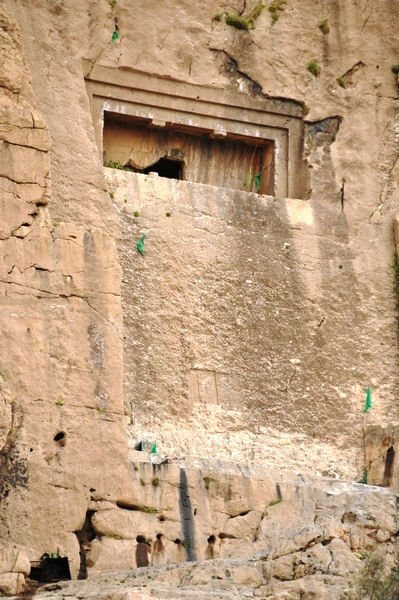
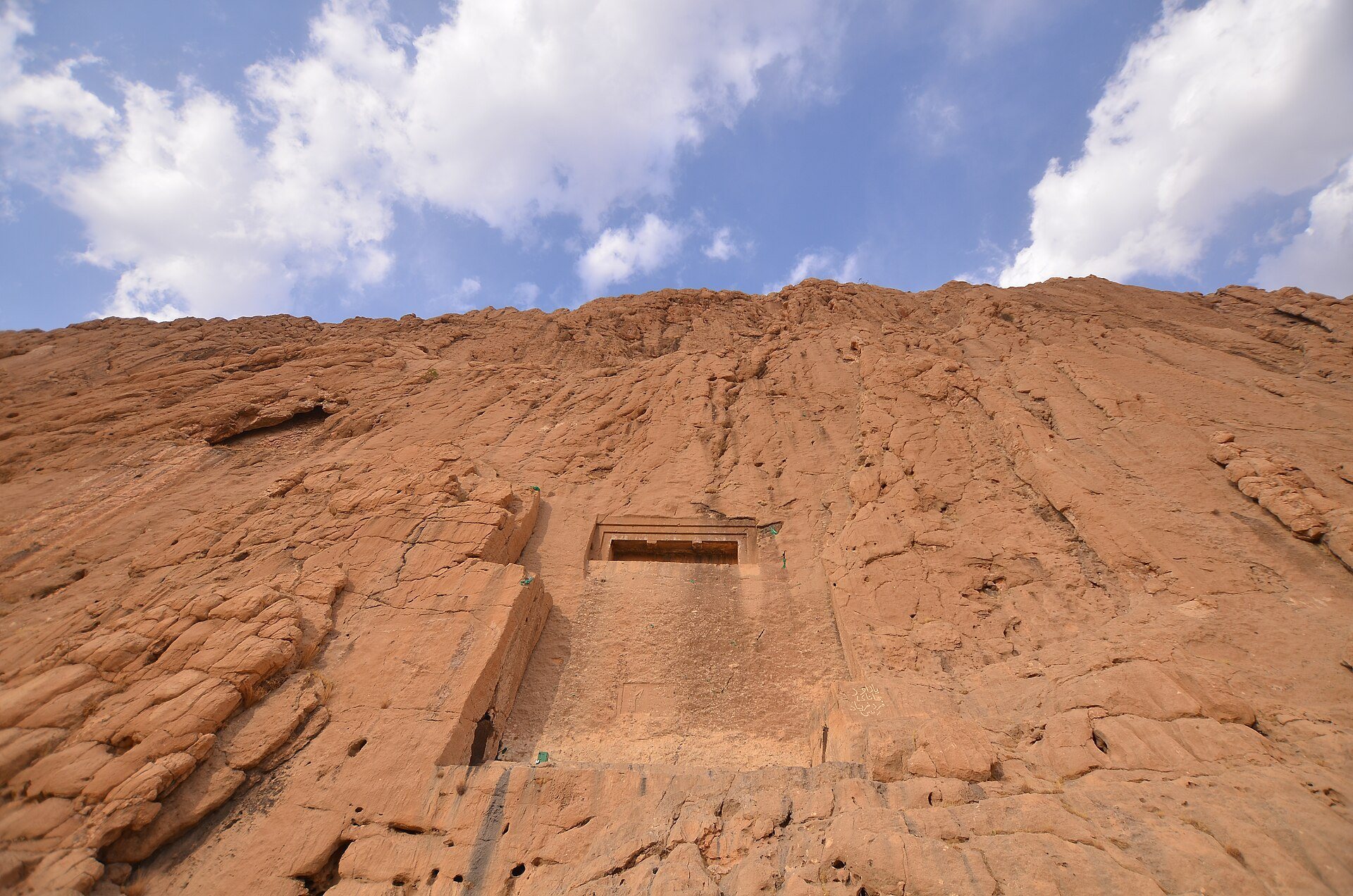
The site occupies a substantial rock face, with the tomb cut several metres above ground and the relief positioned below it. The rock beneath the tomb was smoothed to ground level with hand tools, while access to the chamber remains difficult. The tomb overlooks the relief known locally as Kil-e Daud, or David’s Tomb. A cemetery associated with Yarsan burials extends below the rock-cut monument.
Rock-cut tomb
The tomb has a broad, deep porch or anteroom enclosed by a double decorated frame. Its front measures approximately 9.6 metres across, its rear 7.32 metres, its depth 1.95 metres, and its height 2.60 metres. Two columns once stood beside the entrance. Their shafts have disappeared, but the bases and capitals survive. The square or table-like bases contain circular traces marking the former positions of the shafts. Their form has been compared with columns at the palaces of Pasargadae.
A rectangular doorway about 1 metre wide and 1.5 metres high opens from the rear wall of the porch into the burial chamber. The chamber measures approximately 2.83 metres in length, 2.31 metres in width, and 2.18 metres in height. Its ceiling is curved or arched, contrasting with the flat ceiling of the porch. Five niches are cut into the chamber walls. They may have held votive offerings or lamps, although their function is uncertain. An oval grave, approximately 70 centimetres deep, is cut into the left half of the floor. The tomb’s plan has been compared with rock-cut tombs at Sahna, Qizkapan, and Fakrika.
Relief of the standing figure
Approximately 8 metres below the tomb, a rectangular frame was carved over an earlier frame. It contains a full-length figure shown standing in profile. The figure wears a long garment and a cap that covers the back of the neck and the ears. In one hand the figure holds a barsom, described either as a ritual staff or as a bundle of sacred twigs used in Zoroastrian ritual. The other hand is raised in a gesture interpreted as prayer or as a Zoroastrian rite. The figure has also been identified as a priest.
The relief’s date and cultural attribution remain disputed. Its clothing has encouraged a Median interpretation, while its chronology has also been placed in the late Achaemenid, fourth- or third-century BC, Seleucid, or Parthian periods. The technically crude carving and the absence of clear Hellenistic influence have contributed to its description as a provincial work. These interpretations remain separate from the tomb’s own uncertain date and purpose.