Aspero: A Coastal Center of the Caral-Supe Civilization in Peru
Site at a Glance
- Rating
- 4.6
- Popularity
- Very Low
- Country
- Peru
- Primary era
- Bronze Age
- External website
- Open
- Eras represented
- Bronze Age
- Civilizations
- Caral–Supe
- Site type
- City
On this page11 sections
History
Aspero is a Late Archaic archaeological complex on the right bank of the Supe River near Supe Puerto, Peru, built by communities associated with the Caral-Supe civilization between approximately 3000 and 1800 BC. The Caral-Supe civilization, also called Norte Chico, was an early Andean civilization that developed during the period before pottery became established in the region. Aspero formed an important coastal center within this society and was connected with Caral, about 25 kilometers inland in the Supe Valley.
From coastal settlement to urban center
People began settling the Supe coast by about 5000 BC in small communities that depended on fishing, shellfish collecting, plant gathering, and hunting. During the Late Archaic period, Aspero grew into an urban center that contributed to the emergence of the earliest Andean civilization centered at Caral. Its inhabitants continued to draw heavily on marine and river resources, while also farming and using wetland plants, especially reeds, to produce a range of goods.
Aspero was probably Caral’s principal fishing center or a complementary coastal settlement. Marine products were exchanged with communities in neighboring valleys for cotton and plant foods. The settlement’s political organization has been interpreted as resembling chiefdoms or regional lordships, although its economy depended on connections between maritime and inland communities as well as on local agriculture.
Decline and abandonment
Aspero began to decline around 2000 BC. The quality of its buildings deteriorated, some structures were progressively abandoned, and natural disasters appear to have intensified the crisis. Outside groups eventually destroyed the principal buildings and occupied some abandoned structures while continuing to exploit marine resources. Later occupants began using pottery, marking a change from the earlier Preceramic context.
The site was abandoned in the 1980s, when much of it was converted into a municipal dump serving Supe Puerto and Supe. Aspero is recognized as Cultural Heritage of Peru.
Rediscovery and archaeological research
Max Uhle made the first description of Aspero around 1905 and identified it as an Archaic fishing settlement. Preliminary excavations by Gordon R. Willey and John Corbett in 1941 produced a later chronology. The investigators associated the site with a nearby cemetery and interpreted its mounds as natural formations.
Robert A. Feldman reexamined Aspero during fieldwork in 1974 and 1975. He recognized the site’s greater antiquity and identified its lack of pottery as evidence of a Preceramic setting. His excavations included the Huaca de los Ídolos and Huaca de los Sacrificios, where he found unfired human figurines and human burials.
Interest in Aspero increased after discoveries at Caral in 1997. In 2005, the Caral-Supe Special Archaeological Project, led by Ruth Shady and Daniel Cáceda, began cooperation with the Municipality of Supe. Machinery supplied through the agreement removed about 8,400 tons of modern refuse accumulated over nearly 30 years, making research, conservation, and presentation of the site possible. After four years of work, initial results were presented in 2009. They supported the interpretation of Aspero as a coastal settlement linked to Caral and led to the development of an archaeological circuit complementary to Caral. Research has continued.
Burials from Aspero have also shaped interpretations of its society. In the Huaca de los Sacrificios, Feldman found an adult and an infant beneath a four-legged stone. The infant lay slightly flexed on its right shoulder, with its head toward the north. It was wrapped in cotton cloth, placed in a basket, and enclosed in white cotton fabric. A necklace of about 500 shell, bone, and stone beads suggests that the infant may have belonged to the ruling class.
Between 2005 and 2009, three further burials were found in the same monument: those of two children aged about eight and ten and a newborn. The children’s skulls showed clear evidence of fatal blows, and they may have been sacrificed. In 2016, a flexed burial in the Huaca de los Ídolos was identified as that of a woman about 40 years old, known as the Lady of the Four Tupus. Dated to about 2500 BC, the burial contained valuable objects associated with high social status. In April 2025, another elite female burial was announced in the Huaca de los Ídolos. The woman was about 35 years old and approximately 4,800 years old, and was buried with shell offerings and textiles. Together, these finds emphasize the high-ranking positions women could hold in Aspero society and the settlement’s close relationship with Caral.
Remains
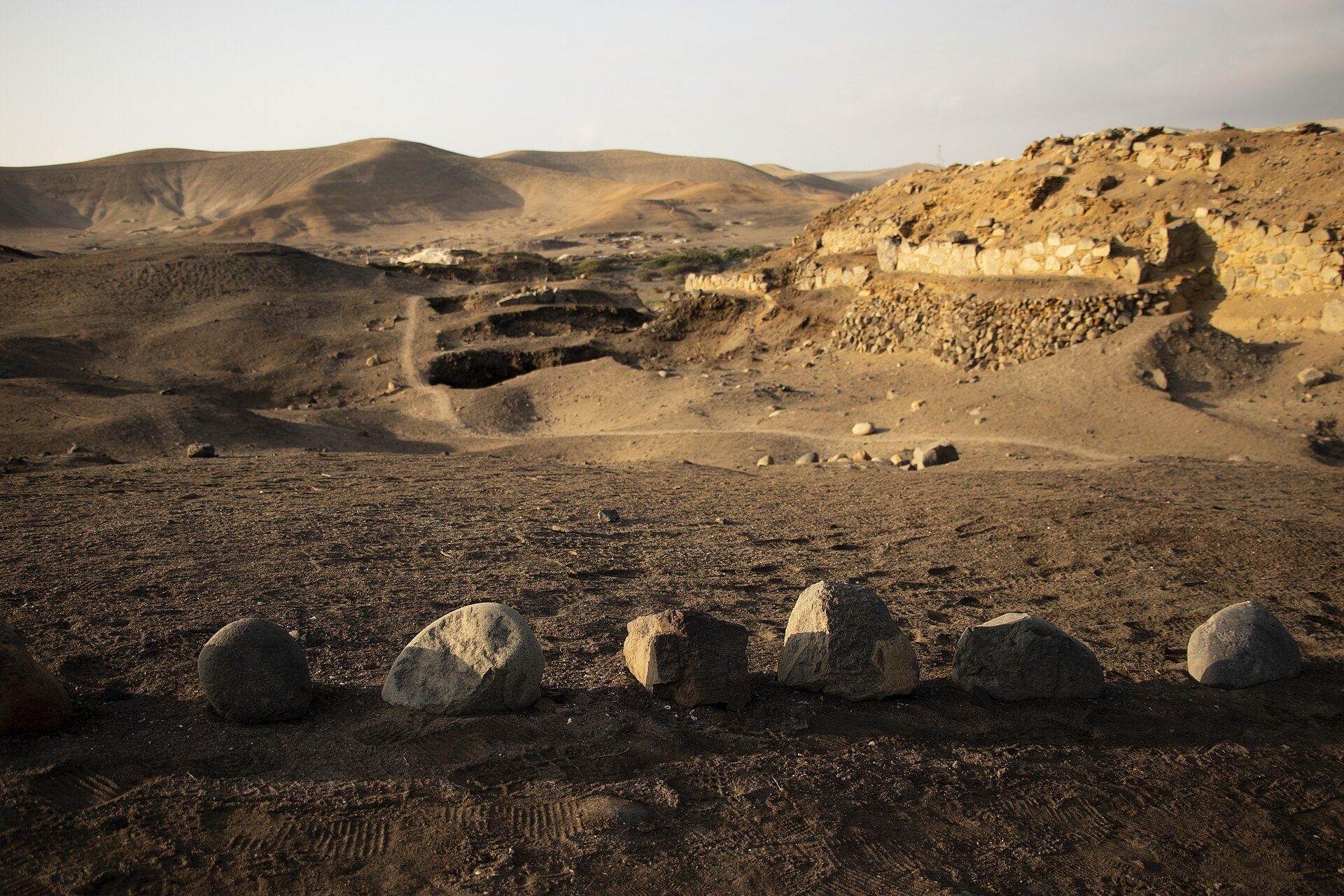
Aspero covers approximately 19 hectares among sandy hills, wetlands, and cultivated fields, about 500 meters from the Pacific Ocean. The complex contains about 30 buildings, including monumental pyramids, elite residential units, storage facilities, habitation groups, ceremonial buildings, plazas, terraces, and large refuse middens. The site is divided into Aspero Alto, on the western hills, and Aspero Bajo, at the foot of the hills and in the northern depression.
Aspero Alto and the principal monuments
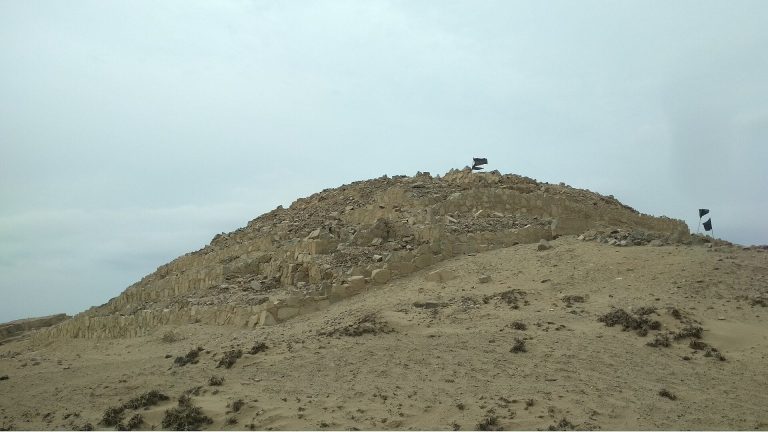
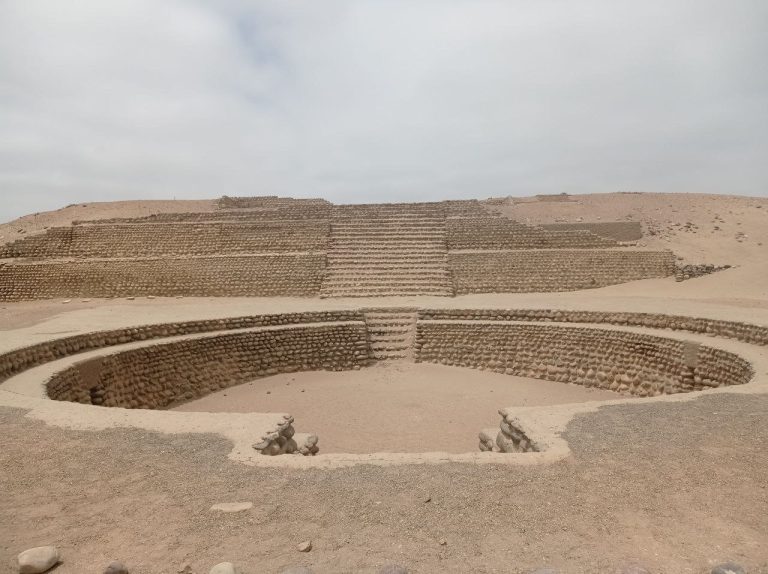
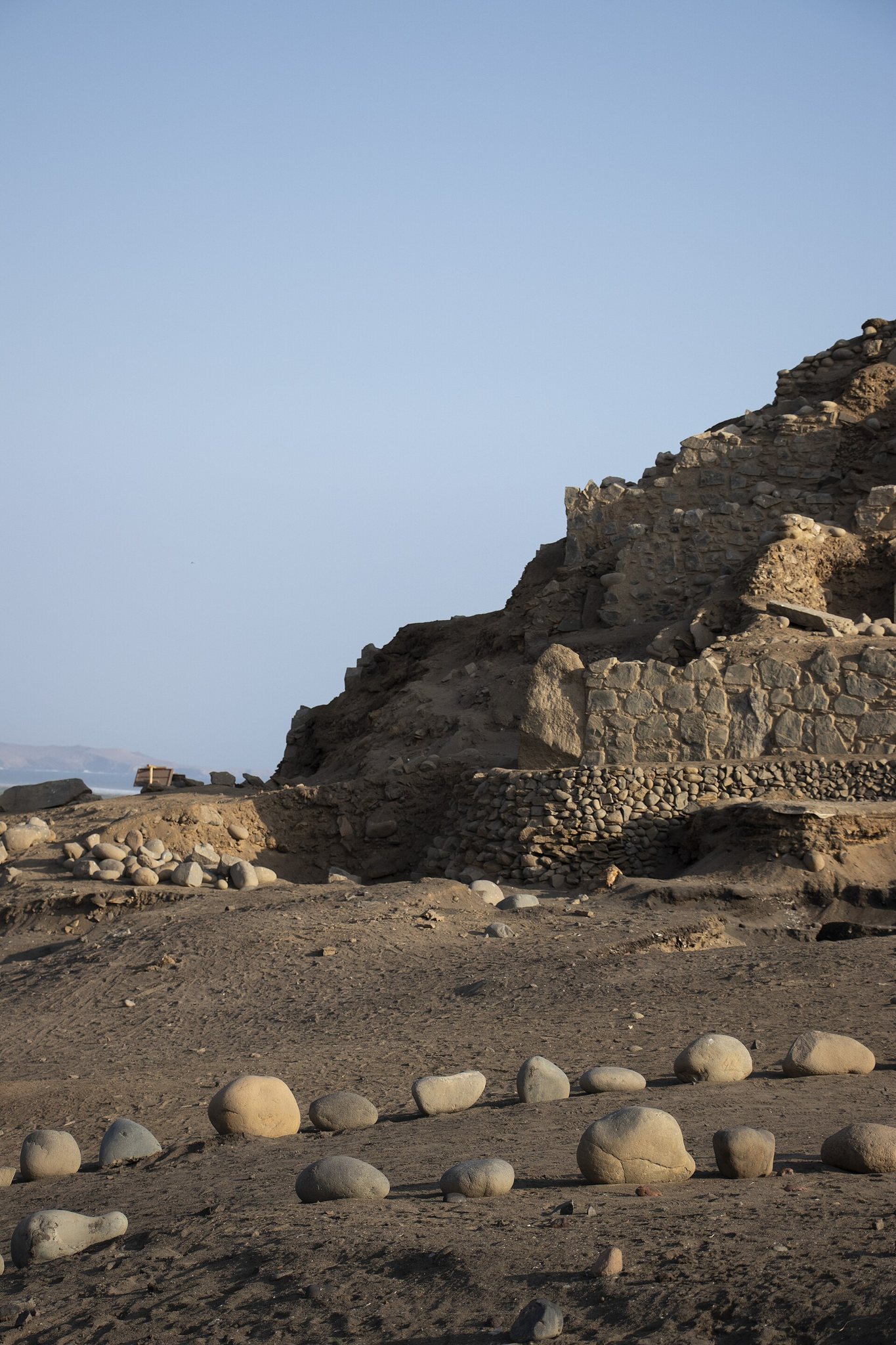
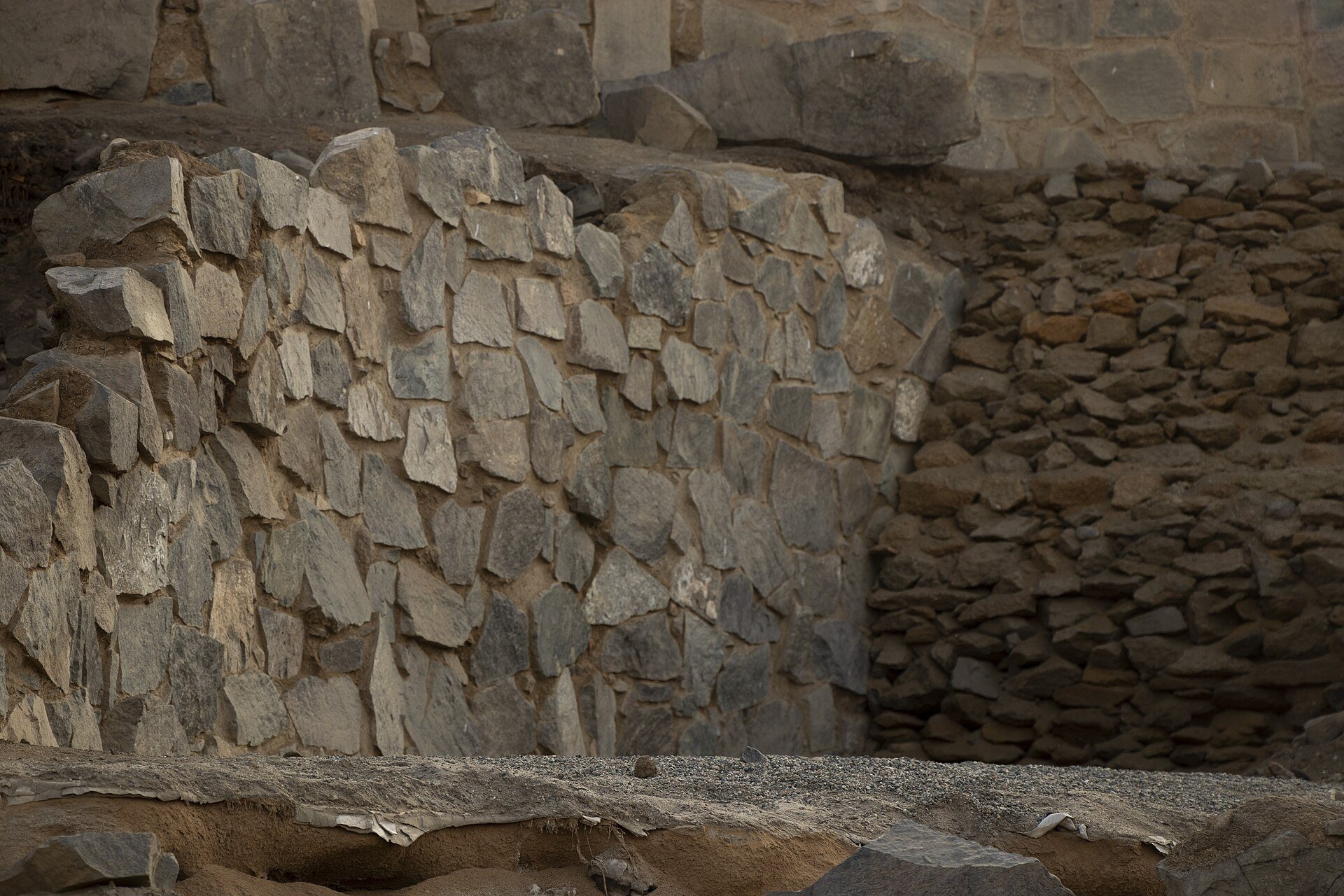
The main pyramids are formed from superimposed platforms, usually two or three tiers rising about 10 meters above the surrounding surface. Their builders used rough, unworked stones bonded with mud. A central staircase led from each façade to the summit, where small rooms contained adobe friezes and niches. The monuments faced an open central plaza and were constructed in successive stages.
Huaca Alta
Huaca Alta is the largest monument and stands on the highest part of Aspero. Its position and scale indicate that it may have been the site’s principal building. Looting since the beginning of the twentieth century destroyed its central section, leaving the pyramid hollowed out. The damage appears to have involved dynamite and iron crowbars.
Huaca de los Ídolos
The Huaca de los Ídolos, in Sector B, contains ritual spaces on its upper platform. Beneath a floor, Feldman found about twelve human figurines modeled in white unfired clay. Small baskets and chira leaves surrounded the figures, whose arrangement formed a votive offering.
The monument also contained the burial known as the Lady of the Four Tupus. Her grave included four bone pins, or tupus, decorated with birds and monkeys, a necklace of shell beads, a pendant made from spondylus, a brightly colored marine shell valued in the ancient Andes, and a gourd container holding fragments and vegetable seeds.
Huaca de los Sacrificios
The Huaca de los Sacrificios, in Sector L, has a more complex design than the other principal pyramids and includes ritual spaces on its upper platform. Its name derives from the burials found there, including those of children and a newborn. The infant burial was associated with a four-legged stone, a cotton shroud, a basket, white cotton fabric, and a necklace of about 500 beads made from shell, bone, and stone.
Residential, storage, and ceremonial areas
Aspero Alto also includes public circular plazas, elite residential groups in Sector F, and storage areas in Sector I. Aspero Bajo contains smaller building groups in Sectors O and P, pyramids in Sectors Q and T, a large residential group in Sector R, and an extensive central plaza. The former central plaza is now cultivated land and a reed-filled wetland. Excavations have identified additional ceremonial buildings, terraces, refuse middens, and domestic contexts across the complex.
Objects and maritime evidence
Excavated caches and midden deposits have yielded unfired clay figurines, wooden bowls, feathers, cotton, string and cane objects, fishhooks, and nets. These remains, together with the coastal setting and marine deposits, show the importance of fishing and other maritime activities. Eight transverse flutes made from animal bone resemble instruments from Caral and provide material evidence of the relationship between the two centers.