Keezhadi Excavation Site: A Sangam-Period Settlement in Tamil Nadu
Site at a Glance
- Rating
- 4.7
- Popularity
- Medium
- Country
- India
- Primary era
- Iron Age
- Eras represented
- Iron Age, Classical
- Civilizations
- Unclassified
- Site type
- City
On this page15 sections
History
The Keezhadi excavation site is a Sangam-period settlement near Keezhadi in Tamil Nadu, India, associated with the ancient Tamil culture of the Vaigai valley. The settlement lies about 12 kilometres southeast of Madurai, near the Vaigai River, and is generally dated from the sixth century BCE to the first century CE. The Sangam period refers to the early historic era of Tamil literary and cultural history, conventionally placed in the early centuries BCE and CE.
Discovery and excavation
The site came to attention during an Archaeological Survey of India survey along the Vaigai River in 2013 and 2014. The survey extended from Theni district to Ramanathapuram district and identified archaeological remains at 293 locations, including settlements, storage areas, trading centres, ports, temples, and other sites. Keezhadi was selected for excavation after archaeological material appeared while nearby land was being ploughed.
The excavation area lies close to an ancient route linking Madurai with the port of Alagankulam. It forms part of a wider archaeological cluster that includes Agaram, Manalur, Konthagai, and Pasiapuram. Konthagai is associated with the settlement as a burial site. The scale of the remains has led to interpretations of Keezhadi as a substantial urban or proto-urban settlement rather than a small habitation. A proposed identification with Perumanalur, a city connected in literary tradition with the Pandyan dynasty, remains unconfirmed.
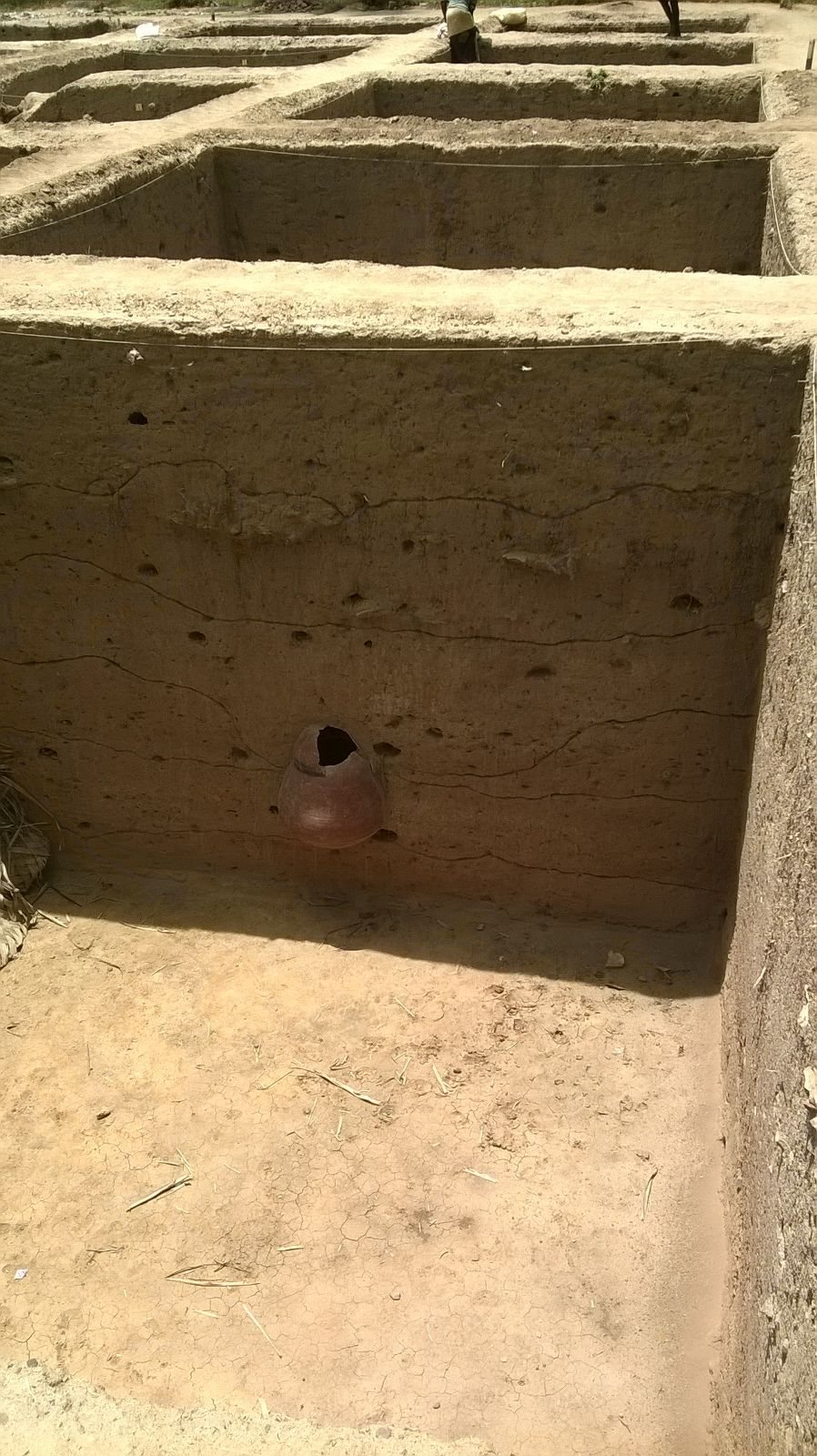
Excavation began in June 2015 under Superintending Archaeologist K. Amarnath Ramakrishna. The Archaeological Survey of India directed the first three phases, while the Tamil Nadu Department of Archaeology conducted the fourth and later phases. The second phase began on 2 January 2016 and yielded more than 6,000 artefacts. The third phase, carried out from January to 30 September 2017, covered 16 excavation areas measuring about 400 square metres in total.
The fourth phase, undertaken between 2017 and 2018, produced 5,820 artefacts and included samples submitted for accelerator mass spectrometry, or AMS, dating. AMS measures small quantities of carbon isotopes and is useful for dating archaeological material. Later work included a fifth phase beginning in June 2019, a seventh phase in 2021, an eighth phase beginning in February 2022, a ninth phase beginning in April 2023, and a tenth phase beginning in June 2024. The ninth phase produced about 183 antiquities, while the tenth identified six terracotta pipelines.
Dating and historical interpretation
Excavated remains have been dated mainly between the sixth and third centuries BCE, with evidence for occupation continuing into the first century CE. Radiocarbon and AMS analyses produced dates of approximately 2,200 to 2,600 years ago. One sample from the fourth phase, recovered at a depth of about 353 centimetres, was dated to around 580 BCE.
The early date remains important but disputed. It is uncertain whether Tamil-Brahmi-inscribed potsherds came from the same archaeological layer as the samples dated to the sixth century BCE. Some parts of the site contain disturbed refuse deposits in which material from different periods was mixed, so the earliest date of the inscriptions has not been securely established. Tamil-Brahmi was an early form of the Brahmi writing system adapted for the Tamil language.
Keezhadi has therefore become part of wider debates about the antiquity of Tamil culture, the development of Tamil-Brahmi writing, and possible connections between the Vaigai valley and the Indus Valley tradition. Some graffiti marks have been compared with signs from the undeciphered Indus script, but resemblance alone does not establish a direct historical relationship. Claims that the site proves a sixth-century BCE date for Tamil-Brahmi remain contested.
The transfer of K. Amarnath Ramakrishna after the second phase also became controversial. Critics alleged that it might delay the project, while the Archaeological Survey of India said the move followed the tenure rules for Superintending Archaeologists and occurred alongside transfers involving 26 officers. A later dispute concerned Ramakrishna’s excavation report, whose chronology and interpretation the Archaeological Survey requested be revised. Ramakrishna defended its conclusions using stratigraphy, material culture, and AMS dating. Subsequent internal criticism and his later transfer continued the disagreement over the report’s completeness and interpretation.
The Keezhadi Heritage Museum opened at nearby Konthagai on 5 March 2023. It presents material from Keezhadi, Konthagai, Agaram, and Manalur, including replicas of burial features and vessels associated with Konthagai.
Remains
The excavated area covers approximately 32.37 hectares, or 80 acres, within a zone with a circumference of about 3.5 kilometres. The principal excavation area is at Pallichanthai Thidal, on a raised mound near the western bank of the Manalur tank and about one kilometre east of Keezhadi village. The mound rose about 2.5 metres above the surrounding ground and had previously been used as a coconut grove. Soil removal for brickmaking exposed a brick wall and led to archaeological excavation.
Settlement architecture and water systems
Brick buildings
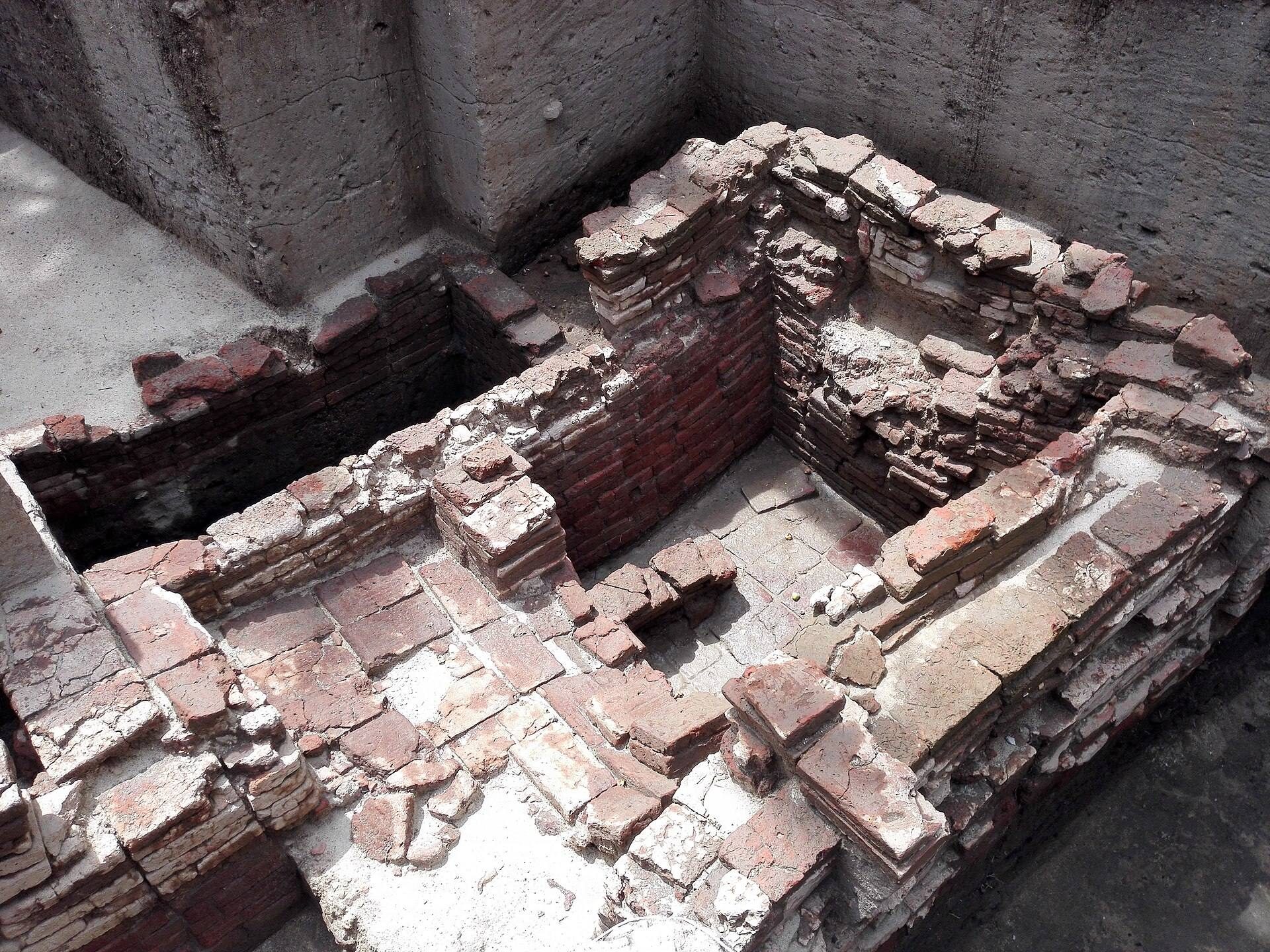
About 48 excavation pits have revealed more than ten buildings, along with numerous brick walls and other brick-built structures. Houses used fine clay, bricks, lime mortar, and iron nails, while recovered roof tiles indicate tiled roofing. The concentration of brick architecture provides evidence for a developed settlement with substantial urban characteristics.
Drainage installations
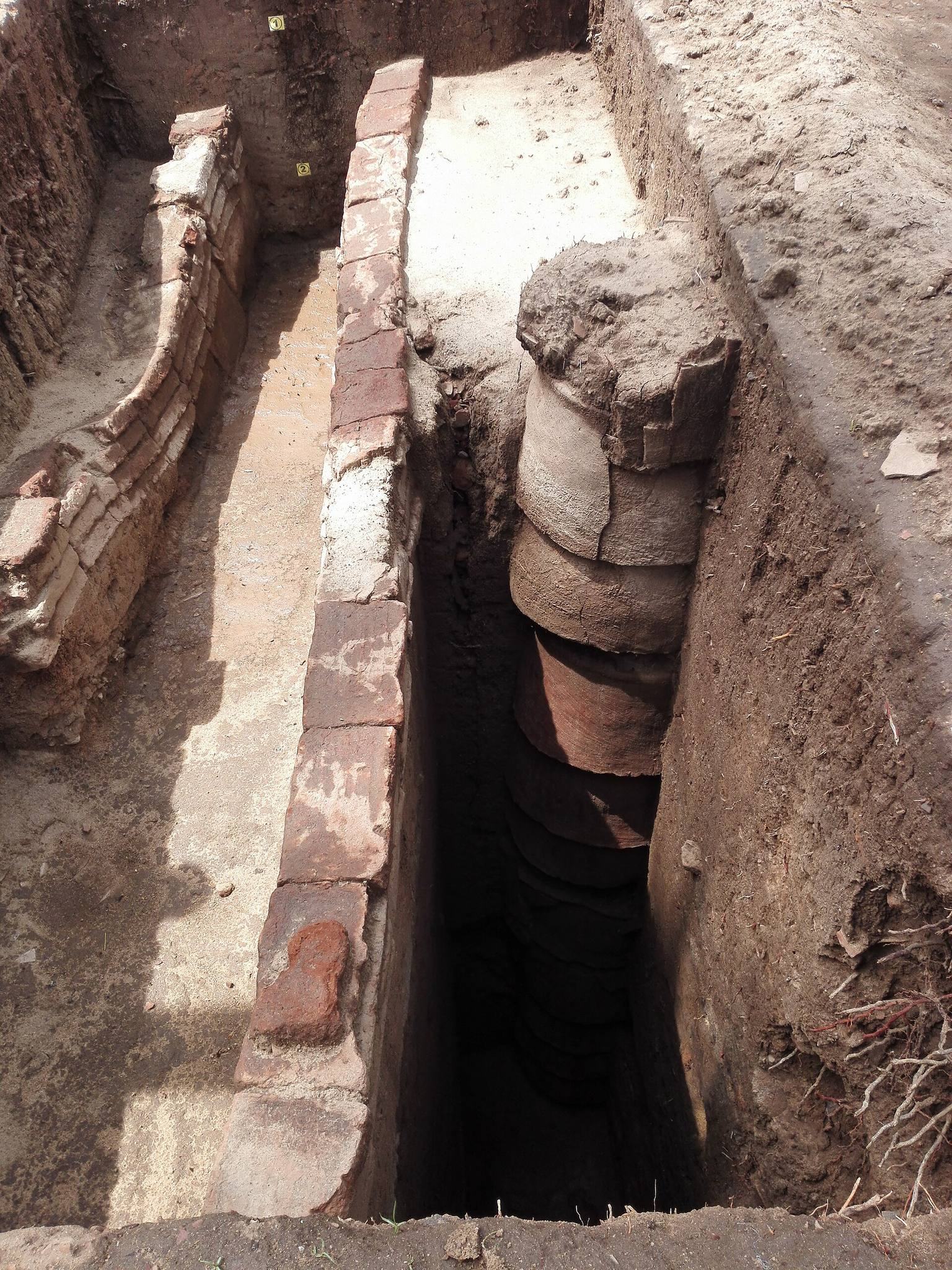
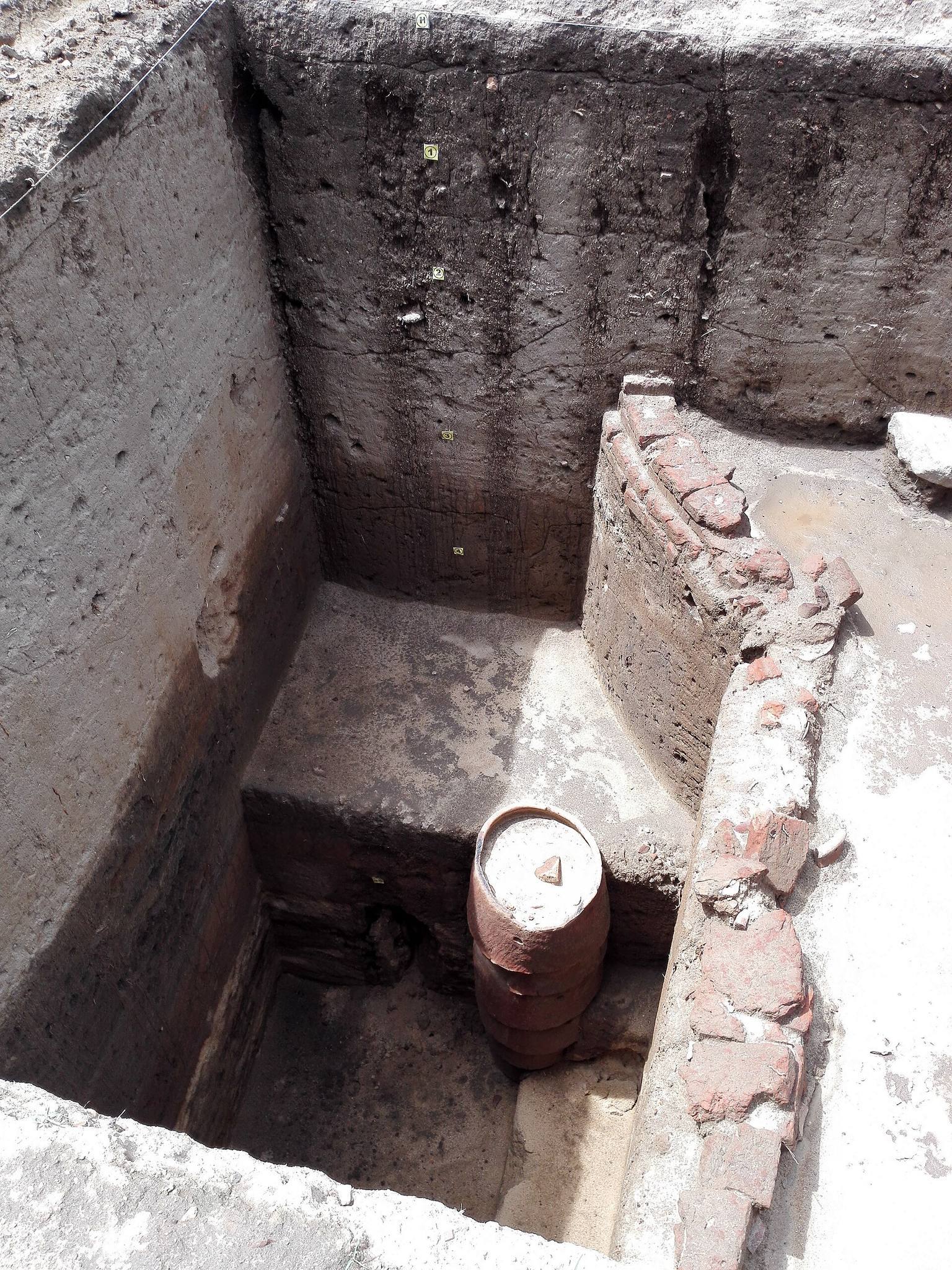
Terracotta pipes formed drainage installations connected with the buildings. One system used two carefully shaped red terracotta pipes joined together. Each pipe measured about 60 centimetres long and 20 centimetres wide and had five projecting rings resembling rims. Beneath them were three interlocking, barrel-shaped terracotta pipes. A filter inside this installation led toward a double vessel. The arrangement may have conveyed water and collected liquid, although the precise functions of the two pipe systems remain uncertain.
Ring wells
Ancient terracotta ring wells were also found. These wells were made from stacked terracotta rings, a construction method that reinforced the sides of a shaft and allowed access to water. Their presence fits the settlement’s position near the Vaigai River and the Manalur tank.
Pottery, writing, and trade
Ceramic vessels
The pottery assemblage includes Black-and-Red Ware, black ware, black polished ware, red ware, white-painted Black-and-Red Ware, and vessels with reddish-brown or russet slip. Analysis of Black-and-Red Ware attributed its black colour to carbon and its red colour to hematite. The pottery was fired at temperatures reaching approximately 1,100 degrees Celsius.
Rouletted Ware, a wheel-made pottery decorated with impressed patterns, and Arretine-type ceramics were also recovered. Arretine Ware is fine tableware associated with Mediterranean production and Roman trade. These finds indicate commercial connections with the Roman world during Indo-Roman trade, while similar ceramics have been found at Alagankulam. Russet-slipped pottery suggests a possible trading connection with the Kongu region.
Tamil-Brahmi inscriptions
At least 72 potsherds recovered during the fourth phase bear Tamil-Brahmi writing. The inscriptions include personal names conventionally romanized as Aathan, Uthiran, and Thiesan. Their relationship to the earliest dated deposits remains a central issue in interpreting the settlement’s chronology.
Objects and burial evidence
Tools, ornaments, and gaming pieces
Objects from the settlement include beads of carnelian, marble, agate, and coloured glass, together with gold ornaments, copper objects, iron arrowheads, knives, spearheads, and needles. Bone tools and writing implements, ivory dice and gaming pieces, copper cosmetic rods, terracotta stamps, toys and figurines, spindle whorls, grinding stones, and pottery moulds further illustrate the range of activities represented at the site.
The fifth phase produced more than 520 gaming objects, 13 terracotta human figurines, 35 earrings, three animal figurines, and metal objects made from gold, iron, and copper. Other finds included an ivory comb, a terracotta bull’s head, a human-head figurine, bone writing implements, coral beads, and a Tamil-Brahmi-inscribed potsherd. Finds from later phases included bone-point tools, terracotta spheres, copper needles, an ivory gaming piece, an iron knife, an antimony rod, and copper pendants.
Burial-related finds
The ninth phase produced 26 burial urns, along with crystal-quartz weighing units, a terracotta snake figurine, copper coins, and hopscotch pieces. Carnelian beads were found in one of the burial urns. These discoveries connect the excavated settlement with the wider archaeological cluster around Konthagai, where burial features associated with Keezhadi are represented.
Keezhadi Heritage Museum
The Keezhadi Heritage Museum at Konthagai occupies about 31,000 square feet and contains six exhibition halls in several buildings designed in a Chettinad architectural style. Its displays include ivory and terracotta dice, male and female terracotta figurines, an iron dagger, punch-marked coins, and burial features from Konthagai, alongside artefacts and replicas from the wider Keezhadi cluster.