Montezuma Castle National Monument: A Southern Sinagua Heritage Site
Site at a Glance
- Rating
- 4.7
- Popularity
- High
- Country
- United States
- Primary era
- Medieval
- External website
- Open
- Eras represented
- Medieval
- Civilizations
- Unclassified
- Site type
- Domestic
- Remains
- House
On this page12 sections
History
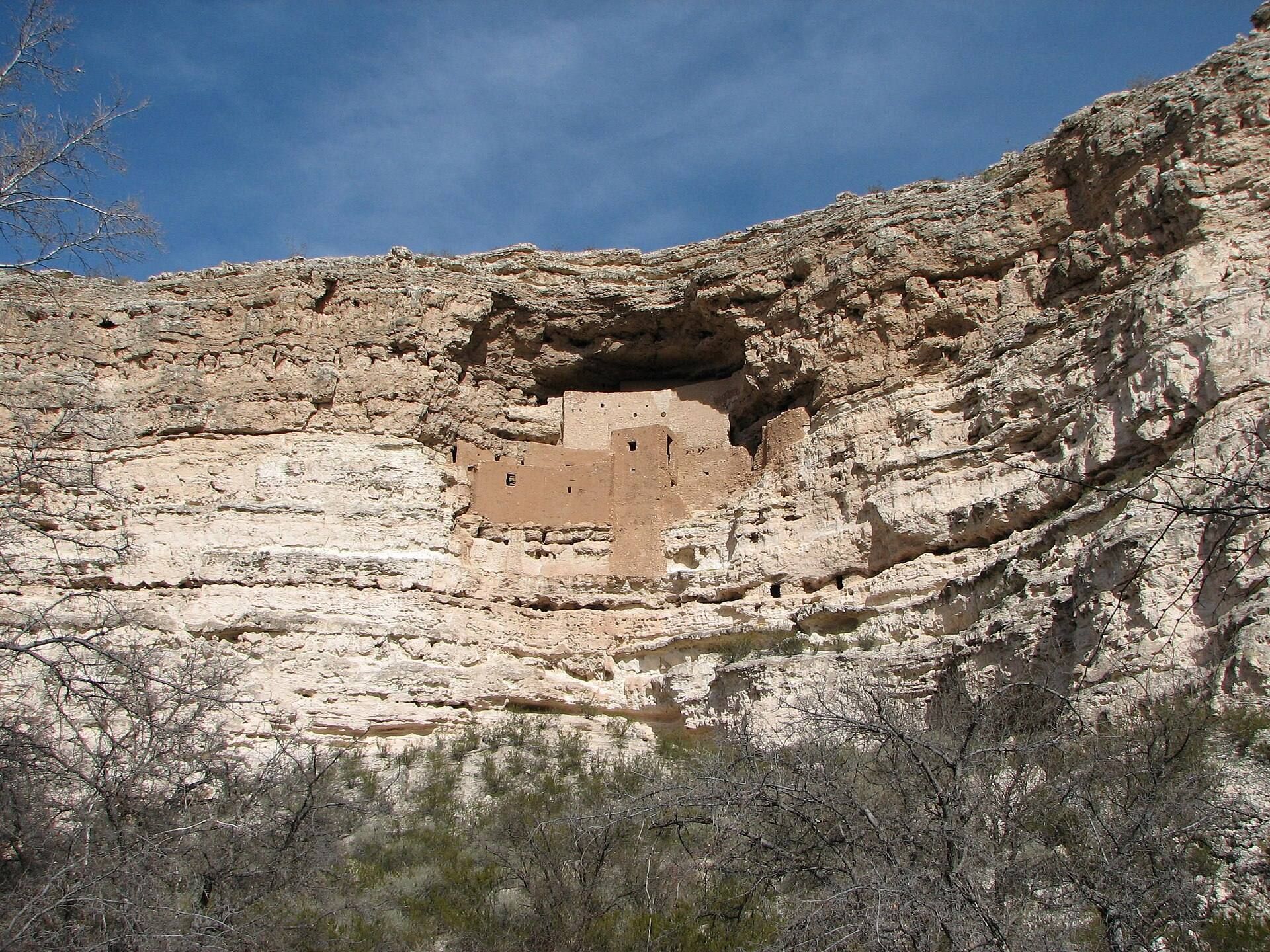
Montezuma Castle National Monument is a protected archaeological and natural site in Camp Verde, Arizona, United States, centered on a Southern Sinagua cliff dwelling built between approximately 1125 and 1173. The monument preserves evidence of ancestral communities that settled the Verde Valley, developed masonry architecture, used irrigation, and maintained enduring cultural connections with the region.
Southern Sinagua settlement
Southern Sinagua cultural traits appear in the archaeological record by about 700, while permanent masonry dwellings began to emerge in the Verde Valley around 1050. Before approximately 1125, communities in the surrounding highlands relied on rainfall for agriculture. They later moved into the Verde Valley, where the Verde River watershed and irrigation systems supported more permanent settlement. Some of these systems may have originated with earlier Hohokam inhabitants.
Construction of Montezuma Castle took place between approximately 1125 and 1173, followed by remodeling and additions during the final decades of the thirteenth century. The dwelling housed no more than about 30 people. Nearby Castle A was probably larger, with approximately 45 rooms and space for many more inhabitants. The regional population probably reached its height around 1300.
The labels Southern Sinagua, Hohokam, and Hakataya are archaeological terms based on material remains and settlement patterns. They do not correspond directly to modern tribes, and contemporary Native American communities may understand ancestry and social identity differently. Many Native American communities trace their ancestry to groups associated with the dwellings and the surrounding area. Hopi clans periodically return to the region for religious ceremonies, while Yavapai communities regard Montezuma Well as a sacred place connected with their emergence into the world.
Depopulation and later naming
Castle A was destroyed by fire between approximately 1375 and 1395. After this event, both dwellings were depopulated, and their inhabitants moved to other villages rather than mysteriously disappearing. The reasons for the wider population movement remain uncertain. Drought, declining resources, conflict, and broader demographic and social changes are possible explanations.
European Americans gave the ruins their present name in the 1860s, believing incorrectly that Moctezuma II or the Aztec people had built them. Moctezuma II ruled the Aztec Empire when the Spanish conquest began in the early sixteenth century, but the dwelling had been depopulated more than forty years before his birth. The word “castle” is also misleading, since the structure was probably a residential cliff complex rather than a fortified European-style residence.
Archaeology and federal protection
Looting caused extensive damage during the late nineteenth and early twentieth centuries. In 1890, Army doctor Edgar A. Mearns described the ruins before much of the later disturbance. Excavations at Castle A in 1933 recovered many artifacts and greatly expanded knowledge of the community.
On December 8, 1906, President Theodore Roosevelt proclaimed Montezuma Castle and its surrounding area a U.S. national monument under the American Antiquities Act. It was one of the four original national monuments designated under the law, whose purpose was to protect important cultural and natural features. Archaeologist Edgar Lee Hewett and Senator John F. Lacey advocated for its protection. The National Park Service assumed management in 1916, and the monument entered the National Register of Historic Places in 1966.
The monument protects approximately 860 acres and is administered by the National Park Service. Interior access to the cliff dwelling ended in 1951 because visitors were damaging the structure and entering it had become hazardous. Montezuma Well became a detached unit of the monument after the federal government acquired it in 1947. Its archaeological and natural features broaden the monument’s history beyond the cliff dwelling itself.
Remains
The preserved area includes a multi-story dwelling set within a limestone alcove above Beaver Creek, the fragmentary remains of a neighboring settlement, and Montezuma Well with its associated irrigation channel. Masonry, timber roofing, cliff formation, water systems, and archaeological objects together show how Southern Sinagua communities adapted their buildings and agriculture to the Verde Valley landscape.
Cliff dwellings
Montezuma Castle
Montezuma Castle occupies a natural limestone alcove approximately 90 feet, or 27 meters, above Beaver Creek near the creek’s drainage into the Verde River. The alcove shelters the structure from exposure and has helped preserve it. The dwelling rises through five stories and contains at least 20 rooms. Its elevated position required residents to use portable ladders, while the sheer cliff formed a natural barrier below the settlement.
The walls consist chiefly of limestone fragments gathered at the base of the cliff and laid in stone-and-mortar masonry. Builders prepared several kinds of mud mortar for different properties, including strength, durability, and color. Room ceilings used sectioned timbers beneath roof thatching. Arizona sycamore provided the principal roofing wood, supplemented by ash, alder, ponderosa pine, Douglas fir, and pinyon pine. The surviving structure remains in the alcove as a largely preserved example of Southern Sinagua residential construction.
Castle A
Castle A occupied a neighboring part of the same cliff wall and was probably larger than Montezuma Castle, with an estimated 45 rooms. Its remaining architecture consists mainly of stone foundations, reflecting its poorer preservation. Excavation there recovered stone tools, manos and metates used to grind grain, bone needles, shell ornaments, and gemstone ornaments.
These objects provide evidence of domestic work, food processing, local craftsmanship, and exchange connections extending beyond the immediate settlement. The excavation also contributed to the interpretation of Castle A as a substantial residential community rather than an isolated structure.
Water and irrigation
Montezuma Well
Montezuma Well is a natural limestone sinkhole measuring approximately 100 by 120 yards and reaching about 17 meters in depth. Underground springs deliver roughly five million liters of water each day. The well contains Sinagua dwellings, linking the natural feature to the archaeological settlement of the surrounding area.
The water is carbonated and contains high levels of arsenic, yet the spring supports several endemic species. These include a diatom, a springtail, a water scorpion, the amphipod Hyalella montezuma, the leech Erpobdella montezuma, and the freshwater snail Pyrgulopsis montezumensis. The author Richard J. Hinton described the spring publicly in 1878, and it became the subject of the first underwater archaeological investigation conducted in a protected area of the United States in 1968.
Prehistoric irrigation channel
Overflow from Montezuma Well feeds a prehistoric irrigation channel. Use of the overflow for irrigation extends back at least to the eighth century. Part of the Sinagua canal system survives physically and continues to be used, preserving a direct connection between the spring, agricultural production, and the settlement history of the Verde Valley.
The spring has also been affected by the invasive aquatic plant Illinois pondweed. Its removal is required to keep the water flowing through the system. The surviving channel and the continuing movement of water illustrate the practical importance of Montezuma Well within the wider archaeological landscape.
Museum interpretation
The monument’s visitor center includes a museum with archaeological artifacts and displays explaining the history of the dwellings and their Native American cultural connections. This interpretation presents the Southern Sinagua as an archaeological designation while recognizing that Indigenous communities maintain distinct cultural understandings of the places associated with their ancestors.