Tashilhunpo Monastery: A Gelug Buddhist Monastery in Shigatse
Site at a Glance
- Rating
- 4.7
- Popularity
- Low
- Country
- China
- Primary era
- Medieval
- Eras represented
- Medieval, Early Modern, Modern
- Civilizations
- Tibetan
- Site type
- Religious
- Remains
- Monastery
On this page20 sections
History
Tashilhunpo Monastery is a major Gelug Buddhist monastery in Shigatse, China, founded in 1447 by Gedun Drub, a disciple of Je Tsongkhapa who was later recognized as the First Dalai Lama. Built on the southern slope of Nyima Ri, it took twelve years to construct and became historically the largest monastery in the Tsang region. It is also one of the six great monasteries of the Gelug tradition, a major school of Tibetan Buddhism whose institutions combine religious education, ritual practice, monastic residence, and administration.
Foundation and early development
Gedun Drub served as Tashilhunpo’s first abbot. Local noble patrons supported the construction, and the monastery initially bore names translated as “Propagation of the Dharma in the Snow Land” and “Prosperous Mount Meru” before it became known as Tashilhunpo. From its foundation until 1959, twenty-one successive abbots held office.
The Panchen Lama institution
Around 1600–1601, Lobsang Chokyi Gyaltsen, the Fourth Panchen Lama and the monastery’s sixteenth abbot, carried out a major expansion and renovation. He founded the Tantric College, where monks could study tantric teachings, and established a major prayer festival. These developments allowed monks to receive advanced instruction and take part in important religious observances without travelling to Lhasa. Tashilhunpo consequently attained a status comparable to the three great monasteries of Lhasa.
From this expansion onward, Tashilhunpo served as the religious residence and administrative seat of successive Panchen Lamas. The Panchen Lama, the holder of a major reincarnate-lama lineage in the Gelug tradition, also exercised temporal authority over three small districts. Shigatse itself remained under a separate official appointed from Lhasa.
After Lobsang Chokyi Gyaltsen died, the Fifth Dalai Lama helped identify his reincarnation, formally establishing the Panchen Lama succession. In 1713, the Kangxi Emperor recognized the religious status of the Fifth Panchen Lama, Lobsang Yeshe, by granting him the title “Panchen Erdeni.”
Conflict, authority, and political change
In 1780, the Sixth Panchen Lama travelled to Beijing to meet the Qianlong Emperor and died there of smallpox. His gifts, offerings, and funeral donations were kept at Tashilhunpo. Disputes over these possessions contributed to the Gorkha invasion of Tibet. Gorkha forces looted the monastery in 1791 after capturing Shigatse, but a combined Tibetan and Chinese army drove them back. Under the peace settlement that followed, the Gorkhas returned the property taken from Tashilhunpo.
In 1846, the Daoguang Emperor gave the Seventh Panchen Lama a golden seal and a golden document that further defined the Panchen Lama’s authority over Tashilhunpo and its associated districts. The monastery’s administration then governed approximately 65 percent of the 140,000 people in the wider Tsang area under its authority, making it one of Tibet’s largest theocratic administrations.
At its height, Tashilhunpo housed more than 4,000 monks in four colleges: Shartse, the Central College, the Tösamling College, and the Tantric College. In 1960, democratic reform abolished the monastery’s political authority and feudal estates, transforming it into a solely religious institution while formally protecting its religious freedom, historic buildings, and cultural relics. It was designated a Major National Cultural Heritage Site in 1961.
Destruction and reconstruction
During the Cultural Revolution, many buildings, statues, scriptures, and the reliquary stupas of the Fifth through Ninth Panchen Lamas were destroyed or damaged. Local people saved some relic remains. Beginning in 1985, the Tenth Panchen Lama, Choekyi Gyaltsen, proposed and oversaw construction of a combined reliquary for the Fifth through Ninth Panchen Lamas. He presided over its consecration on 22 January 1989 and died at Tashilhunpo six days later. A separate reliquary shrine for the Tenth Panchen Lama was completed in 1993.
Tashilhunpo continues religious traditions that include Cham, a Tibetan Buddhist masked dance performed by monks, and the creation of tantric sand mandalas, ritual diagrams made from coloured sand. Cham is performed during the eighth month of the Tibetan calendar, while the sand mandala tradition involves constructing large ceremonial designs. Each year, from the sixteenth to the eighteenth day of the fourth Tibetan month, large thangkas, painted or embroidered Tibetan Buddhist religious images, depicting Kashyapa Buddha, Shakyamuni Buddha, and Maitreya are displayed on the monastery’s thangka wall. Religious dances and theatrical performances also take place during the eighth Tibetan month.
Remains
Layout and monastic buildings
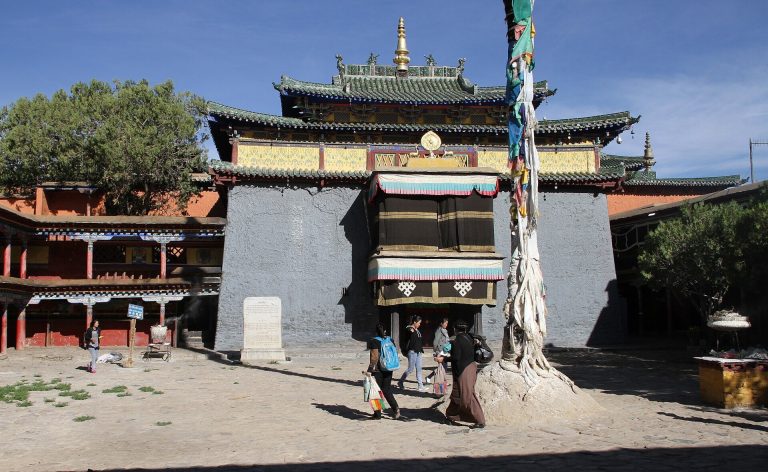
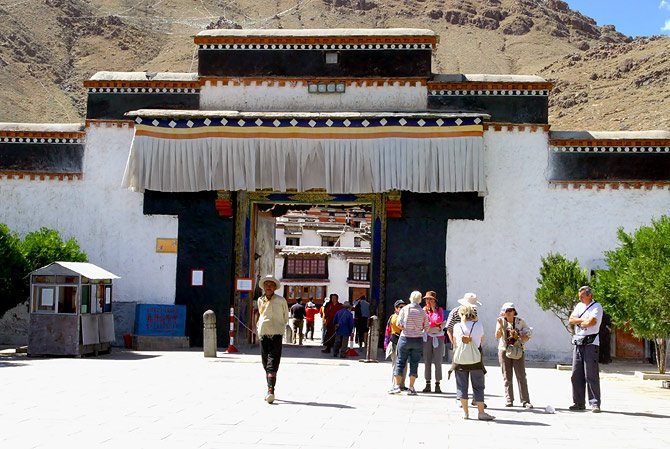
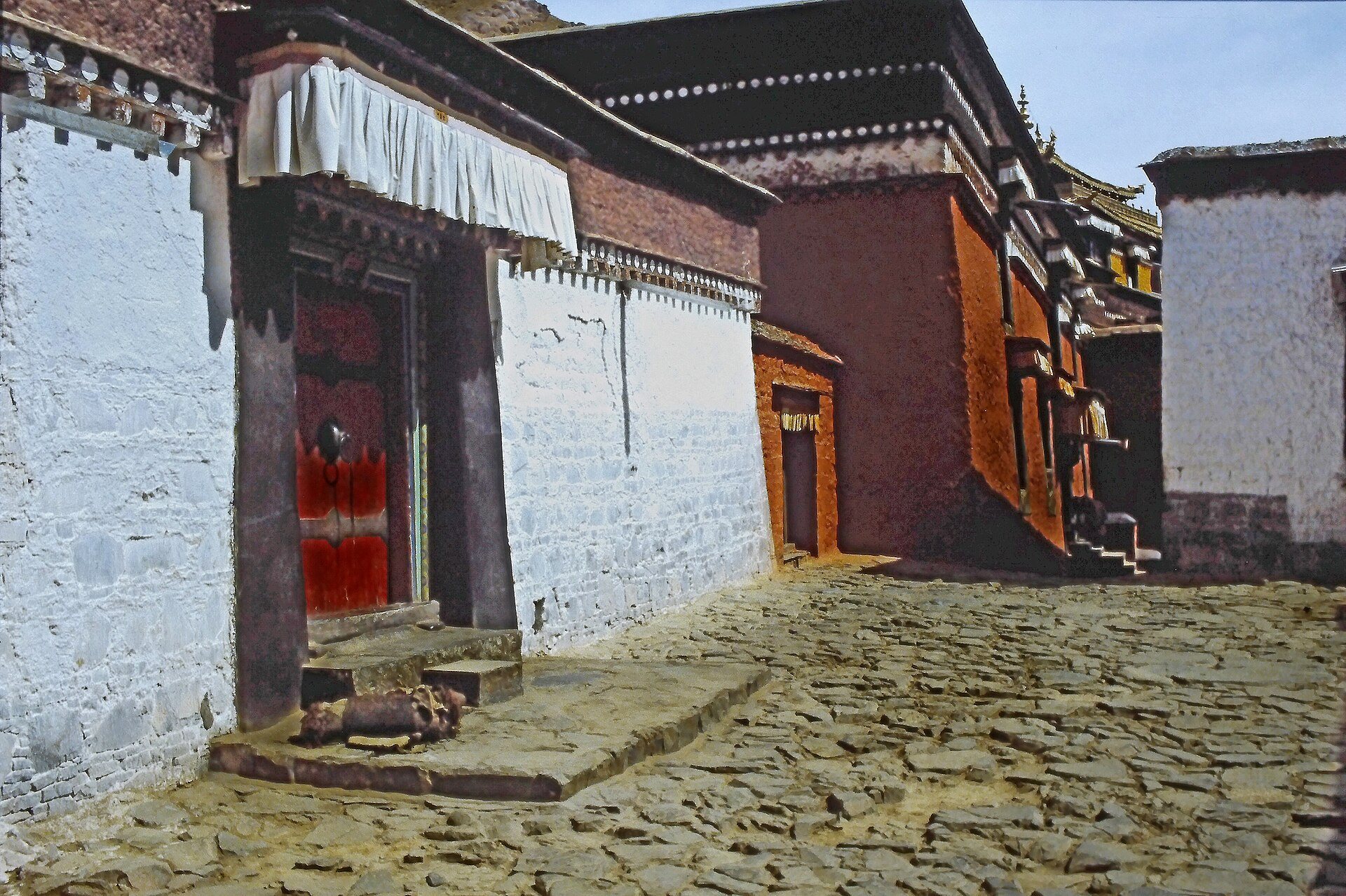
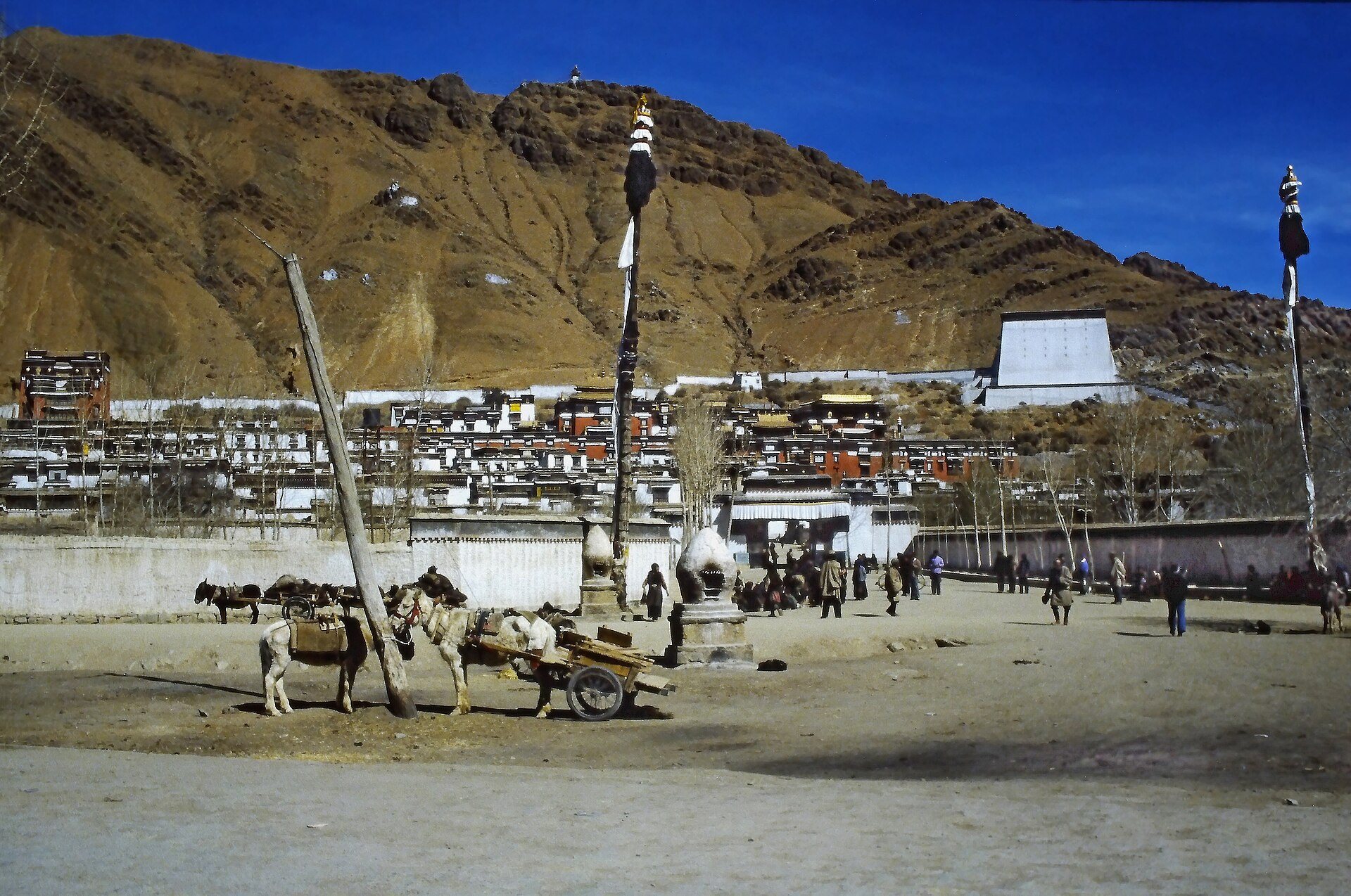
Tashilhunpo covers approximately 230,000 square metres on the southern slope of the hill at the centre of Shigatse and faces south. More than 3,000 metres of enclosing walls surround the complex. Its front section consists mainly of low, whitewashed, flat-roofed buildings used as monk residences and mi tshan, basic instructional units within the monastic colleges. Taller red-walled buildings with gilded roofs occupy the rear section and include temples, assembly halls, and reliquary shrines.
The complex contains approximately fifty-eight mi tshan units, including twenty-six earlier units and thirty-two added during later expansion. Its main assembly hall has forty-eight columns. An open-air scripture debate courtyard lies south of Tashi Namgyal and east of the Great Assembly Hall. Another large courtyard contains more than 1,000 images of Shakyamuni Buddha displaying five symbolic hand gestures. Pilgrims traditionally circumambulate the monastery outside its walls along the lingkhor, a sacred path around a religious site.
Principal temples
Great Assembly Hall
The Great Assembly Hall, also called Tsokchen Hall, is the earliest major building in the complex. It served activities involving the whole monastery and instruction in exoteric Buddhism, the publicly taught forms of Buddhist doctrine. Inside stands a gilded copper image of Shakyamuni Buddha more than five metres high. Relics of Shakyamuni, locks of Je Tsongkhapa’s hair, and the skull of Sherab Sengge, a principal teacher of Gedun Drub, are installed within the image. Eight clay figures of Shakyamuni’s principal disciples stand on either side.
Maitreya Temple
The Maitreya Temple, also called Jampa Chenmo, stands on the western side of the monastery and is approximately 26.2 metres high. Its main image is a gilded copper Maitreya Buddha seated on a lotus throne. Maitreya is regarded as the Buddha of the future and is commonly called Jampa in Tibetan Buddhism. The Ninth Panchen Lama commissioned the image in 1914, and its production took four years. More than 1,400 precious ornaments decorate it, including pearls, diamonds, coral, turquoise, and other gemstones. The statue’s hands are approximately three metres long, its shoulders about 11.5 metres wide, and a large diamond ornament is set in its forehead. Its construction used approximately 279 kilograms of gold and 150,000 kilograms of red and yellow copper, with 110 craftsmen involved.
Smaller Maitreya shrine
A smaller Maitreya shrine east of the central hall contains a gilded copper image approximately twelve metres high. Relics of Shakyamuni and other revered figures are installed inside it. Images of Avalokiteshvara and Manjushri, made from medicinal clay and attributed to Gedun Drub’s workmanship, stand beside the image.
Tara Temple
The Tara Temple contains a gilded copper image of White Tara approximately three metres high. Relics of Buddhas and bodhisattvas, together with a small self-arisen and consecrated image of Tara, are installed within the temple.
Other chapels and temples
Additional religious buildings include the Lima Temple, Kangyur Temple, Yangtse Temple, Ngönga Temple, Chinese Temple, Rinchen Temple, Ngurmik Temple, Pandrub Temple, Gadong Temple, and Lama Temple. The Yabbar Lima Temple has western, central, and eastern sections, and the complex also contains the Yabbar Silver Reliquary Temple.
Reliquaries and institutional spaces
Panchen Lama residences and college
The Labrang, the former residence and office of the Panchen Lama, lies between the Central Reliquary Shrine and Tashi Namgyal. The Tantric College stands behind the Labrang and served as a centre for tantric instruction.
Central Reliquary Shrine
The Central Reliquary Shrine contains the reliquary of the Fourth Panchen Lama. A stupa is a Buddhist reliquary monument that holds sacred relics or the remains of a revered teacher. The shrine formerly held the reliquary of the Fifth Panchen Lama; after the Cultural Revolution, the remains of the Fourth Panchen Lama were transferred there.
Tashi Namgyal
Tashi Namgyal, also called the Panchen Eastern Tomb, is the reliquary shrine for the Fifth through Ninth Panchen Lamas. The shrine constructed for these Panchen Lamas in the 1980s incorporated relic remains preserved by local people after the earlier stupas were destroyed.
Thongwa Donden Temple
Behind the Great Assembly Hall, the Thongwa Donden Temple contains the reliquary stupa of Gedun Drub, the First Dalai Lama. It is described as the only burial place of a Dalai Lama outside Lhasa.
Shrine for the Tenth Panchen Lama
A separate shrine named for victory in the three realms is dedicated to the Tenth Panchen Lama, Choekyi Gyaltsen. His reliquary shrine was completed in 1993.
Courtyards, chapels, and collections
A gallery surrounds the Dejangsar courtyard and leads to eastern chapels containing several hundred small Buddha images. Roof chapels include one with paintings of demons later interpreted as Buddhist protectors, as well as a Tara chapel with blue and gold murals depicting Tibetan history.
The Sutra Hall contains approximately 10,000 hand-carved wooden printing blocks used to print Tibetan translations of Buddhist scriptures. The monastery also houses sculptures, murals, thangkas, ritual implements, imperial seals and documents, craft objects, more than thirty volumes of a biography of Je Tsongkhapa, and a handwritten Kangyur written in gold ink.