Olduvai Gorge: A Palaeoanthropological and Archaeological Site in Tanzania
Site at a Glance
- Rating
- 4.5
- Popularity
- Low
- Country
- Tanzania
- Primary era
- Stone Age
- External website
- Open
- Eras represented
- Stone Age
- Civilizations
- Unclassified
- Site type
- Civic
On this page21 sections
History
Olduvai Gorge is a paleoanthropological and archaeological site in northern Tanzania, within the Ngorongoro Conservation Area in the eastern Serengeti Plains. Its deposits preserve evidence from the Pleistocene, the geological epoch that lasted from about 2.6 million to 11,700 years ago, including fossils and tools associated with several members of the human evolutionary lineage. The gorge is registered among Tanzania’s National Historic Sites, and in October 2022 the International Union of Geological Sciences included the palaeoanthropological sites of Laetoli and Olduvai Gorge among its 100 geological heritage sites.
The name Olduvai derives from the Maasai word oldupai, meaning “the place of the wild sisal.” East African wild sisal grows abundantly in the gorge. Hominin occupation extended across a long sequence of time: Homo habilis lived there about 1.9 million years ago, followed by Paranthropus boisei about 1.8 million years ago and Homo erectus about 1.2 million years ago. Homo sapiens, which is estimated to have emerged about 300,000 years ago, was present at Olduvai about 17,000 years ago.
Early exploration and the Leakey expeditions
German physician and paleontologist Wilhelm Kattwinkel visited Olduvai in 1911 while investigating sleeping sickness. He observed fossil bones belonging to an extinct three-toed horse. Hans Reck led a German expedition to the gorge in 1913 and recovered hominin remains that were later dated by radiocarbon methods to about 17,000 years ago. Four further expeditions were planned, but the First World War prevented them. After the war, Tanganyika came under British control, and British and Kenyan scientists continued research in the area.
Louis Leakey visited Hans Reck in Berlin, examined the Olduvai fossils, and argued that the gorge should also contain prehistoric stone tools because its deposits appeared comparable in age to those at Kariandusi in Kenya. During Leakey’s 1931 expedition, accompanied by Reck and paleontologist Donald McInnes, numerous hand axes were found near the camp. Mary Leakey first visited Olduvai in 1935 with Louis Leakey and Percy Edward Kent. The Leakeys returned in 1941, 1953, 1955, and 1957, establishing excavation programs that transformed the study of early human evolution.
Hominin discoveries and changing interpretations
In July 1959, Mary Leakey found a skull at the FLK site. It was named Zinjanthropus boisei, later called Australopithecus boisei and now frequently classified as Paranthropus boisei. The same site produced abundant animal remains and stone tools that Mary Leakey classified as Oldowan. Oldowan describes an early stone-tool industry characterized by chipped pebbles, flakes, and choppers.
In May 1960, Jonathan Leakey discovered a mandible at FLK North-North. It became the type specimen of Homo habilis, the specimen formally used to define and represent that species. The finds helped distinguish Homo habilis from Paranthropus boisei. The former had a more rounded braincase, a larger estimated brain capacity, smaller teeth, and no sagittal crest, the raised ridge of bone along the top of the skull found in Paranthropus boisei. These differences also contributed to the interpretation that Homo was probably responsible for making the tools.
At least 85 specimens assigned to the family Hominidae have been identified at Olduvai. They include Olduvai Hominids 5, 7, 8, 9, 24, and 62, as well as Olduvai Hominin 86, a proximal phalanx more than 1.84 million years old. Olduvai Hominid 5 is the type specimen of Paranthropus boisei, while Olduvai Hominid 7 is the type specimen of Homo habilis. Hominids 8, 24, and 62 are assigned to Homo habilis. Hominid 9 is assigned either to Homo erectus in the broad sense or to Homo ergaster.
Homo habilis remains occur mainly in Bed I and the lower part of Bed II, where they are contemporary with Paranthropus boisei. Homo erectus remains occur in upper Bed II and overlap with Paranthropus boisei, but not with Homo habilis. Homo habilis was replaced by Homo erectus at about 1.6 million years ago, while Paranthropus boisei continued to persist. The Paranthropus remains from Beds I and II include a skull, a fragment of thigh bone, and several teeth from deposits dated to approximately 1.1 to 2 million years ago.
Stone-tool industries and human behavior
Louis Leakey first described the Oldowan stone-tool industry in 1951. The Leakeys identified 11 Oldowan localities in the gorge, including nine in Bed I and two in Bed II. They also recognized a later and more varied Developed Oldowan assemblage in Beds II to IV. The earliest Oldowan tools at Olduvai occur in Beds I to IV. Bed I dates to approximately 1.85 to 1.7 million years ago, Bed II to approximately 1.7 to 1.2 million years ago, and Oldowan tools continue into Bed IV, where they date to about 800,000 to 600,000 years before present.
The first maker of Oldowan tools remains uncertain. Its emergence has been associated with Australopithecus garhi, while its expansion has been linked with early Homo habilis and Homo ergaster. Early Homo erectus appears to have inherited the technology about 1.7 million years ago and developed it toward the Acheulean industry, a later Lower Paleolithic technology especially associated with bifacial hand axes and cleavers.
The transition between Beds I and II, about 1.5 million years ago, brought larger flakes, more frequent bifacial edges, longer tool edges, and increased battering marks. These changes may reflect more frequent tool use, improved manufacture, and greater transport of tools. Mary Leakey organized Oldowan tools into functional categories A, B, and C and connected them with Modes 1, 2, and 3. Her classification remains important for examining changes in stone-tool production during the Early Pleistocene.
Olduvai’s animal bones and tools also inform debate about hunting and scavenging. Many archaeologists interpret the predominance of carnivore tooth marks before cut marks as evidence that scavenging was probably common, while other interpretations emphasize systematic hunting, including the concentration of adult male wildebeest remains. At David’s Site, antelope bones from Bed I were first gnawed by a large cat and later processed by hominins, providing direct evidence for scavenging.
The archaeological record indicates increasing technological, social, and cognitive complexity among early hominins. Concentrations of stone tools and animal remains point to increasingly organized social activity. At the FLK-Zinjanthropus site, piles of lithic flakes and animal bones include remains of birds, fish, amphibians, and large mammals. Some bones bear marks that may result from hominins breaking them for marrow or removing meat, or from carnivores gnawing them. Suitable flakes could cut meat, while choppers helped extract marrow and process tough plant material.
Commemoration and interpretation
In July 2019, the Olduvai Gorge Monument was erected at the junction of the access road from the Ngorongoro Conservation Area to Serengeti National Park. It commemorates the gorge and incorporates large concrete replicas of the skulls of Paranthropus boisei and Homo habilis, both first discovered at Olduvai. Engineer Joshua Mwankunda conceived the monument. Paleoanthropologists Nicholas Toth, Kathy Schick, and Jackson Njau planned and supervised the replicas at the request of the Tanzanian government, while the Tanzanian artist Festo Kijo created the skulls.
The Olduvai Gorge Museum stands about 5 km from the monument at the junction of the main and secondary gorges. Its educational exhibitions address Olduvai and its long archaeological history. The museum is described as one of Africa’s largest onsite museums of its kind.
Remains
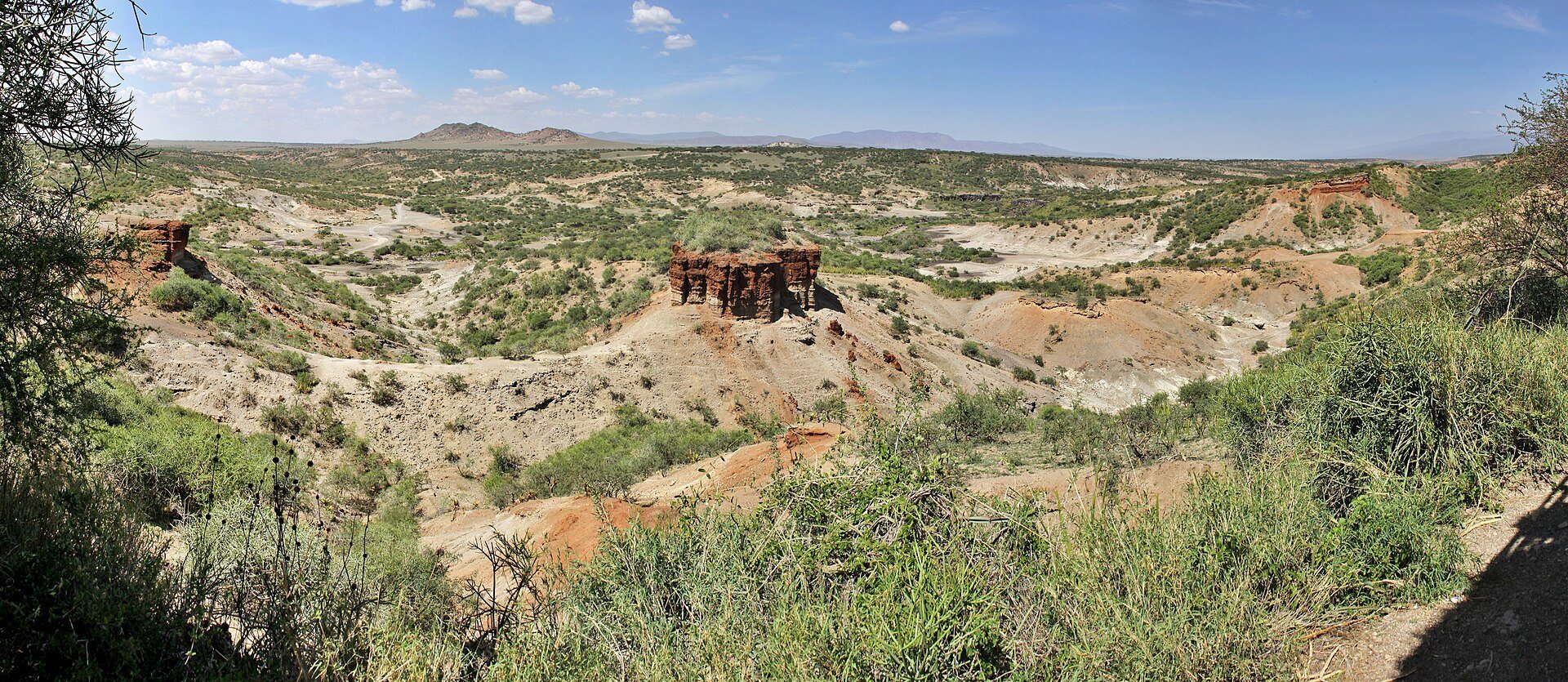
Olduvai Gorge is a steep-sided ravine about 48 km long and up to 90 m deep. It cuts through Pleistocene lake sediments in the Great Rift Valley, about 25 km downstream from Lakes Ndutu and Masek. A secondary gorge beginning near Lemagrut Mountain joins the main gorge about 8 km from its mouth and follows the shoreline of a prehistoric lake associated with fossils and early hominin sites. The exposed stratigraphic sequence, meaning the ordered succession of geological layers, reaches about 90 m in thickness.
Geological formation and layered deposits
The base of the sequence contains welded volcanic tuff, identified as the Naabi ignimbrite. An ignimbrite is rock formed when hot volcanic ash and fragments settle from a fast-moving volcanic flow. Lava flows from Olmoti and another southern source overlie the basal volcanic material. The oldest fossils occur on the surface above these deposits and date to about 1.89 million years ago. Stone tools from the same general sequence date to about 1.7 million years ago.
Volcanic ash from Olmoti and Kerimasi was deposited periodically and helped preserve fossils. The gorge’s present faulted form developed between about 100,000 and 30,000 years ago in connection with the formation of the Olbalbal Depression northwest of Ngorongoro. Potassium-argon dating, which measures radioactive decay in volcanic material, was first used at Olduvai by Garniss Curtis. Fission-track dating, paleomagnetism, amino-acid dating, and radiocarbon dating have also helped establish the ages of the deposits and bones.
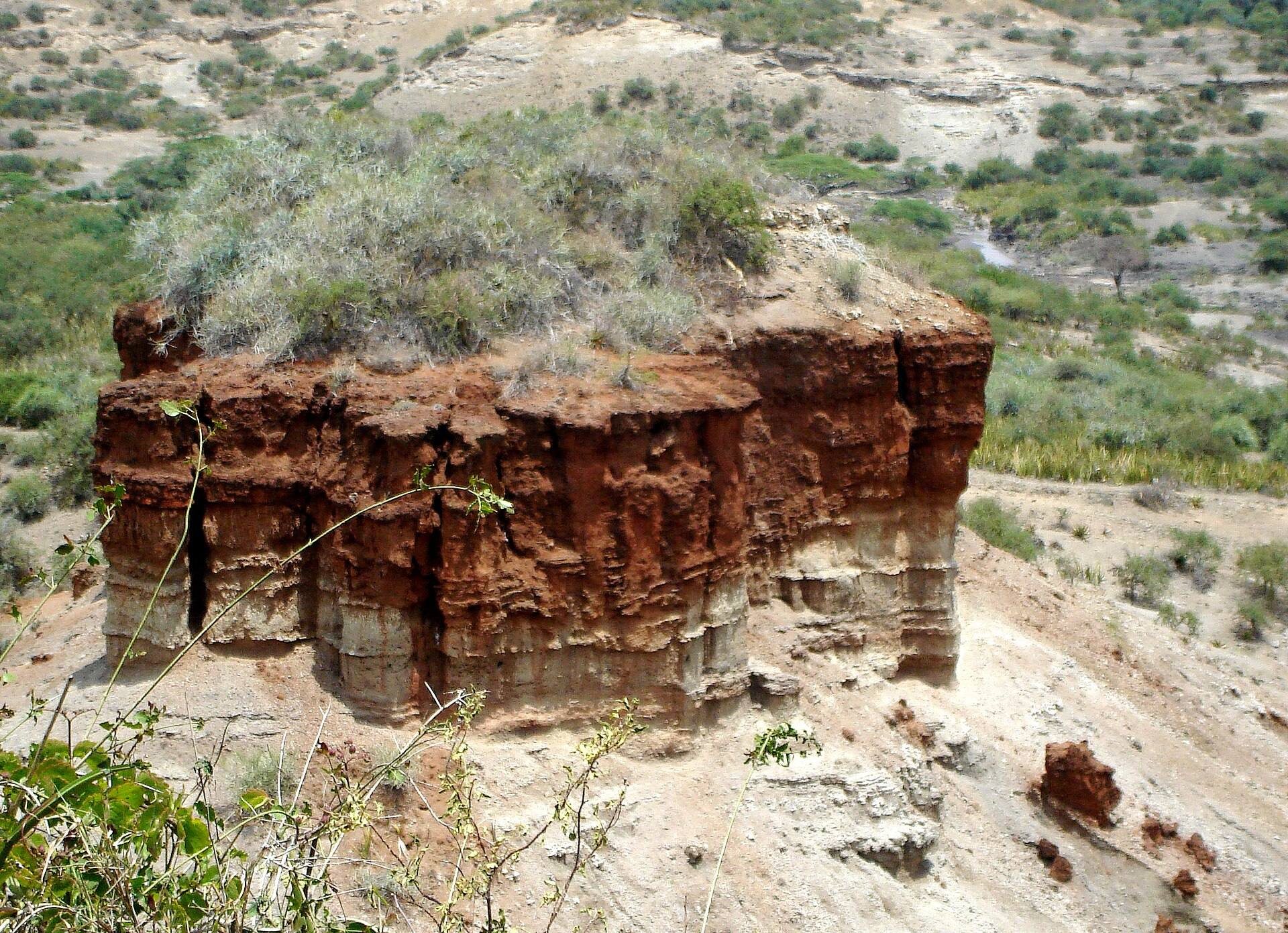
Hans Reck originally divided the sequence into five principal units, Beds I to V, with Bed I the oldest and lowest. Later geological work by Richard Hay and others revised this arrangement. The original Bed IV interval was divided into Bed IV and the Masek Beds, while the original Bed V was reclassified as the Ndutu and Naisiusiu Beds. Hominin fossils and stone tools occur throughout the exposed sequence.
Early lake deposits and Bed I
Bed I living sites
Bed I is a Lower Pleistocene deposit about 20 to 46 m thick. It consists of lake claystone and Olmoti tuff overlying the Naabi ignimbrite. Four well-preserved living sites occur within it: FLK, FLK North-North, DK, and FLK North. These deposits contain early hominin remains, animal bones, and stone tools associated with the first substantial Oldowan record at Olduvai.
DK stone circle
The DK site contains what Leakey interpreted as a stone circle, together with numerous tools and fossil bones dated to approximately 1.75 to 1.9 million years ago. Its remains belong to the early occupation represented in Bed I.
Bed II and the Developed Oldowan
Bed II is 21 to 35 m thick and consists of clay and sandstone deposited by Olduvai Lake and its streams. Its archaeological remains include Developed Oldowan tools, hand axes, animal bones, and hominin fossils. The assemblage is largely made from small chert tools rather than quartzite, with spheroids and subspheroids predominating, followed by choppers.
MNK quarry and manuports
The MNK site contains abundant manuports, natural objects deliberately transported by humans, and a chert-nodule quarry. More than 14,000 pieces were recovered there, including gneiss and lava anvils and hammerstones. The concentration records the movement of raw material and the preparation of tools within the Bed II landscape.
Hand axes and hominin remains
Hand axes were found at the EF-HR and TK sites. The BK site produced a deciduous molar and an adult canine assigned to Australopithecus boisei. The few Paranthropus boisei remains from Beds I and II include a skull, part of a thigh bone, and several teeth. Their large molars and sagittal crest have been interpreted as adaptations for heavy chewing of tough plant foods, including tubers, nuts, seeds, grasses, and sedges.
Later beds and changing tool forms
Bed III is a distinctly red deposit about 6 to 10 m thick, made up of clay, sandstone, and conglomerate. Its sediments reflect changes in the depth of the former lake. It contains few fossils and isolated stone tools. Bed IV, in the eastern gorge, is about 5 to 8 m thick and consists of clay, stream-deposited sandstone, and conglomerate. It contains four distinct tool-bearing levels.
HK and HEB sites
The HK site in Bed IV yielded about 500 hand axes and cleavers. The HEB site produced phonolite hand axes and a single hand axe made from elephant bone. These remains belong to the later tool-bearing sequence, which also includes Abbevillian and Acheulean hand axes, followed by Levallois artifacts and Stillbay implements.
WK hominin remains
The WK site contained a pelvis and femur assigned to Homo erectus. The remains occur within the Bed IV sequence and provide physical evidence for the presence of this hominin during the later part of Olduvai’s early archaeological record.
Masek, Ndutu, and Naisiusiu Beds
The Masek Beds contain two episodes of wind-deposited volcanic ash from Kerimasi. Quartzite hand axes were found in this unit at the FLK site. Dunes formed after the deposition of Oldonyo Lengai tuffs make up the upper part of the Ndutu Beds, which contain few fossils. Oldonyo Lengai tuffs also form the Naisiusiu Beds.
Stone materials and activity areas
Oldowan tools include pebbles chipped along one edge. Choppers make up more than half of the stone tools identified at the gorge. Raw materials came from several places: quartzite from Naibor Soit Inselberg north of the gorge, phonolite from Engelosen volcano about 5 km to the north, and gneiss from Kelogi Inselberg about 9 km to the southwest. Bed II also contains a chert quarry.
At FLK-Zinjanthropus, lithic flakes, sharp fragments detached during tool manufacture, occur with animal bones from birds, fish, amphibians, and large mammals. Some selected flakes were suitable for cutting meat, while choppers could extract marrow and work tough plant material. The stone fragments show that early hominins transported suitable rocks from deposits several kilometres away and shaped them by striking cores at controlled angles.
Monument and museum buildings
Olduvai Gorge Monument
The monument beside the road junction toward Olduvai consists of two large skull models resting on a pedestal with an informative plaque. The models represent Paranthropus boisei and Homo habilis, the two hominins whose original skull discoveries at Olduvai are commemorated there.
Olduvai Gorge Museum
The Olduvai Gorge Museum stands on the gorge rim at the junction of the main and secondary gorges, about 5 km beyond the monument. Its exhibitions concern the gorge and its archaeological history.