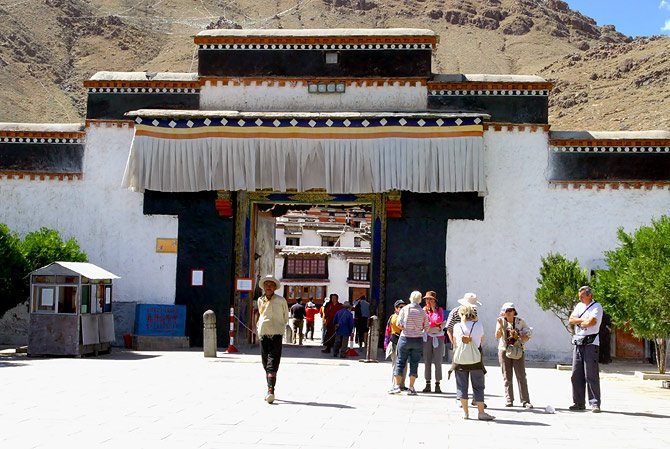
Shalu Monastery: A Tibetan Buddhist Center of the Shalu Tradition
Site at a Glance
- Rating
- 4.2
- Popularity
- Very Low
- Country
- China
- Primary era
- Medieval
- Eras represented
- Medieval
- Civilizations
- Tibetan, Yuan
- Site type
- Religious
- Remains
- Monastery
On this page19 sections
History
Shalu Monastery is a Tibetan Buddhist monastery in the Samzhubzê District of Shigatse, Tibet, China. Founded in the eleventh century, it became the founding monastery of the Shalu tradition, a school associated with the Sakya tradition and known for combining teachings from several Tibetan Buddhist lineages.
Foundation and Early Development
The monastery’s foundation is associated with Chetsun Sherab Jungnay, an eleventh-century Tibetan Buddhist religious figure linked to the Sakya tradition. A foundation tradition says that Chetsun studied in India before choosing the site after his teacher, Lodun Dorje Wangchuk, shot an arrow into newly sprouting crops. The Tibetan word for “green shoots” was then adopted as the monastery’s name, Shalu.
Shalu was established during the revival of Tibetan Buddhism that followed the period of persecution associated with Langdarma. It became one of the major monasteries founded by noble families of the Tsang region and developed as a center of Sakya and Shalu learning. Following the Yuan conquest of Tibet, its political influence brought its hereditary leader, Jizai, into close association with the Sakya leadership. The Yuan court appointed him head of the Shalu myriarchy, a major Mongol-era administrative unit nominally connected with about ten thousand households or troops.
Yuan-Era Expansion and Buton Rinchen Drub
In 1320, Shalu ruler Zhaba Gyantsen, a member of Chetsun Sherab Jungnay’s family, formed a marriage alliance with the Sakya leadership. After visiting the Yuan emperor in China, he received an imperial golden charter and seal, together with financial assistance and craftsmen for the expansion of the monastery. This work gave Shalu much of its later scale, architectural character, painting, and sculpture. Zhaba Gyantsen subsequently invited Buton Rinchen Drub to become abbot.
Buton Rinchen Drub (1290–1364) was a Buddhist scholar, historian, translator, and compiler who led Shalu during its major intellectual and religious development. He taught esoteric Buddhist practices, revised the Buddhist canon, compiled its catalogue, and produced more than one hundred works in twenty-eight fascicles. His history of Buddhism, completed in 1322, described the transmission of Buddhism in India, Nepal, Tibet, and other Tibetan regions and included catalogues of the Kanjur, the collection of texts regarded as the Buddha’s words, and the Tanjur, a collection of commentaries and treatises.
Buton brought together teachings associated with the Kadam, Kagyu, Sakya, and Nyingma traditions. Monks from across Central Tibet gathered at Shalu, which reportedly had more than 3,000 resident disciples during his tenure. The monastery continued as an important center of esoteric and Buddhist studies for several centuries afterward.
Earthquake and Reconstruction
A destructive earthquake in 1329 severely damaged or destroyed the monastery. Jizai was ordered to return from Beijing to rebuild it and received financial assistance for the work. Reconstruction began in 1333 under his direction, with Chinese and Tibetan craftsmen and materials brought from inland China. The resulting complex combined Tibetan and Chinese architectural traditions, a character that remains central to Shalu’s historical identity.
Decline, Damage, and Conservation
By the nineteenth century, Shalu’s importance had declined as Tibetan scholars increasingly favored Samye, a politically stronger Gelug institution. The monastery fell into disrepair, although its main building, outer wall, roof structures, and some fourteenth-century murals survived. Shalu later suffered severe damage during the Cultural Revolution, after which the main assembly hall reportedly remained substantially intact.
Government-funded repairs in 1981 and 1989 restored much of the monastery’s former appearance. A further conservation project began on 13 May 2009, reinforcing building structures, maintaining drainage systems, and improving protection against fire and flooding. Shalu was designated a National Key Cultural Relic in 1988 within the category of ancient buildings and historic memorial structures. In the early twenty-first century, more than sixty monks lived at the monastery.
Remains
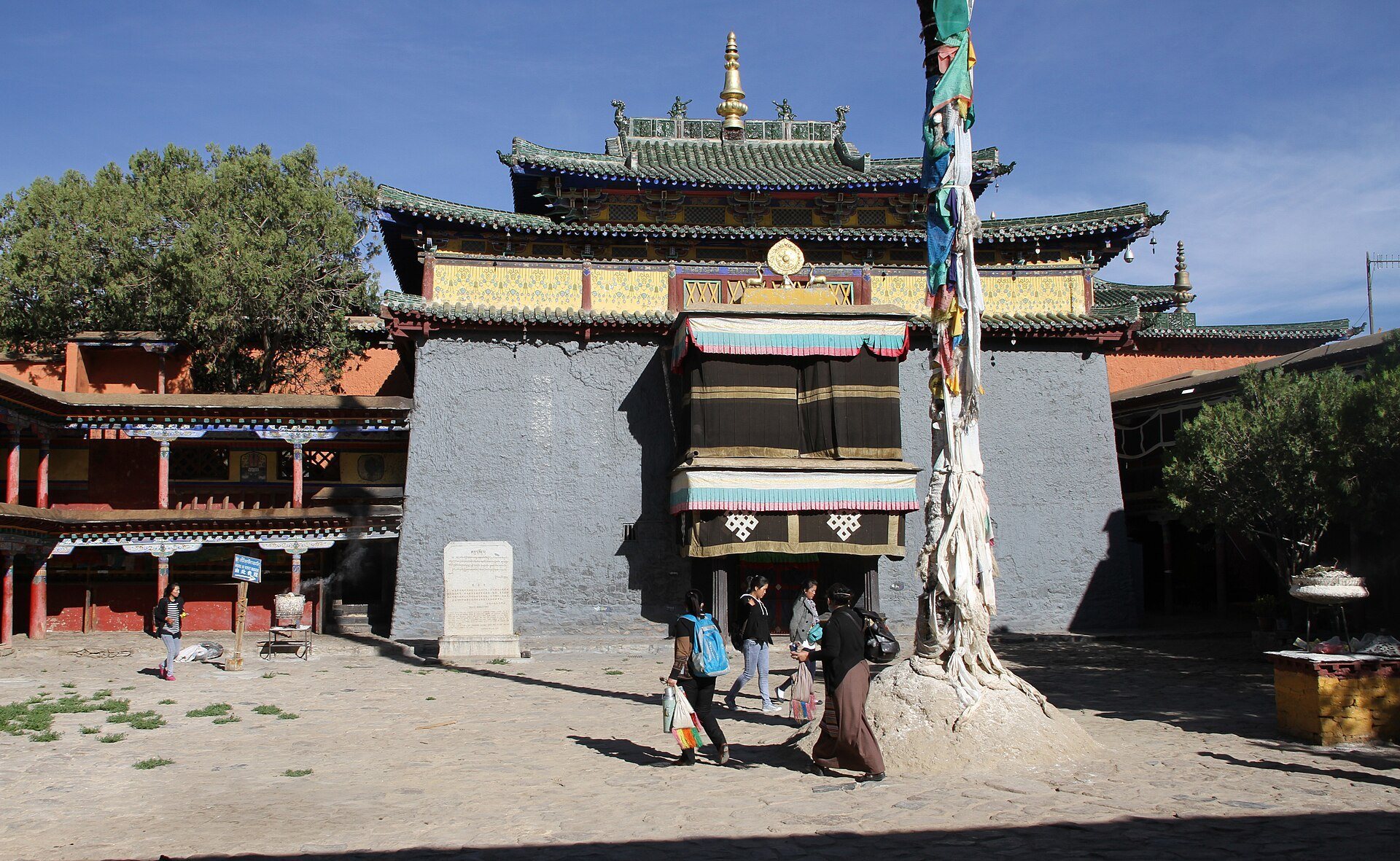
Shalu Monastery lies in a hollow southeast of Shigatse, in the Jicuo Xiong area of Samzhubzê District, approximately 22 to 26 kilometers from central Shigatse. Its surviving complex combines Tibetan halls and wall layouts with Chinese glazed-tile roofs, upturned eaves, ornamental ridge beasts, and timber bracket supports. Thick outer walls lean inward in places around the principal courtyard, while surviving roof structures retain substantial timber supports and glazed ceramic tiles associated with the reconstruction of the 1330s.
Central Temple Complex
Shalu Lhakhang
The central building, Shalu Lhakhang, is a three-story structure that combines Tibetan and Chinese forms. Its walls and plan follow Tibetan conventions, while its roof is a Chinese-style double-eaved hip-and-gable roof covered with green glazed tiles. The building occupies approximately 1,500 square meters and contains forty-nine rooms. Its components include the Golden Hall, surrounding corridors, a protector-deity hall, a chapel devoted to the Perfection of Wisdom, and four Immeasurable Palace chapels on the eastern, western, southern, and northern sides.
First-Floor Halls
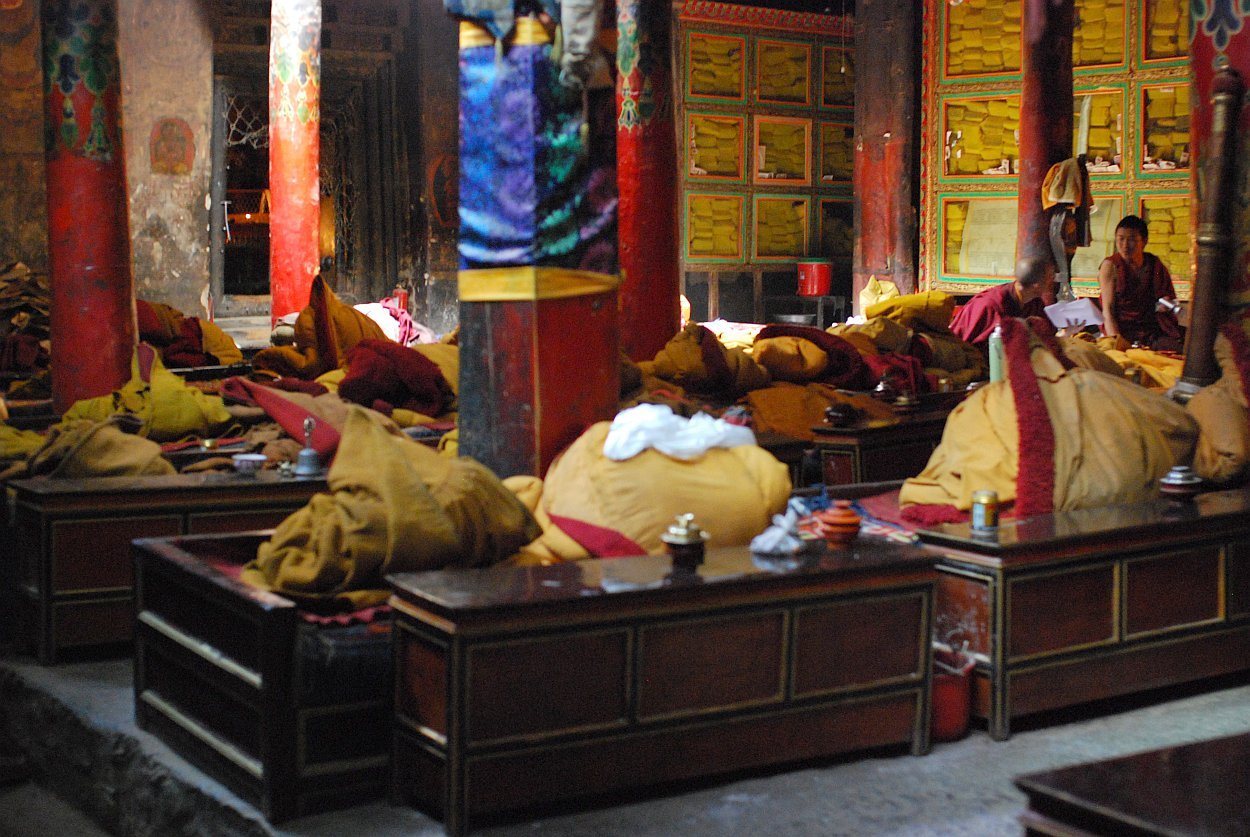
The first floor contains a Tibetan-style inner courtyard and the main assembly hall. The assembly hall holds an image of Shakyamuni Buddha and sculptures of his eight principal disciples. A western scripture hall houses the Kanjur and Tanjur, linking the physical complex to Shalu’s role in the preservation and study of Buddhist learning.
Second-Floor Halls
The second floor contains four Chinese-style halls, consisting of a front hall, a central hall, and two side halls. The central hall contains images of Shakyamuni and Buton. The side halls contain mandala chapels, spaces devoted to mandalas, which are diagrammatic sacred representations of a Buddhist universe, deity, or ritual system. The front hall contains an image of Maitreya and sculptures of the sixteen arhats.
Murals and Religious Art
Narrative Paintings
The walls and halls contain murals, Buddhist sculptures, scriptures, thangkas, ritual implements, and shallow-relief stone panels showing Buddhist figures and celestial beings. A thangka is a painted or embroidered Tibetan Buddhist image made on cloth for devotion, teaching, or ceremonial display. The murals form a major surviving body of Yuan-period Tibetan Buddhist painting. Their exoteric subjects include scenes from the Buddha’s life and jataka stories, narratives of the Buddha’s previous lives, while their esoteric subjects include mandalas and images of Buddhas, bodhisattvas, wrathful deities, and protectors.
The Golden Hall corridors on the first floor contain a sequence of 100 jataka compositions, of which 96 survive. Arranged in a grid around the outer corridor walls, they follow a collection of one hundred birth stories written by Rangjung Dorje, the Fourth Karmapa of the Black Hat lineage. Other narrative paintings show the Buddha’s twelve principal deeds and the story of Sumati’s invitation to the Buddha.
Esoteric Murals
The inner walls of a first-floor corridor show the Five Buddhas, a group of tantric Buddhist figures associated with distinct aspects of enlightened wisdom: Vairocana, Akshobhya, Amitabha, Ratnasambhava, and Amoghasiddhi. A single image appears in the Perfection of Wisdom chapel, while the four Immeasurable Palace chapels contain large mandala compositions.
These compositions include the Shri Samvara, Vajradhatu, Sarvavidya, and Manjushri mandalas, painted according to Buton’s ritual manuals. The Manjushri mandala series in the eastern chapel is attributed to Buton himself. Earlier mandala paintings are partly concealed by more than one hundred thangkas, most produced in Hangzhou during the 1920s. The murals and other historic artworks have required conservation and restoration.
Artistic Influences and Teachings
The murals incorporate influences from Yuan-period Chinese, Nepalese, and Indian Buddhist art. Chinese elements include the forms of the Four Heavenly Kings, landscape and architectural motifs, Azure Dragon and Vermilion Bird designs in the protector hall, shaded trees in paintings of the Sakya patriarchs, and architectural imagery in the main hall corridors. Nepalese and Indian influences appear in some compositions, figure types, and representations of Buddhist deities. The dancers in the “Dancing Birth Story” have distinctly South Asian features.
Shalu’s murals influenced Tibetan painting during the late Yuan and early Ming periods. Their influence extended northward to monasteries including Jonang Monastery, contributing to the formation of the Lato artistic style, and southeastward to the murals of Pelkor Chode Monastery at Gyantse. A fourteenth-century mural also depicts an elephant representing the human mind or consciousness as it progresses through stages toward enlightenment and becomes increasingly white and pure. Other paintings in the inner courtyard preserve instructions about monastic dress and conduct.
Traditional Treasures
Sutra Board
The Sutra Board consists of 108 small wooden blocks assembled into a square. Each block bears one carved character, and together the pieces form a passage of scripture. The board is used to print texts believed to bring protection and blessings.
Holy Water Vessel
The Holy Water Vessel is a large copper vessel approximately 80 centimeters in diameter, positioned in the southeastern corner of the main assembly hall. Tradition holds that its water is changed every twelve years without the quantity increasing or decreasing. The water is said to bring lifelong good fortune and cleanse ten kinds of impurity.
Mantra Stone
The Self-Manifest Six-Syllable Mantra Stone is said to have been unearthed while the monastery foundations were being dug. It bears an inscription of the six-syllable mantra and four small stupas at its corners. The stone is used as a foundation stone at the foot of a monastery wall.
Stone Basin
A stone basin displayed in front of the main hall is traditionally identified as the washing basin used by Chetsun Sherab Jungnay during his ascetic practice. It is said not to overflow when filled with rainwater. Small sculptures of bodhisattvas, incarnate teachers, and religious masters are sometimes covered with banknotes offered by worshippers.